


Welcome to Ballot Bulletin: Ballotpedia's Weekly Election Policy Digest. Every Tuesday, we deliver the latest updates on election policy around the country, including nationwide trends and recent legislative activity.
In this week’s edition, we cover 21 bills state legislatures acted on last week and look at a federal court’s injunction against Ohio’s new documentary proof of citizenship law.
The state of election legislation in the U.S.
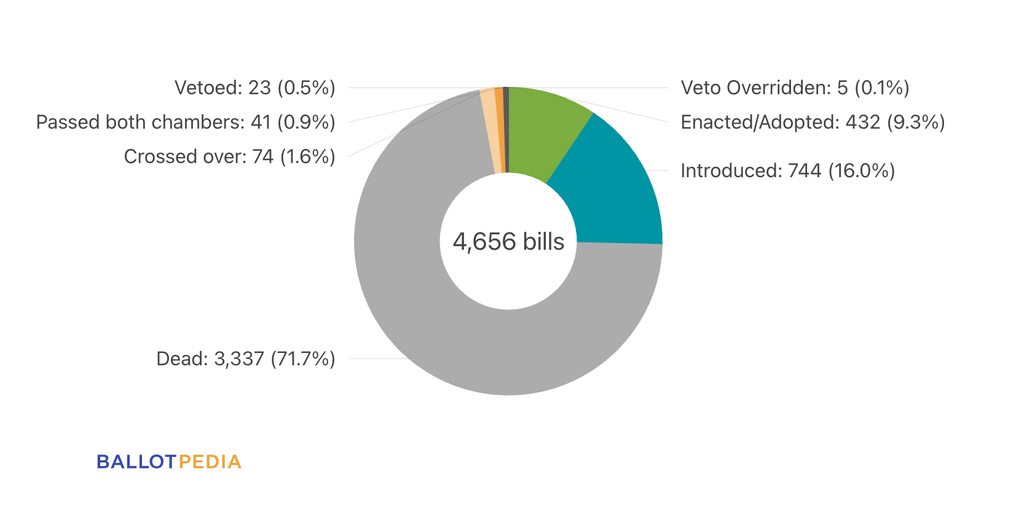
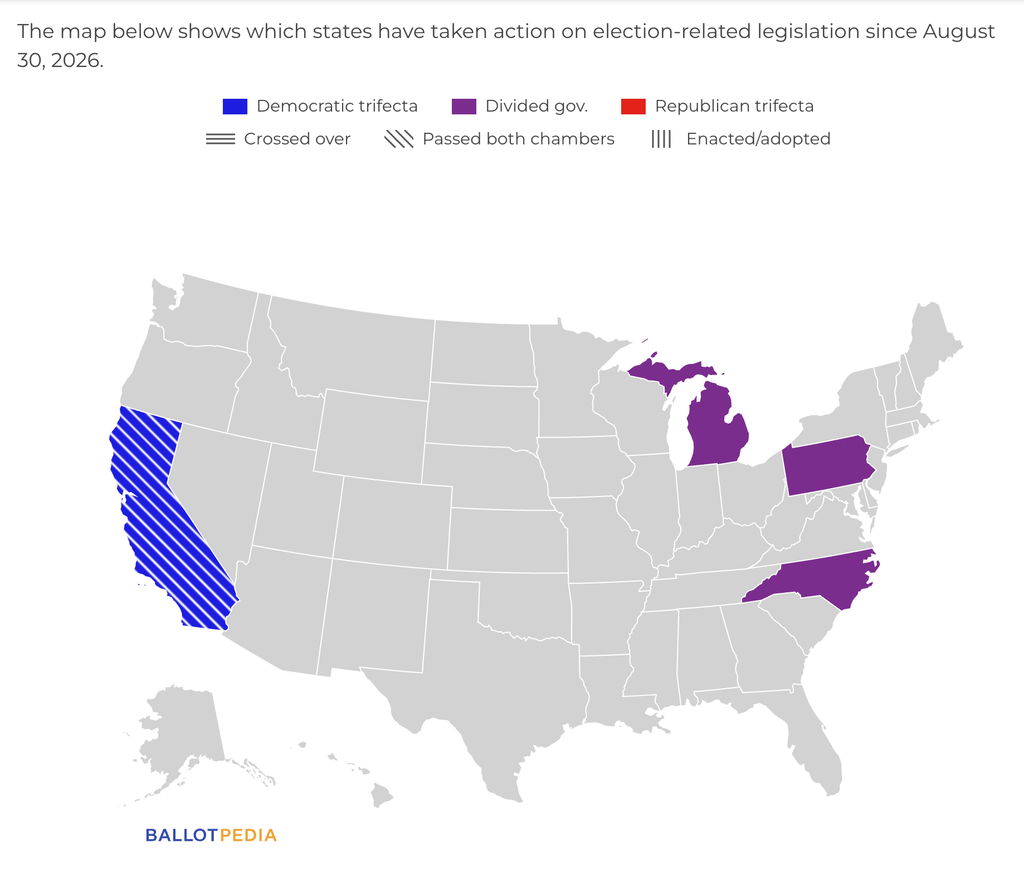
Lawmakers in four states acted on 21 election-related bills last week. Five state legislatures are in regular or special sessions. Last week, no bills were enacted, six bills passed both chambers of a state legislature, and no bills were vetoed.
Of the bills acted on last week, 18 (85.7%) are in states with Democratic trifectas, none are in states with Republican trifectas, and three (14.3%) are in states with divided government. The most active bill categories last week were campaign finance (8), ballot measures (7), ballots and voting materials (6), and ballot access (5).
We are currently tracking 4,656 election-related bills across the country. The chart below breaks down the status of those bills based on where they stand in the legislative process:
Enacted bills
No bills were enacted or adopted last week.
Bills passing both chambers
Six bills passed both chambers of a state legislature last week:
To see a full list of bills awaiting gubernatorial action, click here.
Vetoed bills
No bills were vetoed last week.
To see a list of all bills vetoed this session, click here.
All bills
The chart below shows all bills Ballotpedia is currently tracking, broken down by partisan sponsor.
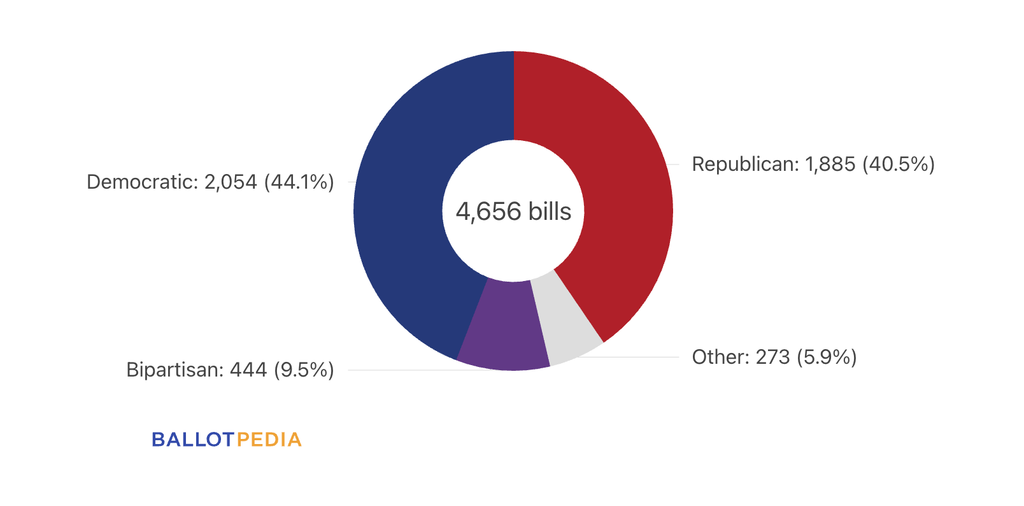
We are currently following 4,656 election-related bills, including bills carried over from the previous year.
- Trifecta status
- Democratic: 2,002 (43%)
- Republican: 1,651 (35.5%)
- Divided: 1,003 (21.5%)
- Partisan sponsorship
- Democratic: 2,054 (44.1%)
- Republican: 1,885 (40.5%)
- Bipartisan: 444 (9.5%)
- Other: 273 (5.9%)
In the news
On Sept. 3, U.S. Solicitor General D. John Sauer filed a request for the U.S. Supreme Court to issue a stay of the Aug. 27 order from the U.S. District Court for the District of Massachusetts, which blocked for 14 days the implementation of an executive order President Donald Trump (R) issued earlier this year prohibiting the delivery of absentee/mail-in ballots to anyone whom state officials did not enroll with the U.S. Postal Service. On Sept. 6, Sauer filed another request for a stay of the district court’s Sept. 4 preliminary injunction order, which would block the implementation of rules to carry out the executive order for longer than 14 days.
U.S. District Court Judge Indira Talwani's ruling blocked the implementation of federal rules that would carry out the executive order. USPS filed the final rules implementing the executive order on Aug. 21. The rules require state officials to enroll voters in a USPS portal in order for them to receive a mail ballot. The physical ballot mail must also meet set standards and contain certain information, such as a unique ID number for each ballot envelope.
In his Sept. 3 filing, Sauer said the order “partially nullifies the Postal Service’s efforts to address the risk that the federal mails will be used to perpetrate voter fraud, 91 Fed. Reg. at 54,969—a particularly pernicious species of fraud that dilutes the votes of lawful voters, prevents election results from reflecting the will of the American people, and undermines ‘public confidence in the integrity of the electoral process.’”
Here are other news stories from across the country:
- On Sept. 3, the Missouri Supreme Court ruled that Missouri’s Congressional Map Referendum must appear on the November election ballot, blocking the use of the state’s new congressional maps adopted in 2025. On Sept. 4, Missouri Attorney General Catherine Hanaway (R) filed an emergency application for a stay of the decision by the U.S. Supreme Court. As covered in the Aug. 25 edition of The Ballot Bulletin, the Cole County Circuit Court upheld Missouri Secretary of State Denny Hoskins’s rejection of the veto referendum on Aug. 19. Writing for the Supreme Court, Judge Ginger Gooch said that “because the plain language of article III, section 49 of the Missouri Constitution authorizes a referendum as to ‘any act of the general assembly’ and no exception applies, the referendum petition was legal, sufficient, and timely.”
- On Sept. 3, the Maryland Supreme Court ruled that Maryland Question 3, a 2026 ballot measure on redistricting, can appear on the November election ballot with modified language. As covered in the Sept. 1 edition of The Ballot Bulletin, two Maryland circuit court judges blocked the ballot measure on Aug. 26 and Aug. 28, respectively. Agreeing with the circuit courts that the previous ballot measure description was misleading, the Supreme Court order required the wording to mirror that of the purpose paragraph of the legislation.
- On Sept. 1, two voting rights groups, the Black Voters Matter Fund and the League of United Latin American Citizens, filed a lawsuit against Florida’s new documentary proof of citizenship law. In the complaint filed with the U.S. District Court for the Southern District of Florida, the plaintiffs said that HB 991 violates the National Voter Registration Act by imposing more stringent requirements on voter registration than federal law. Two other lawsuits were filed challenging the law, one in the U.S. District Court for the Northern District of Florida and the other in the same court as the September lawsuit.
Policy spotlight: Federal judge temporarily blocks Ohio documentary proof of citizenship requirement
The story below is adapted from a recent Ballotpedia News story by Andrew Bahl.
On Aug. 25, a U.S. district court judge temporarily blocked an Ohio law that requires individuals registering to vote at the Bureau of Motor Vehicles to provide documentary proof of citizenship.
Ohio is one of 12 states with laws requiring documentary proof of citizenship for voter registration, though it is the only one where the requirement applies only to voters registering to vote at a motor vehicle agency. Ohio allows individuals to register to vote at the BMV when applying for or renewing a driver’s license or state identification card. Documents accepted as proof of citizenship include a birth certificate, passport, certificate of naturalization, or driver’s license or state ID card issued after April 2023.
Governor Mike DeWine (R) signed HB 54, which enacted the requirement, in 2025. Individuals registering to vote online or via a paper form are not required to provide documentary proof of citizenship.
Two groups, Red Wine & Blue and the Ohio Alliance for Retired Americans, filed a lawsuit in August 2025 alleging that the proof of citizenship requirement violated the National Voter Registration Act (NVRA), which requires states to offer individuals the opportunity to register to vote at the department of motor vehicles.
In his order, U.S. District Court Judge Solomon Oliver Jr. wrote that the proof of citizenship requirement and Ohio’s procedures for registering to vote at the BMV likely violate the NVRA.
Oliver wrote that the policy conflicts with an NVRA requirement that states may require only the minimum amount of information necessary to determine a person’s eligibility to vote, since the state accepts a sworn statement that the registrant is a citizen for other methods of voter registration.
"Not only does Ohio's motor voter system run afoul of the NVRA in practice, it also conflicts with the Act by statutorily requiring applicants to produce documentary proof of citizenship before registering to vote simultaneously with their driver’s license application," Oliver wrote. "The record shows, and Defendants acknowledge, that signed attestation to U.S. citizenship is 'the minimum amount of information necessary,' … to enable Ohio’s election officials to assess voter eligibility and administer other parts of the election process."
Ohio Secretary of State Frank LaRose (R) said, "Under this order, the Bureau of Motor Vehicles would be required to offer a voter registration form to a person who’s applying for a driver’s license, even if that person can't verify that they're a citizen. We strongly disagree with that decision, and I’ve asked our legal team to file an immediate appeal. I will vigorously defend our legal authority to safeguard our voter rolls and protect the integrity of Ohio’s elections."
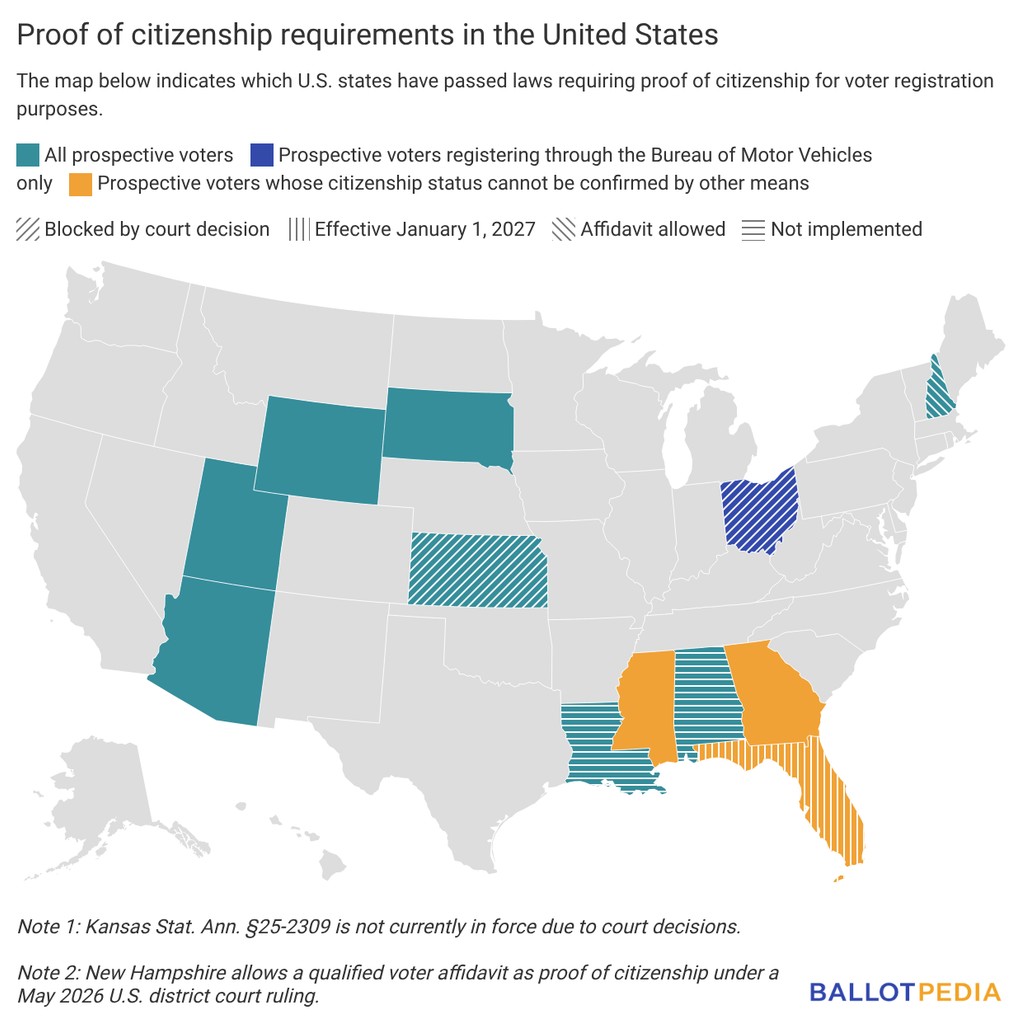
Ohio and Wyoming enacted documentary proof of citizenship requirements in 2025. Florida, Mississippi, South Dakota, and Utah enacted documentary proof of citizenship requirements in 2026.
For more information on proof of citizenship requirements nationally, click here.