


Welcome to Hall Pass, a newsletter written to keep you plugged into the conversations driving school board governance, the politics surrounding it, and education policy.
In today’s edition, you’ll find:
- On the issues: The debate over attendance- or enrollment-based funding for schools
- School board filing deadlines, election results, and recall certifications
- Districts and states take differing stances on AI in K-12 education as students return to school
- Extracurricular: education news from around the web
- Candidate Connection survey
On the issues: The debate over attendance- or enrollment-based funding for schools
In this section, we curate reporting, analysis, and commentary on the issues school board members deliberate when they set out to offer the best education possible in their district. Missed an issue? Click here to see the previous education debates we’ve covered.
K-12 public school funding formulas determine how much money school districts receive from the state. These formulas are complex and designed to ensure students receive adequate funding given fiscal and demographic differences between districts. Depending on the state, the formulas allocate funding to districts based on student attendance or enrollment. According to the Education Commission of the States (ECS), 46 states and D.C. used enrollment and five used attendance as of 2024.
States that use enrollment-based allocations premise funding on the number of students enrolled in a district on a specific date or over a period of time. In Delaware, for example, funding is based on the number of enrolled students on the last school day in September. Arizona uses an average of students enrolled over the first 100 days of the school year.
In states that use attendance instead of enrollment, the calculation tends to be based on Average Daily Attendance (ADA) — that is, the average number of students counted as showing up for school over a period of time. California, Idaho, Kentucky, Missouri, and Texas are the only states that use an attendance-based model.
Today, we look at two perspectives on attendance-based and enrollment-based funding models.
Chris Cargill, the president and CEO of the Mountain States Policy Center, a free-market think tank, says Idaho should not move toward an enrollment-based funding model. Cargill says Idaho’s system, which uses Average Daily Attendance (ADA), is flexible enough to protect district budgets from extraneous circumstances that could keep large numbers of students home, such as viral outbreaks or snowstorms, while giving residents confidence that their tax dollars are actually being used to educate children in classrooms. Cargill says lawmakers should give districts enough funding to provide students with an excellent education, but that districts should have to adjust their budgets if fewer students are attending public schools.
Bruce Bivins, the superintendent of Perris Elementary School District in California, says that attendance-based funding models harm the districts that disproportionately support low-income students — those most likely to be chronically absent from class. Bivins says that low-income students face a variety of barriers to regular school attendance, such as chronic family health issues, unreliable transportation, housing insecurity, and more. Bivins says that instead of penalizing districts with lots of low-income students, lawmakers should transition the state to an enrollment-based model, which could help districts address the root causes of chronic absenteeism in their communities.
Attendance vs. enrollment - so what's the big deal? | Chris Cargill, Idaho State Journal
“Average daily attendance attempts to measure the students schools are actually serving while smoothing out ordinary fluctuations. An enrollment-based model moves in the opposite direction: toward funding institutions based more heavily on how many students they can keep on their books.
“If enrollment or attendance declines, budgets eventually have to adjust. That’s true for businesses, nonprofits, universities and virtually every other organization. Public school districts shouldn’t be uniquely entitled to have taxpayers preserve a budget built for a student population they no longer serve.
“Idaho should absolutely provide the resources necessary to give every public school student a quality education. And policymakers should design a funding system that recognizes legitimate attendance fluctuations and gives districts reasonable predictability from year to year.”
How California’s attendance-based school funding model harms lower-income school districts | Bruce Bivins, The Sacramento Bee
“Every student counts, and every school should receive adequate funding along with the necessary resources to support every student, regardless of attendance rate.
“We must also introduce more needs-based adjustments within an enrollment-based funding model, allowing schools to directly invest in programs that address the root causes of absenteeism, and tailored to the specific needs of communities. Finally, instead of penalizing schools for absenteeism, we should implement ways to reward districts for improving their attendance.
It’s time to invest in a funding model that recognizes the complexities of poverty — one that ensures that every child is counted and has access to a quality education. We owe it to our students and families to create an equitable system that supports their success rather than penalizing them for circumstances beyond their control.”
School board update: filing deadlines, election results, and recall certifications
In 2026, Ballotpedia will cover elections for more than 30,000 school board seats. We’re expanding our coverage each year with our eye on covering the country’s more than 80,000 school board seats.
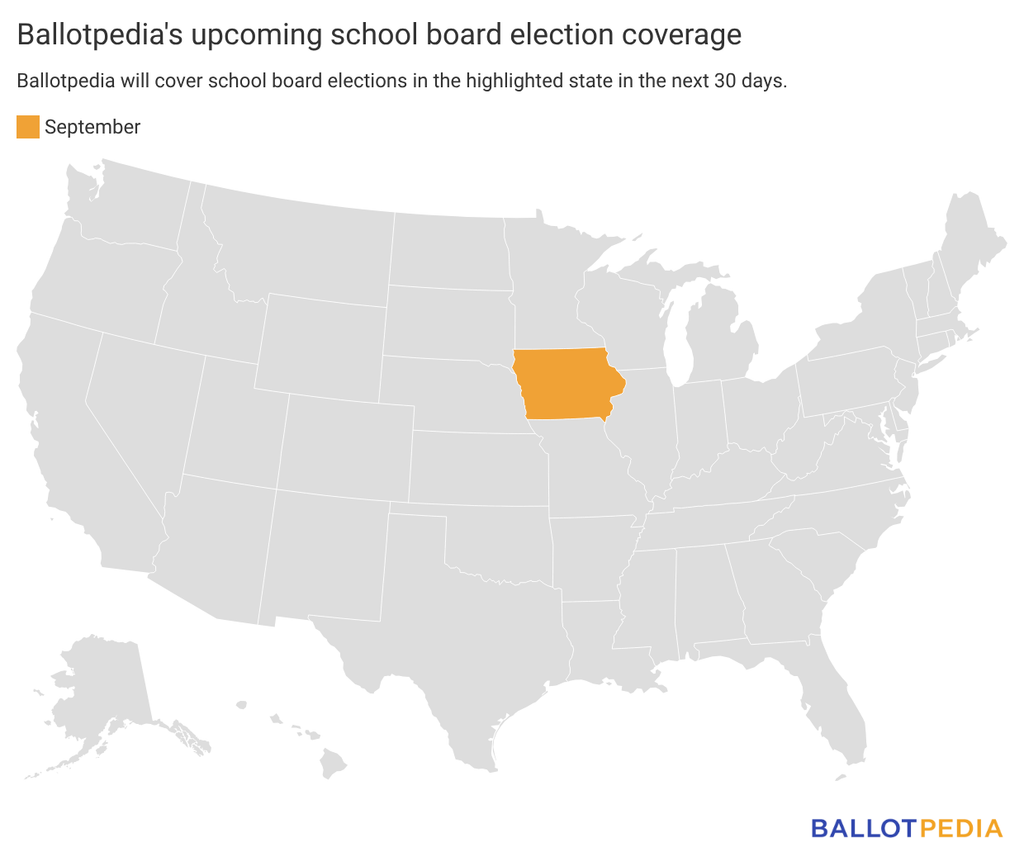
- Ballotpedia will cover a special general election in Iowa for an at-large seat on the Pleasantville Community School District on Sept. 22.
Districts and states take differing stances on AI in K-12 education as students return to school
The start of the school year brings with it many changes. And for the roughly 1.3 million students enrolled in New York City Public Schools (NYCPS) and the Los Angeles Unified School District (LAUSD), the new school year means a new relationship to artificial intelligence (AI) — at least on school grounds.
The two largest public school districts in the country by student enrollment, announced temporary bans on most students’ use of generative AI platforms. The news comes amidst a growing national debate over AI, which is playing out in elections and politics across all levels of government.
Even as NYCPS and LAUSD hit pause on some students’ AI use in school, districts in other parts of the country are taking more accommodating approaches to the technology.
NYCPS and LAUSD implement temporary bans and restrictions on AI
On Sept. 2, New York City Mayor Zohran Mamdani (D) announced an immediate one-year moratorium on AI tools students can interact with in pre-kindergarten through eighth grade, and new AI literacy courses and pilot programs in high schools. Roughly 900,000 students attend NYCPS, and the K-8 ban will affect about 600,000 of them.
“I have yet to see a study showing that AI is beneficial for students in elementary and middle school, with the exception, of course, of research sponsored by the very corporations that stand to profit,” Mamdani said.
The moratorium on accessing all generative AI technology, such as ChatGPT, Claude, or similar applications specifically geared toward education, applies to children enrolled in the city’s childcare programs (like 2-K) and those in kindergarten through eighth grade. In high school, NYCPS will require students to complete an AI literacy course consisting of two 45-minute modules each year. NYCPS’ policy also allows for some use of AI in Career and Technical Education (CTE) programs and other career pathways programs. Additionally, some high school students will have the opportunity to use one of five education-related AI tools (Quill, Edia, Brisk Teaching, Playlab, and Intel AI-Ready Schools) on a limited basis as part of a pilot under NYCPS’ new AI policy. High schools can apply to participate in the pilot.
Popular generative AI tools like ChatGPT and Claude will be blocked for all students.
The policy permits teachers to use generative AI for lesson planning but prohibits them from using it for grading or student assessments.
NYCPS’ policy goes beyond AI and includes grade-specific limitations and recommendations on screen time. Students in 2-K through second grade are banned from 1:1 screen time, while the district recommends that teachers allow those in grades 3-5 and 6-8 no more than 30 and 45 minutes of 1:1 screen time daily, respectively. In high school, screen time limitations will depend on the school and course.
This isn’t the first time NYCPS has banned AI tools. In January 2023, NYCPS blocked access to OpenAI’s ChatGPT just a month after it was first released over fears it could facilitate cheating. That May, the district unblocked access to ChatGPT, with then-Chancellor David C. Banks writing, “While initial caution was justified, it has now evolved into an exploration and careful examination of this new technology’s power and risks.”
Mamdani said that throughout the school year, a working group of teachers, elected officials, union members, and parents called the Technology in Schools Coalition will gather to study the results and make recommendations for the future.
Meanwhile, on the West Coast, LAUSD, the country’s second-largest school district, announced on Sept. 2 that students would be blocked from accessing or using generative AI tools on district-owned technology throughout the 2026-27 school year.
Roughly 378,000 students are estimated to attend LAUSD in the 2026-27 school year.
The ban applies to students in all grades, including high school.
According to the Los Angeles Times, district officials enacted the AI ban at some point following the LAUSD school board’s vote in June to approve limits on screen time, but the board only became aware of it last week during a meeting. Board member Nick Melvoin said the district should spread the word about the new policy, but that it “didn’t really come from the board, so I’m of two minds on that right now.”
The board’s screen time policy limits the amount of time students can use district-owned devices. The policy bans screen time for students in early education, kindergarten, and first grade, while allowing for those in grades three and four to access devices for up to 20 minutes per day. The policy becomes less restrictive with each successive grade up to high school, when students are allotted 90 minutes of screen time per subject each week.
As in New York City, LAUSD also blocked access to ChatGPT shortly after its release, in late 2022, before reversing its policy.
Districts take differing approaches to AI
There’s no consensus among educators, district leaders, and school board members on how districts should approach AI. While districts like NYCPS and LAUSD are hitting pause, especially for younger children, others are finding ways to incorporate AI into the classroom.
Denver Public Schools, in Colorado, allows students to use some AI platforms on district-owned devices. Those include MagicSchool, a platform built for school districts, and Google Gemini. Billy Sayers, the district’s director of Science, Technology, Engineering, Arts, Media Literacy (STEAM), said, “We wanted to get as many students off unapproved platforms and tools to approved tools that are contractually bound to protect our students’ data. We want to get ahead and pretty much set some pretty firm guardrails of what students are allowed to use and not allowed to use.”
Denver Public Schools enrolls roughly 88,000 students.
Some districts’ policies place the responsibility for classroom use of AI largely on teachers.
In Florida, Orange County Public Schools, the nation’s eighth-largest district with more than 200,000 students, released its AI policy in July. The district gives teachers latitude to set their own AI rules. Students can use AI for background research on assignments but cannot submit any AI-written work unless a teacher gives them permission. Charleston County School District, in South Carolina, provides teachers with MagicSchool and allows them to set their own policies for student-facing AI platforms. Deputy Superintendent Luke Clamp said, “The attention paid by the school district to AI comes from a belief that the technology will transform education and the workplace, and that if students are not taught about how to use it they will lag behind others.”
The Charleston County School District has roughly 50,000 students.
How states are responding to AI in education
Public school AI policies are still largely set at the district level, creating a patchwork of approaches within and between states. At the same time, state lawmakers and education officials have sought to establish overarching guidance or laws on AI in classrooms.
According to FutureEd, a Georgetown University think tank, at least 10 bills addressing AI in K-12 education have been enacted into law this year, including in Alabama, Idaho, Oklahoma, Maryland, Virginia, Mississippi, Georgia, and Utah. Overall, FutureEd has tracked 77 bills introduced in 27 states this year related to AI. Some of the laws, such as those in Idaho and Maryland, direct state departments of education to craft AI guidance frameworks. Others, including Georgia’s and Utah’s, mandates AI instruction in the curriculum.
In 35 states, education departments have released AI guidance or frameworks for schools. In most cases, districts are not required to use the guidance in their own AI policies.
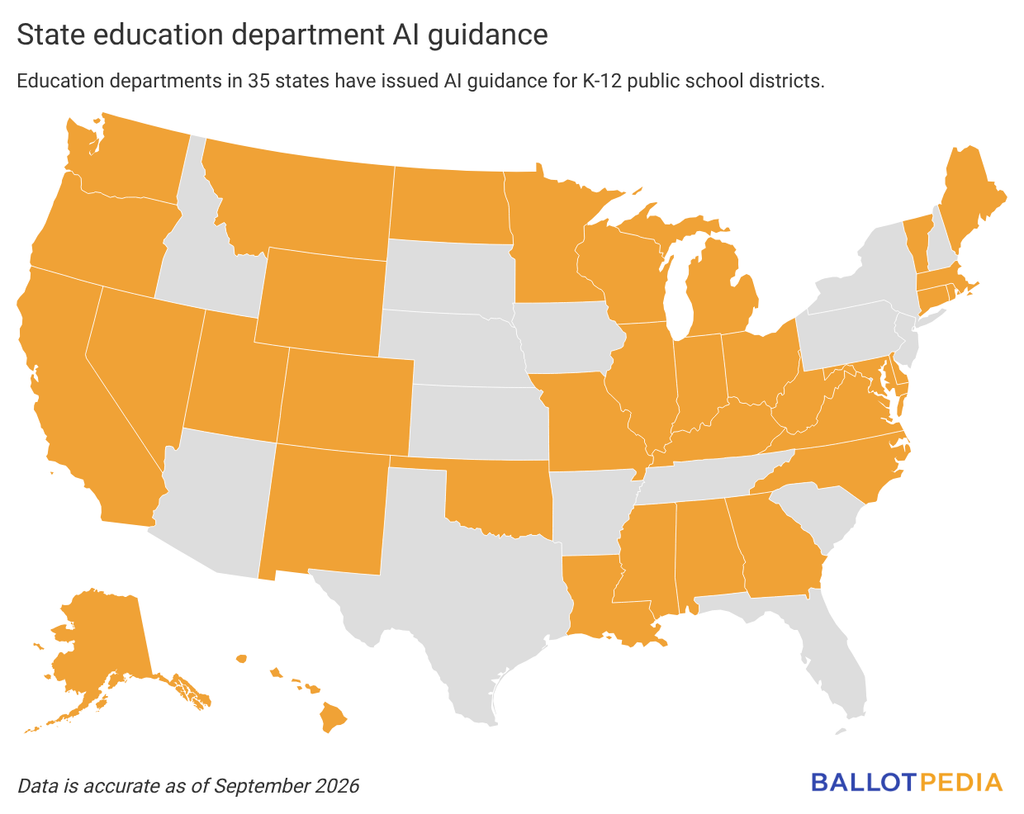
Click here to learn more about state education department AI guidance.
Extracurricular: education news from around the web
This section contains links to recent education-related articles from around the internet.
- School vaccine data can expose hidden outbreak risks. But access depends on where you live. | Chalkbeat
- What if transferable skills don’t exist? | No More Marking Substack
- New Education Results Show America Needs a Talent Strategy, Not More Excuses | Bipartisan Policy Center
- Satisfaction With K-12 Education Hits New Low | Gallup
- U.S. Reading Scores Plummet on Global Exam | The New York Times
- A Generation Later, 9/11 Is Harder to Teach as Lived Memory Fades | The 74
Take our Candidate Connection survey to reach voters in your district
Today, we’re looking at survey responses from the two candidates running in the Nov. 3 general election to represent District 5 on the Brunswick County Schools school board, in North Carolina.
Incumbent Steve Gainey (R) is retired but worked in sales for 25 years. Here’s how he answered the question, “What areas of public policy are you personally passionate about?”

“‘Distraction Free Schools’ Eliminate student access to personal wireless devices during the entire instructional day, i.e. bell-to-bell. Social media access has created mental health issues that impact students in myriad ways. Raleigh must provide funding to implement a bell-to-bell ban.
“Petition the legislature to fund a return to printed textbooks in K-3, per local option. And, in BCS, increase use of pen & paper in grades K-3. Research clearly shows a correlation in improved cognitive development & letter fluency in young children when writing with pen and paper. We can’t stop digital screen use, but we can restrict it to be used only when required. BCS staff will study & report back by Jan. ‘27 for implementation, 8/27.”
Click here to read the rest of Gainey’s responses.
Brian D. Rupp’s (D) career experience includes serving in the U.S. Air Force and being self-employed. Here’s an excerpt from Rupp’s answer to the following question: “What are the main points you want voters to remember about your goals for your time in office?”

- “Protect Every Child's Right to a Quality Education
Every child deserves the sound, basic education promised by the North Carolina Constitution. I will fight to ensure our schools focus on proven academic instruction that prepares students for success while reflecting the principles on which our nation was founded. I believe public schools should remain focused on education and respect the constitutional separation of church and state, ensuring every student and family feels welcome regardless of their personal beliefs. I also believe every student deserves the opportunity to succeed. Students with IEPs and 504 Plans are not problems to solve; they are students with unique strengths and needs. These plans are roadmaps to success.”
Click here to read the rest of Rupp’s responses.
As a reminder, if you're a school board candidate or incumbent running this year, click here to take the survey. If you complete the survey, your answers will appear in your Ballotpedia profile. Your responses will also appear in our sample ballot. If there is an election in your community, share the link with your candidates and urge them to take the survey!