


Welcome to the Wednesday, Sept. 23, 2026, Brew.
By: Lara Bonatesta
Here’s what’s in store for you as you start your day:
- Ohio leads states in number of local ballot measures on data centers for 2026
- North Carolina to hold first congressional elections since redistricting
- One of the two candidates in this local California election died — he could still be elected in November
Ohio leads states in number of local ballot measures on data centers for 2026
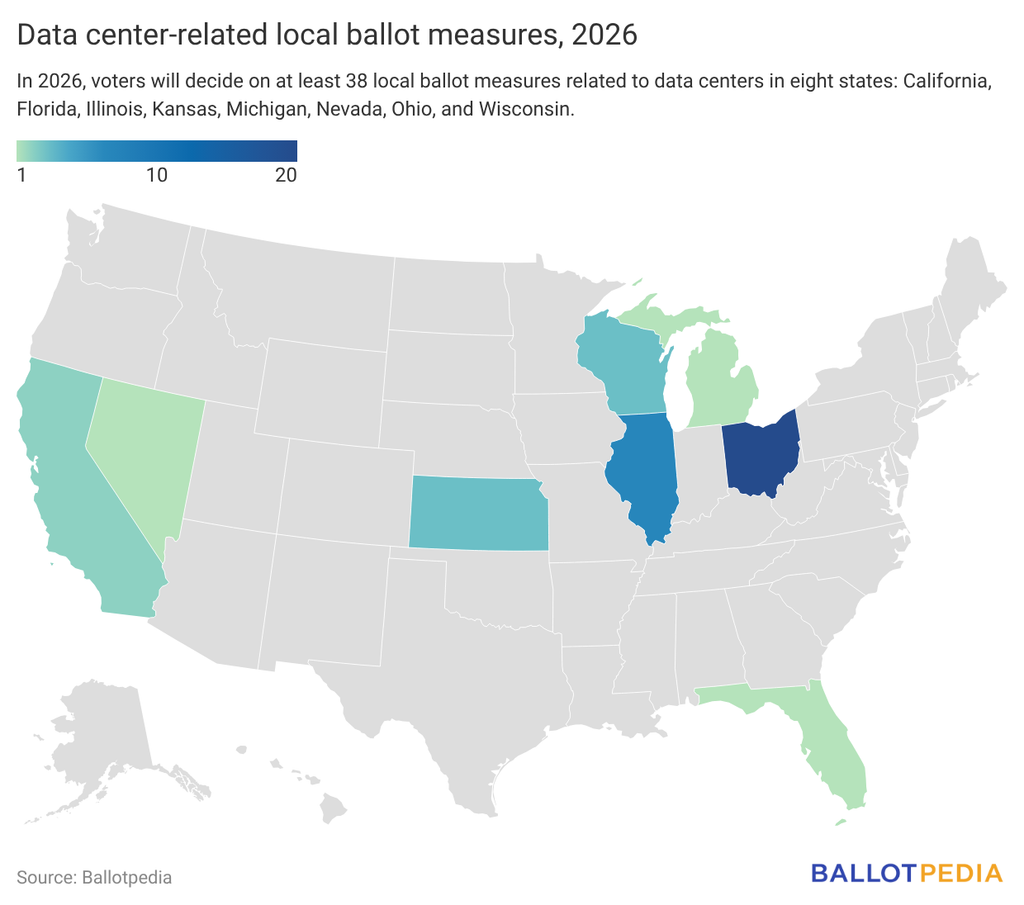
Voters in eight states — Ohio, Illinois, Wisconsin, Kansas, California, Michigan, Nevada, and Florida — will decide on 38 data center-related local ballot measures in 2026. The measures span 35 jurisdictions in 30 counties.
Ohio accounts for 20 measures across 17 jurisdictions, more than half of the total. Illinois has seven measures, including four in Madison County. The remaining 11 measures are in Wisconsin and Kansas, with three each; California, with two; and Michigan, Nevada, and Florida, with one each.
Thirty-one measures (82%) qualified for the ballot through citizen-initiated petition processes, while seven (18%) were referred by local governing bodies.
Nine measures are advisory questions, while the other 29 would enact, amend, approve, or reject laws, charters, zoning decisions, or development agreements. The measures include complete prohibitions, temporary moratoriums, zoning and rezoning decisions, project-specific approvals, requirements for future voter approval, and advisory votes.
Most measures, 34 of 38 (89%), are scheduled for the Nov. 3 general election. The other four appeared earlier in the year, and voters in each case favored greater restrictions on data center development, either by approving a restriction or rejecting a measure that would have facilitated development.
A data center is a physical facility that houses computer systems and related equipment used to store, manage, process, and transmit digital information. Data centers typically contain rows of computer servers, data storage systems, and networking equipment, along with the power and cooling infrastructure needed to operate them.
Data centers vary in size and type. A large, warehouse-sized facility is known as a hyperscale data center. According to the Congressional Research Service, increasing demand for data storage and computing power, particularly for AI, has driven the construction of hyperscale data centers.
Beyond ballot measures, citizens in some jurisdictions launched recall efforts against government officials involved in data center-related decisions. So far this year, there have been 42 data center-related recall efforts targeting 79 officials. Of those, efforts against 41 officials are still underway, efforts against 33 officials did not go to a vote, one official resigned, one official was removed from office, and recall elections against three officials are scheduled.
Click here to learn more about data center-related ballot measures this year.
North Carolina to hold first congressional elections since redistricting
Welcome to our next installment of our 50 States in 50 Days series, covering North Carolina. To view our archive of past editions, click here.
This year's congressional elections in North Carolina are taking place against the backdrop of redistricting. In October 2025, the North Carolina General Assembly approved a new congressional map aiming to shift the 1st Congressional District, which U.S. Rep. Donald Davis (D) currently represents, toward Republicans.
Based on the 2024 presidential election results, that means the redraw could change the state’s representation in the U.S. House of Representatives from 10 Republicans and four Democrats to 11 Republicans and three Democrats.
Although North Carolina has a divided government in which Republicans have majorities in both state legislative chambers and the governor is a Democrat, redistricting bills do not require gubernatorial approval and are not subject to a veto.
To see what’s on your ballot in November, click here to use our Sample Ballot Lookup Tool. Now let’s take a closer look at what’s happening in North Carolina.
Early voting opens Oct. 15 and ends Oct. 31.
Polls open at 6:30 a.m. and close at 7:30 p.m.
Voter ID is required. Acceptable forms of identification include a North Carolina driver’s license or state ID, a voter ID card, a college or university ID, or a military ID. Individuals with a reasonable impediment to showing photo ID, a religious objection to being photographed, or who were victims of a declared natural disaster may fill out an exception form instead of providing identification. For more information on voter ID in North Carolina, click here.
Absentee/mail-in ballots must be requested by Oct. 20 and returned by Nov. 3. Under a 2026 law, voters may cure any deficiencies with their absentee/mail-in ballot before 12 p.m. on the fifth day after the election. Previously, the deadline was 12 p.m. on the third day after the election.
Current party control
Republicans represent 10 congressional districts, and Democrats represent four. Both of North Carolina’s U.S. Senators are Republicans.
Republicans have a 30-20 majority in the North Carolina Senate and a 71-47-2 majority in the North Carolina House of Representatives. Because the governor is a Democrat, North Carolina is one of 11 states with a divided government and one of seven states where one party controls the governorship and the opposing party controls both chambers of the legislature. North Carolina’s attorney general and secretary of state are also Democrats. As a result, North Carolina is one of 21 states with a Democratic triplex. Republicans have a 5-2 majority on the North Carolina Supreme Court.
Offices on the ballot
Elections are taking place for the U.S. Senate, the U.S. House of Representatives, all 120 seats in the state House, and all 50 seats in the state Senate.
One seat on the state supreme court and three intermediate appellate court seats are also up for election.
North Carolina is one of 32 states this year in which we are covering all local elections for school boards and municipal offices.
Battleground elections
U.S. Senate: Roy Cooper (D), Michael Whatley (R), and three others are running. Incumbent Thom Tillis (R) is retiring. Cooper was governor from 2017 to 2025 and Whatley is the former chair of the Republican National Committee. Major race forecasters have rated the election either Lean, Tilt, or Likely Democratic. As of June 30, Cooper had raised $35 million and spent $14.3 million, and Whatley had raised $11.3 million and spent $7.8 million.
North Carolina's 1st Congressional District: Incumbent Donald Davis (D), Laurie Buckhout (R), and Tom Bailey (L) are running. Davis was first elected in 2022 after 12 years in the state Senate. He is a U.S. Air Force veteran and former professor. Buckhout is a U.S. Army veteran and the owner of a defense consulting firm. Davis defeated Buckhout 49.5% to 47.8% under the old district lines in 2024. Major election forecasters rated the election as Toss-up or Lean Republican. According to Inside Elections, the district shifted from an R+3 to R+12 based on the 2024 presidential election results.
North Carolina's 11th Congressional District: Jamie Ager (D), Jennifer Balkcom (R), and two others are running. Major race forecasters have rated the election as Toss-up or Lean Republican. Incumbent Chuck Edwards initially ran for re-election but ended his re-election bid on Aug. 5, after the U.S. House Committee on Ethics recommended him for censure following an investigation related to allegations of sexual misconduct. The lines in this district were not redrawn between the 2024 and 2026 elections.
North Carolina Supreme Court: Incumbent justice Anita Earls (D) and Sarah Stevens (R) are running. Republicans have had a majority on the court since 2022. The next time partisan control of the court will be at stake will be in 2028, when three of the currently Republican-held seats are up. If Earl wins, Republicans would retain their 5-2 majority and would need to retain at least two of the seats up in 2028 to keep partisan control. If Stevens wins, Republicans would have a 6-1 majority, meaning Democrats would need to win all three seats up in 2028 to win control.
Statewide ballot measures
Three statewide measures are on the ballot this year, all of which are legislatively referred constitutional amendments that passed mostly along party lines, with all Republicans voting in favor and most Democrats voting against them. From 1835 to 2025, North Carolina voters have decided on 202 ballot measures approving 147 (73%) and defeating 55 (27%). An average of two measures appeared on the ballot per even-numbered year. For more information about the history of North Carolina’s ballot measures, visit its Historical Measures Factbook.
Here’s a closer look at the three measures:
The first would require the General Assembly to pass laws limiting the maximum amount that property taxes may increase. This is one of 12 property tax-related measures that will appear on the ballot nationally on Nov. 3. One such measure was decided earlier this year in Louisiana. Voters defeated that measure 66.1% to 33.9%.
The second would lower the maximum allowable state income tax rate from 7% to 3.5%, which would prohibit the state government from increasing the state income tax above 3.5% without voter approval of another constitutional amendment. This is one of eight income tax-related measures that will appear on the ballot nationally on Nov. 3. One such measure was decided earlier this year in Missouri. Voters defeated that measure 83.3 to 16.7%.
The third would require photo ID to vote for all voters, not just those voting in person. As of 2026, the photo voter ID requirement applied only to in-person voting. This is one of six voter ID-related measures that will appear on the ballot nationally on Nov. 3. One such measure was decided earlier this year in Oklahoma. Voters approved that measure 54.6% to 45.4%.
Each measure requires a simple majority to pass.
Local ballot measures
We’ll be adding information about local measures in North Carolina as they are certified ahead of the Nov. 3 election.
Join us again in our next edition when we'll preview elections in Washington, the Evergreen State.
Click here to see every edition of 50 States in 50 Days as we publish them, and here to use our Sample Ballot Lookup Tool.
One of the two candidates in this local California election died — he could still be elected in November
Two seats on the Calaveras County Board of Supervisors in California are up for election in November, and in one of those races, one of the two candidates whose name will appear on the ballot has died.
In the nonpartisan race for District 5 of the Board of Supervisors, Clyde Clapp and Bruce Giudici will appear on the ballot. Giudici died on Aug. 31 after falling while campaigning door-to-door. The race for District 5 is open. Incumbent supervisor Benjamin Stopper ran for re-election but lost to Clapp and Giudici in the June 2 primary. According to the primary election results, Giudici received 36.9% of the vote, Clapp received 35.6%, and Stopper received 27.5%.
According to California law (Govt. Code § 25060), if Giudici wins, the governor will appoint a supervisor to fill the vacancy until the election and qualification of a successor at the next general election. In an email to Calaveras Enterprise, Calaveras County clerk-recorder and registrar of voters Rebecca Turner wrote that she expects that election to take place on March 7, 2028, “unless a qualifying statewide general election is called sooner.”
After Giudici died, Carrie Biggs-Adams, a representative for Giudici’s campaign, said, “The campaign is absolutely still going. We know that this was Bruce's mission to get elected and we're going to complete the mission.”
In a phone call with the Union Democrat after Giudici’s death, Clapp said, “I like Bruce. We have different ideologies and stuff but, you know that you put that aside. I think it’s tragic. I’m in shock. I pray for his family. I just can’t imagine.”
This election is the third time that Clapp and Giudici have run against each other. The first two times were in 2016 and 2020. This year, both Clapp and Giudici completed Ballotpedia’s Candidate Connection survey. Below is a selection from both candidates’ surveys. Click here and here to read their full responses.
Clapp, who previously represented District 5 from 2016 to 2018, is running on his record. In his survey response, he wrote, “My passions center on practical, taxpayer-first governance and land use: keeping costs down (especially water and roads), restoring local control where it was lost, maintaining fiscal surpluses instead of deficits, and directly protecting residents’ homes and daily quality of life.”
Giudici, whose career experience included working as a chief financial officer, wrote, “County government must prioritize public and fire safety, working to preserve the property values of residents. District Five needs positive leadership with deep roots in the community, fiscal integrity, and budget experience.”
Ballotpedia’s Candidate Connection helps voters better understand how their candidates think about the world and how they intend to govern — information they need to feel confident in their choice. Click here to learn more about our survey, and here to learn more about elections happening in Calaveras County this year.