


Voters in three local jurisdictions will decide on ballot measures that would implement ranked-choice voting systems on Nov. 3, 2026.
Voters in Irvine, California, will decide on Measure D. Voters in Honolulu, HI, will decide on Question 5. Both would amend city ordinances. Longmont, CO voters will decide on Question 3C, a city charter amendment.
All three ballot measures would require ranked-choice voting systems in mayoral and city council elections. Honolulu Question 5 would also require ranked-choice voting to elect the city’s prosecuting attorney. City councils referred all three measures to the ballot; none are citizen initiatives.
A ranked-choice voting system (RCV) is an electoral system in which voters rank candidates by preference on their ballots. There are multiple forms of RCV. All three ballot measures would institute instant-runoff voting.
In instant-runoff voting, the most common form of RCV, if a candidate wins a majority of first-preference votes, they win. If no candidate wins a majority of first-preference votes, the candidate with the fewest first-preference votes is eliminated. Ballots that ranked a failed candidate as their first, or highest choice, depending on the round, are then reevaluated and counted as first-preference ballots for the next-highest-ranked candidate in that round. A new tally determines whether any candidate has won a majority of ballots. The process is repeated until a candidate wins an outright majority.
Support and opposition to ranked-choice voting
Colorado Common Cause supports Longmont Question 3C, saying it would lead to “more equitable and representative local elections.” Voter Choice Irvine, the organization campaigning for Measure D, says that an instant-runoff system allows voters to “vote their conscience every time without fear of wasting their vote.”
Former Hawaii state Rep. Beth Fukumoto (D-36), who supports Honolulu Question 5, said, “Ranked choice voting would improve Hawaii’s elections by increasing competition, strengthening representation and encouraging voter participation.”
Irvine Vice Mayor James Mai said switching to an RCV system is unnecessary because Irvine already has an election system that works. He said, “Cities that adopted ranked-choice voting did so to eliminate expensive runoff elections. IRVINE DOES NOT HOLD RUNOFF ELECTIONS. We don't have the problem this is supposed to solve.”
The Heritage Foundation, in a 2019 report opposing RCV in all jurisdictions, said RCV “destroys clarity of political debate and forces voters to cast ballots in hypothetical future runoff elections. When we have Republicans versus Democrats versus Greens and Libertarians, we know who is running against whom and the actual distinctions between the candidates on issues. Second- or third-choice votes should not matter in America.”
Ranked-choice voting ballot measures at the state level
In addition to the three local RCV measures on the November ballot, Alaska voters will decide on Ballot Measure 2. The measure would:
- eliminate top-four primaries and RCV general elections in Alaska;
- establish a party primary system; and
- eliminate campaign finance provisions that require persons and entities that contribute more than $2,000 that were themselves derived from donations, contributions, dues, or gifts to disclose the true sources (as defined in law) of the political contributions.
Ballot Measure 2 seeks to repeal changes to Alaska’s election system that were implemented by a voter-approved ballot measure in 2020. Ballot Measure 2 (2026) is similar, though not identical, to a 2024 initiative, also called Ballot Measure 2. The 2024 initiative would have eliminated top-four primaries and RCV general elections in Alaska and established a party primary system. Voters rejected the measure with 49.9% voting 'yes' and 50.1% voting 'no'. As of 2026, this was the narrowest ballot measure result in Alaska's history.
Prevalence of ranked-choice voting in the United States
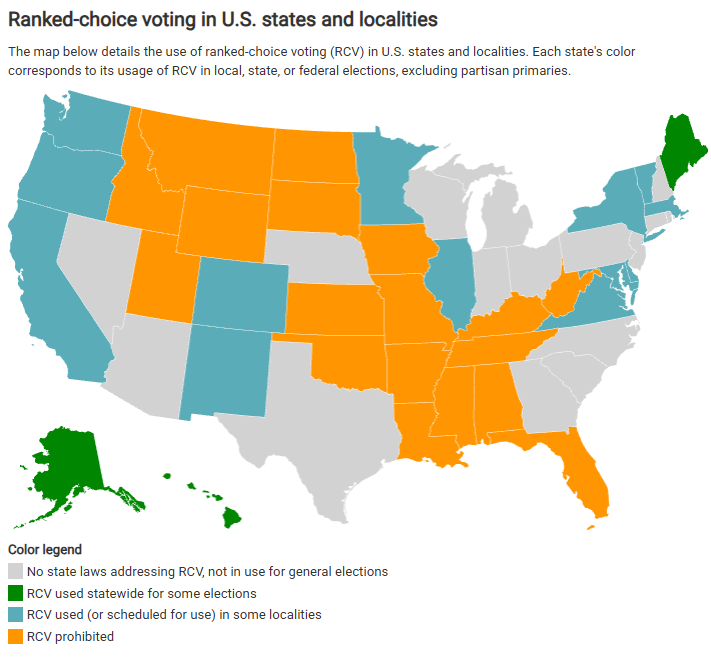
As of September 2026, three states use RCV statewide. Alaska and Maine use RCV in some federal and statewide elections, while Hawaii uses it for certain statewide elections. Thirteen states where RCV is not used in any statewide elections contain localities that either use or are scheduled to begin using RCV in municipal elections. Nineteen states have adopted laws prohibiting RCV in any elections. Most recently, Indiana and Ohio passed laws in 2026 prohibiting RCV.
The map below shows which states use RCV statewide or in some localities as of September 2026. It also shows the states where RCV is either prohibited or not addressed in the law. It does not show states where a political party uses RCV for partisan primaries, or where military/UOCAVA voters use ranked ballots for runoff elections. See the table beneath the map for details on these uses of RCV.
History of ranked-choice voting in the United States
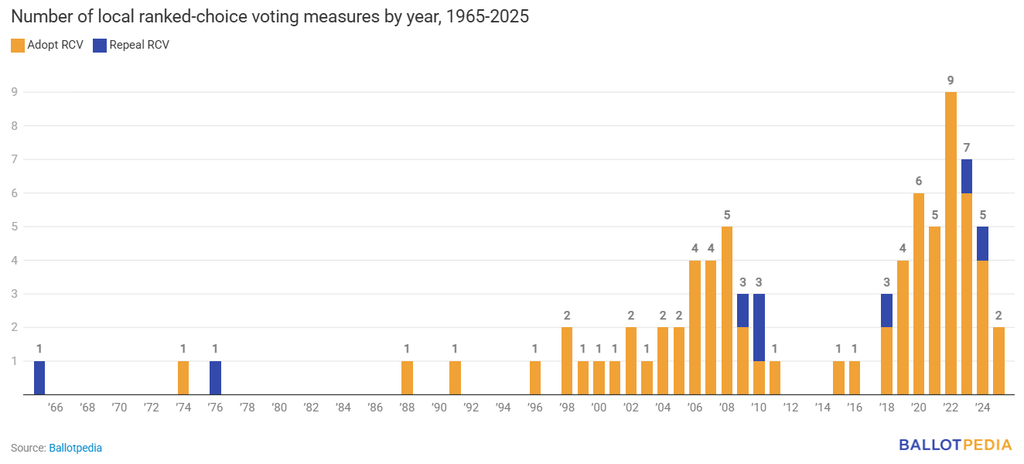
Since 1915, there have been more than 150 ballot measures to adopt or repeal ranked-choice voting systems. Ashtabula, Ohio, was the first jurisdiction to approve a ranked-choice voting measure in 1915.
From 1965 through 2025, there were 12 statewide ballot measures in eight states. Ten (83.3%) were to adopt RCV, and two (16.7%) were to repeal or preempt RCV.
Ballotpedia has located 72 local ballot measures to adopt RCV. Voters approved 57 (79.2%) and rejected 15 (20.8%). Alternatively, there were eight local ballot measures to repeal RCV. Voters approved four (50.0%) and rejected four (50.0%). The year with the greatest number of local ranked-choice voting (RCV) measures on the ballot was 2022, when there were nine.
Additional reading: