


Welcome to Hall Pass, a newsletter written to keep you plugged into the conversations driving school board governance, the politics surrounding it, and education policy.
In today’s edition, you’ll find:
- On the issues: The debate over Missouri’s A-F district and school grading framework
- School board filing deadlines, election results, and recall certifications
- Education on the November ballot (Part 1): athletics, free school meals
- Extracurricular: education news from around the web
- Candidate Connection survey
On the issues: The debate over Missouri’s A-F district and school grading framework
In this section, we curate reporting, analysis, and commentary on the issues school board members deliberate when they set out to offer the best education possible in their district. Missed an issue? Click here to see the previous education debates we’ve covered.
On Sept. 15, the Missouri State Board of Education approved a framework for grading K-12 public and charter schools on an A-F scale.
The framework originated in an executive order that Gov. Mike Kehoe (R) signed in January 2026, directing the State Board of Education to issue annual grades to schools. Kehoe said: “Parents deserve clear, easy-to-understand information about how schools are performing so they can make the best decisions for their children. The A-F framework is about bringing greater transparency and accountability to Missouri's education system by giving greater weight to student outcomes rather than the administrative process.”
The Missouri Department of Elementary and Secondary Education (DESE) already publishes annual reports on districts and schools. Kehoe’s order states that “families and community members often find current accountability reports difficult to interpret.”
Under the new framework, DESE will evaluate schools serving K-8 students on criteria like academic achievement and how much progress students have made toward meeting the state’s definition of proficiency in English Language Arts (ELA), literacy, mathematics, and science. For high schools, the letter grades are based on additional metrics like the four-year graduation rate.
Districts will also receive annual letter grades under the framework.
The State Board of Education announced on Sept. 15 that schools could receive grades under the new framework by mid-November. The board delayed the rollout, initially scheduled for September or October, after four superintendents present at the meeting asked for more time to learn about the framework.
Today, we look at two perspectives on the new framework.
Missouri State Board of Education member Kerry Casey, who was appointed in 2021, says the goal of the A-F system is to help parents easily understand if schools are succeeding in educating their children. Casey says student learning can get overshadowed in Missouri’s existing accountability system, which she says is based on both academic and non-academic factors. Casey says the framework primarily focuses on the progress students make over time in their classes, so that schools with a greater portion of disadvantaged students aren’t penalized, and those with students who come in ahead can’t rest on their laurels. Casey says the framework will lead to greater transparency and better information for parents and education officials about what is and isn’t working in schools.
Judy Young, an organizer who works with nonprofits to improve public education, says the State Board of Education is rushing the implementation of the A-F framework and not giving due consideration to what she sees as its flaws. Young says the letter grades are based primarily on how students do on the Missouri Assessment Program, a standardized test, and don’t reflect other factors like students’ knowledge, curiosity, or kindness, or teachers’ hard work. Young says the framework will not help students because the state won’t send more funding or other kinds of assistance to schools that receive low letter grades. She says schools given low grades could unjustifiably reflect poorly on their communities, deterring families and businesses from relocating.
Clear grades through proposed A-F system will help build stronger schools | Kerry Casey, St. Louis Business Journal
“Contrary to the concern that grades will simply reward schools whose students begin with greater advantages, the design gives substantial weight to how much children improve. Growth is one of the fairest ways to understand a school’s contribution because it separates where students start from how much they move forward.
“For elementary and middle schools, nearly two-thirds of the proposed grade is tied to growth. About one-third measures how much students improve from where they began, and just under another third looks at whether students who are behind are making sufficient progress to reach and sustain proficiency. Together, those measures recognize schools for moving children forward, not simply for enrolling students who arrived ahead.”
Missouri schools deserve better than a single letter grade | Judy Young, Missouri Independent
“A low letter grade impacts more than just the school itself and should concern any group interested in the public perception of a community. People consider the success of a school district when deciding where to raise a family or start a business. The letter grade will become a representation of the community as a whole.
“A single letter grade ignores the hard work of public school educators by measuring success solely based on their student’s performance on a single standardized test. Most importantly, this one test doesn’t reflect a student’s knowledge, curiosity, problem solving, creativity, kindness, or future success.”
School board update: filing deadlines, election results, and recall certifications
In 2026, Ballotpedia will cover elections for more than 30,000 school board seats. We’re expanding our coverage each year with our eye on covering the country’s more than 80,000 school board seats.
Election results from the past week
Ballotpedia covered a special general election in Iowa for an at-large seat on the Pleasantville Community School District on Sept. 22.
- Pam Anthony won, receiving 57.3% of the votes.
Education on the November ballot (Part 1): athletics, free school meals
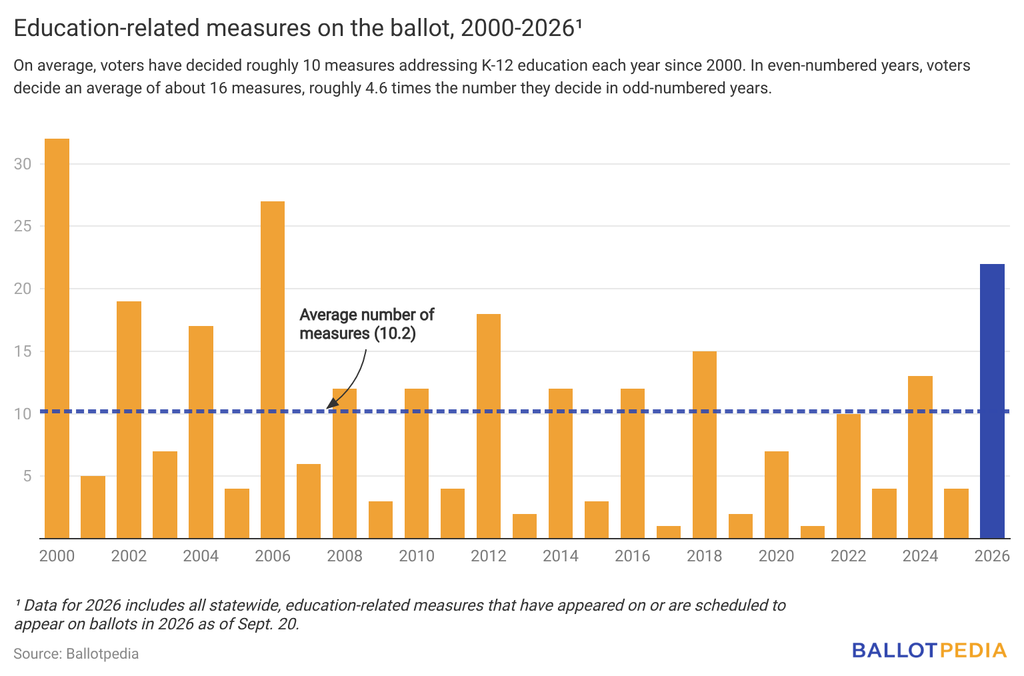
On Nov. 3, voters across the country will decide on 20 statewide ballot measures affecting education policy, the most in a single year since 2006.
This will be the first part of a two-part series looking at some of the noteworthy K-12 education-related measures. Today, we’re looking at the measures addressing athletics and one in North Dakota regarding free school meals.
Voters in California and Louisiana have already decided seven local education-related measures this year.
Athletics
Voters in Arizona, Colorado, Nebraska, and Washington this year will decide whether the law should require student athletes in K-12 public schools to compete in the sports category that matches their sex. Today, we’re going to look at Arizona’s and Colorado’s measures in detail.
Click here to read Hall Pass’ previous coverage of Washington’s initiative.
On June 30, 2026, the U.S. Supreme Court ruled 6-3 in West Virginia v. B.P.J. and Little v. Hecox that laws requiring athletes to compete in the category that matches their sex are consistent with federal law. Click here to read Hall Pass’ deep dive into the cases.
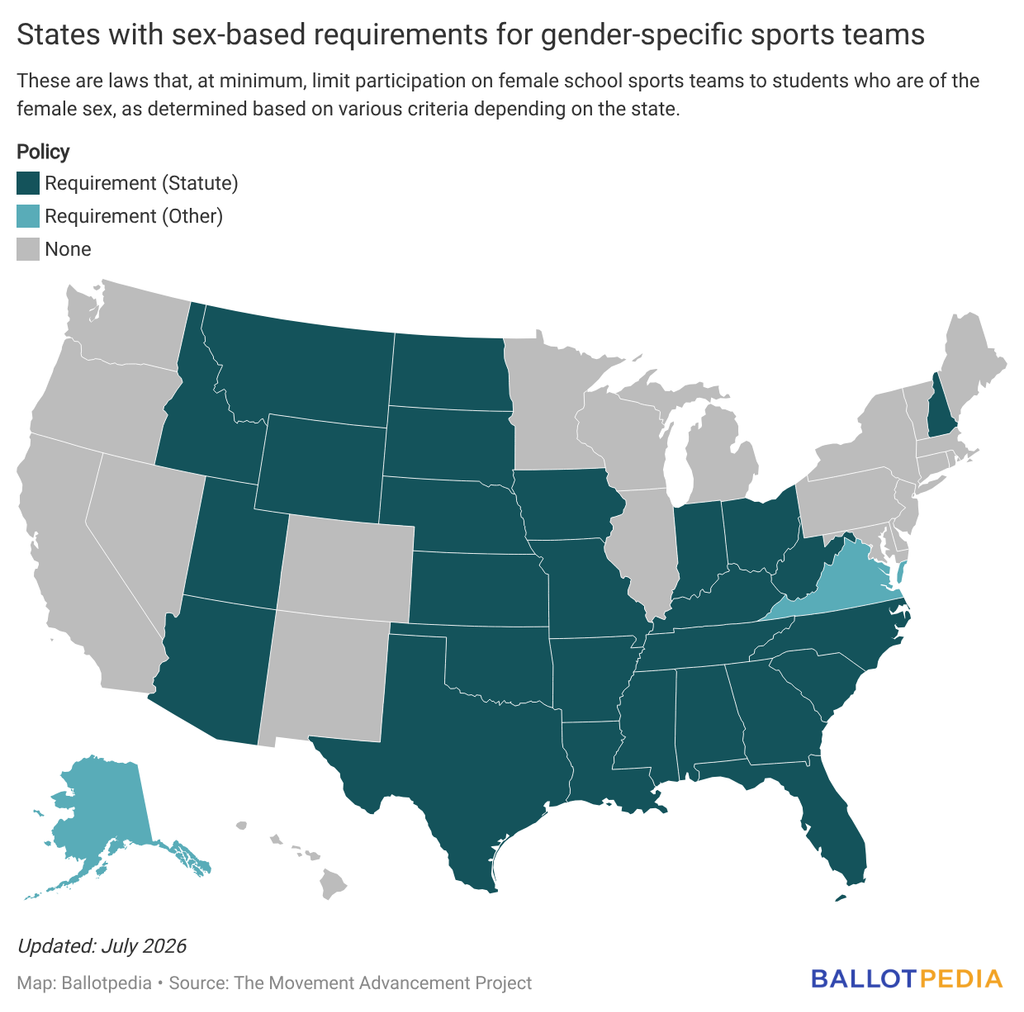
Twenty-nine states have laws, regulations, or interscholastic association rules that limit participation on female school sports teams to students of the female sex, as determined based on various criteria in each state.
Arizona
On June 12, 2026, the Arizona Legislature referred Proposition 318, Require All Schools and Athletic Associations to Restrict Sports Participation and Access to Private Spaces Based on Sex Measure, to the ballot.
Arizona has a divided government. Republicans control both legislative chambers, and Democrats hold the governor’s office.
Here’s what the initiative would change: Proposition 318 would prohibit schools and athletic associations from authorizing a student, athlete, employee, or other individual to use a restroom, locker room, shower room, or other private space that is not designated for their sex. It would define sex as the "biological status as male or female as recorded at birth on the individual's original birth certificate.” The measure would also remove a provision from an existing Arizona law that allows any students, including females, to participate in any interscholastic or intramural athletic team or sport designated for males. Existing law prohibits males from participating in female sports.
Here’s what supporters and opponents are saying:
- Protect Girls' Sports in Arizona, which is leading the campaign in support of the measure, said: “In girls' sports, pretending to be something you're not isn't just wrong, it's dangerous. Voting yes on Prop 318 protects girls' locker rooms and showers, and designates sports male, female, and Co-Ed. Everyone gets to play."
- No on 318, which is leading the campaign against the measure, said: “Every kid deserves the chance to learn, play, and belong -- no matter their race, gender, or where they come from. But the same politicians invading students' privacy with unnecessary gender checks, bullying transgender kids off sports teams, and separating immigrant children from their families are also cutting money from our schools to give breaks to their wealthy friends. Arizonans aren't fooled. We can see when politicians are trying to play us against each other to distract from what they're really doing.”
Colorado
Proposition 134, Sex Requirement for School and College Sports Initiative, is a citizen initiative. Proposition 134 qualified for the ballot on March 26, 2026. Supporters said they submitted more than 164,000 signatures, exceeding the required 124,238 valid signatures.
Colorado has a Democratic trifecta.
Here’s what the initiative would change: Proposition 134 would require school- and association-sponsored athletic teams to be classified in one of three categories: (1) males/men/boys, (2) females/women/girls, or (3) coeducational or mixed. The measure would not limit participation in teams designated as coeducational or mixed.
- The initiative would define females as "person[s] whose biological reproductive system is organized around the production of ova," and males as "person[s] whose biological reproductive system is organized around the production of sperm."
- Each school’s governing body would be required to adopt a policy implementing the measure.
Here’s what supporters and opponents are saying:
- Protect Kids Colorado, which is leading the campaign in support of the initiative, said: “It's not fair – It's not safe. Bigger, stronger biological males are invading girls' sports in Colorado, taking away our girls' dignity, safety, and opportunity. Our ballot measure ensures girls' sports are protected, requiring sports leagues and teams be specifically designated male, female, or co-ed. Because girls' sports in Colorado should be for girls. That's it.”
- Z Williams, co-director of Bread and Roses Legal Center, which describes itself as a social justice legal center, said: “This ballot measure is basically taking a non-issue — there are not that many children who are trans, and there are not that many people who are trans who are athletes — and is using it as a flashpoint for organizations who are very concerned, and I think rightfully so, that their ideology is dwindling. ... They're organizations that are interested in protecting very few kids and, like I said, their efforts are going to open up increased scrutiny of all girls and make all girls now the target of investigation about their gender arrangement, about their biology.”
School meals
North Dakota
Constitutional Measure 2, the Require Schools to Provide Free Meals to Students Initiative, was certified for the ballot on May 14. The Together for School Meals campaign said it submitted 57,229 signatures, more than the required 31,164 signatures.
Here’s what the initiative would change: Constitutional Measure 2 would require all public schools to provide one free breakfast and one free lunch to students each school day, establishing the Healthy School Meals For All (HSMFA) program. Schools that provide these meals would be eligible for reimbursement if they first maximize federal reimbursement.
- The requirement would apply to all public school districts, public schools, and public charter schools.
- Nonpublic schools, the Bureau of Indian Education schools, and other tribal schools would have the option to participate.
Here’s what supporters and opponents are saying:
- Together for School Meals, the campaign behind the initiative, said: “School meals have been proven to support children’s health, reduce hunger, and improve academic outcomes. Participation in school meal programs is associated with better nutrition, increased consumption of fruits and vegetables, and a reduction in food insecurity. These benefits extend beyond the classroom, lifting families above the poverty line and setting students up for lifelong success.”
- Gov. Kelly Armstrong (R), who opposes the initiative, said: “No matter what happens in the future of North Dakota’s budget, you could have $7 soybeans, you could have $12 oil, and this money comes off before anything else is spent. I don’t like constitutional mandated spending at all. Because by its nature, you are saying this is the single most important thing that exists ... I think school lunches is a very important debate. I think there is a reason people have brought it and I think it’s a worthy conversation to have. I do not think it is the most important $140 million under any circumstance that North Dakota would spend."
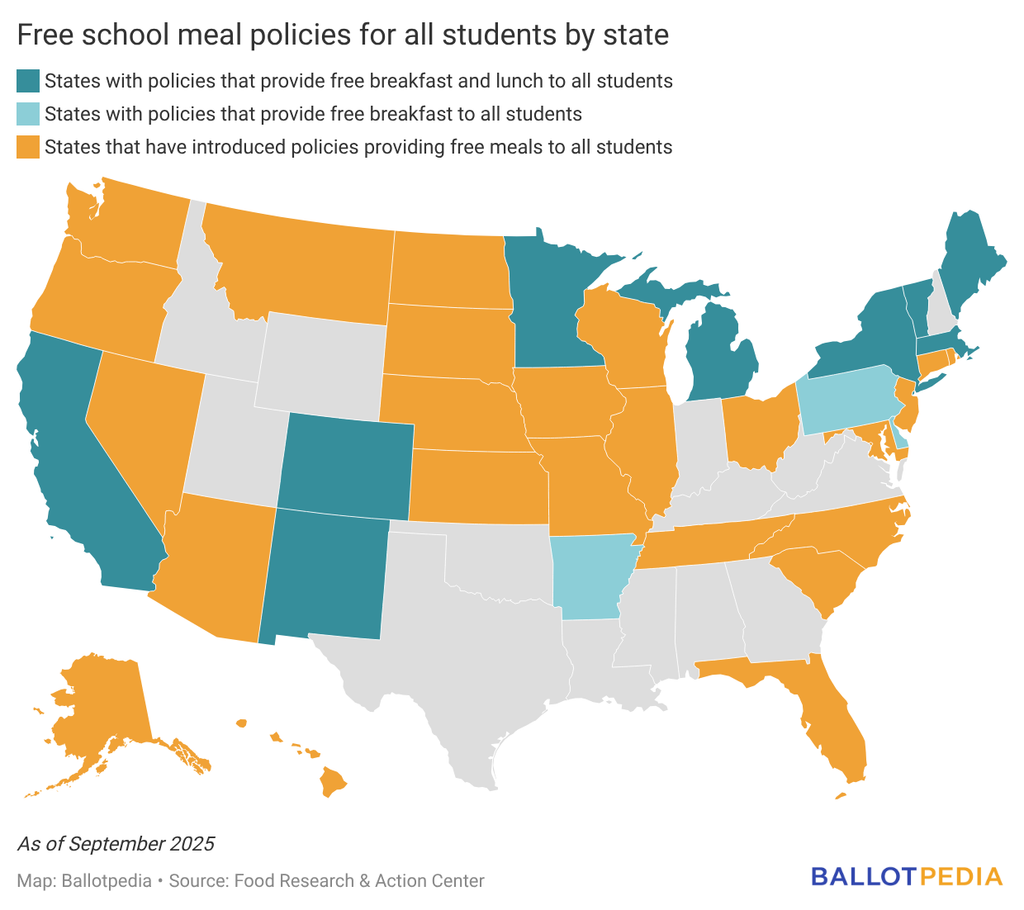
Context: Nine states provide both a free breakfast and lunch to all students, while three states provide free breakfast to all students. According to the Food Research and Action Center, a group that advocates for solutions to poverty-related hunger, at least 26 states have introduced legislation to provide free breakfast and lunch to students.
- Currently, school meals in North Dakota are funded through two federal programs—the National School Lunch Program (NSLP) and the School Breakfast Program (SBP). The programs cover free meals, reduced-price meals, and paid meals. Students eligible for free meals have household incomes at or below 130% of the federal poverty level, and students eligible for reduced-price meals have household incomes at or below 185% of the federal poverty level.
Extracurricular: education news from around the web
This section contains links to recent education-related articles from around the internet.
- Measure ed tech by more than screen time, American Psychological Association says | K-12 Dive
- In Fighting for Every Black Child, Did I Betray My Own? | The New York Times Magazine
- Math interventions bill would now exempt some Ohio schools from teaching science of reading | Ohio Capital Journal
- Federal ‘Science of Reading’ Legislation Passes the House | Education Week
- Who Gets Held Back? | The Assembly
- Superintendent turnover returns to pre-pandemic levels among 500 largest districts | K-12 Dive
Take our Candidate Connection survey to reach voters in your district
Today, we’re looking at survey responses from two of the three candidates running in the Nov. 3 general election to represent Trustee Area 2 on the Montebello Unified School District school board in California.
Jasmin Jauregui Paulson and Aaron Reveles, two educators, completed the survey. As of this writing, Lizbeth Renova had not submitted a survey.

Here’s how Paulson answered the question, “What areas of public policy are you personally passionate about?”
“I’m passionate about education policies that turn the promise of equal opportunity into meaningful support for every student. Schools need reliable public funding so that a child’s opportunities do not depend on their ZIP code or family income. Students also need accessible mental health services, strong enforcement of special education protections, and classrooms where teachers have enough time to understand each student’s needs. Smaller class sizes can help make that individual attention possible. I believe good policy should be shaped by research and by the experiences of students, families, and educators. It should also be evaluated by whether students feel supported, can participate fully, and have the resources they need to thrive.”
Click here to read the rest of Paulson’s responses.
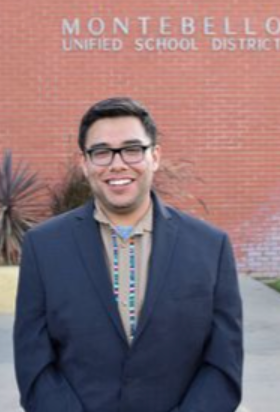
Here’s how Reveles answered the question, “What areas of public policy are you personally passionate about?”
“I’m most passionate about public education, working-class economic justice, and investing in our communities. As a classroom teacher and union organizer, I’m passionate about fully funding public schools, reducing class sizes, expanding early childhood education and Pre-K, strengthening special education, and ensuring educators have the resources they need to support students.
I also believe our schools should be connected to the communities they serve. That means meaningful parent and community engagement, culturally responsive education, strong neighborhood schools, and making sure public resources are invested in students rather than privatization or corporate interests.”
Click here to read the rest of Reveles’ responses.
If you're a school board candidate or incumbent, click here to take the survey.
The survey contains over 30 questions, and you can choose the ones you feel will best represent your views to voters. If you complete the survey, a box with your answers will display on your Ballotpedia profile. Your responses will also appear in our sample ballot.
And if you're not running for school board, but there is an election in your community this year, share the link with the candidates and urge them to take the survey!