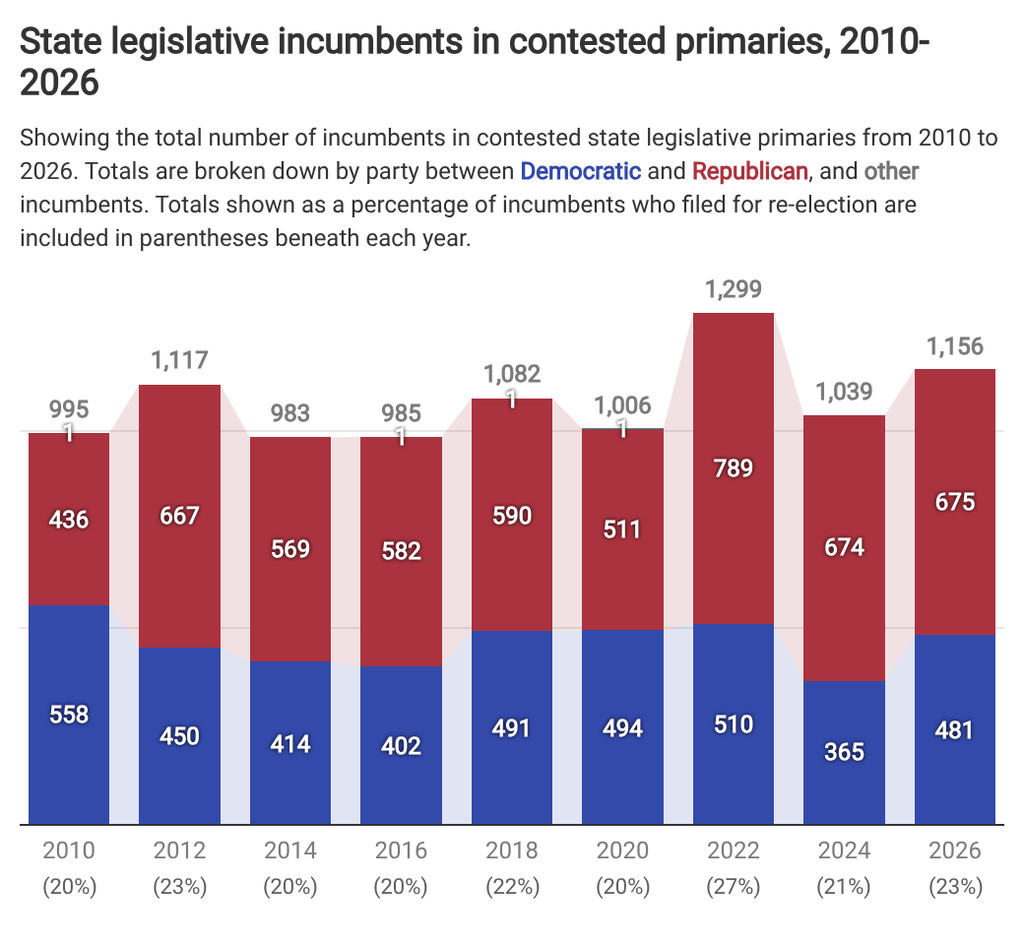
In 2026, there were 1,156 state legislative incumbents in contested primaries, representing 23% of all incumbents who filed for re-election. That tied 2012 for the second-highest percentage of contested incumbents since 2010, next to 2022 at 27%.
Ballotpedia uses the number and percentage of incumbents in contested primaries to help determine the overall competitiveness of an election cycle. A larger number of contested primaries indicates more opportunities for voters to elect a non-incumbent to office. A smaller number indicates fewer of those opportunities.
Across the 46 states holding state legislative elections this year, 481 Democratic incumbents were contested, representing 21% of the 2,314 Democratic incumbents who filed for re-election. That was a 6% decrease from 2022. Republicans had 675 contested incumbents, 25% of the 2,737 Republican incumbents who filed for re-election and a 14% decrease from 2022.
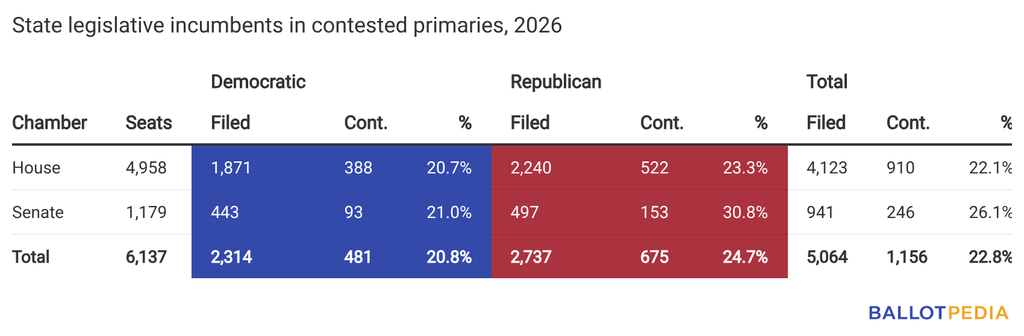
In two states – Connecticut and Maine – less than 5% of incumbents who filed for re-election faced primary challengers. In three states – Maryland, South Dakota, and Wyoming – over half of incumbents who filed for re-election faced primary challengers.
The average number of contested incumbents between 2010 and 2024 was 1,063. In just midterm years during that period, the average was 1,090.