


Welcome to the Thursday, Sept. 24, 2026, Brew.
By: Briana Ryan
Here’s what’s in store for you as you start your day:
- States are recruiting poll workers for November. Here's what they require.
- Washington is one of four states that will decide on a ballot measure addressing sex-based school sports eligibility this year
- Washington Supreme Court overturns natural gas initiative that voters approved in 2024
States are recruiting poll workers for November. Here's what they require.
With the Nov. 3 general election approaching, states across the country are recruiting poll workers to serve on Election Day and during the early voting period.
Poll workers perform a variety of functions. They may help set up or break down polling places, greet and check in voters, issue and transport ballots, and perform other tasks to support the election.
States have different laws and requirements governing who may serve as a poll worker, how much they are paid, and what training they must complete.
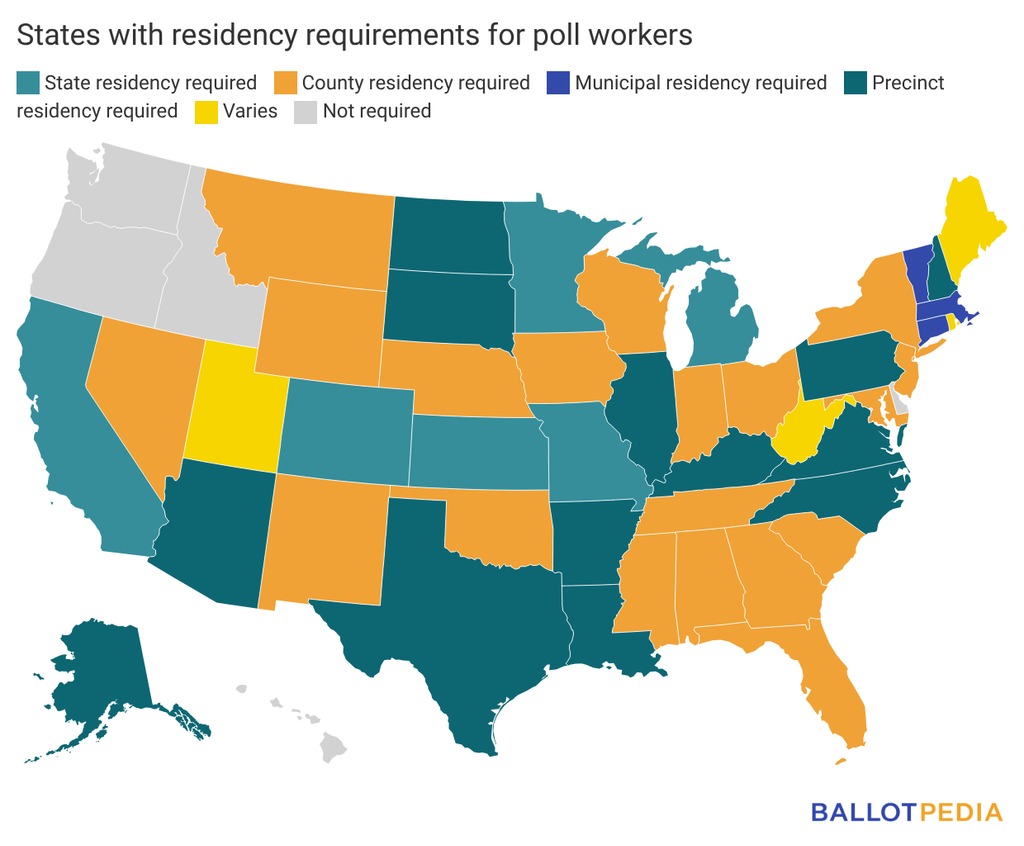
Forty-two states require poll workers to be registered to vote in that state. Forty-five require them to be residents of the state, county, municipality, or precinct where they work.
Of those 45 states:
- Six require poll workers to be residents of the state
- Nineteen require poll workers to be residents of the county where they work
- Three require poll workers to be residents of the municipality where they work
- Thirteen require poll workers to be residents of the precinct where they work
- In four states, the requirement varies by election type
Among the states that require poll workers to reside in a specific local jurisdiction, some make exceptions when there are poll worker shortages.
Forty-four states require poll workers to undergo some form of training, whether in person or online. Six states do not have a statewide training requirement, though some counties and municipalities in those states may have their own mandatory training.
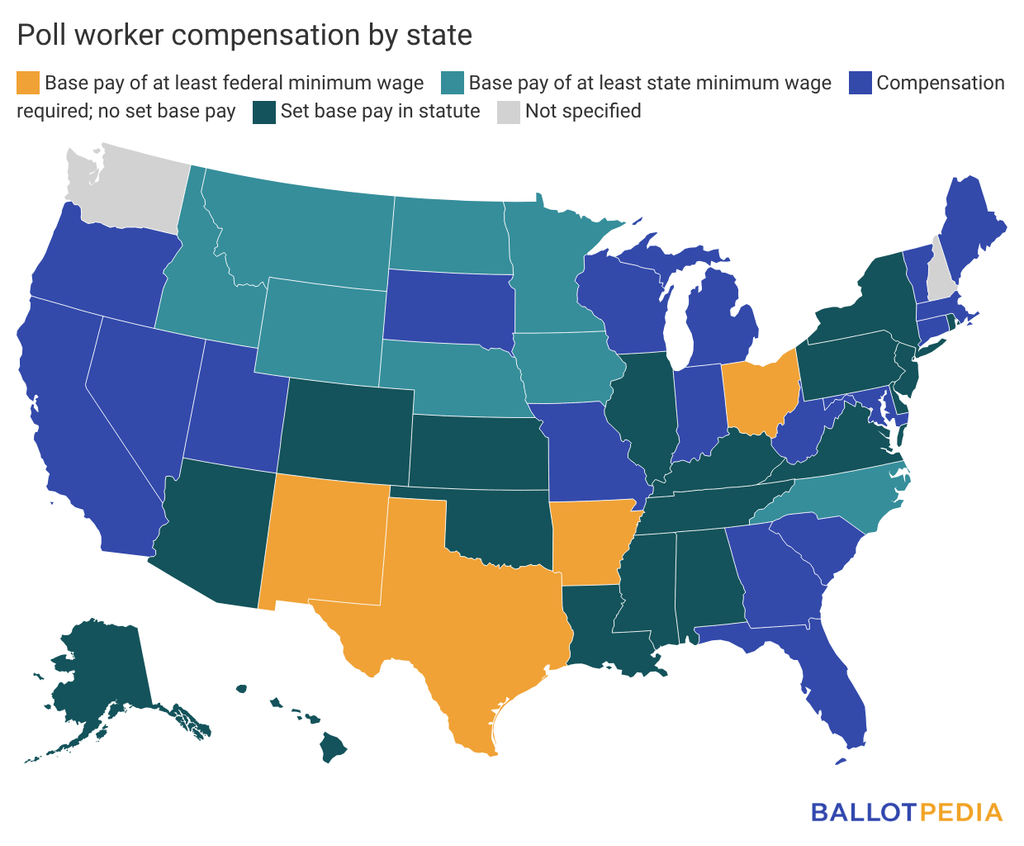
In 48 states, poll workers must be paid for their work. In some of those states, poll workers may choose to serve as unpaid volunteers. New Hampshire and Washington have no statewide pay requirements, though counties and municipalities may still pay poll workers.
Eight states require poll workers to be paid at least their state's minimum wage, four states set the base pay rate at the federal minimum wage, and 18 states set a base pay rate in statute. Eighteen other states require compensation but do not prescribe a minimum rate.
This year, 11 states have passed 14 bills related to election workers or volunteers. Idaho became the first state to allow individuals to serve as poll workers instead of on juries. A county must identify a shortage of poll workers for the option to be offered to prospective jurors. Anyone who serves as a poll worker instead of reporting for jury duty is not paid.
Click here for more information about poll worker requirements.
Washington is one of four states that will decide on a ballot measure addressing sex-based school sports eligibility this year
Welcome to our next installment of our 50 States in 50 Days series, covering Washington. To view our archive of past editions, click here.
Washington is one of four states that will decide on statewide ballot measures this year that would establish sex-based requirements for participation on school athletic teams, with the specific regulations and methods for determining sex varying.
The measure would require school districts and nonprofit organizations that regulate interscholastic activities to "prohibit biologically male students from competing with and against female students" in sports with separate team or individual competitions for male and female students. It would also require students seeking to participate in athletic activities for female students to submit documentation from their healthcare provider verifying "the student's biological sex [based on]... reproductive autonomy, genetic makeup, or normal endogenously produced testosterone levels."
Washington voters will decide on two other statewide measures this year.
One measure would re-enact Initiative 2081, known as the Washington Declaration of Parental and Legal Guardian Rights, which the Washington Legislature previously modified and repealed in 2025. Initiative 2081 provided parents with a right to review educational materials, receive certain notifications, and opt out of sexual health education.
Another measure would repeal a bill that the Legislature passed that would impose a 9.9% tax on household income above $1 million beginning in 2028. This measure is one of five that voters will decide on this year that would prohibit, cap, or decrease income taxes.
Between 1889 and 2025, Washington voters decided on 511 ballot measures, or eight per even-numbered year. During that period, voters approved 269 measures and defeated 242. For more information about the history of Washington's measures, visit its Historical Ballot Measures Factbook.
We'll also be adding information about local measures in Washington as they are certified ahead of the Nov. 3 election.
Voters must register online or via mail by Oct. 26. Voters can also register in person through Nov. 3.
Early voting opens Oct. 16 and ends Nov. 3.
Washington is an all-mail voting state. Individuals who prefer to vote in person may do so at voting centers, which close at 8:00 p.m. on Election Day.
Voter ID is required for individuals voting in person at a voting center. Acceptable forms of identification include a driver's license, state ID card, student ID card, or tribal ID. Individuals may also sign a ballot declaration instead of showing identification.
Absentee/mail-in ballots are automatically mailed to all registered voters at least 18 days before the election. A postage-paid return envelope is included with each ballot. Ballots must be returned by Nov. 3.
Current party control
Democrats represent eight congressional districts, and Republicans represent two. Both of Washington's U.S. Senators are Democrats.
Democrats have a 30-19 majority in the Washington Senate and a 59-39 majority in the Washington House of Representatives. Because the governor is a Democrat, Washington is one of 16 states with a Democratic trifecta. Washington’s attorney general and secretary of state are also Democrats. As a result, Washington is one of 21 states with a Democratic triplex. Democratic governors appointed six members of the Washington Supreme Court, and three members were elected in nonpartisan elections.
Offices on the ballot
There will be elections for the U.S. House of Representatives as well as for 24 seats in the state Senate and all 98 seats in the state House.
Five state supreme court justices and eight intermediate appellate court judges are up for nonpartisan election.
Washington is one of 32 states this year where we are providing comprehensive election coverage down to the local level. This year's ballot includes elections for municipal, county, and judicial offices.
Notable elections
3rd Congressional District: Incumbent Rep. Marie Gluesenkamp Perez (D) and John Braun (R) are running. This district is one of 23 Democratic-held districts that President Donald Trump (R) won in 2024. In 2024, Perez defeated Joe Kent (R) 51.7% to 47.9%. In the 2024 presidential election, Trump defeated Kamala Harris (D) 50.3% to 47% in the district.
Next, we'll preview elections in Nevada, the Silver State.
Click here to see every edition of 50 States in 50 Days as we publish them, and here to use our Sample Ballot Lookup Tool.
Washington Supreme Court overturns natural gas initiative that voters approved in 2024
As Washington voters are preparing to weigh in on three statewide ballot measures this year, the Washington Supreme Court recently overturned a citizen initiative that voters previously approved.
On Sept. 17, the Court overturned Initiative 2066, ruling 6-3 that it violated the Washington Constitution's single-subject rule. In 2024, Washington voters approved Initiative 2066 51.7% to 48.3%.
The initiative prohibited legal restrictions or penalties on access to natural gas and required both private and public utility suppliers to provide natural gas to consumers. It also repealed HB 1589, a bill the Washington Legislature passed in 2024. The bill required the Washington Utilities and Transportation Commission to assess alternatives to current and planned gas infrastructure projects and achieve all cost-effective electrification of end uses currently served by natural gas.
Writing for the majority, Chief Justice Debra Stephens said that the initiative included "several provisions with markedly distinct purposes and regulatory effects, embracing four distinct subjects. It is not possible by judicial construction to sever and save any of the separate provisions and therefore I-2066 is unconstitutional in its entirety."
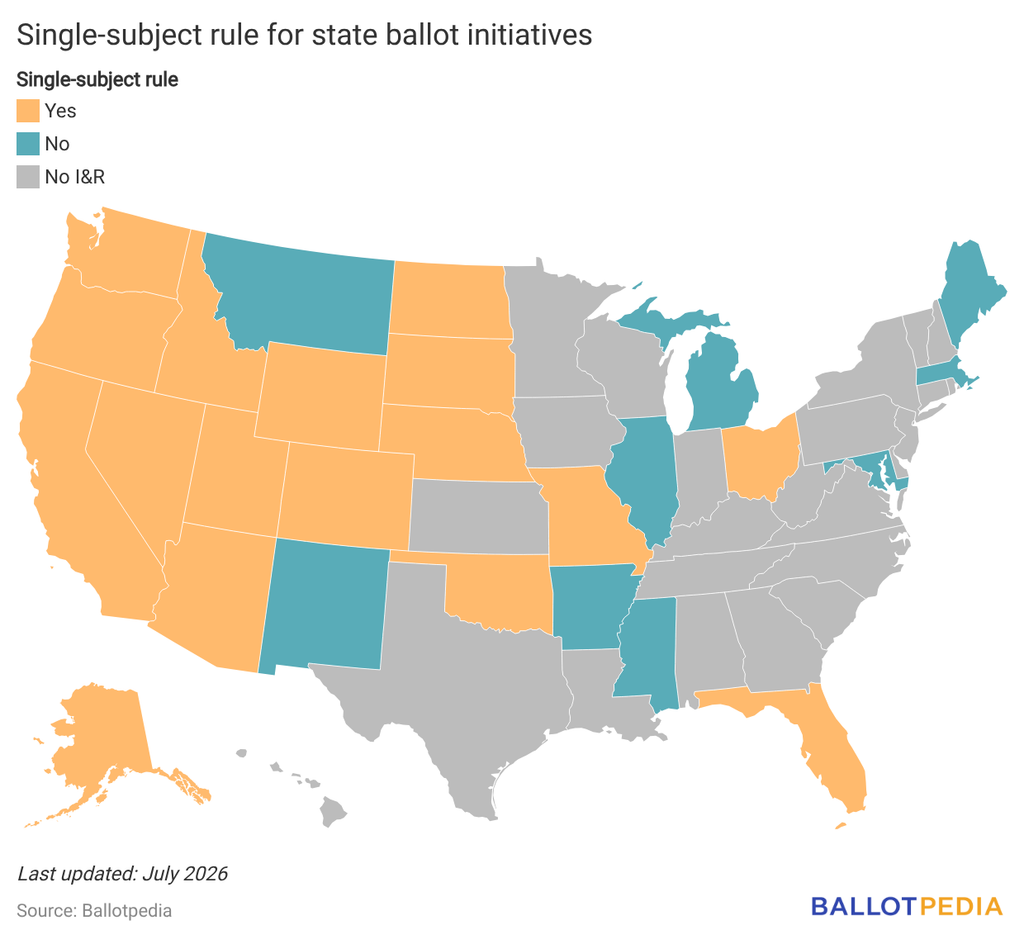
Washington's single-subject rule states that "No bill shall embrace more than one subject, and that shall be expressed in the title." The rule was part of the original state constitution. Seventeen of the 26 states that allow at least one type of statewide citizen initiative have a single-subject rule.
Since 2010, voters in three states have decided on four constitutional amendments to adopt single-subject rules for citizen initiatives:
- In 2018, South Dakota voters approved Amendment Z 62.4% to 37.6%.
- In 2022, Arizona voters approved Proposition 129 55.2% to 44.8%.
- In 2024, North Dakota voters defeated Constitutional Measure 2 56.4% to 43.6%.
- In 2026, North Dakota voters approved Constitutional Measure 1 66.4% to 33.6%.
Click here to learn more about Initiative 2066.