


Welcome to the Friday, Sept. 25, 2026, Brew.
By: Lara Bonatesta
Here’s what’s in store for you as you start your day:
- Voters in three cities will decide on ballot measures to implement ranked-choice voting in local elections on Nov. 3
- Nevada voters to decide ballot measures on abortion, voter ID this year
- One statewide candidate filing deadline in the next two weeks
Voters in three cities will decide on ballot measures to implement ranked-choice voting in local elections on Nov. 3
On Nov. 3, voters in Irvine, California, Honolulu, Hawaii, and Longmont, Colorado, will decide on ballot measures that would require ranked-choice voting (RCV) in mayoral and city council elections. The measure in Honolulu would also require RCV to elect the city’s prosecuting attorney.
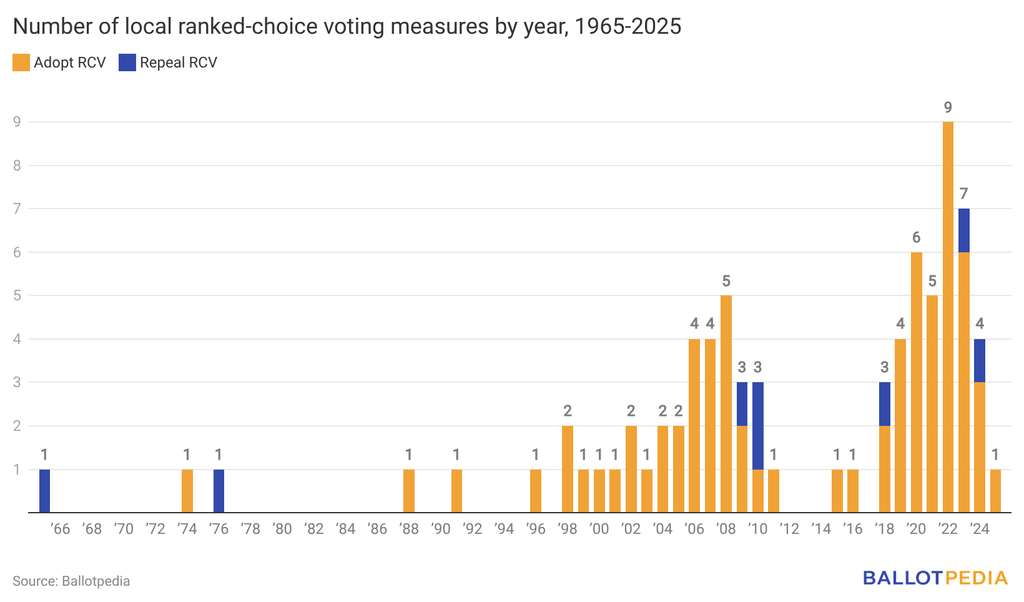
This year’s total of three local RCV ballot measures is more than there were in 2025 (one measure), but otherwise fewer than in any other year since 2019. The number of local RCV measures peaked in 2022 at nine. The chart below shows the total number of these measures in years between 1965 and 2025.
City councils put all three measures on the ballot. Question 5 in Honolulu and Question 3C in Longmont would amend their cities’ respective charters. Measure D in Irvine is an ordinance.
RCV is an electoral system in which voters rank candidates by preference on their ballots. All three measures would institute a system where if a candidate wins a majority of first-preference votes, they win. If no candidate wins a majority of first-preference votes, the candidate with the fewest first-preference votes is eliminated. Ballots that ranked a failed candidate as highest choice are then counted as first-preference ballots for their next-highest-ranked candidate. The process is repeated until a candidate wins a majority.
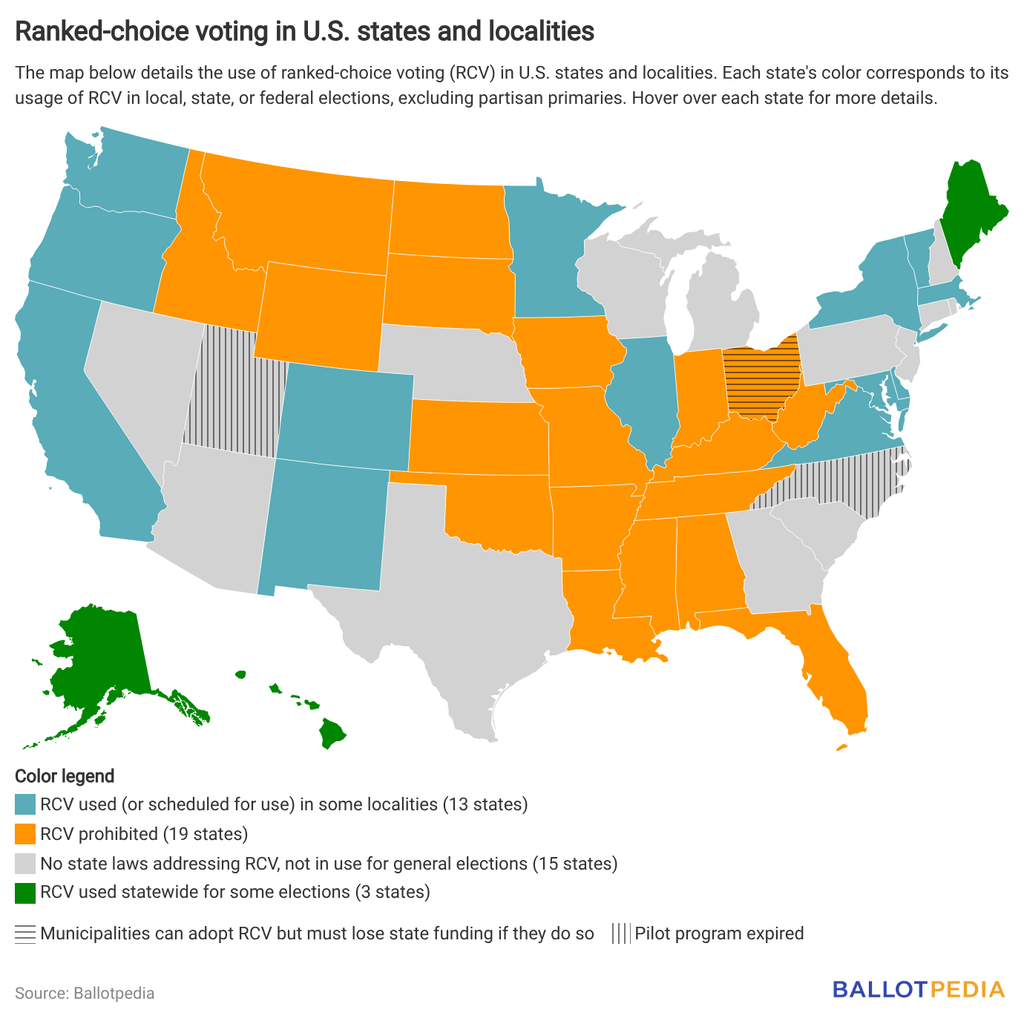
Currently, three states use RCV statewide. Alaska and Maine use RCV in some federal and statewide elections, while Hawaii uses it for certain statewide elections. An additional five states have statutes authorizing the use of RCV for local elections.
Forty-one localities in 14 states, as well as Washington, D.C., use or are scheduled to use RCV. Two of those localities, Washington, D.C. and Multnomah County, Oregon, began or will begin using RCV this year. An additional six localities are scheduled to begin using RCV in 2027.
Nineteen states prohibit the use of RCV in any election. Indiana and Ohio passed laws this year prohibiting RCV. In the last three years, 14 states have banned the use of ranked-choice voting, while one state, Virginia, expanded the use of RCV in local elections.
The map below shows which states use RCV statewide or in some localities. It also shows the states where RCV is either prohibited or not addressed in the law. It does not show states where a political party uses RCV for partisan primaries, or where military and overseas voters use ranked ballots for runoff elections.
History of local ranked-choice voting ballot measures in the United States
Ashtabula, Ohio, was the first jurisdiction to approve an RCV measure in 1915. From 1965 through 2025, Ballotpedia identified 80 local ballot measures related to ranked-choice voting. Of the 72 measures to adopt RCV, voters approved 57 (79.2%) and rejected 15. These include advisory questions. There were eight local measures to repeal RCV. Of these, voters approved four (50%) and rejected four.
Fifty-three localities in 14 states have stopped using RCV after using it in past local elections, though some may have later resumed its use.
Ranked-choice voting ballot measures at the state level
At the state level, Alaska voters will decide on Ballot Measure 2. It would:
- eliminate top-four primaries and RCV general elections in Alaska
- establish a party primary system
- eliminate campaign finance provisions that require persons and entities that contribute more than $2,000 that were themselves derived from donations, contributions, dues, or gifts to disclose the true sources (as defined in law) of the political contributions.
Ballot Measure 2 would repeal changes to Alaska’s election system that voters approved in 2020. The 2026 initiative is similar, though not identical, to a 2024 initiative, also called Ballot Measure 2. The 2024 initiative would have eliminated top-four primaries and RCV general elections in Alaska and established a party primary system. Voters rejected that measure 50.1% to 49.9%. This is the narrowest ballot measure result in Alaska's history.
From 1965 to 2025, there were 12 statewide measures on RCV in eight states. Ten were to adopt RCV, and two were to repeal or preempt RCV. Of the 10 measures to adopt RCV, four were approved and six were defeated. Of the two measures to repeal or preempt RCV, voters approved one and defeated one. The year with the most statewide RCV measures was 2024, when there were six.
Click here to learn more about local ballot measures related to electoral systems and here to learn more about historical ranked-choice voting measures.
Nevada voters to decide ballot measures on abortion, voter ID this year

Welcome to our next installment of our 50 States in 50 Days series, covering Nevada. To view our archive of past editions, click here.
On Nov. 3, Nevada voters will decide on statewide ballot measures on abortion and voter ID. Both are citizen-initiated constitutional amendments that voters approved in 2024 and must approve a second time to become part of the Nevada Constitution.
Question 6 would create a state constitutional right to abortion. Question 7 would require voters to present photo ID when voting in person or to provide the last four digits of their driver’s license or Social Security number when voting by mail. We’ll discuss both of these measures in more detail below.
Question 6 is one of four measures in 2026 related to abortion policy. Three measures would provide for a state right to an abortion. One measure – in Missouri – would repeal the constitutional right to abortion that voters approved in 2024 and prohibit abortion, among other things. The 2026 measures follow a record year for abortion-related ballot measures in 2024, when voters decided on 11 such measures.
Question 7 is one of seven ballot measures that would establish or expand voter identification requirements in state constitutions in 2026. This is the largest number of statewide ballot measures related to voter ID in a single year.
In addition to the statewide measures, voters in Boulder City will also be deciding Question 1, which would allow data center facilities to be an approved land use within the Eldorado Valley Transfer Area outside of the Multi-species Habitat Conservation Easement. As we mentioned in our Sept. 23 edition of the Daily Brew, voters in eight states will decide on at least 38 local data center ballot measures this year.
Want to see what’s on your ballot this November? Click here to use our Sample Ballot Lookup Tool. Now let’s take a closer look at what’s happening in Nevada.
Early voting opens Oct. 17 and ends Oct. 30.
Nevada is an all-mail voting state. This means absentee/mail-in ballots are automatically mailed to all active registered voters in every election. Voters can opt out of receiving a mail-in ballot. Ballots must be postmarked by Nov. 3. Individuals who opt out of receiving a mail ballot or who wish to vote on Election Day may do so at a polling location between 7:00 a.m. and 7:00 p.m.
Voter ID is not required when voting in Nevada, except in cases where the federal Help America Vote Act requires it. The Help America Vote Act requires that individuals in all 50 states who register to vote by mail and who have not voted previously in a federal election in their state must provide either their driver's license or a paycheck, bank statement, current utility bill, or government document showing their name and address. Additionally, individuals registering to vote at an early voting site or election day polling place must provide their Nevada driver’s license or ID card or, under some circumstances, a tribal ID.
Current party control
Democrats represent three congressional districts, and Republicans represent one. Both of Nevada’s U.S. Senators are Democrats.
Democrats have a 13-8 majority in the Nevada Senate and a 27-15 majority in the Nevada Assembly. Because the governor is a Republican, Nevada is one of 11 states with a divided government. Nevada’s attorney general and secretary of state are both Democrats. As a result, Nevada is one of five states where neither party holds triplex control. Democratic and Republican governors each appointed one member of the Nevada Supreme Court. The other five justices joined the court via nonpartisan election.
Offices on the ballot
Elections are taking place for the U.S. House of Representatives and eleven state executive offices.
The state executive offices that are up for election are the governor, lieutenant governor, attorney general, secretary of state, controller, treasurer, and five seats on the state board of regents.
All 42 seats in the state Assembly and 11 seats in the state Senate are also up for election.
Nevada is one of 32 states this year in which we are covering all local elections for school boards and municipal offices.
Battleground elections
Governor: Incumbent Joe Lombardo (R), Aaron Ford (D), and Danielle Ford (No Political Party) are running. Major race forecasters have rated the general election a Toss-up or Lean/Tilt Republican. Lombardo was first elected in 2022, when he defeated incumbent Steve Sisolak (D) 49% to 47%. Ford is the state’s attorney general and was first elected in 2018.
Attorney General: Nicole Cannizzaro (D) and Adriana Guzmán Fralick (R) are running. Incumbent Aaron Ford is term-limited and running for governor. Cannizzaro has served in the Nevada Senate since 2016 and as the Senate majority leader since 2019. Guzmán Fralick is an attorney who served as legal counsel to the Nevada Commission on Ethics, general counsel to former Gov. Jim Gibbons (R), and assistant general counsel to the Nevada Public Utilities Commission. A major theme in the election is the attorney general's role in suing the federal government, with Cannizzaro saying that she would sue the administration and Guzmán Fralick saying that she believes that some of the current attorney general’s lawsuits were necessary and some were politically driven. In August, Sabato's Crystal Ball's Louis Jacobson shifted his rating of the office from Toss-up to Leans Democratic.
Secretary of State: Incumbent Cisco Aguilar (D), Jim Marchant (R), Brad Barnhill (Independent American Party), and John T. Kennedy (L) are running. The election is a rematch of the 2022 election, when Aguilar defeated Marchant 48.9% to 46.7%. Aguilar is an attorney and the founder of the sports technology company Blueprint Sports & Entertainment. Marchant is a retired businessman who worked in telecommunications and served in the Nevada Assembly from 2016 to 2018. According to the Las Vegas Review-Journal, this race was “arguably the most important on the statewide ballot in November, outside of only the races for U.S. Senate and governor, as the victor will be able to exert control over how elections are conducted in Nevada for the next four years.”
1st Congressional District: Incumbent Rep. Dina Titus (D), Carrie Buck (R), Steven St John (No Political Party), and Bobby Khan (No Political Party) are running. Major race forecasters have rated the election Lean or Likely Democratic. Titus, who was first elected in 2012, was re-elected 52% to 44.5% in 2024. She previously represented Nevada's 3rd Congressional District from 2009 to 2011 and Nevada Senate District 7 from 1988 to 2008. Buck was first elected to represent Nevada Senate District 5 in 2020. Her experience includes working as a teacher and an elementary school principal. The National Republican Congressional Committee (NRCC) named Buck to its MAGA Majority program, which supports candidates in Democratic-held or open districts.The Democratic Congressional Campaign Committee (DCCC) named Titus to its Frontline program, which supports Democratic incumbents in competitive districts.
3rd Congressional District: Incumbent Susie Lee (D), Marty O'Donnell (R), and Jon Kamerath (Independent American Party) are running. Major race forecasters have rated the election Lean or Likely Democratic. Lee was re-elected 51.4% to 48.6% in 2024. That year, Donald Trump (R) defeated Kamala Harris (D) 49.5%–48.8% in the district. Lee was first elected to the House in 2018. She previously worked as a nonprofit executive. O'Donnell is a former composer and sound designer in the film and video game industries.
Statewide ballot measures
As we mentioned above, there are two statewide measures on the ballot this year. Between 2000 and 2024, voters decided 67 ballot measures, or an average of five per even-numbered year, approving 39 and defeating 28.
Here's a closer look at the two measures.
Question 6 would create a state constitutional right to abortion, allow the state to regulate abortion after fetal viability, except where medically indicated to "protect the life or health of the pregnant patient." Question 6 defines fetal viability as the point of pregnancy when "there is a significant likelihood of the fetus' sustained survival outside the uterus without the application of extraordinary medical measures," in the professional judgment of a health practitioner. In Nevada, abortion is legal until 24 weeks of pregnancy. In 2024, voters approved Question 6 64.4% to 35.6%.
Question 7 would require voters to present photo ID when voting in person or to provide the last four digits of their driver’s license or Social Security number when voting by mail. Currently, Nevada does not require voters to present identification while voting, other than in the cases we mentioned above. Thirty-six states require voters to show ID in order to vote at the polls on election day, but many states provide for exceptions to these rules. In 2024, voters approved Question 7 73% to 27%.
Join us again next edition when we'll preview elections in Massachusetts, the Bay State.
Click here to see every edition of 50 States in 50 Days as we publish them, and here to use our Sample Ballot Lookup Tool.
One statewide candidate filing deadline in the next two weeks
It's officially fall, and there are 39 days until the November midterm election.
Connecticut is the only state with a statewide filing deadline in the next two weeks. Connecticut’s statewide write-in candidate filing deadline is Oct. 5.
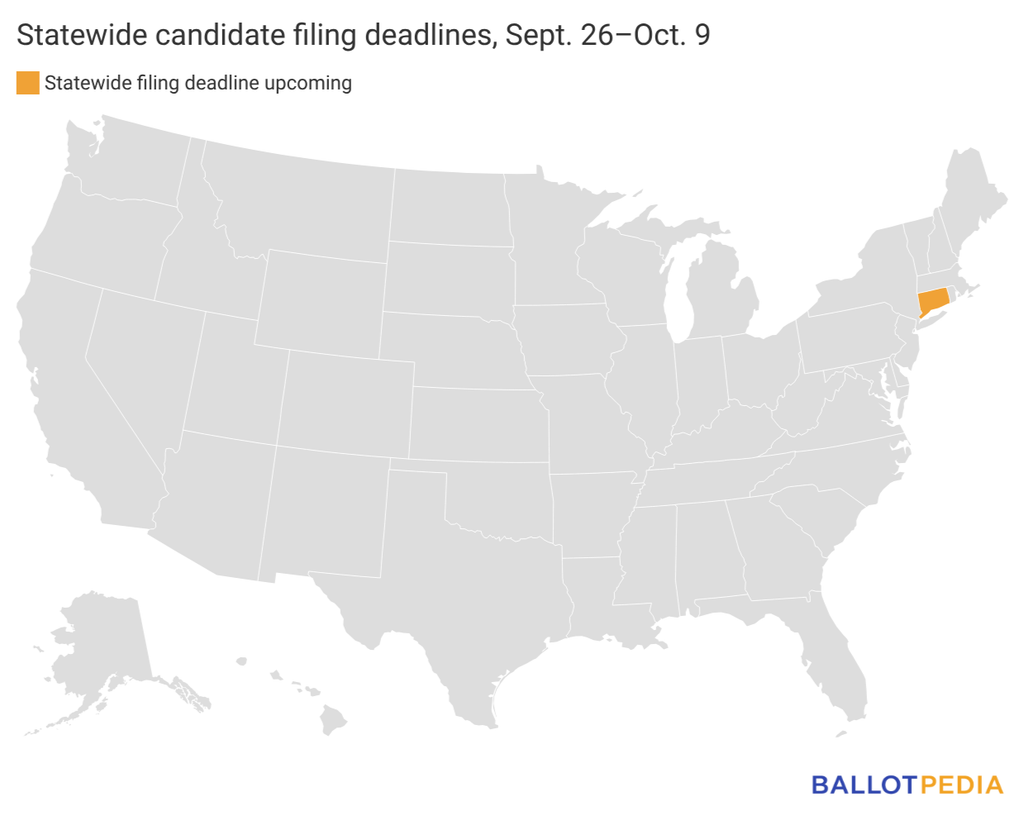
Candidates must meet various state-specific filing requirements and deadlines to appear on primary and general election ballots. These regulations, known as ballot access laws, determine whether and how candidates can make it onto the ballot. These laws are set at the state level and apply to candidates running for state and federal offices.
Voting in upcoming elections
There are no statewide elections taking place in the next two weeks.
Voter participation deadlines
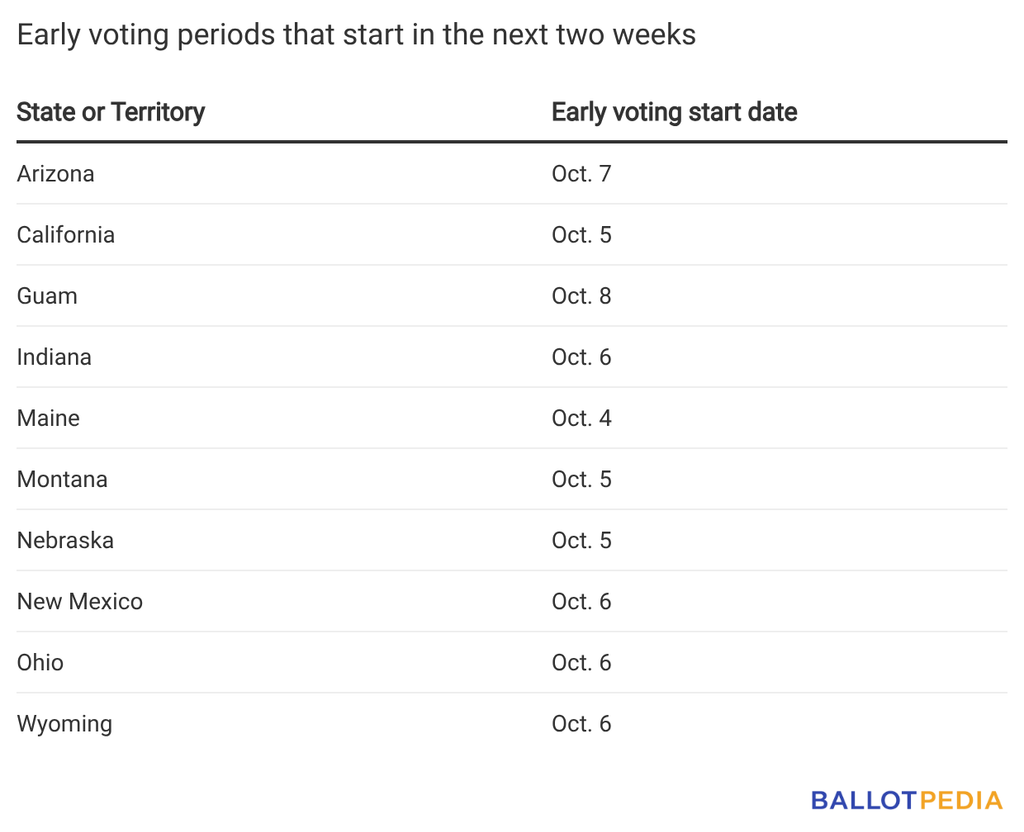
Nine states and Guam have early voting periods that start in the next two weeks:
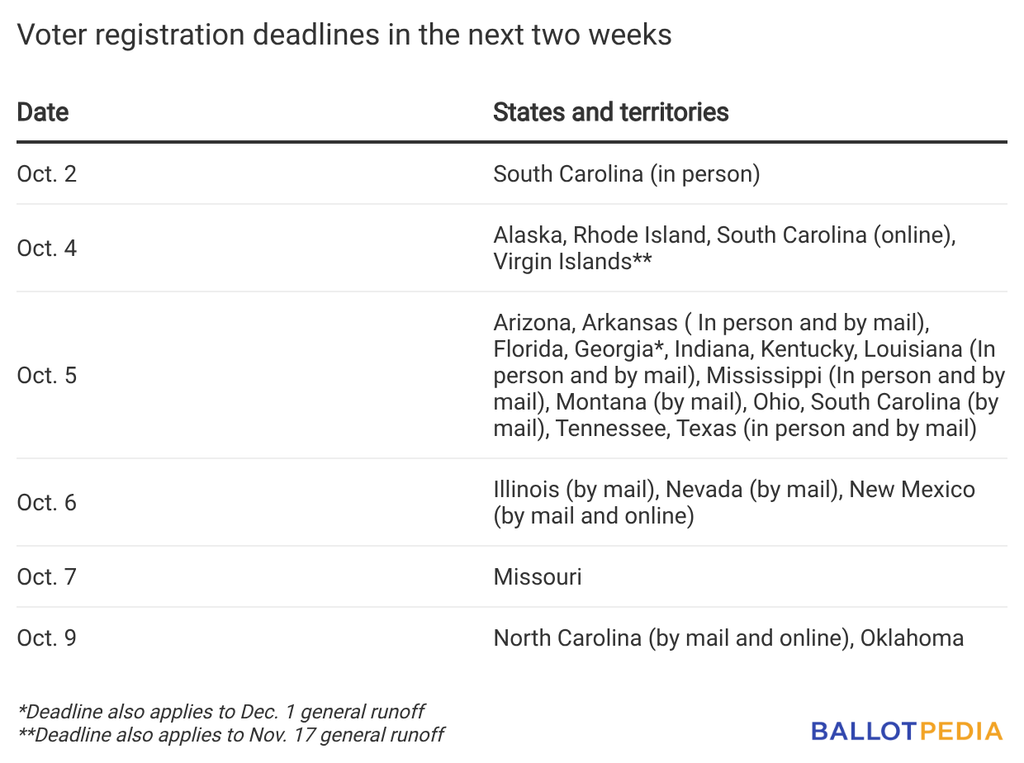
Upcoming voter registration deadlines
21 states and the U.S. Virgin Islands have voter registration deadlines in the next two weeks:
Upcoming absentee/mail-in ballot request deadlines
One territory has an absentee/mail-in ballot request deadline in the next two weeks:
- Northern Mariana Islands: Oct. 9 is the last day to request an absentee/mail-in ballot by mail and online for the Nov. 3 general election.
Click here to see our list of upcoming election dates and filing deadlines.