


Welcome to the Monday, Sept. 28, 2026, Brew.
By: Briana Ryan
Here’s what’s in store for you as you start your day:
- Voters to decide on 474 rematches of elections from 2024 and 2022 this year
- Massachusetts voters will decide on nine statewide ballot measures this year — tying for the second-most in state history
- Stopgap funding bill delays OMB grants rule until Dec. 11
Voters to decide on 474 rematches of elections from 2024 and 2022 this year
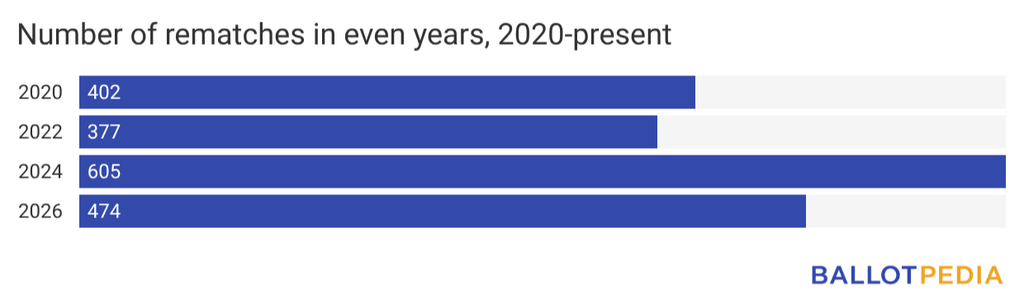
This year's ballot may look familiar to some voters because 474 races are rematches between candidates who last ran against each other for the office in 2022 or 2024 — the second-highest number of rematches since 2020.
By office type:
- 10.1% of U.S. House elections are rematches
- 4% of state executive elections are rematches
- 6.2% of state legislative elections are rematches
- 0.9% of local elections within the 100 most populous cities, state capitals, and the 200 largest school districts by enrollment are rematches
Rematches here only include those between major-party candidates for the same office, even if the specific district they're running for changed. For 2022 to 2026 rematches, this analysis includes only offices with four-year terms.
The last time 124 of these match-ups took place, the margin of victory was 10 percentage points or fewer. That's 26.2% of this year's rematches — the lowest percentage since 2020. By comparison, previous winners had won by that margin in 28.8% of rematches in 2024, 29.4% in 2022, and 60% in 2020.
Like in previous election cycles, most rematches are between candidates who last ran against each other two years ago. This year, there are 414 rematches between candidates who last ran against each other in 2024. Meanwhile, there are 60 rematches between candidates who last ran against each other in 2022.
Here's a closer look at this year's rematches by office types.
U.S. House of Representatives
10.1% of all U.S. House races are rematches this year, compared to an average of 13.9% each year.
Click here for a full list of the U.S. House districts where the 44 rematches are happening this year.
The last time these U.S. House candidates faced each other in 2024, Democrats won 23 and Republicans won 21.
Ten of this year's 44 rematches for the U.S. House were last decided by 10 percentage points or fewer. Democrats won six of those races by 10 percentage points or fewer in 2024, and Republicans won four.
State executive offices
4% of all state executive races are rematches this year, compared to an average of 1.3% each year.
The 12 state executive rematches this year are happening for the following offices:
- Secretary of State of Idaho
- Governor of Illinois
- Attorney General of Kansas
- Governor of Maryland
- Secretary of State of Nevada
- Attorney General of North Dakota
- Massachusetts’ Governor’s Council District 2
- New Hampshire Executive Council District 4
- New Hampshire Executive Council District 5
- Governor of Oregon
- Secretary of State of Vermont
- Attorney General of Wisconsin
Two of this year's state executive rematches include candidates who last ran against each other in 2024. Democrats and Republicans each won two of those races. The other eight rematches date back to 2022, when Democrats won five and Republicans won three.
Six of this year's seven rematches for state executive offices were last decided by 10 percentage points or fewer. Democrats and Republicans each won three of those races by 10 percentage points or fewer in 2024, the last time they were up for election.
State legislative offices
6.2% of all state legislative races are rematches this year, compared to an average of 6.2% each year.
Click here for a full list of the state legislative districts in which the 383 rematches are happening this year.
Three hundred sixty-two of this year's state legislative rematches include candidates who last ran against each other in 2024. Democrats won 151 of those races, and Republicans won 211. The other 21 rematches date back to 2022, when Democrats won 15 and Republicans won six.
Ninety-three of this year's 383 rematches for state legislative offices were last decided by 10 percentage points or fewer. Democrats won 50 of those races by 10 percentage points or fewer the last time they were up for election and Republicans won 43.
Local offices
0.9% of all local races within our core scope are rematches this year, compared to an average of 0.7% each year.
Click here for a full list of the 35 rematches happening this year for local offices.
All 35 of this year's rematches for local offices within our core scope are for nonpartisan offices. Four of this year's rematches include candidates who last ran against each other in 2024. The remaining 31 rematches include candidates who last ran against each other in 2022.
Fifteen of this year's 35 rematches for local offices were last decided by 10 percentage points or fewer.
Click here to check out the full list of rematches taking place this year.
Massachusetts voters will decide on nine statewide ballot measures this year — tying for the second-most in state history

Welcome to our next installment of our 50 States in 50 Days series, covering Massachusetts. To view our archive of past editions, click here.
Massachusetts voters will decide on nine statewide ballot measures on Nov. 3 — tying with 1972, 1976, and 1994 for the second-most measures in state history. Massachusetts voters have only decided on more than nine measures once, in 1918. That year, voters decided on 19 constitutional amendments that a constitutional convention referred to the ballot.
Between 1910 and 2025, Massachusetts voters decided on 231 measures, or an average of four per even-numbered year. During that period, voters approved 161 measures and defeated 70. For more information about the history of Massachusetts' measures, visit its Historical Ballot Measures Factbook.
Here's a closer look at three of this year's nine measures:
Question 7 would require cities and towns to allow single-family homes on residentially zoned lots that meet a minimum area of 5,000 square feet. Currently, local governments set policies concerning the minimum standards for constructing a single-family home, not state law. It is one of six housing policy measures on the ballot nationwide this year.
Question 8 would repeal laws that permit the sale of recreational marijuana and the personal cultivation of cannabis in homes. In 2016, Massachusetts voters approved Question 4, which legalized the use of recreational marijuana, 53.7% to 46.3%. If voters approve Question 8, Massachusetts would be the first state to repeal a voter-approved measure legalizing marijuana.
Question 9 would ask voters whether to retain or repeal House Bill 4885. The bill would require the state to develop an electronic tracking system for firearms, prohibit assault-style firearms (as defined in law), require safety certificates to obtain firearm parts, mandate serial numbers for firearms, allow school administrators and licensed healthcare providers to request that a court issue an Extreme Risk Protection Order, and permit courts to order firearm surrenders when issuing a Harassment Prevention Order.
Voters must register online, in person, or via mail by Oct. 24.
Early voting opens Oct. 17 and ends Oct. 30.
Polls open on Election Day at 7:00 a.m. and close at 8:00 p.m.
Voter ID is not required to vote in Massachusetts, in most cases. Voters may be asked to show ID if they are on the inactive voter list, are casting a provisional or challenged ballot, or if the poll worker has a legal reason to request identification. In addition, the federal Help America Vote Act requires that individuals in all 50 states who register to vote by mail and who have not voted previously in a federal election in their state must provide either their driver's license or a paycheck, bank statement, current utility bill, or government document showing their name and address.
Absentee/mail-in ballots must be requested by Oct. 27 and postmarked by Nov. 3. Massachusetts sends a mail ballot application to all registered voters before statewide elections.
Current party control
Democrats represent all nine congressional districts. Both of Massachusetts' U.S. Senators are also Democrats.
Democrats have a 35-5 majority in the Massachusetts Senate and a 132-25 majority, with one independent, in the Massachusetts House of Representatives. There are also two vacancies in the state House. Because the governor is a Democrat, Massachusetts is one of 16 states with a Democratic trifecta. Massachusetts' attorney general and secretary of state are also Democrats. As a result, Massachusetts is one of 21 states with a Democratic triplex. A Republican governor appointed five members of the Massachusetts Supreme Judicial Court, and a Democratic governor appointed two.
Offices on the ballot
There will be elections for the U.S. Senate and U.S. House of Representatives.
Voters will decide elections for governor, lieutenant governor, attorney general, secretary of the commonwealth, auditor, treasurer, and all eight seats on the Massachusetts Governor's Council. All 40 seats in the state Senate and all 160 seats in the state House are also up for election.
There are also elections happening this year for the Suffolk District Attorney and Suffolk County Register of Probate.
Notable elections
6th Congressional District: Dan Koh (D) and Micah Jones (R) are running. Incumbent Rep. Seth Moulton (D) ran for U.S. Senate instead of for re-election. Koh wrote in his Candidate Connection survey that he "is running for Congress to fight for working families, defend democracy, and stand up to Donald Trump." Jones wrote in his Candidate Connection survey that he is "running for Congress because the people of Massachusetts' Sixth Congressional District deserve practical, accountable leadership that puts service before politics." Four independent race forecasters have rated the general election as Solid/Safe Democratic.
Next, we'll preview elections in Texas, the Lone Star State.
Click here to see every edition of 50 States in 50 Days as we publish them, and here to use our Sample Ballot Lookup Tool.
Stopgap funding bill delays OMB grants rule until Dec. 11
On Sept. 3, President Donald Trump (R) signed a stopgap spending bill which funds the federal government until Dec. 11. The bill prevented a government shutdown, but also delayed the implementation of an Office of Management and Budget (OMB) proposed rule on federal grantmaking that would give political appointees and agencies more say in awarding or terminating grants. As proposed, the rule would have gone into effect on Oct. 1, but the bill prohibits OMB from finalizing or implementing the rule through Dec. 11.
The OMB published the proposed rule, titled “Regulation for Federal Financial Assistance,” in the Federal Register on May 29. The proposed rule had a public comment period that ended on July 13 and drew more than 160,000 submissions. As proposed, the rule would have gone into effect on Oct. 1, and would have applied to all funding in Fiscal Year 2027 (which begins that day).
The rule would revise a federal regulation known as Uniform Guidance, which instructs agencies in providing various forms of financial assistance, such as grants for research or to state and local governments. The Uniform Guidance was first introduced by the Obama Administration in 2013, replacing at least eight separate OMB guidance publications focused on different categories of aid recipients.
According to the National Council of State Legislatures, the proposed rule “represents the most significant revision to the federal grant-management framework since the Uniform Guidance was established in 2013.”
Among other changes, the rule would:
- Change the status of the Uniform Guidance from OMB guidance for grantmaking agencies to a binding regulation which OMB could amend in the future through its own rulemaking
- Increase the role of appointed officials in grantmaking determinations, reducing the peer review-based decision making that agencies currently use to an advisory role
- Restrict fixed-amount awards to instances specifically authorized by statute
- Expand agencies’ ability to terminate ongoing grants
- Codify prohibitions against grantmaking “used to fund, promote, encourage, subsidize, or facilitate" practices like diversity, equity, and inclusion (DEI)
OMB Director Russell Vought said that the Office will not implement the rule before Jan. 1.
Click here to read more about the Office of Management and Budget.