


Welcome to Hall Pass, a newsletter written to keep you plugged into the conversations driving school board governance, the politics surrounding it, and education policy.
In today’s edition, you’ll find:
- On the issues: The debate over AI in the classroom
- School board filing deadlines, election results, and recall certifications
- Education on the November ballot (Part 2): Funding and affirmative action
- Extracurricular: education news from around the web
- Candidate Connection survey
On the issues: The debate over AI in the classroom
In this section, we curate reporting, analysis, and commentary on the issues school board members deliberate when they set out to offer the best education possible in their district. Missed an issue? Click here to see the previous education debates we’ve covered.
In the Sept. 9 edition of Hall Pass, we highlighted the differing approaches K-12 school districts are taking to students’ use of artificial intelligence (AI). New York Public Schools (NYPS) and the Los Angeles Unified School District (LAUSD), the country’s two largest districts by student population, recently announced policies for the 2026-27 school year barring students in most or all grades year from using AI in classrooms, on district-owned technology, and for homework.
But other districts have adopted policies that grant students license to use AI subject to certain restrictions and guardrails. Orange County Public Schools, in Florida, for example, implemented a policy this summer allowing students in even the earliest grades to use AI in some circumstances and with the permission of teachers and parents.
Little by little, the nation’s more than 13,000 districts are charting various courses when it comes to how and whether students should use an increasingly ubiquitous technology as part of their formal schooling.
Today, we feature two perspectives on how schools should approach AI.
Jonah Goldberg, editor in chief of The Dispatch and Los Angeles Times Opinion columnist, says schools should mostly keep AI out of the classroom so that students can develop the capacity to think on their own. Goldberg says AI can make people more productive at different cognitive tasks, but only once they’ve done the hard work of mastering certain skills. AI, Goldberg says, allows students to offload their thinking and learning to a tool. Goldberg says schools in the AI era will need to focus on building students’ cognitive muscles, including by requiring more memorization and in-class testing.
Randy Sparkman, a retired associate chief information officer for NASA, says schools need plans for gradually introducing students to AI in early grades with restrictions and allowing them to use it in high school. Sparkman says social media offers schools a lesson in what not to do with AI. Sparkman says children were left largely unsupervised to explore social media when it first came on the scene, and that it wasn’t until later that adults in and outside of schools sought to regulate its use. Sparkman says that when it comes to AI, which he anticipates will affect every profession in the future, schools should act first to help students understand the technology and prepare them to use it responsibly on their own.
Keep artificial intelligence out of American classrooms | Jonah Goldberg, The Los Angeles Times
“Educators learned a similar lesson when cheap calculators became widely available in the 1970s. As you got more advanced, you could use calculators for certain problems. But first you needed to learn how to do the basics. You also needed to learn to think mathematically. AI is essentially a souped-up calculator for nearly all mental tasks. Again, that’s often — but not always — great for adults who grew up in a pre-AI world.
“Which is why I think education should mostly stay in the pre-AI world. That will be very difficult. It will require more memorization, more tests in the classroom and an education establishment that can resist the seduction of technological fads. If the point of education is to build-up muscle memory for how to think and how to do things, letting kids go home and have AI give them the answers is not very different, educationally, than letting kids cheat. For the same reason that having a robot do 50 push-ups for you wouldn’t be acceptable for a physical fitness test, having a robot read a book for you shouldn’t be acceptable either.”
While NYC and LA Schools Draw a Line on AI, Alabama Has a Plan | Randy Sparkman, The 74
“The workplace advantage, then, is not simply knowing how to operate an AI product. It is knowing how to use these systems to extend your own capacity: to frame a problem, find and interpret information, generate options, judge what comes back and know what judgment should remain your own.
“Most workers will not need to build AI systems. But they will increasingly work alongside people who have learned to use them well.
“We waited too long to teach children how the social-media world worked. They entered it first, and adults tried to understand the consequences later.
“With artificial intelligence, we can reverse the order: protect children where protection is warranted, progressively teach them how the digital world works, and eventually give them command of the tools that will help shape their livelihoods.”
School board update: filing deadlines, election results, and recall certifications
In 2026, Ballotpedia will cover elections for more than 30,000 school board seats. We’re expanding our coverage each year with our eye on covering the country’s more than 80,000 school board seats.
Upcoming school board elections
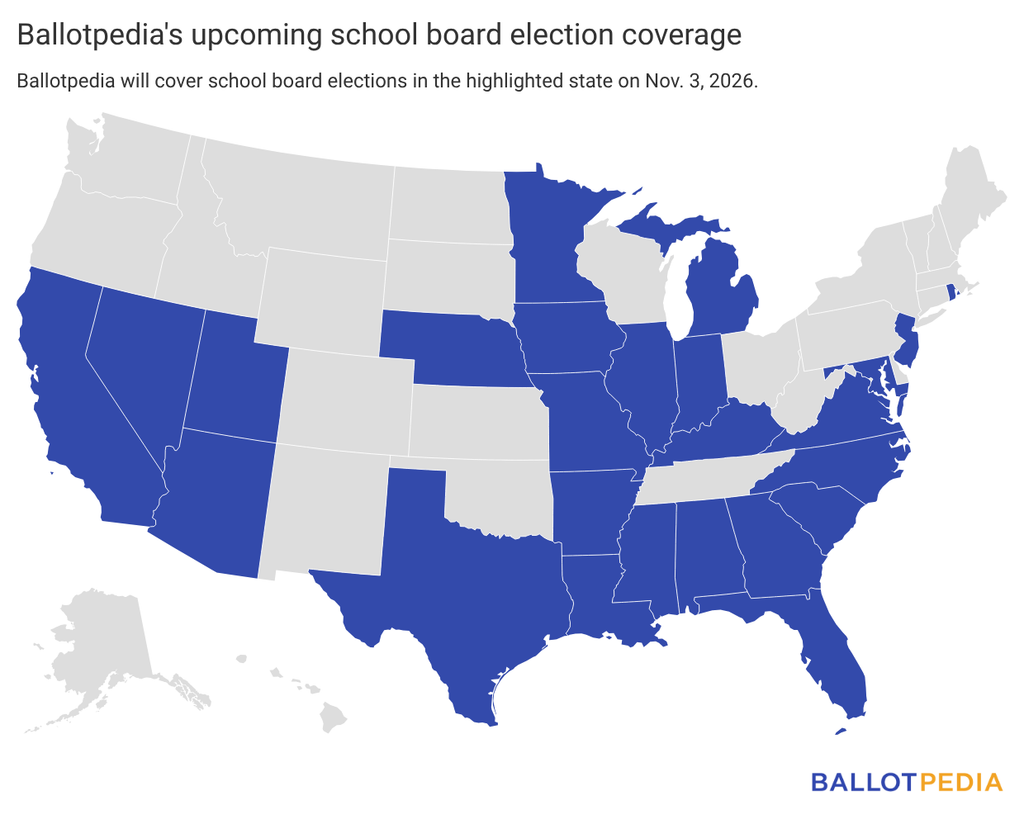
Ballotpedia will cover school board elections in 25 states on Nov. 3.
Education on the November ballot (Part 2): Funding and affirmative action
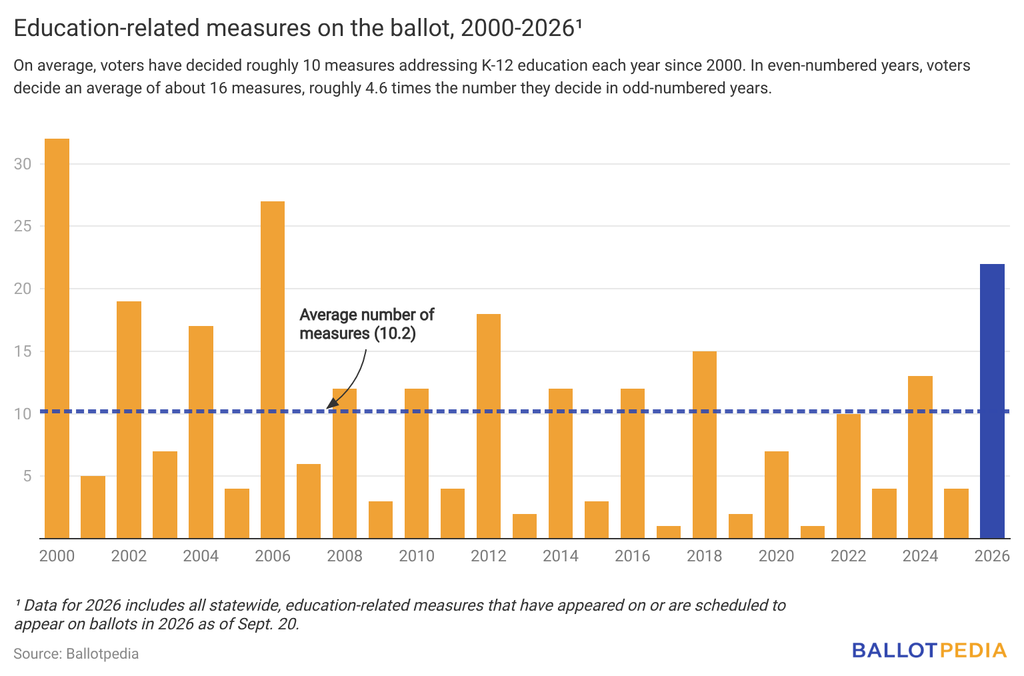
Welcome to the second installment of our series looking at noteworthy education-related statewide measures on the Nov. 3 ballot. Last week, we looked at measures in Arizona, Colorado, and Nebraska that would change the rules around school athletics and one in North Dakota that would provide free school meals to all students in public schools.
Today, we’re digging into measures affecting funding and affirmative action.
Funding
Voters in Arizona, California, Colorado, Minnesota, and New Mexico will decide measures that would increase funding for districts or regulate how districts can spend funding. Let’s look at the measures in Colorado and California.
Colorado
Voters will decide Amendment 87, the Establish Graduated Income Tax and Dedicate New Revenue to Education, Healthcare, and Childcare Initiative. It is a combined initiated constitutional amendment and state statute.
Colorado has a Democratic trifecta.
Here’s what the initiative would change: The ballot initiative would establish a graduated income tax, ranging from 3.7% to 8.4%, and remove the uniform tax rate requirement from the Taxpayer's Bill of Rights (TABOR). The revenue generated from this change would be allocated towards the Colorado Future's Account, which covers K-12 public education funding, healthcare funding, and early childcare funding.
- Currently, Colorado has a flat income tax rate — set at 4.4% — which applies to all taxpayers at the same rate, regardless of income.
Yes, but: Opposing the initiative, the organization Advance Colorado gathered and submitted signatures for a separate measure — known as Proposition 136 — which would place a cap on individual and corporate income tax at 4.4% of a taxpayer's federal taxable income.
- Since the initiatives conflict — one establishes rates above 4.4% for certain income brackets, and the other prohibits individual and corporate income tax rates above 4.4% — if both measures are approved by voters, the conflicting provisions of whichever measure receives more votes would take effect.
Here’s what supporters and opponents are saying:
- Kathy White, executive director of the Colorado Fiscal Institute, supports the measure, saying: “[Working families] shouldn’t have to pick up the tab so the wealthiest get a $71,000-a-year gift from Congress — especially when TABOR has already tied our hands for decades.
- The Independence Institute, which opposes the measure, said: “Because of bracket creep, all Coloradans will experience long-term tax increases under this “progressive’ system, as incomes rise due to wage growth and inflation, while the brackets remain fixed. This is a major long-term tax increase on Coloradans through no fault of their own. Additionally, Colorado’s highest earners, whom this measure targets, are crucial to the state’s business and philanthropy sectors, government revenue, and job creation. The downstream economic effects of punishing Colorado’s most productive will result in fewer businesses, fewer jobs, higher tax burdens, and a weaker economy.”
California
Voters will decide Proposition 3, Renew State Income Tax Increase for Education Funding Initiative. It is an initiated constitutional amendment.
California has a Democratic trifecta.
Here’s what the initiative would change: The initiative would amend the California Constitution to make permanent the state’s top marginal tax rates on higher incomes, which are set to expire in 2031. It would continue the higher marginal income tax rates across three brackets, which vary depending on income from 10.3% to 12.3%. If voters reject the initiative, rates for all three brackets would decline to 9.3%.
- Current law divides the revenue generated from the tax between K-12 public schools (89%) and state community colleges (11%). The initiative would make that permanent.
Here’s what supporters and opponents are saying:
- David Goldberg, president of the California Teachers Association, supports Proposition 3: “People have shown us time and time again that they know that investing in our students, our communities, and educators is one of the best investments we can make as a state. Frankly, they also are blown away by income inequality we have in the state. ... If we do not pass this, it actually is a tax cut for the wealthiest Californians.”
- Wayne Winegarden, senior fellow at the Pacific Research Institute, opposes Proposition 3: “Extending these income tax rates, it’s hitting those same pressure points and it’s causing the same incentives to leave. And if you look at the latest IRS migration data, you can see it. People with greater means are leaving the state.”
Affirmative action
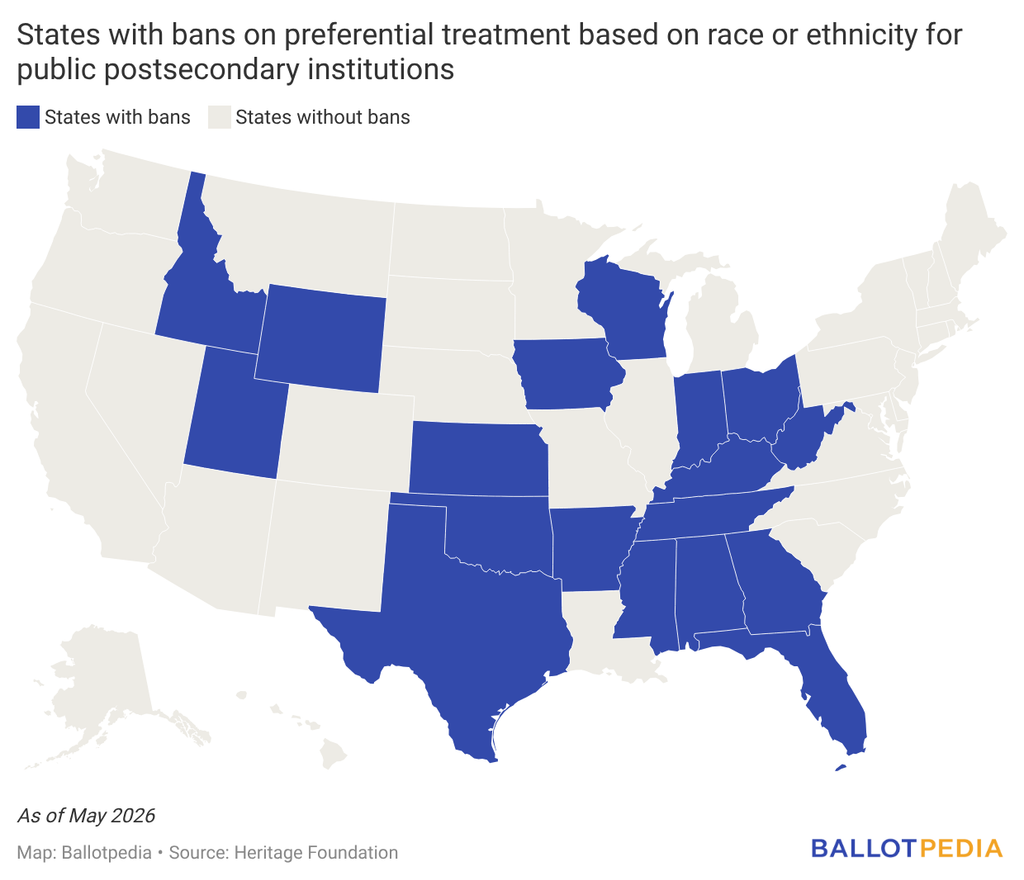
Affirmative action refers to policies that seek to increase the proportion of historically disadvantaged minority groups within both public and private organizations and institutions. Arizona and Wisconsin are the only two states this cycle where affirmative action is on the ballot. Click here for a full list of affirmative action measures in other years.
Arizona
Voters will decide Proposition 142, the Prohibit Race- or Ethnicity-Based Preferential Treatment, Public Education Offices, and Disciplinary Policies Amendment. It is a legislatively referred constitutional amendment. It passed the Arizona House and Senate along partisan lines.
Here’s what the initiative would change: Proposition 142 would prohibit the state and any political jurisdiction within the state, including public universities and school district, from requiring an applicant, student, or employee to endorse "promoting preferential treatment toward or discrimination against an individual or group on the basis of race or ethnicity."
- It would also prohibit the use of state funds for training or offices that aim to promote preferential treatment toward or discrimination against an individual or group due to their race or ethnicity.
- Additionally, it would prohibit a political subdivision from requiring employees or students to enroll in a course or training that promotes the creation of a race-based diversity, equity, and inclusion or intersectionality.
Here’s what supporters and opponents are saying:
- Matt Beienburg, Goldwater Institute director of education policy, supports Proposition 142: “DEI in Arizona is, thankfully, facing a reckoning with a new federal investigation and now a major case before the Arizona Supreme Court. With these and other developments, now is the time for lawmakers to end discriminatory 'diversity, equity, and inclusion' practices for good by giving voters the chance to enshrine protections in the state constitution through HCR2044 [Proposition 142].”
- LD3 Democrats Northeastern Maricopa County, which opposes Proposition 142, said: “This culture-war-driven measure would block teachers from discussing accurate history, censor certain content from being taught in schools, and ban trainings on how to support LGBTQ+ staff and students. It would also allow the legislature to ‘prescribe related practices or concept’ to ban — in other words, to forbid any conceivable notion that conspiracy theorists propagate, and claim they already have voter approval to do it.”
Extracurricular: education news from around the web
This section contains links to recent education-related articles from around the internet.
- 30 Ideas for Fixing U.S. Schools, Ranked by Experts | The New York Times
- 5 strategies to boost U.S. K-12 math achievement | eSchool News
- The Underfunding Myth Is Exposed | National Review
- Individual Choices Won’t Fix America’s Public Schools | New Yorker
- Trump, Bucking Congress Yet Again, Cancels $100 Million for Education | Education Week
- I was a white girl at a majority-black school. Here’s what the education debate gets wrong | The Times
- Who would vote for school choice? | EdChoice
- For Kids With Challenges, These Missouri Schools Are Bright Spots for Reading | The 74
- US K-12 Education Changes 2026: Funding, Oversight, AI, and Policy Updates | Cuemath
Take our Candidate Connection survey to reach voters in your district
Today, we’re looking at survey responses from Geramie Parrish and Rachel Weatherington, the two candidates running in the Nov. 3 general election to represent Place 4 on the Keller Independent School District school board, in Texas.
Two of the seven seats on the school board are up for general election and one seat is up for special election on Nov. 3. Keller Independent School District is the 36th largest in Texas, with roughly 33,000 students.
Parrish’s career experience includes working as a sales manager. Here’s how he answered the question, “What areas of public policy are you personally passionate about?”

“I care about the policies that decide whether families can trust their public schools: how tax dollars are spent, who controls what kids are taught, and whether local districts keep enough money to operate.
That means school finance and recapture—Keller should not ship money to Austin while we close campuses and pinch teacher pay. It means parental rights and academics, not politics in the classroom. It means real board oversight of budgets and bonds instead of rubber stamping whatever Central Administration presents them.
I am passionate about local control and transparency: the public sees the numbers before votes on closures, boundaries, or a bond.”
Click here to read the rest of Parrish’s responses.
Weatherington’s career experience includes working as an educator. Here’s how she answered the question, “What are the main points you want voters to remember about your goals for your time in office?”

- “I put students first. The job of a Trustee is to protect what works, help fix what doesn’t, and make sure students are at the heart of every decision. I am running for Keller ISD Board of Trustees because I have the experience, dedication, and a commitment to putting students first- and the record to prove it. I am a teacher and a mom, not a politician: we need to finish getting PAC money out of our school board elections and choose leaders who have already demonstrated that they put students first.
- I am ready to advocate in Austin. We need Trustees who are strong enough to stand up for public school dollars in Texas. For the 26-27 school year, Texas has set aside $1B to spend on vouchers while our public school students and teachers go without. This is unacceptable. We also need to change the funding mechanism for our schools so we can better ensure the long-term financial stability of our district without compromising the quality of our kids’ education.
- I know how to recruit and retain the very best. When we’re talking about recruiting and retention, money is low-hanging fruit. It is absolutely correct that all of our district employees deserve more money- especially our paraprofessionals who can make as little as $22k/year, and it will help with recruiting and retention. But our teachers and administrators want to see policy changes as well, and that doesn’t cost any money. They want to have access to quality support and the time to do their jobs well.”
Click here to read the rest of Weatherington’s responses.
If you're a school board candidate or incumbent, click here to take the survey.
The survey contains over 30 questions, and you can choose the ones you feel will best represent your views to voters. If you complete the survey, a box with your answers will display on your Ballotpedia profile. Your responses will also appear in our sample ballot.
And if you're not running for school board, but there is an election in your community this year, share the link with the candidates and urge them to take the survey!