


Welcome to the Monday, Oct. 5, 2026, Brew.
By: Lara Bonatesta
Here’s what’s in store for you as you start your day:
- Here's what to know about casting an absentee/mail-in ballot in the November election
- Alaska voters to decide whether to repeal top-four ranked-choice voting system, which voters approved in 2020
- A look at right-to-compute laws and the data center debate
Here's what to know about casting an absentee/mail-in ballot in the November election
As the Nov. 3 election approaches, election officials across the country are beginning to send absentee/mail-in ballots to voters. Laws governing the absentee/mail-in voting process vary from state to state. Here's an overview of what those laws look like this year.
All states have some form of absentee/mail-in voting. Thirteen states require voters to provide a valid excuse to vote by mail. Depending on the state, those excuses can include illness or disability, travel outside the state, or military service.
After Connecticut approved legislation earlier this year to remove its excuse requirement, 29 states now allow any eligible voter to cast an absentee/mail-in ballot. Eight states have all-mail voting systems, where all eligible voters receive a mail-in ballot by default.
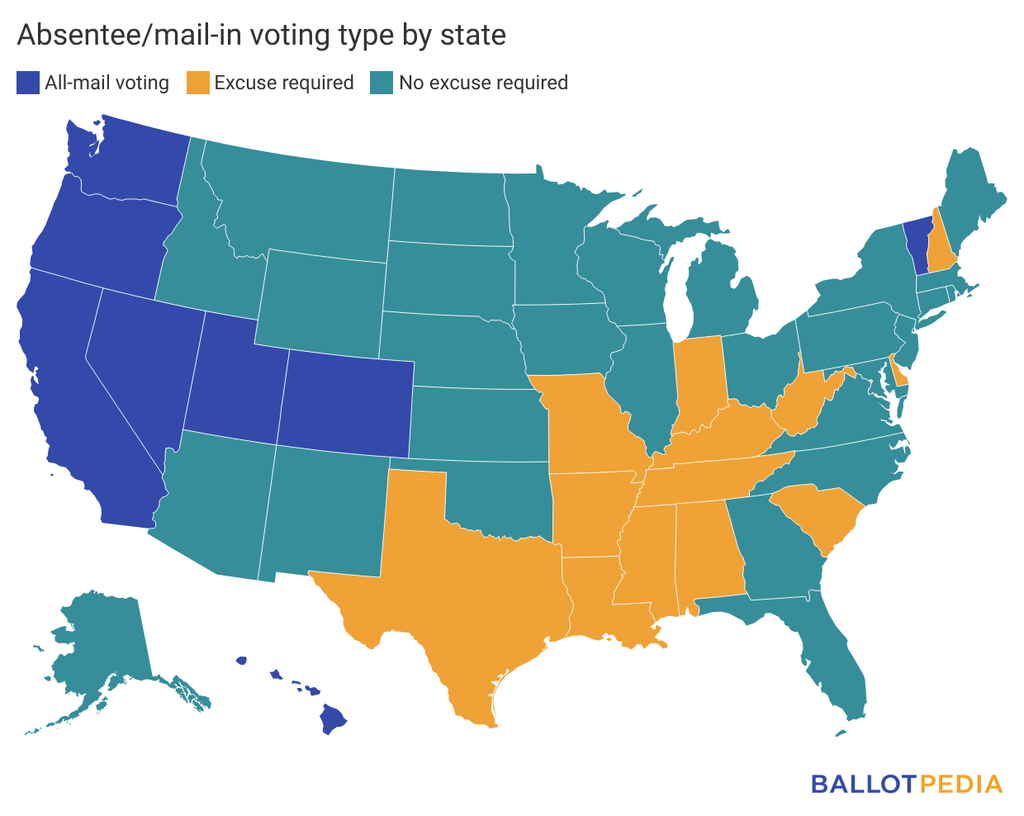
Once a voter has completed a ballot and signed the ballot envelope, they can return it to election officials. The deadlines for return ballots vary by state.
In 34 states, ballots returned by mail must be received by Election Day in order to be counted. In Louisiana, ballots must be received by 4:30 p.m. on the day before the election.
Fifteen states allow ballots postmarked by Election Day and received within a set post-election window to be counted. In Texas, ballots must be received by the day following the election. In Washington, the deadline is the county canvass, which must occur within 21 days of the election.
A court order currently prohibits Kansas from enforcing a state law requiring ballots to be received by the close of polls in order to be counted. As a result, ballots could be counted if they are postmarked by election day and received by the third day after the election.
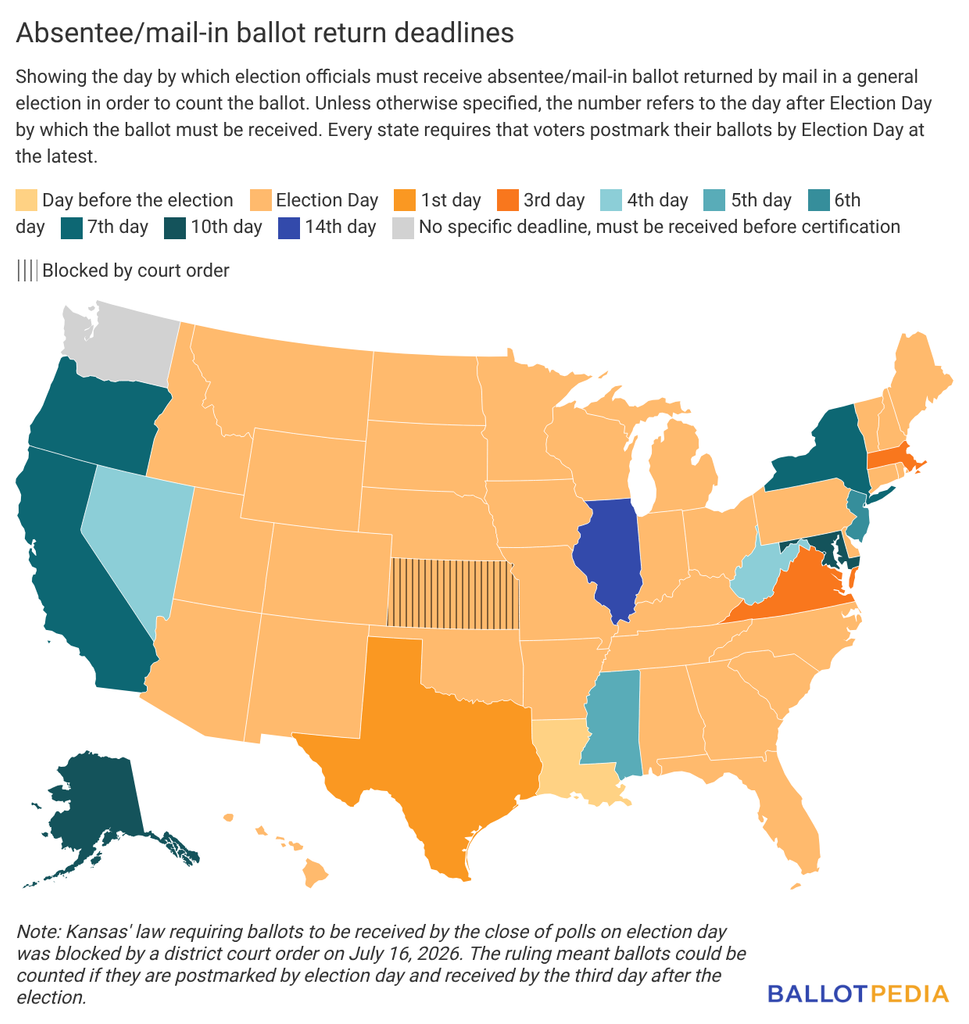
In most states, voters may choose to return ballots in person. No state allows ballots to be returned in person after polls close on Election Day. Alabama, Arkansas, Connecticut, Louisiana, Oklahoma, and West Virginia require ballots returned in person to be received before Election Day. Voters in some states may also return their ballots via a drop box.
Once election officials receive a ballot, they may review it to ensure there are no issues that might disqualify it from being counted. All states require voters to sign a statement on the ballot envelope. Many states require the signature on the ballot envelope to match the signature on file with a voter’s registration record. If the signature is missing or does not match, the ballot may be rejected.
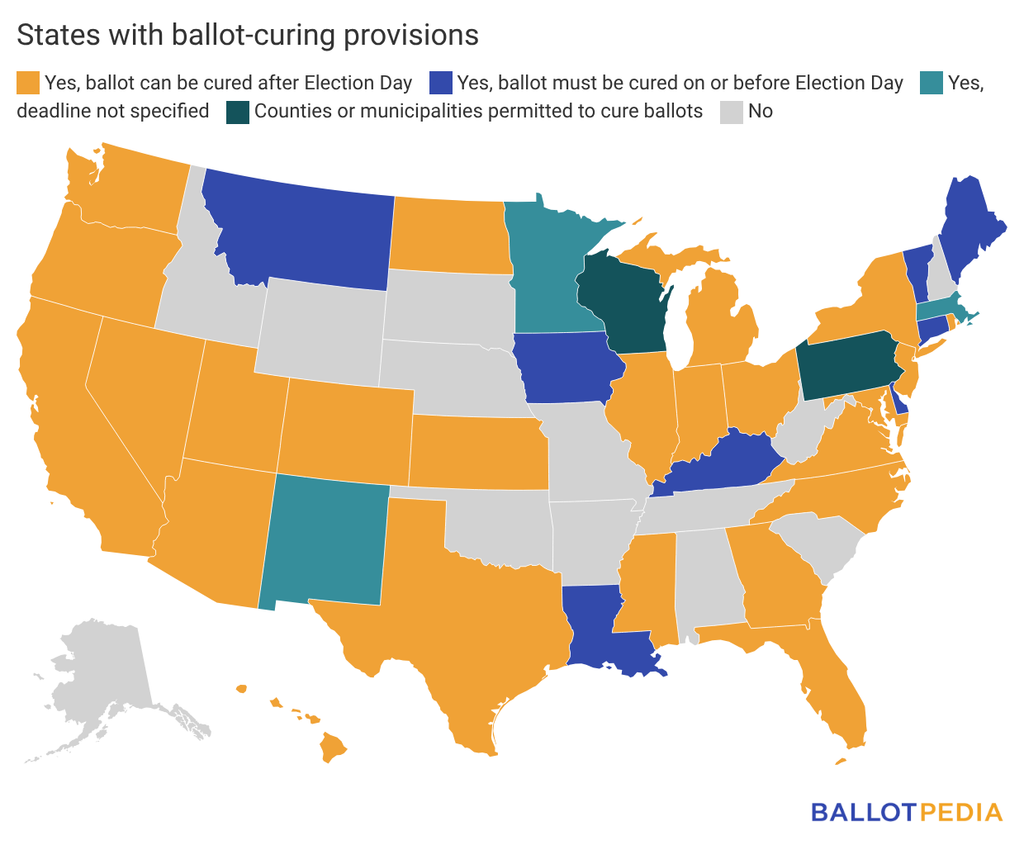
In 35 states, election officials are required to notify voters of issues with their absentee/mail-in ballots and give them a chance to fix them. This is called ballot curing. Of those states, 24 allow voters to cure their ballots after Election Day, eight require voters to cure their ballots on or before Election Day, and three do not have a specific timeline. Connecticut became the latest state to enact a cure period in 2026.
Pennsylvania and Wisconsin allow but do not require municipalities or counties to let voters cure their ballots. Thirteen states have no ballot curing requirements. In states that do not have a ballot curing process, ballots returned without signatures — or, in states that conduct signature matching, with mismatched signatures — are not counted.
Election officials must process absentee/mail-in ballots before they can be counted. State laws governing this step of the process may affect how long it takes for states to report their unofficial election results.
Nineteen states permit election officials to fully process and scan at least some early and absentee/mail-in ballots before Election Day. Twenty-five states permit election officials to perform at least some aspects of absentee/mail-in ballot processing before Election Day. Six states do not permit election officials to begin processing absentee/mail-in ballots until Election Day.
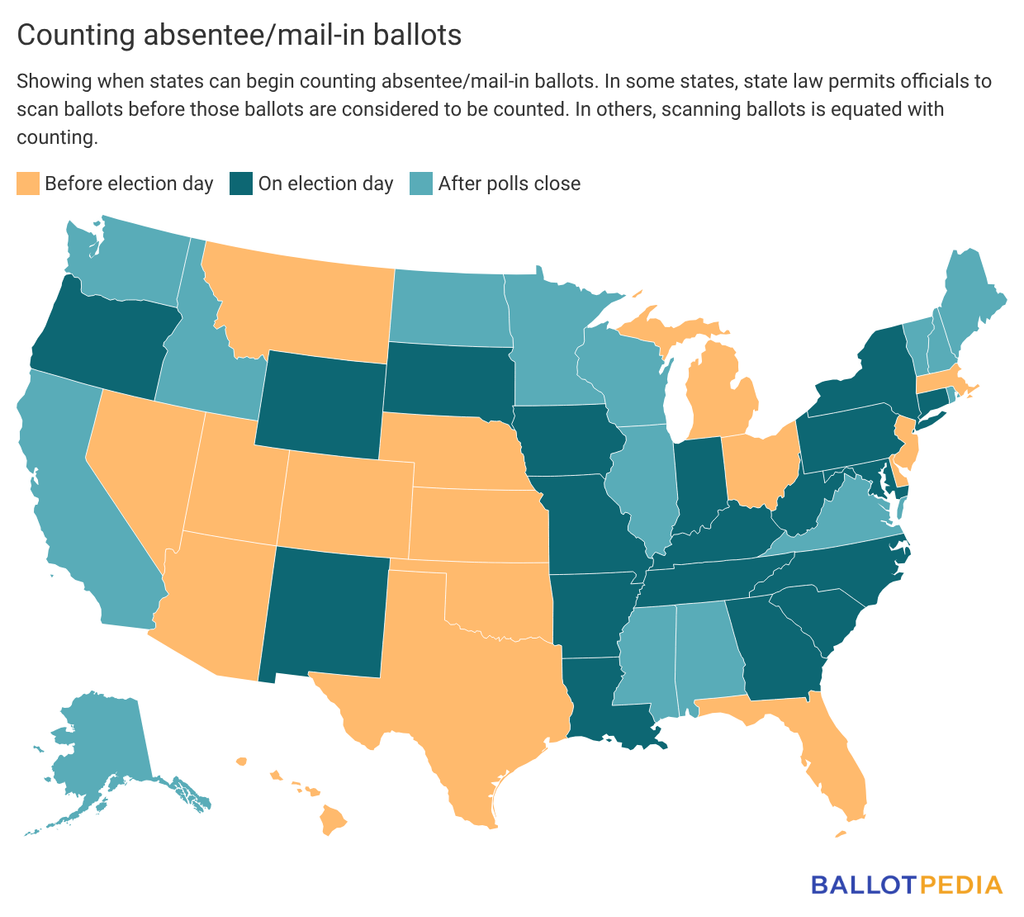
Once a ballot has been processed, it is set aside to be counted. Sixteen states permit counting to begin before Election Day. An additional 19 states allow counting to begin on election day before the polls close. The remaining 15 states require counting to begin only after voting has ended on election day. Some states may have an additional deadline for election officials to complete the counting and tabulation process.
Click here to learn more about absentee/mail-in voting.
Alaska voters to decide whether to repeal top-four ranked-choice voting system, which voters approved in 2020

Welcome to our next installment of our 50 States in 50 Days series, covering Alaska. To view our archive of past editions, click here.
On Nov. 3, Alaska voters will decide on ranked-choice voting (RCV) for the third time since 2020. Alaska’s 2024 measure on RCV was the closest election for a ballot measure result in state history.
Ballot Measure 2 would repeal the top-four RCV system that voters adopted 50.5% to 49.5% in 2020. Maine adopted RCV at the state level in 2016. Hawaii uses RCV in special congressional elections and county council vacancies. For more information on RCV, click here.
The 2026 measures would also eliminate campaign finance provisions that voters approved in 2020. Those provisions require persons and entities that contribute more than $2,000 that were themselves derived from donations, contributions, dues, or gifts to disclose the true sources (as defined in law) of the political contributions.
In 2024, voters defeated another measure, also called Ballot Measure 2, 50.1% to 49.9%. That measure was similar to the one on the ballot this year, but not identical. It would have repealed the top-four primaries and the RCV system. It would not have changed the campaign finance disclosure requirements also included in the 2020 measure.
Want to see what’s on your ballot this November? Click here to use our Sample Ballot Lookup Tool. Now let’s take a closer look at what’s happening in Alaska.
Early voting opens Oct. 19 and ends Nov. 3.
Polls open on Election Day at 7:00 a.m. and close at 8:00 p.m.
Voter ID is required. Acceptable forms of ID include a voter registration card, driver’s license, birth certificate, hunting or fishing license, or a copy of a utility bill or paycheck.
Absentee/mail-in ballots must be requested by Oct. 24 and postmarked by Nov. 3.
Current party control
A Republican represents Alaska’s At-large Congressional District. Both of Alaska’s U.S. Senators are also Republicans.
Multipartisan governing coalitions with Democratic majorities control both chambers of the Alaska Legislature. Republicans have an 11-9 numerical majority in the Alaska Senate and a 21-14-5 numerical majority in the Alaska House of Representatives. Alaska’s governor is a Republican.
Because of the governing coalitions, Alaska is one of 11 states with a divided government. Alaska’s attorney general and secretary of state are Republicans. As a result, Alaska is one of 24 states with a Republican triplex. A Republican governor appointed four members of the Alaska Supreme Court and an independent governor appointed one.
Offices on the ballot
Elections are taking place for the U.S. Senate, U.S. House of Representatives, governor, and lieutenant governor.
All 40 seats in the Alaska House and 10 of the 20 seats in the Alaska Senate are also up for election.
Battleground elections
U.S. Senate: Incumbent Sen. Daniel S. Sullivan (R), Mary Peltola (D), Gerald Heikes (R), and Dan J. Sullivan (R) are running. Daniel S. Sullivan and Peltola lead in polls, noteworthy endorsements, and fundraising. Major election forecasters have rated the election Toss-up or Tilt Republican. The Alaska Division of Elections initially removed Dan J. Sullivan, a retired teacher who has the same name as the incumbent, from the primary election ballot over accusations that he entered the race to confuse voters and siphon votes from the incumbent. The Alaska Supreme Court ruled that Dan J. Sullivan had to appear on the ballot. In the top-four primary, Peltola received 49.5% of the vote, Daniel S. Sullivan received 41.4%, Dan. J. Sullivan received 2.5%, and David Leslie (D) received 1.1%. Leslie withdrew from the race ahead of the deadline on Aug. 31 and fifth-place finisher Heikes, who received 1% of the vote, advanced instead.
U.S. House: Incumbent Nicholas Begich (R), Bill Hill (Nonpartisan), Eric Hafner (D), and John Brendan Williams (D) are running. Major election forecasters have rated the election Likely Republican. In 2024, Begich defeated incumbent Mary Peltola 51.2% to 48.8% after three rounds of ranked choice voting. National Republican groups and groups aligned with the MAGA Inc. super PAC are supporting Begich. On Sept. 15, the Democratic Congressional Campaign Committee announced that it was adding Hill to its Red to Blue program, which supports candidates running in Republican-held districts. The Alaska Democratic Party also endorsed Hill. According to the Anchorage Daily News, Hill, a nonpartisan, has not said whether he’d caucus with either major party if elected and instead said that he wants there to be multipartisan coalitions like those in the Alaska Legislature.
Governor: Jonathan Kreiss-Tomkins (D), David Bronson (R), Treg Taylor (R), and Bernadette Wilson (R) are running. Incumbent Gov. Mike Dunleavy (R) is term-limited. A Republican has held the governor’s office since Dunleavy was elected in 2018. Alaska's last Democratic governor, Tony Knowles, left office in 2002. Major election forecasters have rated the election as Toss-up or Lean Republican.
State Senate: Ten of the 20 seats are up for election. After the 2024 elections, a 17-member coalition with a Democratic majority retained control of the chamber. The coalition of nine Democrats and eight Republicans first assumed control after the November 2022 elections. Coalition-aligned incumbents or challengers who indicated they would join a bipartisan coalition were the top finishers in top-four primaries in seven of the 10 districts up for election this year.
Statewide ballot measures
There are three measures on the ballot in Alaska this year — one that was on the ballot in August, and two on the ballot in November. Between 1956 and 2026, Alaskans voted on 222 state ballot measures, approving 160 (72%) and defeating 62 (28%). An average of six measures appeared on the ballot per even-numbered year. To take a look at Alaska’s complete ballot measure history and analysis, click here.
Ballot Measure 3 would amend state law to provide that "Only a person who is a citizen of the United States" may vote in any election. Ballot Measure 3 is one of six measures this November related to citizenship requirements for voting. For information on the others, click here.
Local ballot measures
We’ll be adding information about local measures in Alaska as they are certified ahead of the Nov. 3 election.
Join us next edition when we'll preview elections in South Carolina, the Palmetto State.
Click here to see every edition of 50 States in 50 Days as we publish them, and here to use our Sample Ballot Lookup Tool.
A look at right-to-compute laws and the data center debate
Voters in eight states will decide on 38 local data center-related ballot measures in 2026, including 20 in Ohio. The measures span 35 jurisdictions and address issues ranging from zoning and project approvals to moratoriums and prohibitions on data-center development.
The emerging debate over data centers also includes discussions over what are sometimes called right-to-compute laws. This broader debate includes topics such as AI regulation, individual rights, data-center development, energy and water use, and the division of authority between state and local governments.
Right-to-compute laws establish legal protections for the ownership and lawful use of computers, artificial intelligence, and other computational resources, including computers, servers, and data storage. Montana became the first state to enact a Right to Compute law in 2025, while lawmakers in Ohio and New Hampshire have considered similar proposals in 2026.
Right-to-compute legislation remains under consideration in several states. Ohio lawmakers introduced House Bill 392, the Ohio Right to Compute Act, in 2025. The bill remains in the House as of September 2026. New Hampshire's House passed House Bill 1124, its Right to Compute Act, in March 2026, and the Senate referred the proposal for interim study in May.
Supporters of right-to-compute laws say that access to computational technology is increasingly connected to existing rights such as property and free expression. They say that governments should have to justify restrictions on lawful uses of computing technology and that right-to-compute protections can encourage technological innovation and investment.
Opponents of right-to-compute laws say they limit state and local governments' authority to regulate data-center development and manage resources such as water, potentially opening up communities to harm. Opponents say the laws can expose governments to litigation and constrain their ability to address environmental, infrastructure, public-health, or other concerns as computational technologies develop.
Click here to learn more about the debate over right-to-compute laws.