


Welcome to the Oct. 5 edition of Robe & Gavel, Ballotpedia’s newsletter about the Supreme Court of the United States (SCOTUS) and other judicial happenings around the U.S.
It’s time, dear reader! SCOTUS’s October 2026-2027 term is upon us. We’re excited to see what this new term will bring. As always, we’ve got some court updates for you. So grab a seat, and let’s gavel in!
Follow Ballotpedia on X and Bluesky or subscribe to The Daily Brew for the latest news and analysis.
We #SCOTUS and you can, too!
Grants
SCOTUS has accepted four new cases to its merits docket since our Sept. 28 issue. To date, the court has agreed to hear 29 cases for the 2026-2027 term. Twenty cases have yet to be scheduled for arguments.
Click the links below to learn more about these cases:
- Department of Homeland Security v. D.V.D. originated from the U.S. Court of Appeals for the First Circuit and concerns deportation policy and the legality of third-country removals, in which an immigrant is deported to a country that will accept them and to which they have no previous connection.
- Rhoney v. Barbosa da Cunha concerns deportation proceedings. The case originated from the U.S. Court of Appeals for the Second Circuit.
- Marschner v. Marschner originated from the North Dakota Supreme Court and concerns the Uniformed Services Former Spouses’ Protection Act.
- Missionaries of Saint John the Baptist, Inc. v. Frederic concerns the Religious Land Use and Institutionalized Persons Act. The case originated from the Kentucky Supreme Court.
Arguments
The Supreme Court will hear four arguments this week. Click here to read more about SCOTUS' current term.
Click the links below to learn more about the cases being argued this week:
Oct. 5
- Suncor Energy Inc. v. County Commissioners of Boulder Countyconcerns the Clean Air Act.
- The questions presented: 1. “Whether federal law precludes state-law claims seeking relief for injuries allegedly caused by the effects of interstate and international greenhouse-gas emissions on the global climate.
“2. Whether this court has statutory and Article III jurisdiction to hear this case.”
- The questions presented: 1. “Whether federal law precludes state-law claims seeking relief for injuries allegedly caused by the effects of interstate and international greenhouse-gas emissions on the global climate.
- Johnson v. United States Congressconcerns the Veterans’ Judicial Review Act.
- The questions presented: “Did the Veterans' Judicial Review Act strip district courts of the jurisdiction, recognized by this Court in Johnson v. Robison, 415 U.S. 361 (1974), to hear challenges to the constitutionality of acts of Congress affecting veterans' benefits?"
Oct. 6
- Anderson v. Intel Corporation Investment Policy Committeeconcerns the Employee Retirement Income Security Act of 1974 (ERISA).
- The questions presented: “Whether, for claims predicated on fund underperformance, pleading that an ERISA fiduciary failed to use the requisite ‘care, skill, prudence, or diligence’ under the circumstances and thus breached ERISA's duty of prudence when investing plan assets requires alleging a ‘meaningful benchmark.”
Oct. 7
- Department of the Air Force v. Prutehi Guahanconcerns the Resource Conservation and Recovery Act (RCRA) and the National Environmental Policy Act (NEPA).
- The questions presented: "1. Whether the federal government's submission to a state or territorial regulator of an application to renew a RCRA permit is ‘final agency action’ that is immediately reviewable under the Administrative Procedure Act, 5 U.S.C. 704.
“2. Whether the federal government must comply with the general environmental review procedures of the National Environmental Policy Act of 1969, 42 U.S.C. 4321 et seq., before submitting a permit-renewal application under RCRA, which sets forth its own specific procedures to review environmental impacts in the context of hazardous-waste treatment."
- The questions presented: "1. Whether the federal government's submission to a state or territorial regulator of an application to renew a RCRA permit is ‘final agency action’ that is immediately reviewable under the Administrative Procedure Act, 5 U.S.C. 704.
In its October 2025 term, SCOTUS heard arguments in 59 cases. Click here to read more about SCOTUS' previous term.
Opinions
SCOTUS has not ruled on any cases since our September 28 edition. The court has not issued rulings in any cases so far this term.
Federal court action
Nominations
President Trump has not announced any new Article III nominees since our Sept. 28 edition.
Committee action
The Senate Judiciary Committee has not reported any new nominees out of committee since our Sept. 28 edition.
Confirmations
As of Oct. 2, the Senate has confirmed 56 of President Trump's judicial nominees—45 district court judges, 10 appeals court judges, and one Court of International Trade judge—since January 2025.
Vacancies
The federal judiciary currently has 27 vacancies, all of which are for lifetime Article III judgeships. As of publication, there were 16 pending nominations.
According to the Administrative Office of U.S. Courts, there are 15 upcoming vacancies in the federal judiciary, where judges have announced their intention to leave active judicial status.
For more information on judicial vacancies during President Trump’s term, click here.
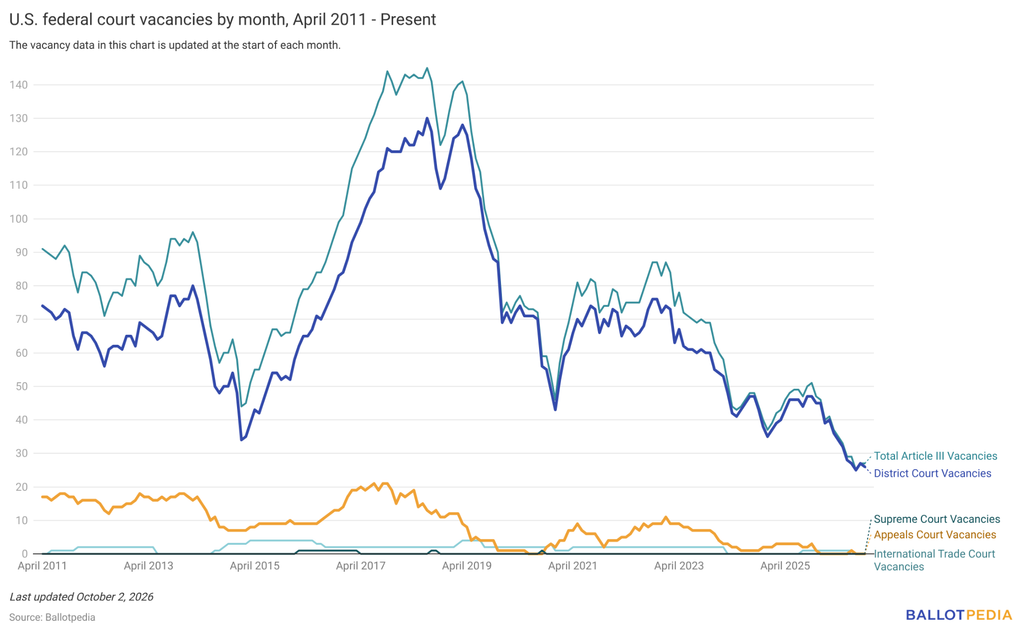
Do you love judicial nomination, confirmation, and vacancy information? We figured you might. Our monthly Federal Vacancy Count monitors all the faces and places moving in, moving out, and moving on in the federal judiciary. Click here for our most current count.
Need a daily fix of judicial nomination, confirmation, and vacancy information? Click here for continuing updates on the status of all federal judicial nominees.
Or, keep an eye on our list for updates on federal judicial nominations.
Spotlight: Justice Sonia Sotomayor
Sonia Sotomayor is an associate justice of the U.S. Supreme Court. Sotomayor was born in the Bronx, New York, on June 25, 1954. President Barack Obama (D) nominated her to fill the vacancy following Justice David Souter's retirement on June 29, 2009. The U.S. Senate confirmed her nomination on Aug. 6, 2009. She was sworn in on Aug. 8, 2009, becoming the first Hispanic justice to sit on the court.

Sotomayor graduated summa cum laude from Princeton University with an undergraduate degree in history in 1976. After graduating from Princeton University, Sotomayor attended Yale Law School, where she received her J.D. in 1979.
In a 2025 conversation with Georgetown Law School Dean William M. Treanor, Sotomayor said, “For me, my approach has always relied on a broader understanding that it’s not mere words and it’s not mere history... The idea that we would think that we were frozen into a period of time seems alien to what I think the purpose of the Constitution is. ... The vast majority of my dissents surround issues of fair process, because that really guides what I think justice is about."
Justice Sotomayor has written several children's books. She has said that her favorite art form is dance, and that she enjoys cycling around Washington, D.C.
Looking ahead
We’ll be back on Oct. 12 with a new edition of Robe & Gavel. Until then, gaveling out!
Contributions
Myj Saintyl compiled and edited this newsletter, with contributions from Kate Carsella, Ellie Mikus, and Sam Post.