


Welcome to Ballot Bulletin: Ballotpedia's Weekly Election Policy Digest. Every Tuesday, we deliver the latest updates on election policy around the country, including nationwide trends and recent legislative activity.
In this week’s edition, we cover 13 bills state legislatures acted on last week and look at absentee/mail-in voting policies across the country ahead of the November election.
The state of election legislation in the U.S.
Lawmakers in four states acted on 13 election-related bills last week. Five state legislatures are in regular or special sessions. Last week, three bills were enacted, no bills passed both chambers of a state legislature, and no bills were vetoed.
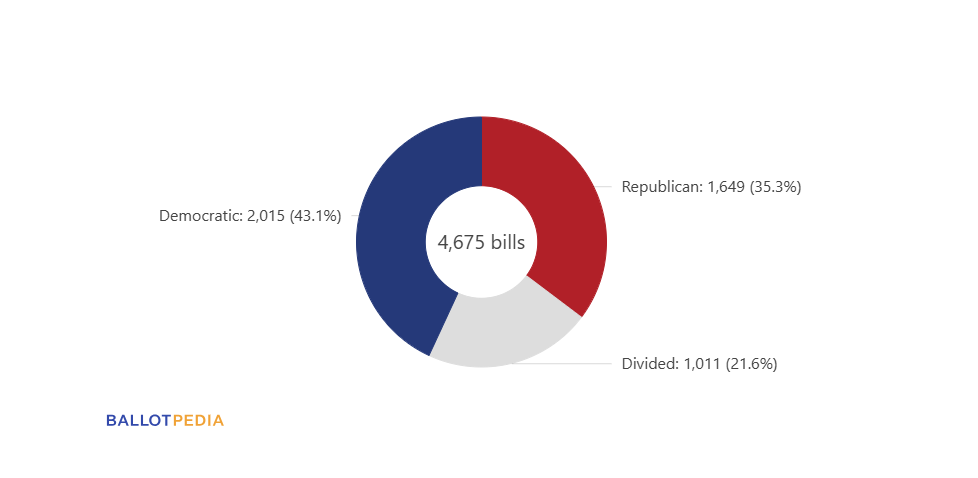
Of the bills acted on last week, four (31%) are in states with Democratic trifectas, none are in states with a Republican trifecta, and nine (69%) are in states with divided government. The most active bill categories last week were campaign finance (6), election types and stages (5), and voter registration and list maintenance, audits and oversight, and ballot access (four each).
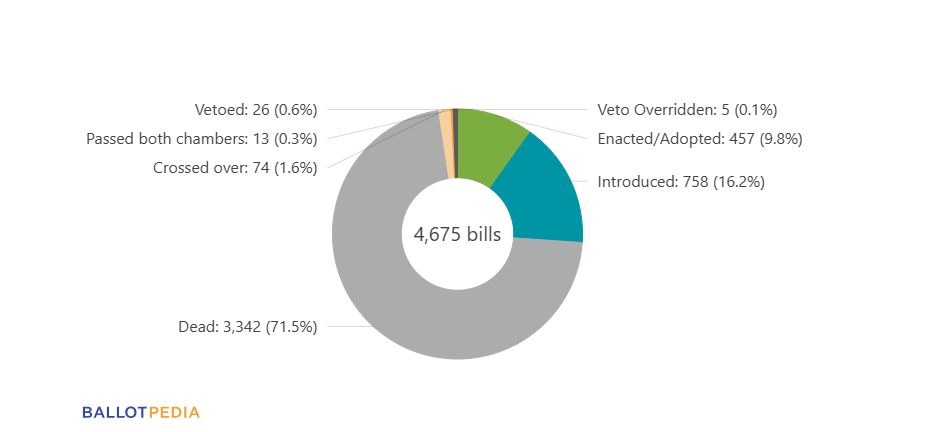
We are currently tracking 4,675 election-related bills across the country. The chart below breaks down the status of those bills based on where they stand in the legislative process:
Enacted bills
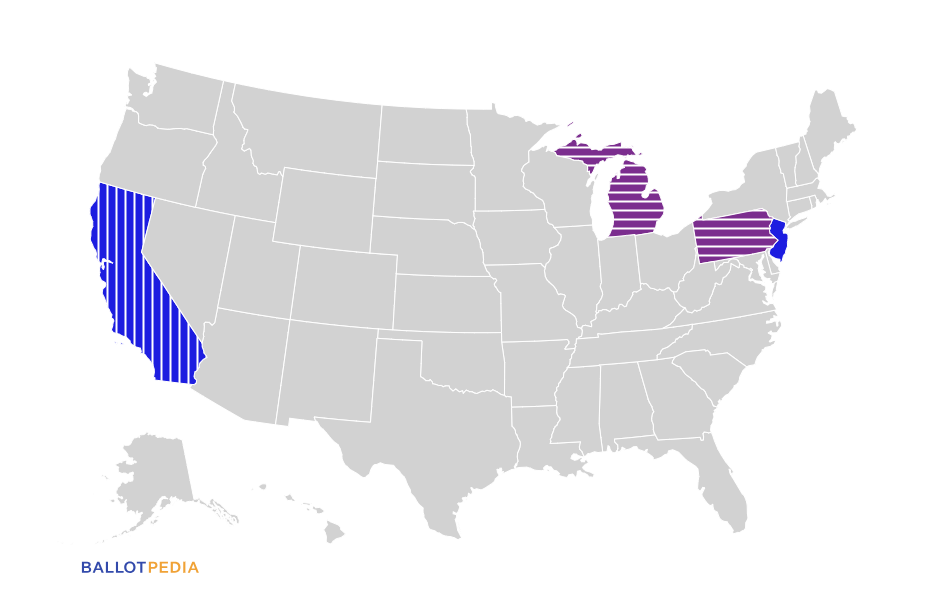
Three bills were enacted or adopted last week. On Sept. 30, California Gov. Gavin Newsom (D) signed SB 1369 into law. It requires a paid signature gatherer to verbally tell each person before providing a petition that they are being paid to circulate the petition. The paid signature gatherer must make this disclosure regardless of whether the person asks if the signature gatherer is being paid.
Two other bills were enacted or adopted last week:
Bills passing both chambers
No bills passed both chambers of a state legislature last week.
To see a full list of bills awaiting gubernatorial action, click here.
Vetoed bills
No bills were vetoed last week.
To see a list of all bills vetoed this session, click here.
All bills
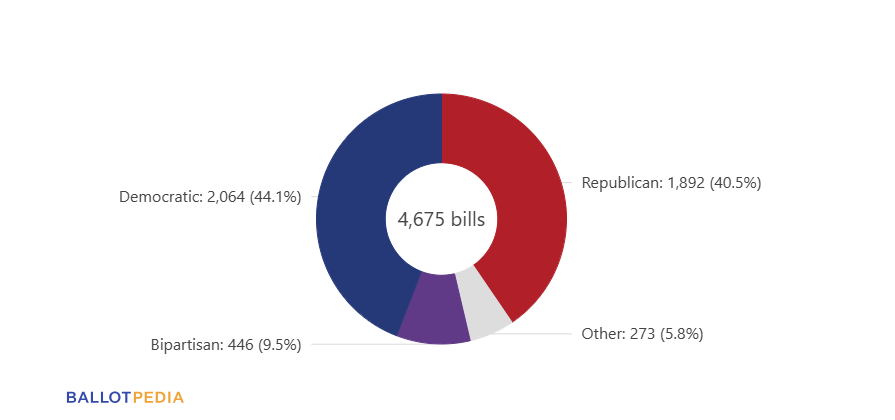
The chart below shows all bills Ballotpedia is currently tracking, broken down by partisan sponsor.
The chart below shows all bills Ballotpedia is currently tracking, broken down by trifecta status.
In the news
California Gov. Gavin Newsom (D) signed three election-related bills into law on Sept. 30, the last of the 34 election bills passed during the state’s 2026 session. That brings California’s total of enacted election-related bills to 32, making it the state with the second-most election-related bills enacted so far this year. Virginia has enacted 49 election bills in its 2026 session, the most of any state.
Legislators in California enacted election-related bills on a variety of topics, including regulations on law enforcement near polling places and election sites, procedures for mail-in voting, non-English language assistance for voters, and ballot curing. Newsom also vetoed two bills.
For more information on California’s 2026 session, click here.
Here are other news stories from across the country:
- On Oct. 1, a U.S. district court judge ruled that a Jamaican citizen could not be prosecuted for allegedly voting in the 2020 election, holding that a federal statute prohibiting noncitizen voting was unconstitutional. U.S. District Court Judge David Leibowitz ruled that the U.S. Constitution “does not authorize Congress to legislate voter qualifications for federal elections.” The U.S. Department of Justice has appealed the ruling.
- On Sept. 30, a U.S. district court judge dismissed a lawsuit challenging South Carolina’s ballot collection laws. The South Carolina chapter of the NAACP and three voters filed the lawsuit in December 2025, arguing that a 2022 law capping the number of ballots a person may return made it harder for nursing or group home residents to vote. U.S. District Court Judge Mary Geiger Lewis ruled that the plaintiffs lacked standing to challenge the law.
- On Sept. 29, the Pennsylvania House of Representatives voted 115-88 to approve a bill that would allow unaffiliated voters to participate in state primaries, moving Pennsylvania to semi-closed primaries. The state currently has a closed primary system where only registered party members or voters affiliated with a party are allowed to vote. Ninety-nine Democrats and 16 Republicans voted in favor of the bill, with 84 Republicans and four Democrats voting in opposition. The bill now goes to the state Senate for consideration.
Policy spotlight: Here's what to know about casting an absentee/mail-in ballot in the November election
The story below is adapted from a recent Ballotpedia News story by Andrew Bahl.
As the Nov. 3 election approaches, election officials across the country are beginning to send absentee/mail-in ballots to voters. Laws governing the absentee/mail-in voting process vary from state to state. Here's an overview of what those laws look like this year.
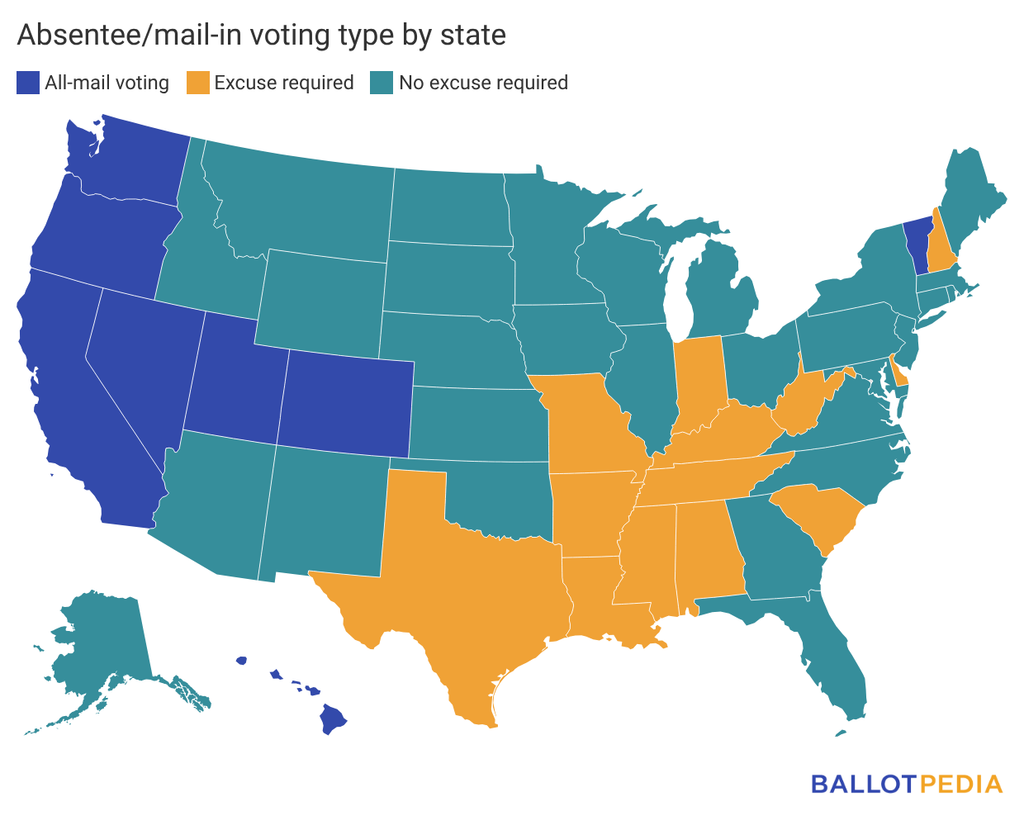
All states allow for some form of absentee/mail-in voting. Thirteen states require voters to provide a valid excuse to vote by mail. Depending on the state, those excuses can include illness or disability, travel outside the state, or military service.
After Connecticut enacted legislation earlier this year to remove its excuse requirement, 29 states now allow any eligible voter to cast an absentee/mail-in ballot. Eight states have all-mail voting systems, where all eligible voters receive a mail-in ballot by default.
Once a voter receives a ballot, they must fill it out, sign the ballot envelope, and return it to election officials. The deadlines for when the ballot must be returned vary by state.
In 34 states, ballots returned by mail must be received by Election Day in order to be counted. In one state, Louisiana, ballots must be received by 4:30 p.m. on the day before the election.
Fifteen states allow ballots postmarked by Election Day and received within a set post-election window to be counted. In Texas, ballots must be received by the day following the election, while in Washington, the deadline is the county canvass, which must occur within 21 days of the election. Kansas' statute requiring ballots be received by the close of polls in order to be counted is currently enjoined by a court order, meaning ballots could be counted if they are postmarked by Election Day and received by the third day after the election.
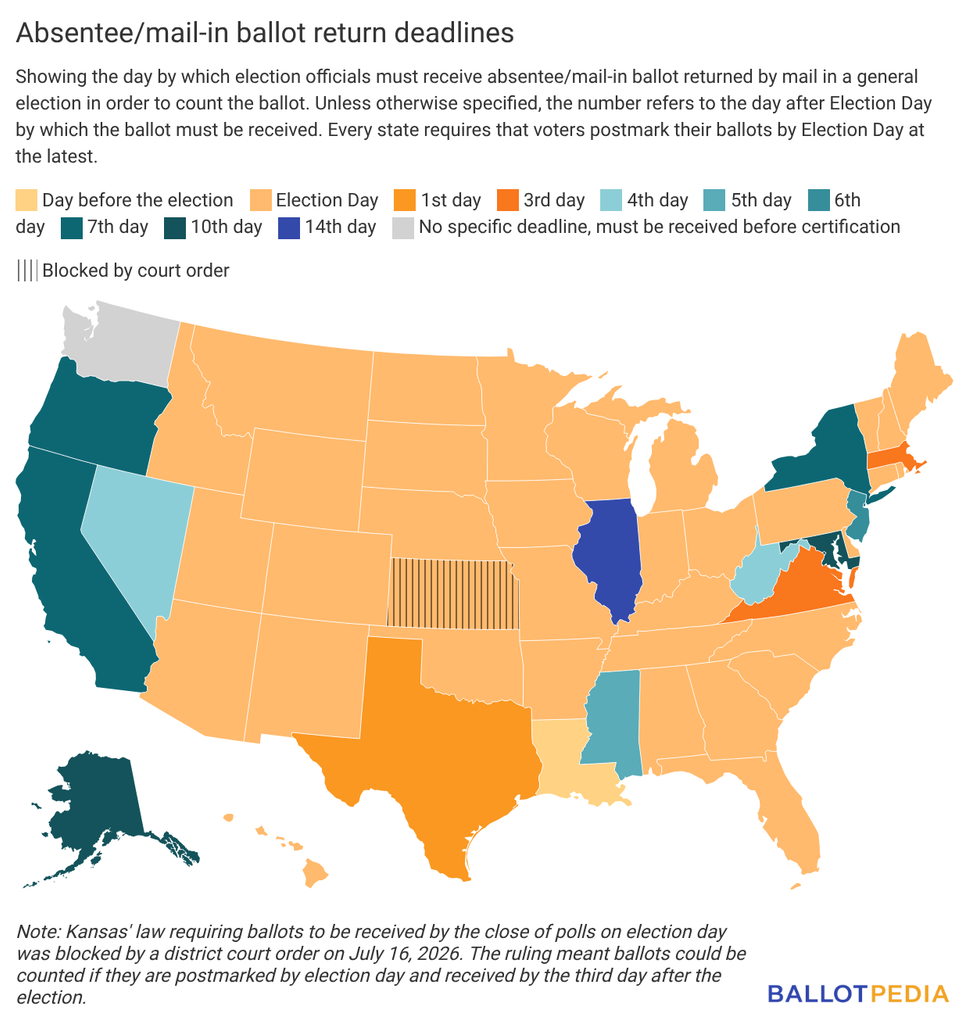
In most states, voters may choose to return ballots in person. No state allows ballots to be returned in person after polls close on Election Day. Alabama, Arkansas, Connecticut, Louisiana, Oklahoma, and West Virginia require ballots returned in person to be received before Election Day. Voters in some states may also return their ballots via a drop box.
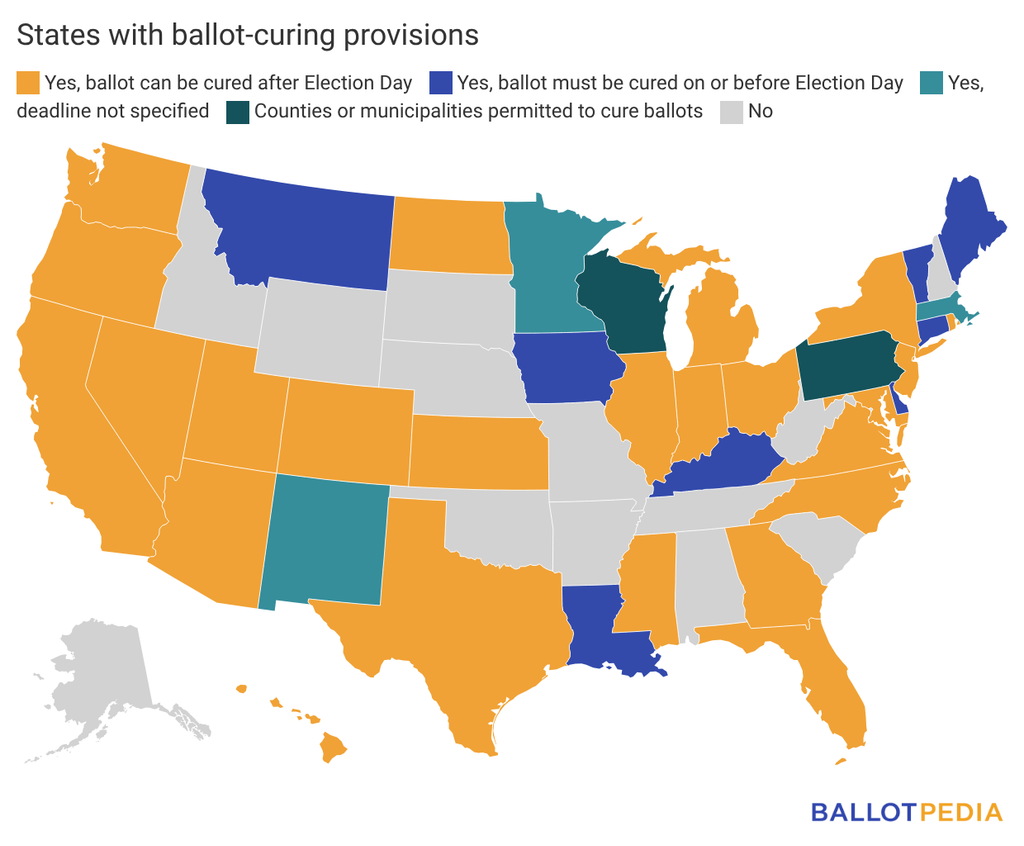
Once election officials receive a ballot, they may review it to ensure there are no issues that might disqualify it from being counted. All states, for instance, require voters to sign a statement on the ballot envelope. Many states require the signature on the ballot envelope to match the signature on file with a voter’s registration record. If the signature is missing or it does not match, the ballot may be rejected.
In 35 states, election officials are required to notify voters of issues with their absentee/mail-in ballots and give them a chance to rectify them. This is called ballot curing. Of those states, 24 allow voters to cure their ballots after Election Day, eight require voters to cure their ballot on or before Election Day, and three do not specify a timeline in statute. Connecticut became the latest state to enact a cure period in 2026.
Pennsylvania and Wisconsin allow, but do not require, municipalities or counties to let voters cure their ballots. Thirteen states have no ballot curing requirements. In states that do not have a ballot curing process, ballots returned without signatures — or, in states that conduct signature matching, with mismatched signatures — are not counted.
Election officials must process absentee/mail-in ballots before they can be counted. State laws governing this step of the process may affect how long it takes for states to report their unofficial election results.
Processing activities may include steps such as verifying ballots are in the appropriate envelope, comparing signatures or identification numbers on ballots to those in a voter's file, removing ballots from secrecy sleeves or outer envelopes, organizing ballots for tabulation or scanning, and scanning or tabulating ballots without disclosing results.
State laws differ as to when processing may begin. Nineteen states permit election officials to fully process and scan at least some early and absentee/mail-in ballots before Election Day.
Twenty-five states permit election officials to perform at least some aspects of absentee/mail-in ballot processing before Election Day. Six states do not permit election officials to begin processing absentee/mail-in ballots until Election Day.
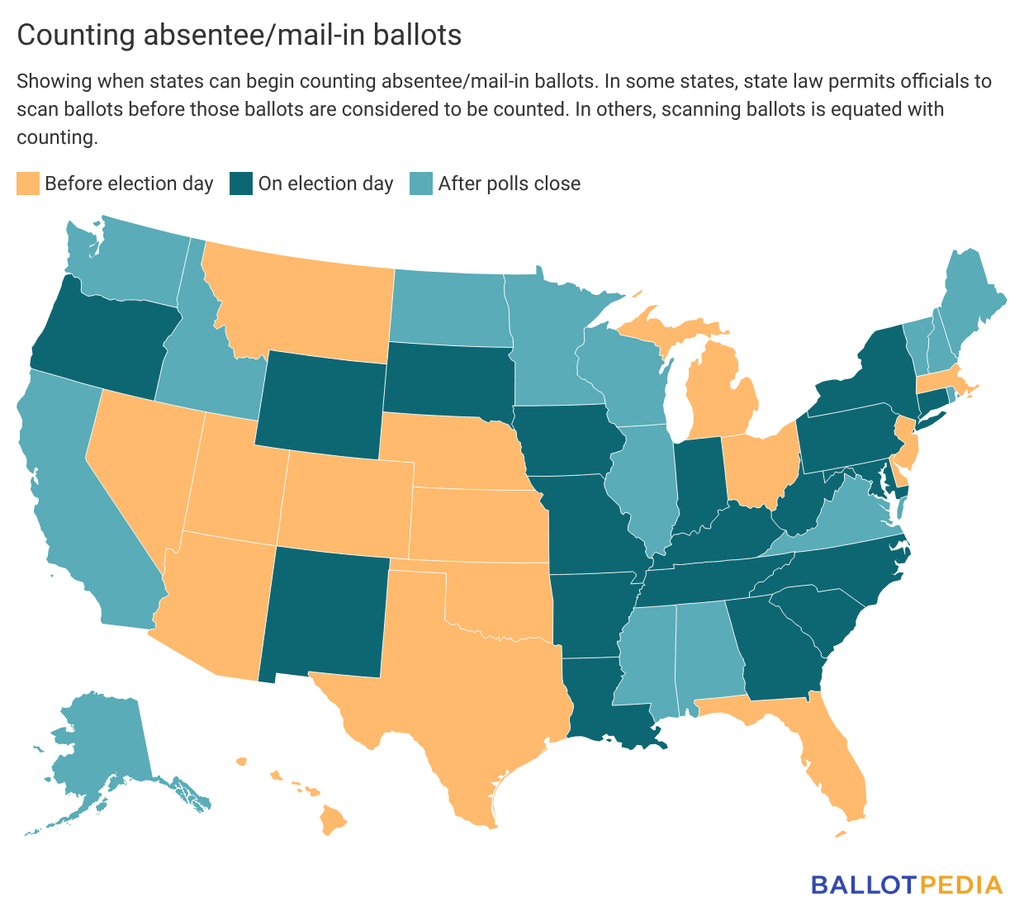
Once a ballot has been processed, it is set aside to be counted. Sixteen states permit counting to begin before Election Day. An additional 19 states allow counting to begin on Election Day before the polls close. The remaining 15 states require counting to begin only after voting has ended on Election Day. Some states may have an additional deadline for election officials to complete the counting and tabulation process.