


Welcome to Hall Pass, a newsletter written to keep you plugged into the conversations driving school board governance, the politics surrounding it, and education policy.
In today’s edition, you’ll find:
- On the issues: The debate over Career and Technical Education (CTE)
- School board filing deadlines, election results, and recall certifications
- The federal government released proposed regulations governing the new nationwide education scholarship tax credit program. Here’s what to know.
- Extracurricular: education news from around the web
- Candidate Connection survey
On the issues: The debate over Career and Technical Education (CTE)
In this section, we curate reporting, analysis, and commentary on the issues school board members deliberate when they set out to offer the best education possible in their district. Missed an issue? Click here to see the previous education debates we’ve covered.
One way K-12 public schools try to prepare students for the workforce is by providing them with opportunities for learning skills associated with high-demand occupations. These classes commonly belong to the category of Career and Technical Education (CTE). CTE seeks to open up multiple pathways for students leaving high school, giving them the option of enrolling in a trade school, a traditional four-year college or university, or joining the workforce directly. Most K-12 public high schools offer CTE courses to students. The Education Commission of the States (ECS), a nonpartisan research organization, found that, as of 2023, at least 43 states allowed students to earn both high school and college credit through their CTE classes. According to Education Week, the number of K-12 students enrolling in CTE classes increased 10% between the 2022-23 and 2023-24 school years, from roughly eight million to about eight and a half million. That latter figure represents about 17% of all K-12 public school students.
According to the Congressional Research Service (CRS), “CTE is commonly organized into 14 career clusters that help design career pathways and programs of study and coordinate them with employment opportunities.” Those clusters include construction, digital technology, financial services, and healthcare.
Today, we bring you two perspectives on CTE. Both authors support it but emphasize different priorities: one on expanding access, the other on improving program quality.
Cynthia Solivan, chair of the career and technical education program at Destinations Career Academy, an online public school in New Mexico, says New Mexico’s lawmakers should expand CTE programs because they can inspire students, leading to better academic outcomes, higher graduation rates, and greater preparedness for college or a career. Solivan says that tens of thousands of residents in New Mexico ages 16-24 aren’t working or in school, and she says CTE can help them find purpose. She says data shows that while many New Mexico students start CTE programs, few end up taking more than one course or getting certified. She says that with more support, students can earn certifications in promising fields.
Cami Anderson, founder and CEO of Thirdway Solutions, a consulting firm, says CTE programs need to be more academically rigorous and better designed to equip students for the jobs of today and tomorrow. Anderson says that, while she is a proponent of CTE, too often the programs are backward-looking, training students on outdated technology. She says programs that appear to be working often use minimum GPAs and other standards to exclude the disadvantaged students who stand to benefit most from career-connected learning opportunities. Those students, she says, tend to get funneled into low-quality programs. Anderson says robust CTE programs both impart the academic and technical skills students need to enter the workforce and partner with mentors and employers who can work with disadvantaged students.
Career educations builds a stronger New Mexico | Cynthia Solivan, Albuquerque Journal
“In Rio Rancho, a 17-year-old high school student opened a coffee trailer after discovering a passion for creating specialty drinks in a culinary arts class. This summer she is serving customers outside popular shopping spots while learning to navigate business licenses, permits and taxes. Another 17-year-old was recently hired as a fabricator with a pathway into pipeline welding; a principles of marketing and entrepreneurship certificate helped build his confidence as he entered the workforce. After earning an agriculture certificate, another student took on a larger operational role at his family's alfalfa farm. These students earned more than good grades in their career and technical education courses; they found a purpose.
“Too often, CTE is treated as secondary to traditional academics. In reality, when students have access to a broad range of skill development, they become invested in learning because they can see how it connects to their future. I've watched students transform when they're given the chance to study subjects that genuinely interest them.”
Is Career and Technical Education Stuck in the Past? | Cami Anderson, Education Week
“But the dominant pattern, both during my time as superintendent and as I travel the country in my current work as CEO of ThirdWay Solutions, is very different—and troubling. Certifications tied to already obsolete software programs. Work-readiness courses for youth involved with the juvenile-justice system that are infantilizing and culturally clueless. Auto-repair programs that teach students how to fix cars that went out of rotation decades ago instead of focusing on the technology transforming the industry. Few programs track whether young people are building the core academic and durable skills that underpin economic mobility. The worst offenders: pathways pushing young people into debt at for-profit colleges for antiquated credentials that neither close skill gaps nor prepare them for a rapidly transforming world of work.
“Often, CTE programs that look good on paper are just screening out the very students they should be particularly eager to serve. Many of the programs require minimum GPAs, evidence of reading skills, or demonstrated work readiness to enroll. More insidiously, workforce funding, metrics, and the politics of shiny new programs create incentives to admit students who drive up numbers in attendance, passing rates, and credentials—useful or not.”
School board update: filing deadlines, election results, and recall certifications
In 2026, Ballotpedia will cover elections for more than 30,000 school board seats. We’re expanding our coverage each year with our eye on covering the country’s more than 80,000 school board seats.
Upcoming school board elections
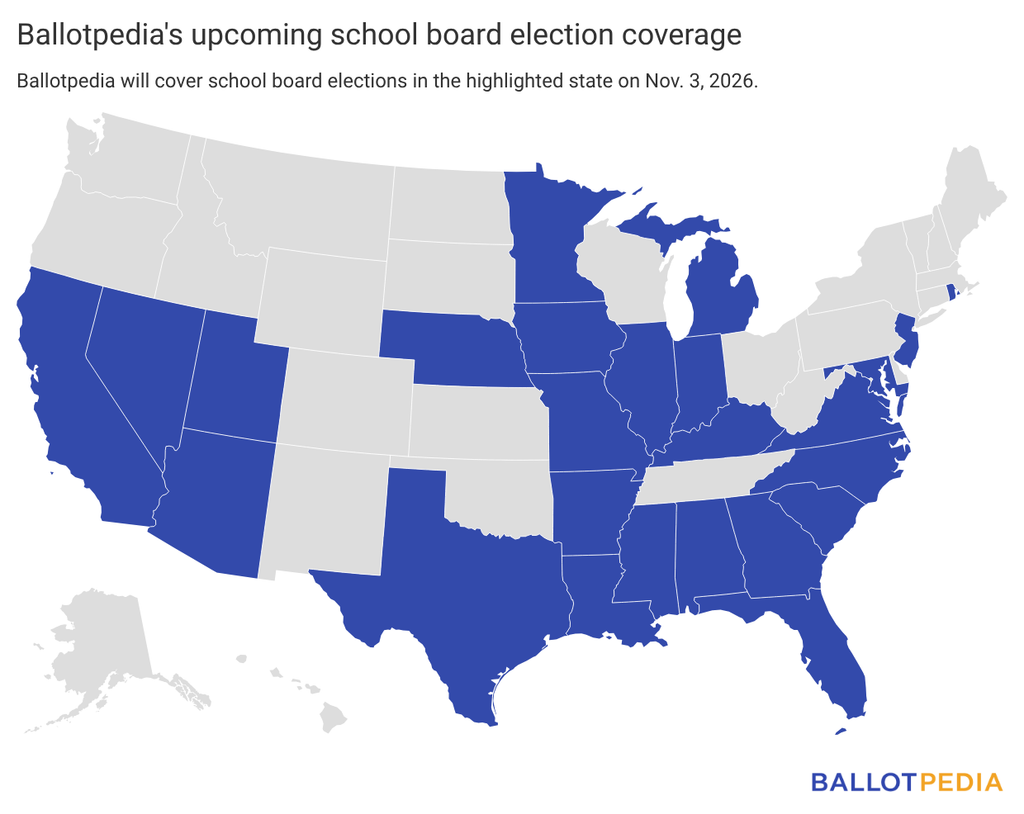
Ballotpedia will cover school board elections in 25 states on Nov. 3.
Upcoming school board recall elections
Ballotpedia is covering an election on Oct. 13 to recall Amanda O'Bryan from her position representing Position 2 on the Lake County School District 7 school board, in Oregon.
The election will be conducted by mail.
Click here to learn more about this year’s school board recall elections.
The federal government released proposed regulations governing the new nationwide education scholarship tax credit program. Here’s what to know.
On Oct. 1, the U.S. Treasury Department and the Internal Revenue Service (IRS) released long-awaited regulations governing the first nationwide federal K-12 education tax credit program, scheduled to take effect on Jan. 1, 2027. The program, enacted in 2025 as part of the One Big Beautiful Bill Act (OBBBA) and known as both the Federal Scholarship Tax Credit and the Education Freedom Tax Credit, allows taxpayers to reduce their federal taxes in exchange for donations to authorized K-12 scholarship-granting organizations (SGOs). Taxpayers in any state can claim the credit, but only students in states that opt into the program can benefit from the scholarships. The scholarships can be used for a variety of educational expenses, including private school tuition.
Since President Donald Trump (R) signed the OBBBA on July 4, 2025, the Federal Scholarship Tax Credit has been the subject of much debate in education policy circles, the media, and among elected officials. This was at least partly because the federal government had not yet released the regulations governing the program, leaving some questions about how it would work unanswered.
With the text of the proposed regulations now in hand, let’s walk through the details most relevant for taxpayers, schools (public, private, and otherwise), and families. We’ll also touch on some of the lingering unknowns.
A quick primer on the Federal Scholarship Tax Credit
Before we dive headlong into the new regulations, let’s review how the Federal Scholarship Tax Credit program works. You can explore the different provisions of the program, including the text of the law, in greater detail here.
- The credit: Section 70411 of the OBBBA created a federal, dollar-for-dollar, nonrefundable education tax credit, allowing individuals to lower their federal tax liability by $1 for every $1 donated to an SGO — up to $1,700. The program is codified as section 25F of the Internal Revenue Code.
- Student eligibility and scholarship use policies: The scholarships would be available to families making 300% of the region’s median income. The scholarships could be used to pay private school tuition, hire tutors, and purchase textbooks and other supplies. Scholarships can be used to cover public, private, or religious education expenses.
- State participation policies: Governors or other individuals, agencies, or entities designated under each state's law to make elections on behalf of the state regarding federal tax benefits can elect to participate in the program annually. To participate, states must submit to the U.S. Department of the Treasury a list of the scholarship-granting organizations that meet the requirements described in the bill and are located in the state by Jan. 1 of each year.
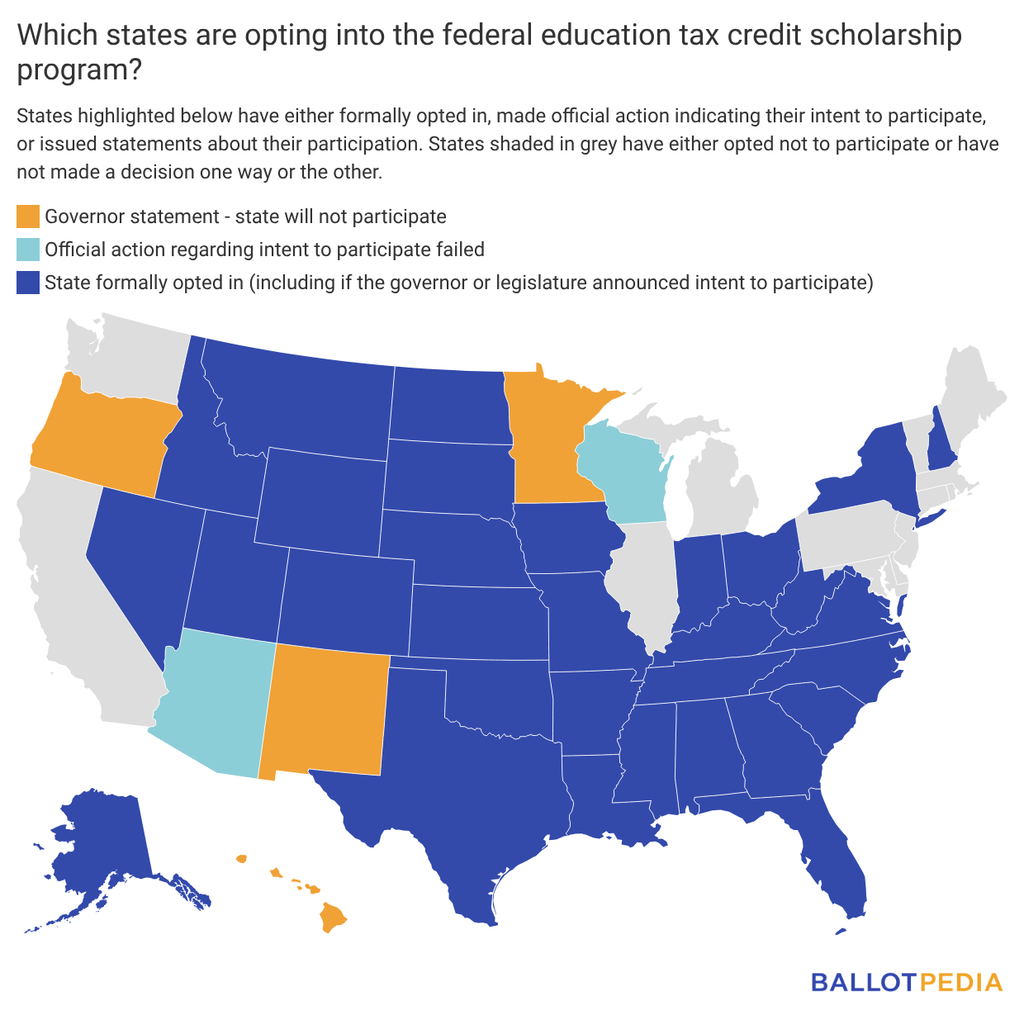
As of October, 31 states had indicated that they would participate in the program. Twenty-three of those states have Republican trifectas, three have Democratic trifectas, and five have divided governments. Several Democratic governors said they were waiting to see the proposed regulations before deciding whether to opt their states into the program.
Proposed regulations
The regulations came in two parts. The IRS proposed regulations related to student eligibility, calculating taxpayer credits, SGO operations, and state operations and requirements. It also issued temporary regulations identical to the procedural requirements for states and SGOs listed in the proposed regulations, which the IRS said must become effective for the program to begin in 2027.
The proposed rule has a 60-day comment period and a public hearing scheduled for Dec. 15, 2026. The temporary regulation also has a 60-day comment period and will take effect on Dec. 1.
Notable provisions include:
- Married couples filing jointly may receive up to $3,400 in federal tax credits under the program. Each spouse may claim the $1,700 tax credit for qualified contributions.
- Some students will be categorically eligible for scholarships. This includes need-based benefit recipients, those in foster care, and those schools selected as needing academic or special needs services if the school is located in low-income areas. Schools may select students for scholarships based on academic or special needs.
- Students may use scholarships based on future enrollment. Expenses are eligible contingent on a student's school enrollment, but the regulations said students may use a scholarship in the summer if they are enrolled in the school year starting in the fall. Students may also be able to use scholarships for services before and after school.
- "School" means any K-12 school that provides elementary or secondary education, as determined under state law. Depending on the state, homeschooled students or microschool students may be eligible for scholarships.
- States may not impose restrictions on SGOs more stringent than federal requirements. States must include on their list all SGOs that meet federal requirements and are requesting to participate.
- SGOs "located in the state" are defined as those authorized to do business in the state. They are not required to be physically located in the state. This enables multi-state SGOs.
Questions the proposed regulations don’t answer
The regulations leave unclear what counts as a qualified educational expense. The U.S. Treasury and IRS have stated they intend to issue standalone guidance to address that question. Other questions the regulations don’t address include whether private schools that accept the scholarship money become subject to federal laws.
What counts as a qualified educational expense that can be paid for or reimbursed with scholarship money? The proposed regulations don’t say. Instead, the regulations cite federal statute 530(b)(3)(A), which covers qualified educational expenses under Coverdell education savings accounts, which are tax-advantaged accounts families can use for certain higher education and K-12 expenses. Qualified expenses according to 530(b)(3)(A) include tuition, academic tutoring, uniforms, and technology purchased for educational purposes.
The regulations state that the federal government is working on supplying its own definition of qualified educational expenses: “The Treasury Department and the IRS recognize that guidance describing the types of expenses permitted is critical to States, SGOs, eligible students, and other stakeholders. Such guidance will be issued separately under section 530. As indicated previously, the Treasury Department and the IRS are working on the development of that guidance and are treating the issuance of that guidance as a high priority.”
The regulations also don’t address the legal implications for private schools that accept scholarship funding. According to an analysis by law firm Fisher Phillips, “The proposed regulations aren’t clear as to whether a private school receiving tuition paid with these scholarships would be considered a recipient of federal financial assistance,” which could come with obligations under federal law. However, the analysis states that, among other things, “the money should flow between the SGO and the school, not through the Treasury, so it’s less likely to be considered federal financial assistance.”
Other questions that stakeholders have raised include wanting more clarity about the definition of qualified tutoring and afterschool programs, which homeschool expenses if any qualify in states where the law does not define home schools as schools, and whether donors can direct donations to particular schools.
Reactions
In support of the program
- The American Federation for Children (AFC), a nationwide organization that advocates for private school choice, said, “The guidance released today made clear what families and education leaders have known since the law passed: the EFTC benefits children across educational settings – public, private, and even homeschool in some states. Treasury will also issue clear rules to prevent misspending. With 31 states already opted in or signaling intent to do so, the remaining holdout governors must act now.”
- Jorge Elorza, CEO of Democrats for Education Reform (DFER), an organization whose mission is to support and elect “Democrats who deliver bold reforms that put students and families first,” said: “Democrats have a chance to listen to their voters and deliver hundreds of millions of dollars for critical educational supports like tutoring, special-needs services and after-school programs. That’s new money, on top of what schools already allocate.”
Against the program
- Randi Weingarten, the president of the American Federation of Teachers (AFT), the nation’s second-largest teachers union, said, “For every precious public dollar funneled to private schools under this scheme — money that could be spent on instruction, lowering class sizes, modern buildings or new books in the library — public school parents will be hunting for stray pennies on the floor.”
- Paige Shoemaker DeMio, a senior policy analyst at the Center for American Progress, a policy institute advocating for progressive ideas, said, “As governors and state legislators review the newly released temporary and proposed rules, it is imperative to understand how these regulations fail to reduce the risks this program creates—risks that threaten equal access to a high-quality education for all students by undermining civil rights protections; opening doors for waste, fraud, and abuse; and directing funds to the wealthy over public school students most in need.”
Thirty-six states have gubernatorial elections in 2026. Because the IRS issued the regulations within a few months of program’s start date, the IRS gave states until Feb. 15, 2027, to submit SGO lists, which completes their decision to participate. Newly elected governors who want to reverse their state's decision to participate could decide not to submit an SGO list and effectively opt out of the program. States have the option to opt in annually.
Extracurricular: education news from around the web
This section contains links to recent education-related articles from around the internet.
- Goodbye to the One-School Student As K–12 Goes Modular | Progressive Policy Institute
- District 15: Longtime Boise school district trustee faces Idaho’s PTA secretary | Idaho Ed News
- Math needs a phonics-style reckoning | Slow Boring
- Super PACs ramp up spending in Chicago’s school board elections | Chalkbeat Chicago
- We need to spend more on K-12 education and steer it to underfunded areas | Las Vegas Sun
- Inclusion without support is student neglect | EdSource
- Does Education Reform Have Regrets? | Governing Right
- My misguided six-year foray into ‘social justice journalism’ (2016-2022) | Alexander Russo’s The Grade
Take our Candidate Connection survey to reach voters in your district
Today, we’re looking at survey responses from Becca Hogan and Aaron Puno, two of the nine candidates running in the Nov. 3 election for four at-large seats on the Ann Arbor Board of Education, in Michigan. Aside from Hogan and Puno, none of the other candidates, including incumbent Rima Mohammad, had completed the survey as of this writing.
Four of the seven seats on the board are up for election this year. Additionally, one seat is up for a special election.
Ann Arbor Public Schools is the 13th largest district in Michigan, with roughly 17,000 students.
Here’s how Hogan answered the question, “What are the main points you want voters to remember about your goals for your time in office?”

- “Value our educators.
- Practice principled, transparent spending.
- Strengthen the community.”
Click here to read the rest of Hogan’s responses.
Here’s an excerpt from Puno’s response to the question, “What are the main points you want voters to remember about your goals for your time in office?”

- “Transparency and Good Government: The underlying problem is that we cannot trust the administration or the current school board majority -- nor are they willing to attempt to gain our trust. If elected, my slate and I will ensure that decisions are made in the public and for the public. I'll ensure that decisions are made during publicly-accessible meetings with ample opportunity for the public to give comment and for experts and key stakeholders to give advice. I'll ask the relevant questions, demand written answers or verbal testimony from district staff members, and not be afraid to hear from the public as to their opinions and perspectives on important decisions we must make -- especially when it comes to financial matters.”
Click here to read the rest of Puno’s responses.
As a reminder, if you're a school board candidate or incumbent planning to run this year, click here to take the survey. If you complete the survey, your answers will appear in your Ballotpedia profile. Your responses will also appear in our sample ballot. If there is an election in your community, share the link with your candidates and urge them to take the survey!