


Welcome to the Thursday, Oct. 8, 2026, Brew.
By: Briana Ryan
Here’s what’s in store for you as you start your day:
- Homebuyer loan program for University of California staff is the first initiative to qualify for California’s 2028 ballot
- Either party could establish a state government trifecta in Wisconsin on Nov. 3
- President Donald Trump issued 11 executive orders in September
Homebuyer loan program for University of California staff is the first initiative to qualify for California’s 2028 ballot
A citizen initiative to establish a first-time homebuyer down payment loan program for University of California staff qualified for the Nov. 7, 2028, ballot in California. This is the first citizen initiative certified for the 2028 ballot in California. It joins two other measures that the state legislature put on the ballot. So far, a total of six statewide measures have been certified for the 2028 ballot nationwide.
The measure, sponsored by the AFSCME 3299, would create a program that would offer loans equal to 20% of the house's value for down payments for first-time homebuyers who have worked for the University of California system for at least five years.
On Oct. 2, the secretary of state reported the initiative qualified for the 2028 ballot after submitting 947,631 valid signatures. The deadline for withdrawing citizen initiatives from the 2028 ballot is June 29, 2028.
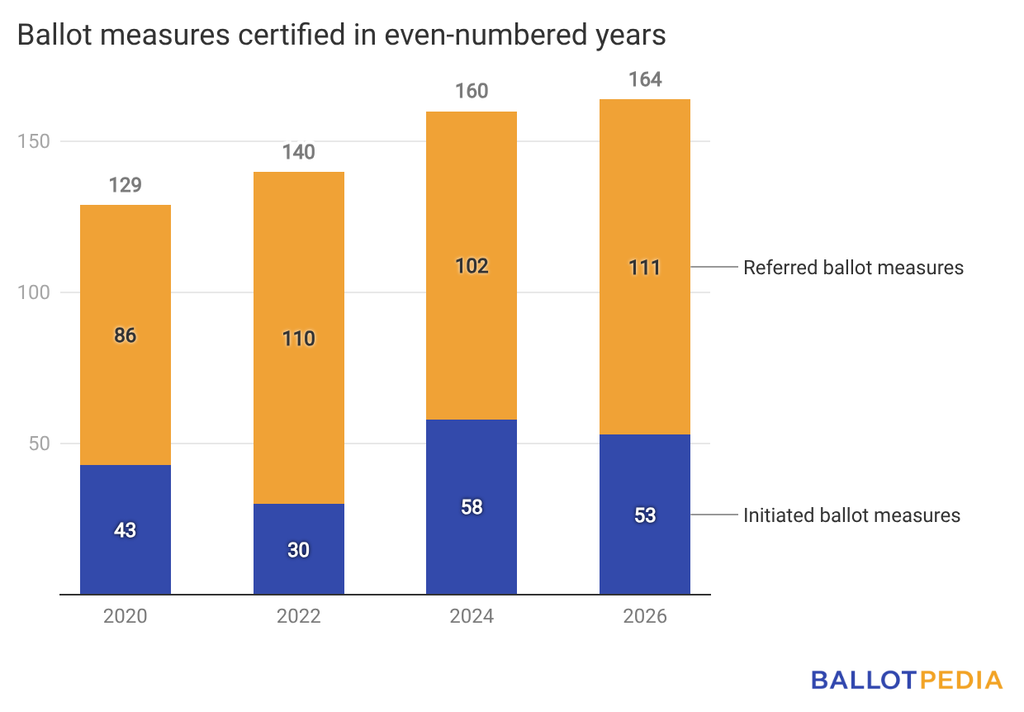
Six statewide ballot measures have been certified for the 2028 ballot in four states: California, Connecticut, Hawaii, and Illinois. An average of 161 measures were on the ballot in each even-numbered year from 2010 to 2024.
The citizen initiative certified in California is so far the only citizen initiative certified for the ballot in any state for the 2028 ballot. An average of 53 citizen initiatives were on the ballot in each even-numbered year from 2010 to 2024.
State legislatures put the other five measures on the 2028 ballot. An average of 108 legislatively referred measures were on the ballot in each even-numbered year from 2010 to 2024.
Officials have authorized an additional 22 citizen initiatives in five states to begin collecting signatures. Deadlines for submitting those signatures range from Sept. 14, 2026, in Alaska to Aug. 29, 2028, in Oklahoma.
Four legislatively referred measures in three states have reached the halfway point in the certification process. Legislators in Indiana, Iowa, and Nevada will consider whether to approve those measures for the 2028 ballot during their 2027 legislative sessions.
Click here to read more about the California State University Staff First-Time Homebuyer Down Payment Loan Program Initiative.
Either party could establish a state government trifecta in Wisconsin on Nov. 3
Welcome to our next installment of our 50 States in 50 Days series, covering Wisconsin. To view our archive of past editions, click here.
The Nov. 3 elections could result in Wisconsin having a Democratic or Republican state government trifecta. The state has an open governor's race. Additionally, 17 seats in the Wisconsin Senate and all 99 seats in the Wisconsin Assembly are up for election.
Republicans have an 18-15 majority in the state Senate and a 54-45 majority in the state Assembly. Because the governor is a Democrat, Wisconsin is one of 11 states with a divided government.
We assessed a moderate possibility that either party could form a trifecta in Wisconsin. Democrats would need to maintain the governorship, and Republicans would need to gain the governorship. Democrats would need to win at least two seats to gain control of the state Senate, and Republicans would need to lose no more than one seat to maintain their majority. Democrats would need to win at least five seats to gain control of the state Assembly, and Republicans would need to lose no more than four seats to maintain their majority.
Voters must register online or via mail by Oct. 14. Voters can also register in person through Nov. 3.
Early voting opens Oct. 20 and ends Nov. 1.
Polls open on Election Day at 7:00 a.m. and close at 8:00 p.m.
Voter ID is required. Acceptable forms of ID include a Wisconsin Department of Transportation-issued driver's license or ID card, a U.S. passport, a tribal ID, or a certificate of naturalization. Click here for more information on voter ID in Wisconsin.
Absentee/mail-in ballots must be requested by Oct. 29 and received by Nov. 3.
Current party control
Republicans represent six congressional districts, and Democrats represent two. One of Wisconsin's U.S. Senators is a Democrat, and the other is a Republican.
In addition to having a divided state government, Wisconsin is one of 21 states with a Democratic triplex. That's because the state's governor, attorney general, and secretary of state are all Democrats. Liberals have a 5-2 majority on the Wisconsin Supreme Court.
Offices on the ballot
Elections are taking place for the U.S. House of Representatives.
In addition to the gubernatorial and legislative offices mentioned above, there will also be elections for lieutenant governor, attorney general, secretary of state, and treasurer.
Wisconsin is one of 32 states this year where we are providing comprehensive election coverage down to the local level. This year's ballot includes elections for county offices.
Notable elections
Governor: David Crowley (D), Tom Tiffany (R), and Jamie Jo Carothers (I) are running in the open race. The Milwaukee Journal Sentinel's Molly Beck wrote, "The two major candidates running to be Wisconsin's next governor are battling to gain the upper hand on an emerging issue that neither political party owns yet: data centers. ... Democrat David Crowley and Republican Tom Tiffany are each seeking to portray the other as friendlier to big tech."
Secretary of State: JoCasta Zamarripa (D), Jay Schroeder (R), and Pete Karas (G) are running in the open race. According to the Wisconsin Examiner, this is the first time in more than 40 years that the incumbent is not running for re-election.
3rd Congressional District: Incumbent Rep. Derrick Van Orden (R), Rebecca Cooke (D), Alexander Valiensi Kent (I), and Rustin Provance (I) are running. This race is a rematch of the 2024 general election, in which Van Orden defeated Cooke 51% to 49%.
Statewide ballot measures
There are three statewide measures on the ballot this year. Between 1846 and 2025, Wisconsin voters decided on 258 ballot measures, or an average of two per even-numbered year. During that period, voters approved 185 measures and defeated 73. For more information about the history of Wisconsin's ballot measures, visit its Historical Ballot Measures Factbook.
Here's a closer look at the measures:
Question 1 would prohibit governors from using their partial veto power to create or increase any tax or fee. Currently, the governor cannot use their partial veto power to reject individual letters in words to create a new word or combine parts of multiple sentences to create new sentences in an enrolled bill.
Question 2 would prohibit the government from closing gatherings at places of worship during declared emergencies, including public health emergencies.
Question 3 would prohibit any governmental entity from discriminating or granting preferential treatment based on race, sex, color, ethnicity, or national origin in public employment, public education, public contracting, or public administration.
Local ballot measures
We're also covering local measures in Wisconsin. One of those measures in Janesville, Wisconsin, would require voter approval before the city could approve development on undeveloped portions of the GM/JATCO site if the project's cost exceeds $450 million. Voters nationwide will decide on 34 other local measures on data centers on Nov. 3.
Join us again in our next edition when we'll preview elections in Utah, the Beehive State.
Click here to see every edition of 50 States in 50 Days as we publish them, and here to use our Sample Ballot Lookup Tool.
President Donald Trump issued 11 executive orders in September
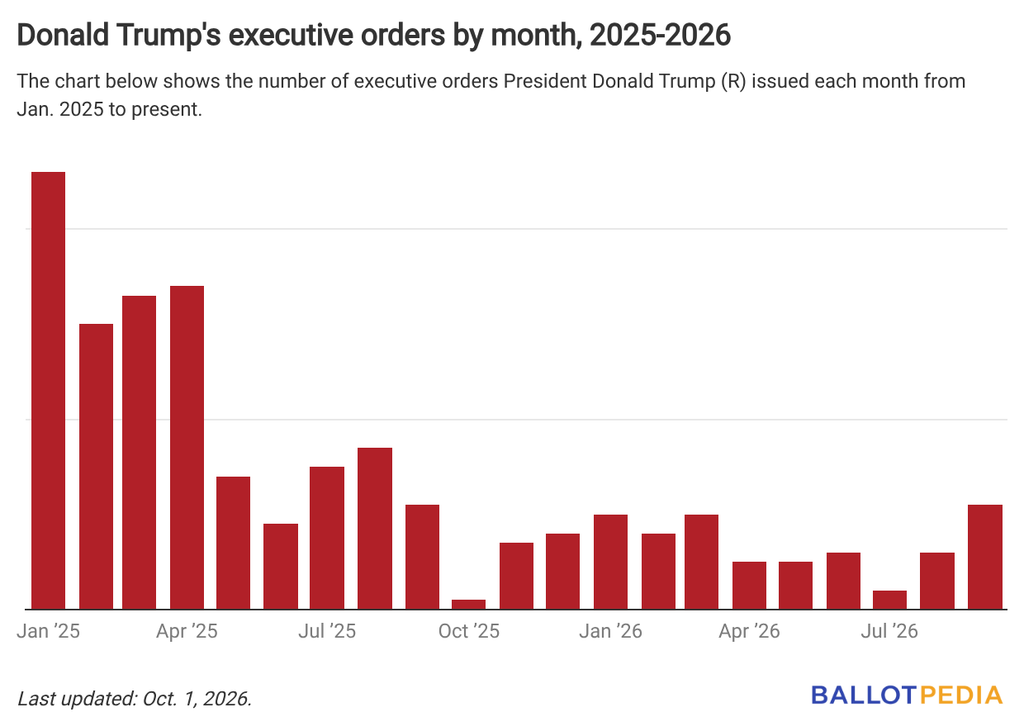
President Donald Trump (R) issued 11 executive orders in September, bringing his second term total to 288 as of Oct. 1. At this point in Joe Biden’s presidency, he had signed 100 executive orders.
The September executive orders addressed livestock, ranching, adjustments to delegations under the Defense Production Act, veterans benefits and employment opportunities, water quality, hunting, fishing, the H-1B Nonimmigrant Visa Program, America.gov, super intelligence, and disease-carrying pests.
Trump issued 46 executive orders in January 2025, more than in any other month of his second term. He issued one executive order in October 2025, the fewest in a single month of his second term.
Among all U.S. presidents, Trump has issued the ninth-most executive orders, with 508 across his two terms in office as of Oct. 1. Franklin D. Roosevelt (D) issued the most executive orders of any U.S. president, with a total of 3,721 during his 12 years in office. William Henry Harrison (Whig) issued the fewest, having issued none during his one month in office. Three presidents issued only one executive order each: James Madison (Democratic-Republican), James Monroe (Democratic-Republican), and John Adams (Federalist).
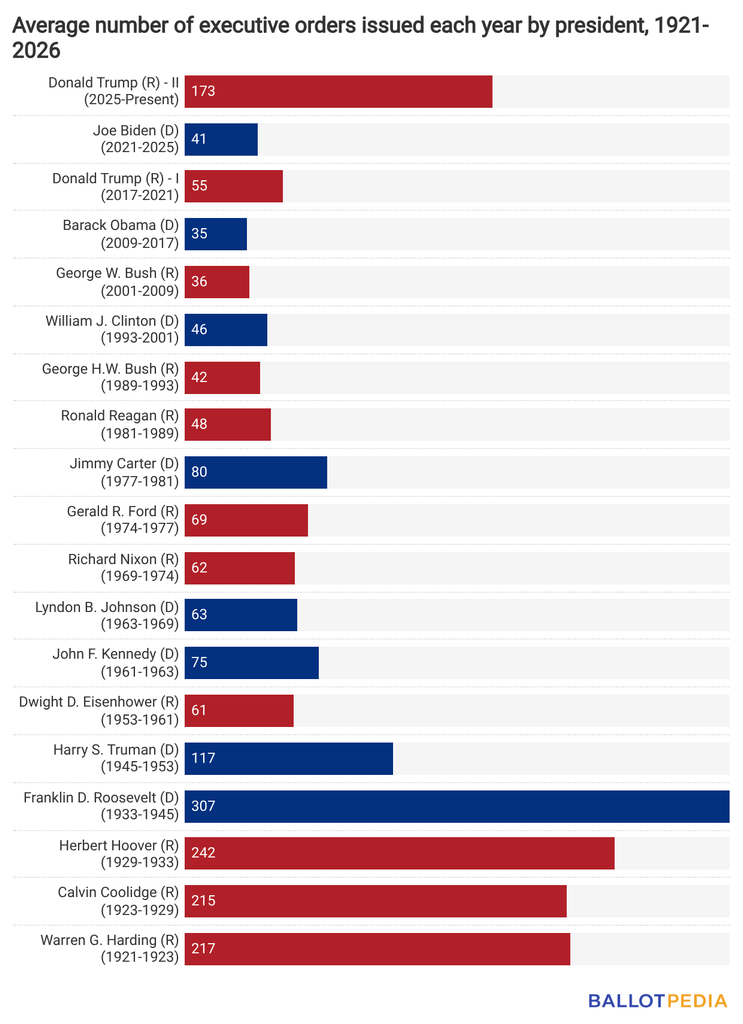
Trump has issued an average of 173 executive orders per year in office in his second term, the highest average among the seven presidents who have held office since 1981. In his first term, Trump averaged 55 executive orders per year, the second-highest in that time. Biden averaged 41 per year, the third-fewest in that time. Franklin D. Roosevelt (D) issued an average of 307 executive orders per year, the most of any U.S. president.
Click here for more information about Trump’s executive orders and actions in his second term.