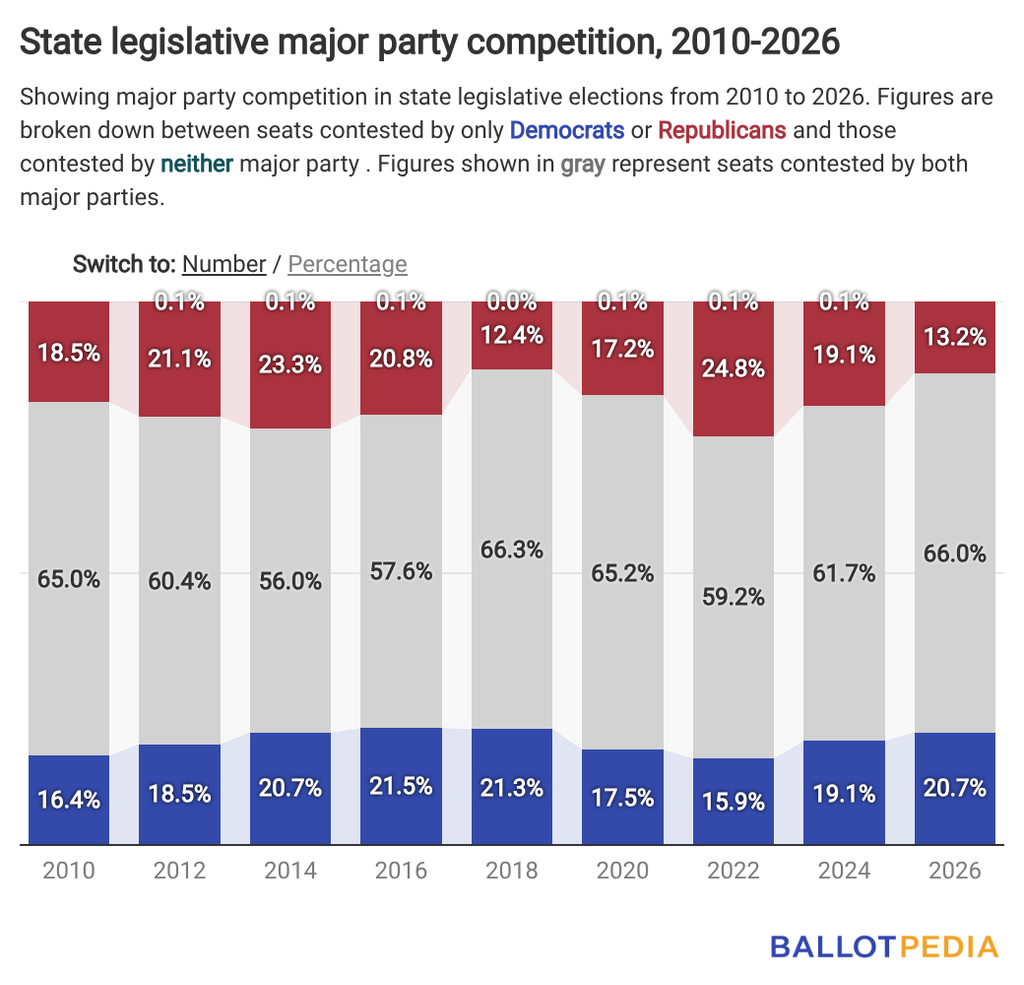
Both major parties are contesting 66% of the state legislative seats up for general election across the country this November. That is just shy of the 2018 record of 66.3%. Of the 6,137 total state legislative seats up for election, 2,085 (34%) are uncontested.
A seat has major party competition when candidates from both major parties are on the general election ballot. When only one major party is running for a seat, it has no major party competition and is effectively guaranteed to the major party candidate on the ballot.
Ballotpedia uses the level of major party competition to help determine the overall competitiveness of an election cycle. A larger number of seats without major party competition indicates fewer options on the ballot. A smaller number indicates more options.
Of the 2,085 uncontested seats:
- Democrats are guaranteed to win 1,272 seats (21%) that lacked Republican competition, a 27% increase from 2022.
- Republicans are guaranteed to win 813 seats (13%) that lacked Democratic competition, a 50% decrease from 2022.
The total number of seats without major party competition — 2,085 — was below the average of 2,343 since 2010 and a 19% decrease from 2022. One of the two major parties is guaranteed a simple majority in 17 chambers across 11 states due to the lack of major party competition.
The chart below compares states by the percentage of seats contested by each of the major parties. In states located in the upper-right corner, almost all seats are contested by both major parties.
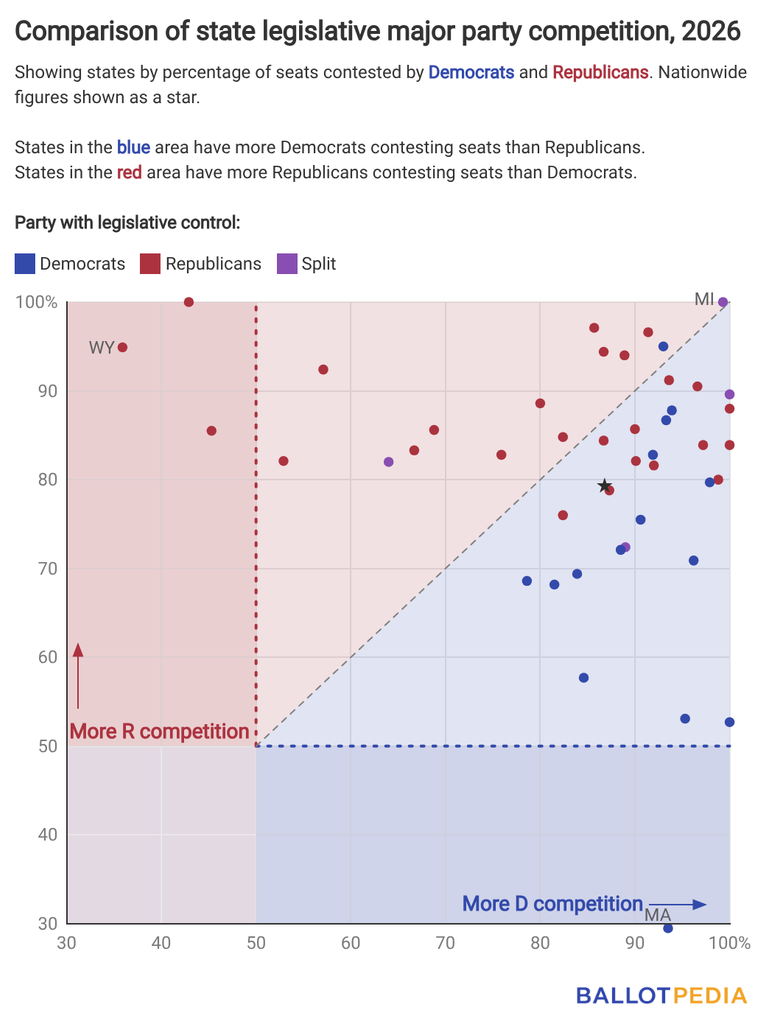
Across the 46 states with state legislative elections this year, 4,052 seats are contested by both major parties, representing 66% of the seats up for election. That is up from 59% of seats featuring major party competition in 2022.