Ballotpedia published its 16th Annual State Legislative Competitiveness Report analyzing all 6,137 state legislative seats that are up for election on November 3, 2026, in 46 states. Competitiveness in 2026 is the third-highest since 2010, behind only fellow midterm years 2018 (36.1) and 2022 (36.6).
In 2026, the nationwide State Legislative Competitiveness Index is 35.4, above the average of 34.0 between 2010 and 2024.
Compared to 2022, the most recent midterm year and overall most competitive year since 2010, the percentage of open seats is down from 23.8% to 17.3%, the percentage of incumbents in contested primaries is down from 26.8% to 22.8%, and the percentage of seats contested by both major parties in the general election (66.0%) is up from 59.2%, nearly matching the 2018 record of 66.3%.
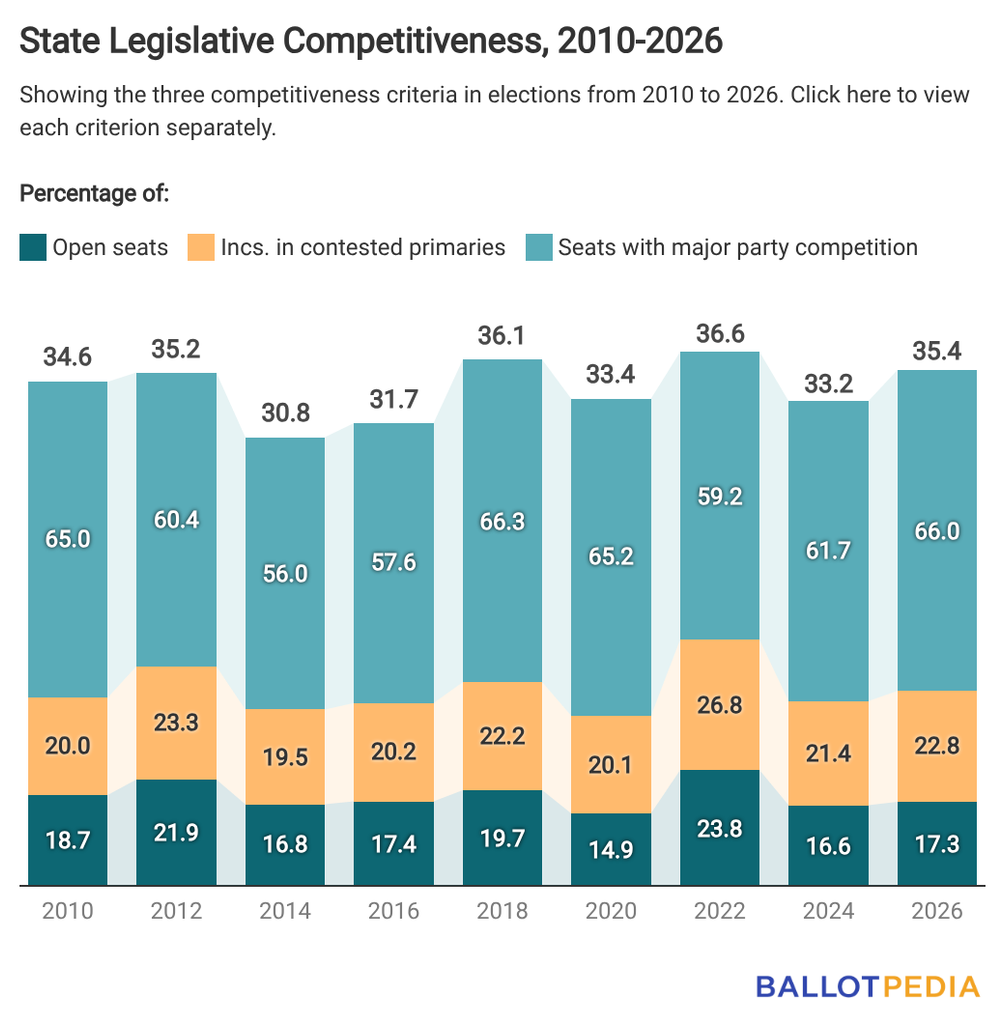
Here are the three components of the competitiveness score:
- 1,064 seats were open (17.3%), below the average of 18.7% each year since 2010.
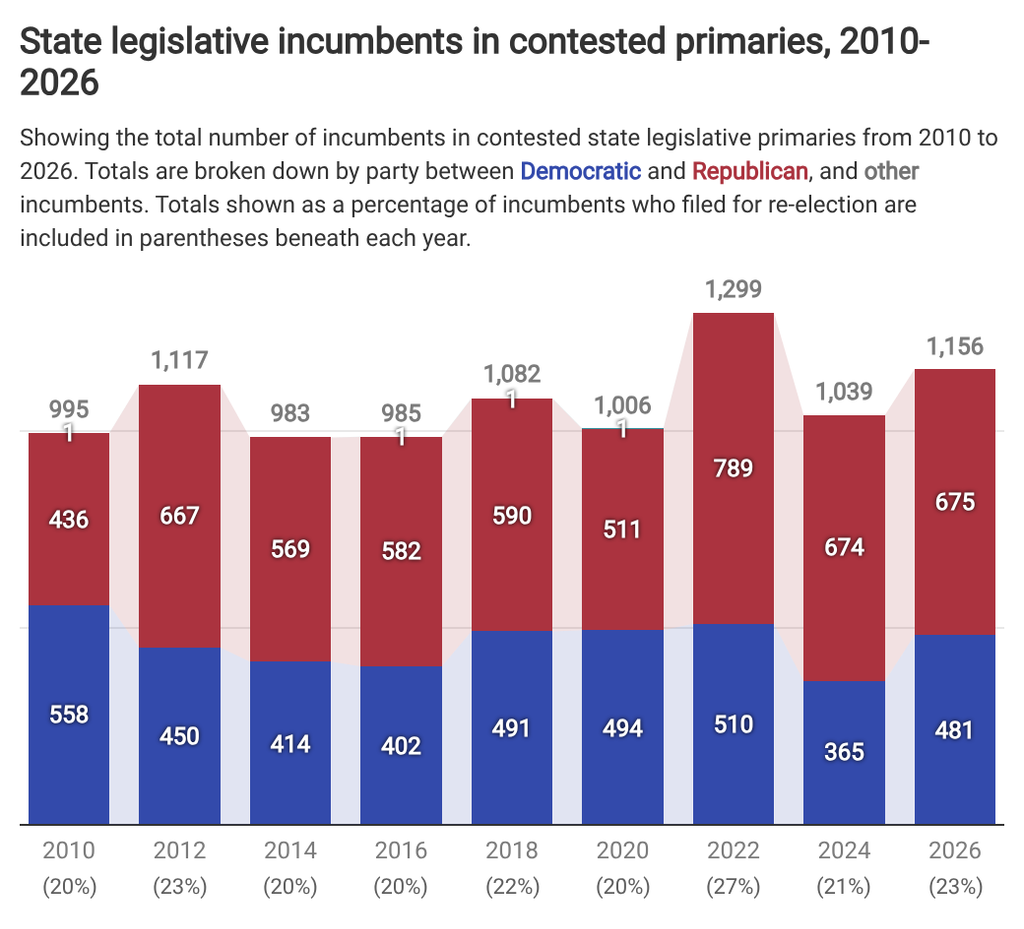
- 1,156 incumbents faced contested primaries (22.8%), above the average of 21.7% each year since 2010.
- 4,052 seats are contested by both major parties (66.0%), above the average of 61.4% each year since 2010.
Newcomers are guaranteed to win 17% of this year's state legislative races
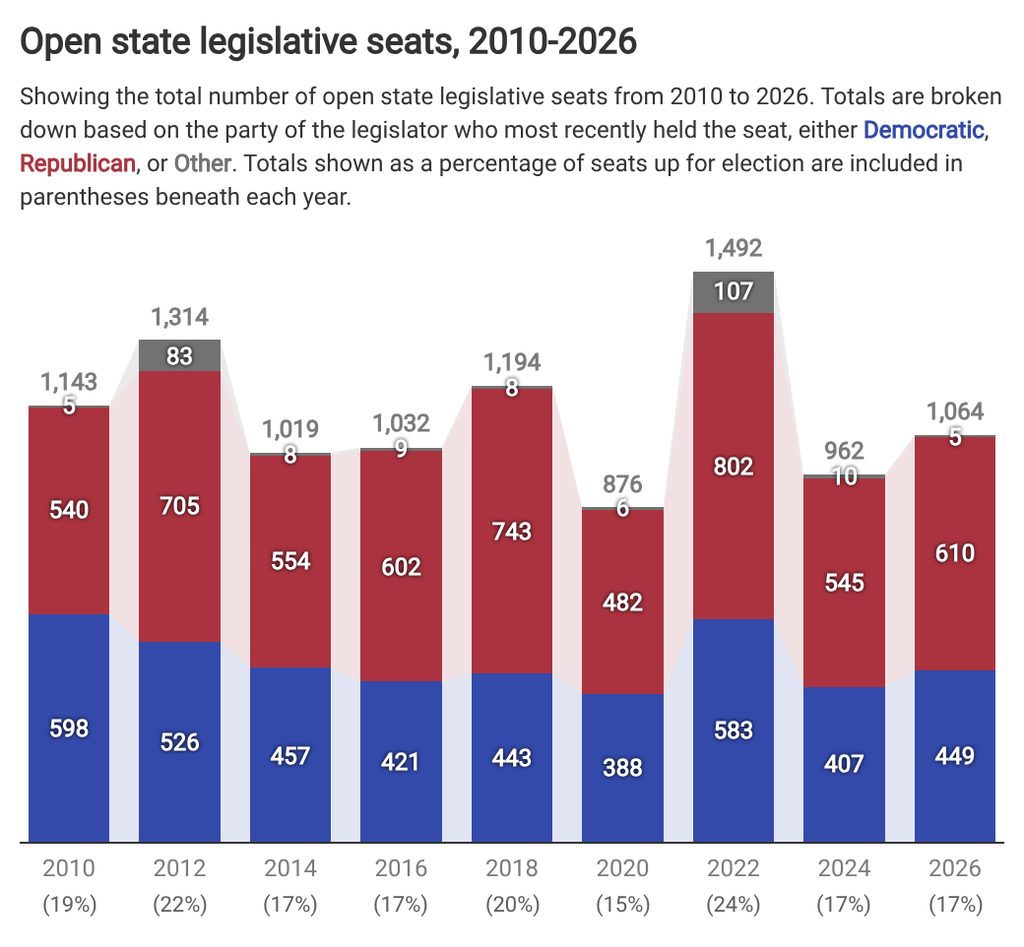
There are 1,064 open seats in this year’s state legislative elections, 17% of all 6,137 seats up for election. That is below the average of 19% in each cycle since 2010. Looking only at previous midterm election years since 2010, that average was 20%.
A greater number of open seats guarantees more newcomers entering legislatures and typically results in more candidates running for office. A smaller number of open seats guarantees fewer newcomers and typically results in fewer candidates running for office.
Across the 46 states holding state legislative elections this year, 449 Democrat-held seats are open, 610 Republican-held seats are open, and five independent or minor party seats are open. That is 6% below average for Democrats and 2% below average for Republicans. For independent and minor party seats, that ties 2010 for the record low.
Share of incumbents in contested primaries above average in 2026, but less than previous midterm
In 2026, there were 1,156 state legislative incumbents in contested primaries, representing 23% of all incumbents who filed for re-election. That tied 2012 for the second-highest percentage of contested incumbents since 2010, next to 2022 at 27%.
A larger number of contested primaries indicates more opportunities for voters to elect a non-incumbent to office. A smaller number indicates fewer of those opportunities.
Across the 46 states holding state legislative elections this year, 481 Democratic incumbents were contested, representing 21% of the 2,314 Democratic incumbents who filed for re-election. That was a 6% decrease from 2022. Republicans had 675 contested incumbents, 25% of the 2,737 Republican incumbents who filed for re-election and a 14% decrease from 2022.
Both major parties are contesting 66% of this year’s state legislative races
Both major parties are contesting 66% of the state legislative seats up for general election across the country this November. That is just shy of the 2018 record of 66.3%. Of the 6,137 total state legislative seats up for election, 2,085 (34%) are uncontested.
A larger number of seats without major party competition indicates fewer options on the ballot. A smaller number indicates more options.
The total number of seats without major party competition—2,085—was below the average of 2,343 since 2010 and a 19% decrease from 2022. One of the two major parties is guaranteed a simple majority in 17 chambers across 11 states due to the lack of major party competition.
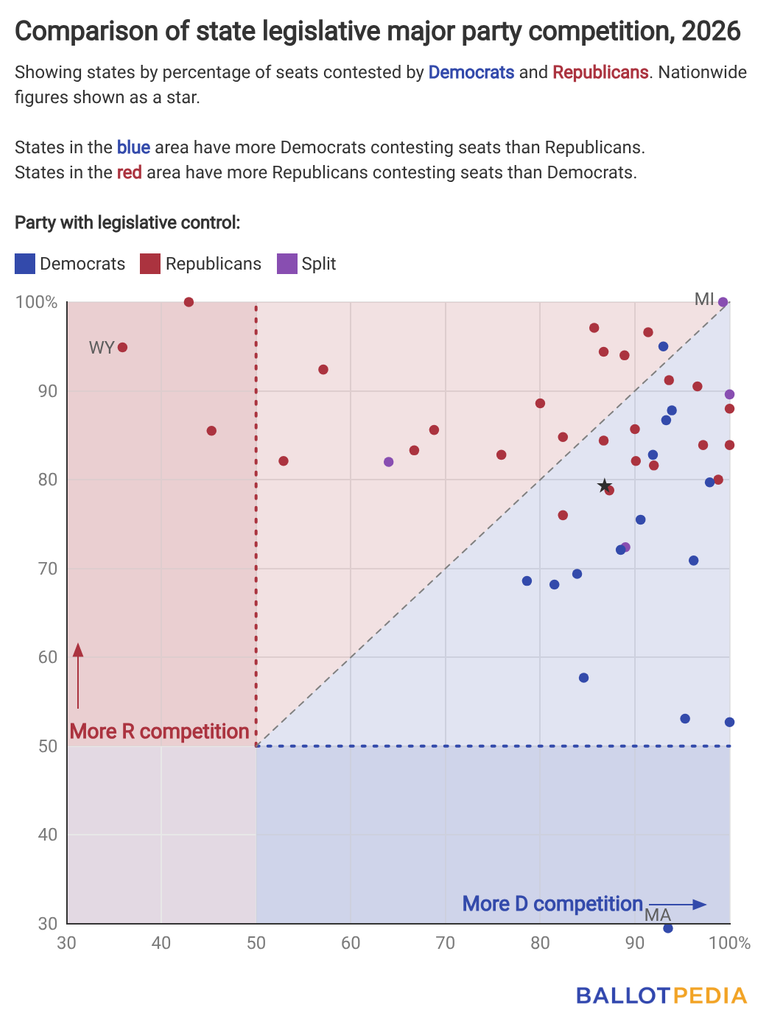
The chart below compares states by the percentage of seats contested by each of the major parties. In states located in the upper-right corner, almost all seats are contested by both major parties.