


Welcome to the Friday, Oct. 9, 2026, Brew.
By: Andrew Bahl
Here’s what’s in store for you as you start your day:
- This year has the most open state executive elections since 2018
- Utah to hold first elections since approving proof-of-citizenship requirement to register to vote in state or local elections
- Seven statewide write-in candidate filing deadlines are in the next two weeks
This year has the most open state executive elections since 2018
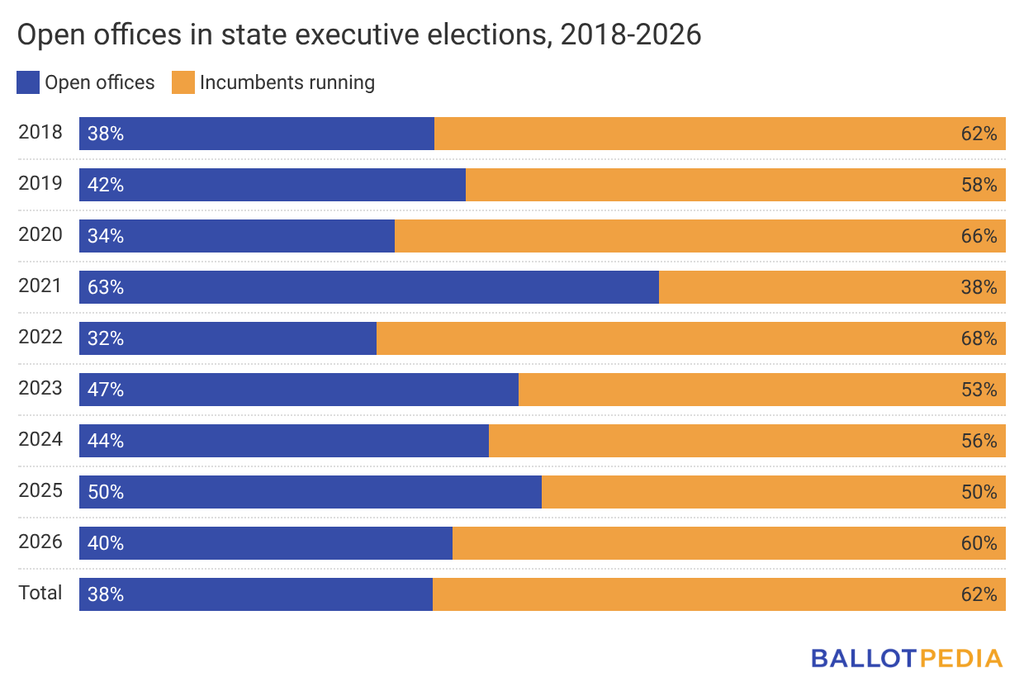
In the 2026 elections, 118 out of the 296 state executive offices up for election have no incumbent running, meaning those positions are open. This is the largest number of open offices since 2018, when we started collecting this data.
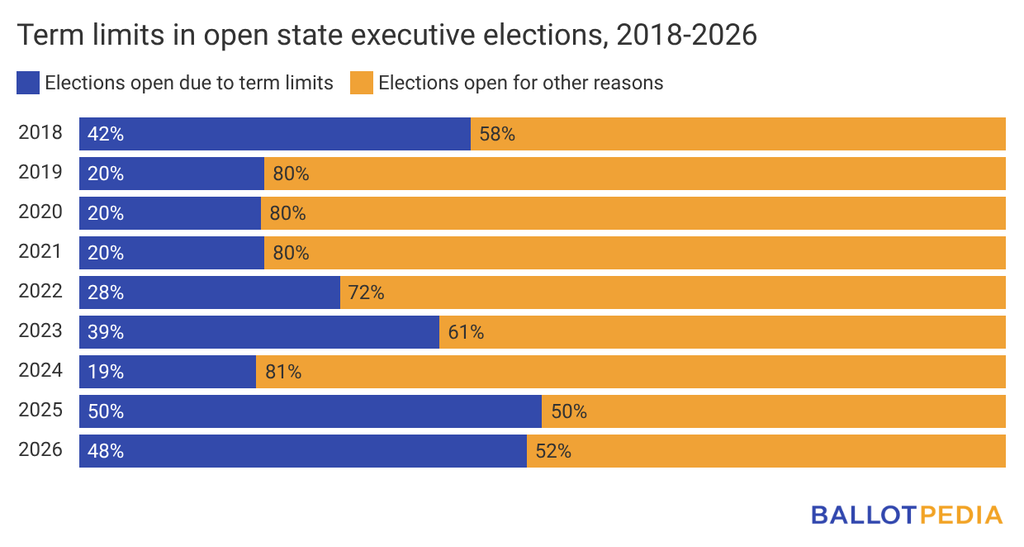
One contributing factor to this year’s number of open offices is term limits. Fifty-seven offices (48% of all 118 open offices) are open because of term limits, the largest total since 2018 and the highest percentage in an even year since 2018.
While 2026 has the highest total number of open offices since 2018, it does not have the highest percentage of open offices. This year, 39.8% of offices are open, down from 43.7% in 2024. Approximately 36.9% of these offices were open in even-year elections from 2018 to 2024, while roughly 63.1% had incumbents seeking another term.
Contested general elections
There are 287 general elections for 296 offices this year. Among those, 267 elections (93%) are contested, and 20 (7%) are uncontested. (Note: The number of total general elections differs from the total number of offices due to primaries that were won outright and multi-seat races.) That is both the largest number of contested general elections and the highest percentage of contested elections in an even year since 2018.
Of the 161 incumbents who are running in the general elections, 144 (89.4%) are contested and 17 (10.6%) are uncontested. That is more uncontested incumbents than in 2022 but fewer than 2018, the last two midterm election cycles. In 2022, there were 16 uncontested incumbents (8.6% of the 185 incumbents running in the general elections) and 307 offices up for election. In 2018, there were 19 uncontested incumbents (11.1% of the 171 incumbents running in the general elections) and 303 offices up for election.
Offices up in November and battlegrounds
The 296 offices up for election this year include
- 36 gubernatorial offices, 10 of which Ballotpedia has identified as battlegrounds
- 31 lieutenant gubernatorial offices
- 30 attorney general offices
- 26 secretary of state offices
- 173 down ballot offices
Primary competition
A total of 276 (50.5%) of a possible 546 primaries were contested, and 270 (49.5%) were uncontested. An average of 50% of state executive primaries were contested in even-year elections from 2018 to 2024.
Of the 161 incumbents running in the general elections, 85 advanced without a contested primary. Fifteen incumbents were defeated in primaries, primary runoffs, or conventions.
Notable primary defeats included:
- Rhode Island Gov. Daniel McKee, who lost to Helena Foulkes in the Democratic primary. McKee is the first Rhode Island governor to lose a primary since 1994.
- Indiana Secretary of State Diego Morales, who lost to Max Engling at the Republican nominating convention.
- Nebraska Secretary of State Bob Evnen, who lost to Scott Petersen in the Republican primary.
- South Dakota Secretary of State Monae Johnson, who lost to Heather Baxter at the Republican nominating convention.
- Alabama Public Service Commissioners Jeremy Oden, Chris Beeker, III, and Alabama State Board of Education member Marie Manning all lost in the Republican primaries for their seats.
Of the various types of executive offices, only seven exist in all 50 states: governor, attorney general, superintendent of schools, insurance commissioner, agriculture commissioner, labor commissioner, and public service commissioner. Other state executive offices include lieutenant governor, secretary of state, treasurer, controller, auditor, and more.
Click here to read our 2026 state executive competitiveness report. To read more about state executive official elections in 2026, click here.
Utah to hold first elections since approving proof-of-citizenship requirement to register to vote in state or local elections
Welcome to our next installment of our 50 States in 50 Days series, covering Utah. To view our archive of past editions, click here.
Utah is holding its first general election since the state adopted a law requiring individuals to provide proof of citizenship to register to vote in state or local elections. Utah is one of four states, along with Florida, Mississippi, and South Dakota, that enacted new or expanded proof-of-citizenship requirements this year. Nationally, 12 states have laws requiring proof of citizenship to register to vote in at least some cases, though some of these laws may not have been implemented or have been blocked by a court order.
According to the new Utah law, acceptable documents to demonstrate proof of citizenship include a Utah driver’s license or ID card number that verifies U.S. citizenship, a copy of a birth certificate or passport, or a Bureau of Indian Affairs card number. Individuals who do not provide proof of citizenship when registering to vote may only vote in federal elections.
Want to see what’s on your ballot this November? Click here to use our Sample Ballot Lookup Tool. Now let’s take a closer look at what’s happening in Utah.
Utah is an all-mail voting state. All registered voters are mailed an absentee/mail-in ballot before the election. Ballots must be received by Nov. 3. Under a 2025 law, election officials must receive mail-in ballots, or ballots must be deposited in a drop box, by 8 p.m. on Election Day. Previously, ballots were counted as long as they were postmarked by Election Day and received before noon on the date of the county canvass.
Voters wishing to vote in person on Election Day may do so at vote centers between 7:00 a.m. and 8:00 p.m.
Early voting opens Oct. 20 and ends Oct. 30.
Voter ID is required. Voters must provide either one primary form of ID, such as a Utah driver’s license or ID card, passport, or tribal ID, or two other forms of ID that prove their name and current residence, such as a utility bill, bank statement, birth certificate, hunting or fishing license, or student ID. Voters must provide the last four digits of their driver's license, ID card, or Social Security number when returning a mail-in ballot. If voters do not provide those numbers, election officials will attempt to match the voter's signature on the envelope affidavit to the signature on file. For more information on voter ID in Utah, click here.
Current party control
Republicans represent all four congressional districts. Both of Utah's U.S. Senators are also Republicans. Republicans have a 22-6-1 majority in the Utah Senate and a 60-14 majority with one vacancy in the Utah House of Representatives.
Because the governor is a Republican, Utah is one of 23 states with a Republican trifecta. Utah’s attorney general is also a Republican. Utah is one of three states that does not have a secretary of state. Republicans appointed all seven members of the Utah Supreme Court.
Offices on the ballot
Elections are taking place for the U.S. House of Representatives, eight seats on the State Board of Education, 15 state senate seats, and all 75 state house seats.
In 2024, the Utah Supreme Court ruled that the Legislature's override of a 2018 ballot initiative likely violated voters' constitutional right to participate in government. The initiative, Proposition 4, established a redistricting commission to draw congressional, state legislative, and school board district boundaries for the Legislature to consider. In 2025, Third District Court Judge Dianna Gibson struck down the state’s congressional maps, enacted in 2021. Gibson rejected a redrawn map proposed by the Legislature that would have maintained four Republican-leaning districts in favor of a proposal from the plaintiffs in the case that adds one Democratic-leaning district.
One justice on the state supreme court and six Utah intermediate appellate court judges will also face retention elections.
Battleground elections
Utah Supreme Court: Justice Jill Pohlman, who Gov. Spencer Cox (R) appointed in 2022, is standing for retention this year. This election is taking place amid a conflict between the court and Republicans in state government following the July 2024 ruling on Proposition 4. A second justice set to stand for retention in November, Diana Hagen, resigned from the court in May.
Statewide ballot measures
Utah voters will decide on two ballot measures on Nov. 3. Between 1895, the year before statehood, and 2025, Utahns have voted on 220 ballot measures, averaging about three per even-numbered year. Of those 220 measures, 140 (63.6%) were approved, and 80 (36.4%) were defeated.
Both measures on the 2026 ballot are constitutional amendments that the Legislature placed on the ballot. Utah voters have approved 132 of 188 (70.2%) of legislatively referred constitutional amendments since 1895.
Constitutional Amendment A would require that constitutional amendments be published 60 days before the general election in which they are scheduled to be on the ballot. Currently, the Utah Constitution specifies that any proposed constitutional amendment must be published in at least one newspaper in every county in the state for two months before the election. In effect, the ballot measure would remove that specification and permit the Legislature to determine how proposed constitutional amendments are to be published.
Constitutional Amendment A is on the ballot two years after two ballot measures were invalidated because they didn’t meet the newspaper publication requirement.
Constitutional Amendment B would require that citizen initiatives proposing certain tax-related changes receive at least 60% of the vote to be approved. This threshold would apply to measures that:
- Create a new tax
- Expand an existing tax to include items or transactions that were not previously subject to the tax under state law
- Increase an existing tax rate
- Alter a property tax rate, causing it to decrease less than it otherwise would under state law.
Constitutional Amendment B is one of nine ballot measures in seven states related to the initiative and referendum process on the ballot this year.
Join us next edition when we'll preview elections in Louisiana, the Pelican State.
Click here to see every edition of 50 States in 50 Days as we publish them, and here to use our Sample Ballot Lookup Tool.
Seven statewide write-in candidate filing deadlines are in the next two weeks
With just over three weeks until the November midterm elections, remaining write-in candidate filing deadlines and voter participation deadlines are coming up fast.
Seven states and the Virgin Islands have write-in candidate filing deadlines between Oct. 10 and Oct. 23.
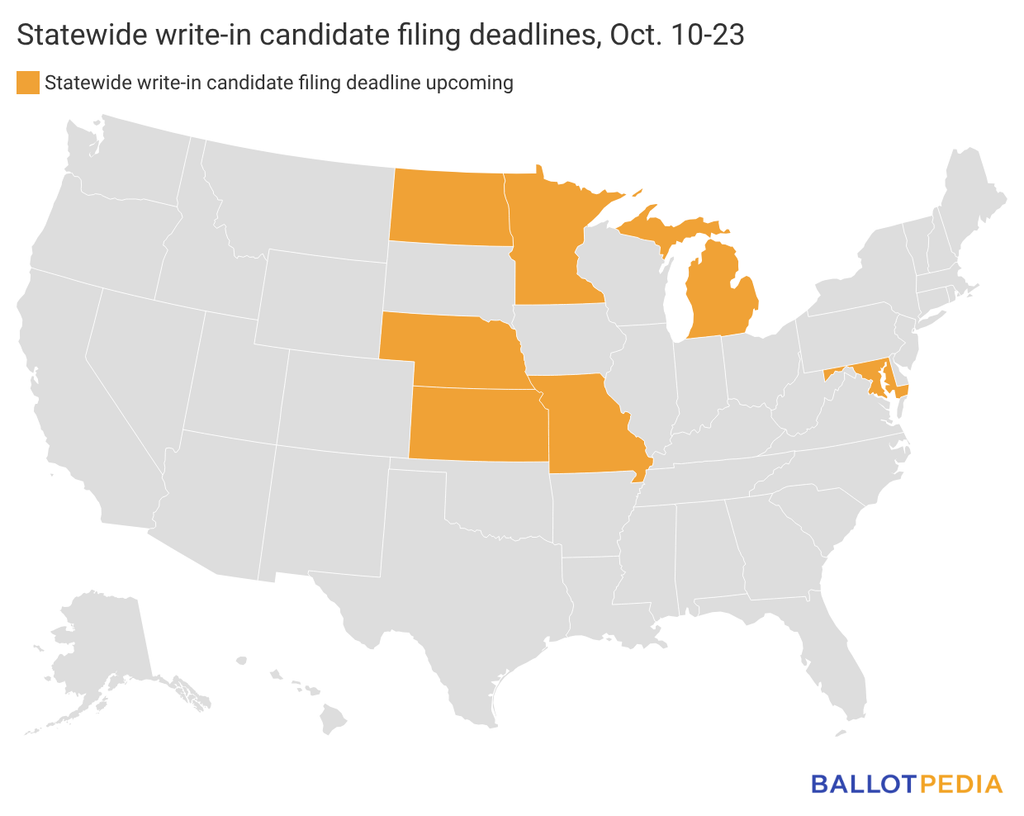
- Kansas: Oct. 12 (statewide write-in candidate filing deadline)
- Maryland: Oct. 15 (statewide write-in candidate filing deadline)
- Michigan: Oct. 23 (statewide write-in candidate filing deadline)
- Minnesota: Oct. 15 (statewide write-in candidate filing deadline)
- Missouri: Oct. 23 (statewide write-in candidate filing deadline)
- Nebraska: Oct. 23 (statewide write-in candidate filing deadline)
- North Dakota: Oct. 13 (statewide write-in candidate filing deadline)
- Virgin Islands: Oct. 19 (territory-wide write-in candidate filing deadline)
Candidates must meet various state-specific filing requirements and deadlines to appear on primary and general election ballots. These regulations, known as ballot access laws, determine whether and how candidates can make it onto the ballot. These laws are set at the state level and apply to candidates running for state and federal offices.
Most states allow voters to write in the name of a candidate who does not appear on the ballot in a general election. In 31 states, write-in candidates must file before the election in order for their votes to be counted.
Voter participation deadlines
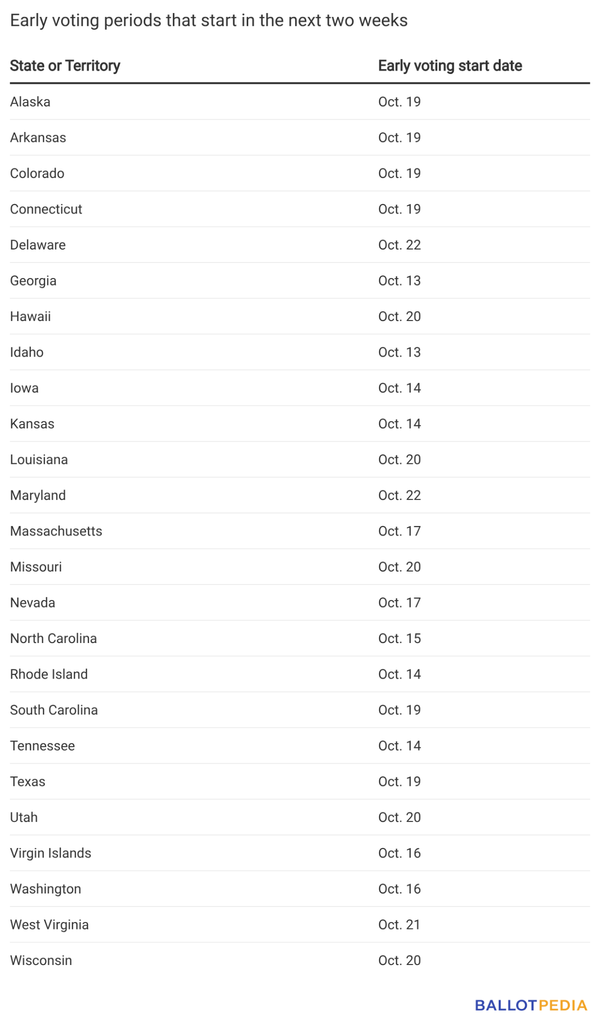
Twenty-four states and the Virgin Islands have early voting periods that start in the next two weeks:
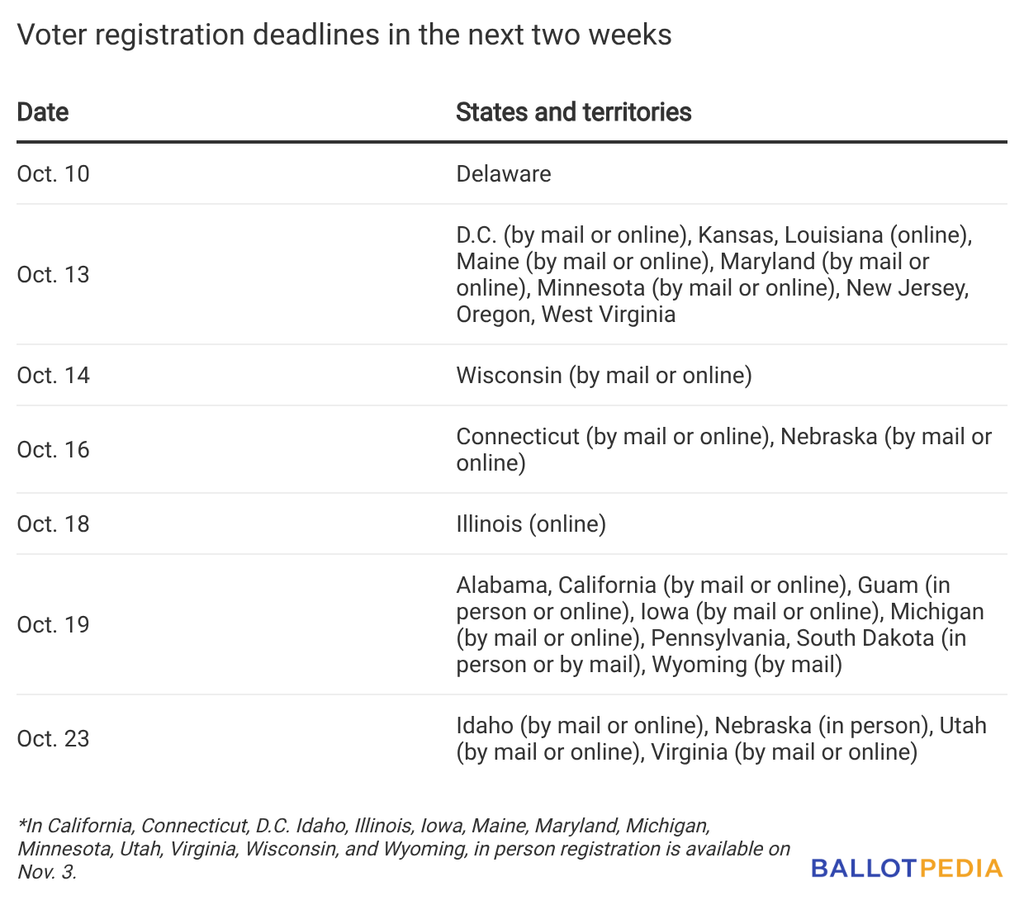
Twenty-three states, the District of Columbia, and Guam have voter registration deadlines in the next two weeks:
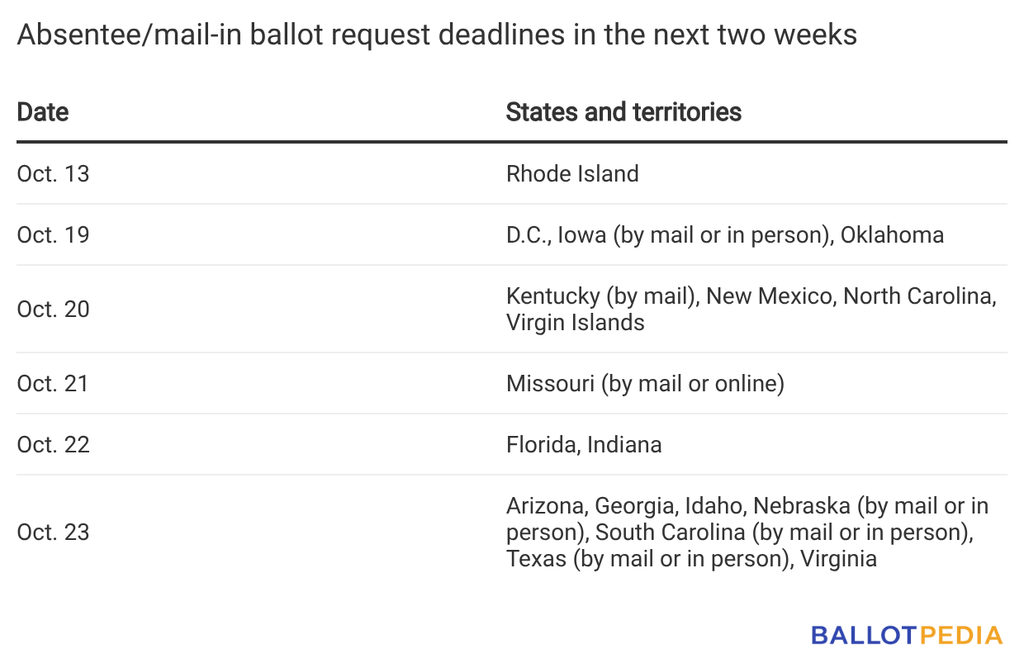
Sixteen states, the District of Columbia, and the Virgin Islands have absentee/mail-in ballot request deadlines in the next two weeks:
Click here to see our list of upcoming election dates and filing deadlines.