


Welcome to the Monday, Oct. 12, 2026, Brew.
By: Briana Ryan
Here’s what’s in store for you as you start your day:
- This year's state legislative elections are the third most competitive since 2010
- Louisiana to use a new congressional map in this year’s elections
- Federal Register adds 22,454 pages in the third quarter of 2026 — the second-highest of President Donald Trump's second term
This year's state legislative elections are the third most competitive since 2010
State legislative elections are the third most competitive this year than they've been since 2010, driven by an above average percentage of incumbents who faced contested primaries and seats contested by both major parties in the general election.
According to our 16th Annual State Legislative Competitiveness Report, competitiveness across all 6,137 state legislative seats up for election on Nov. 3 in 46 states trails only the two other most recent midterm years in that time — 2018 and 2022. This year, our overall competitiveness index score for the year is 35.4, above the average of 34.0 between 2010 and 2024.
That score is based on three factors each year: the percentage of open seats, contested primaries, and general elections contested by both major political parties.
Here are the three components of the competitiveness score:
- 4,052 seats are contested by both major parties (66.0%), above the average of 61.4% each year since 2010.
- 1,156 incumbents faced contested primaries (22.8%), above the average of 21.7% each year since 2010.
- 1,064 seats are open (17.3%), below the average of 18.7% each year since 2010.
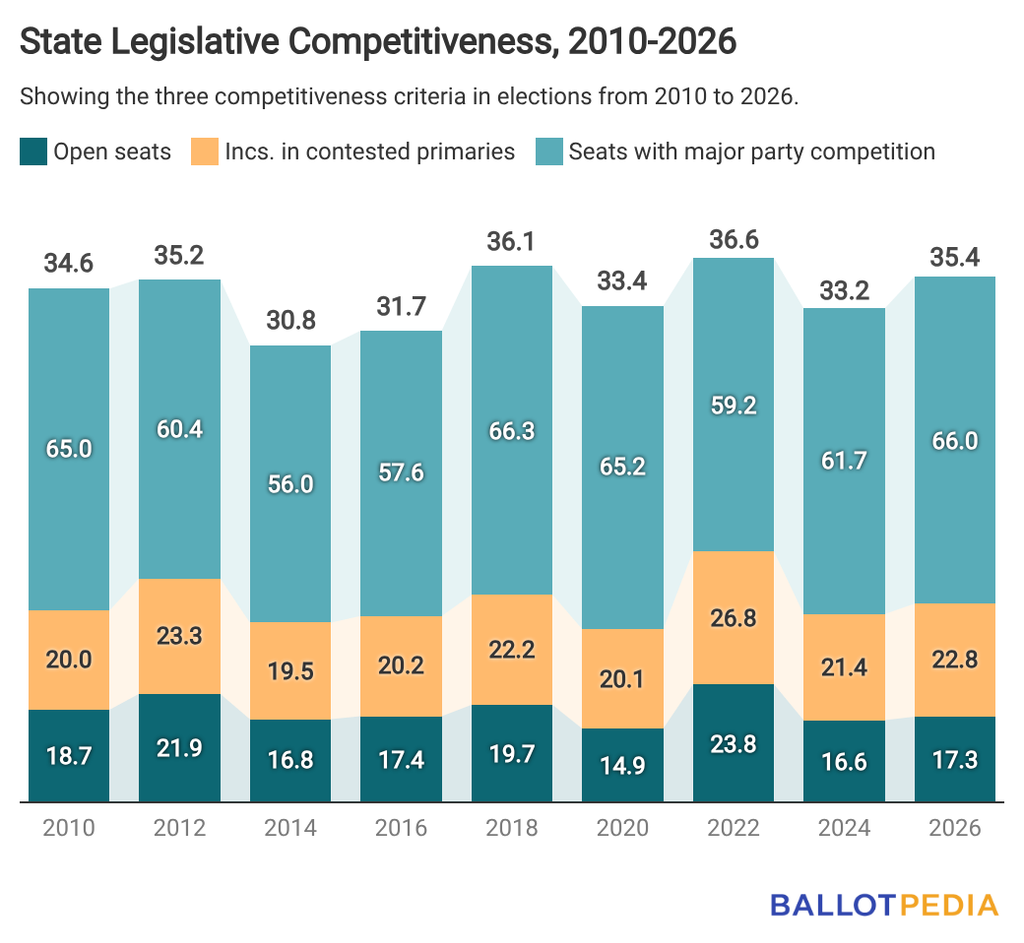
Both major parties are contesting 66% of this year’s state legislative races
Both major parties are contesting 66% of the state legislative seats up for election. That is just shy of the 2018 record of 66.3% since 2010. Of the 6,137 total state legislative seats up for election, 2,085 (34%) are uncontested.
A larger number of seats without major party competition indicates fewer options on the ballot. A smaller number indicates more options.
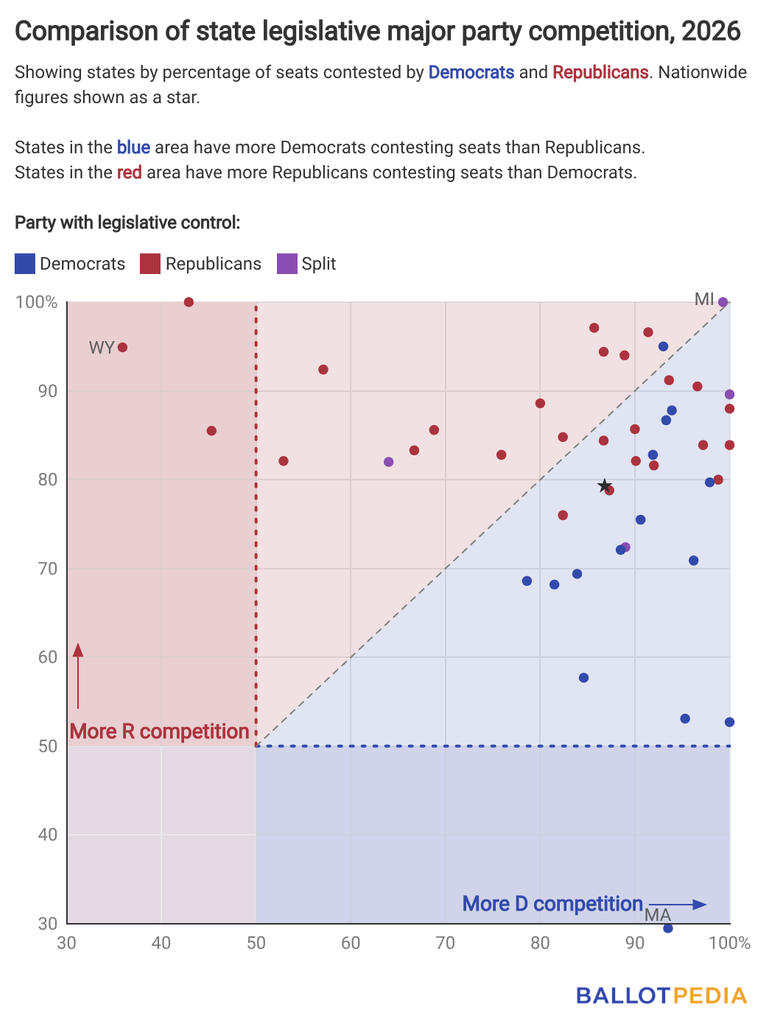
The total number of seats without major party competition — 2,085 — was below the average of 2,343 since 2010 and a 19% decrease from 2022. One of the two major parties is guaranteed a simple majority in 17 chambers across 11 states due to the lack of major party competition.
The chart below compares states by the percentage of seats contested by each of the major parties. In states located in the upper-right corner, almost all seats are contested by both major parties.
Share of incumbents in contested primaries above average in 2026, but less than previous midterm
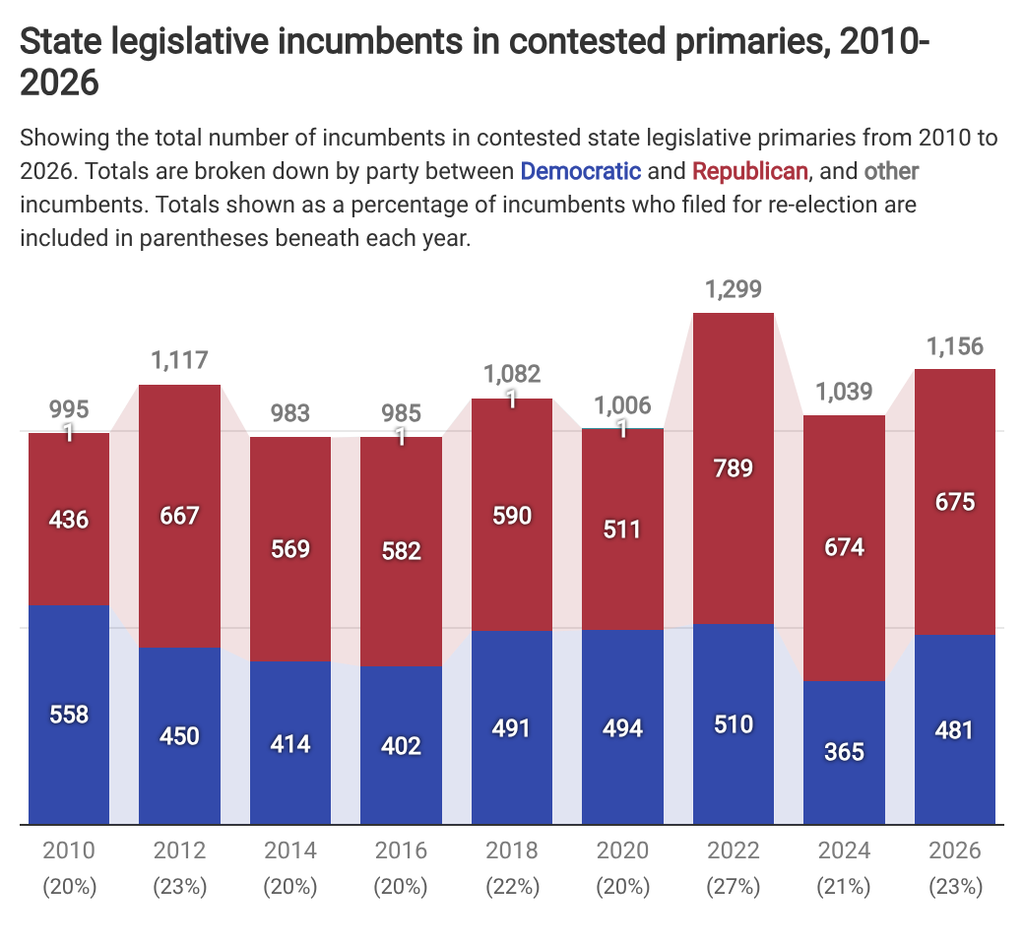
In 2026, there were 1,156 state legislative incumbents in contested primaries, representing 23% of all incumbents who filed for re-election. That tied 2012 for the second-highest percentage of contested incumbents since 2010, next to 2022 at 27%.
A larger number of contested primaries indicates more opportunities for voters to elect a non-incumbent to office. A smaller number indicates fewer of those opportunities.
Across the 46 states holding state legislative elections this year, 481 Democratic incumbents were contested, representing 21% of the 2,314 Democratic incumbents who filed for re-election. That was a 6% decrease from 2022. Republicans had 675 contested incumbents, 25% of the 2,737 Republican incumbents who filed for re-election and a 14% decrease from 2022.
Newcomers are guaranteed to win 17% of this year's state legislative races
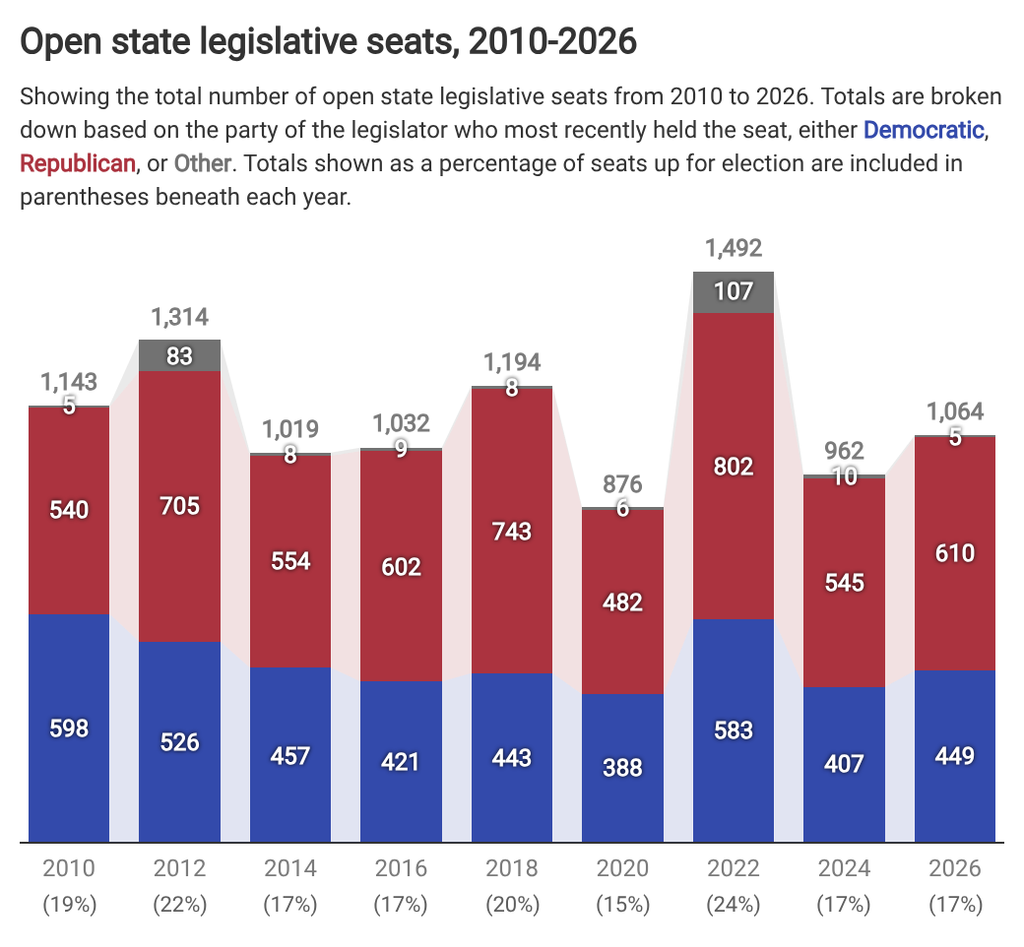
There are 1,064 open seats in this year’s state legislative elections, 17% of all 6,137 seats up for election. That is below the average of 19% in each cycle since 2010.
A greater number of open seats guarantees more newcomers entering legislatures and typically results in more candidates running for office. A smaller number of open seats guarantees fewer newcomers and typically results in fewer candidates running for office.
Across the 46 states holding state legislative elections this year, 449 Democrat-held seats are open, 610 Republican-held seats are open, and five independent or minor party seats are open. That is 6% below average for Democrats and 2% below average for Republicans. For independent and minor party seats, that ties 2010 for the record low.
Click here to read Ballotpedia's 16th Annual State Legislative Competitiveness Report.
Louisiana to use a new congressional map in this year’s elections

Welcome to our next installment of our 50 States in 50 Days series, covering Louisiana. To view our archive of past editions, click here.
Louisiana will use a different congressional map in this year’s elections than it did in 2024. Louisiana redrew its congressional district boundaries following the U.S. Supreme Court ruling in Louisiana v. Callais. The decision affected how Section 2 of the Voting Rights Act (VRA), which prohibits voting practices and procedures that discriminate on the basis of race, is applied in disputes over district boundaries.
Based on the 2024 presidential election results, the new map would result in Republicans winning the 6th Congressional District — one of the state’s two Democratic-held congressional districts.
Louisiana is using a semi-closed primary system for this year’s U.S. Senate and state executive elections. Under this system, candidates advanced from partisan primaries to the general election.
However, Louisiana will use the majority-vote system for elections for the U.S. House of Representatives. Under this system, candidates of all parties are running on the same ballot on Nov. 3. If a candidate wins a simple majority of all votes cast for the office, they win the election outright. If no candidate meets that threshold, the top two finishers, regardless of their partisan affiliations, advance to a second election on Dec. 12. In that election, the candidate who receives the greatest number of votes wins.
Voters must register in person or via mail by Oct. 5. Voters can also register online by Oct. 13.
Early voting opens Oct. 20 and ends Oct. 27.
Polls open on Election Day at 6 a.m. and close at 8 p.m.
Voter ID is required. Acceptable forms of ID include a Louisiana driver's license or special ID, a digital driver's license, a military ID, or another generally recognized picture ID that contains the voter’s name and signature. If a voter does not have an acceptable form of ID, they may instead fill out an affidavit. For more information on voter ID in Louisiana, click here.
Absentee/mail-in ballots must be requested by Oct. 30 and received by Nov. 2. Under a 2025 law, voters notified of a deficiency on their absentee by mail ballot certificate may receive a replacement ballot, either in person or via an immediate family member.
Current party control
Republicans represent four congressional districts, and Democrats represent two. Both of Louisiana's U.S. Senators are Republicans.
Republicans have a 28-10 majority in the Louisiana Senate, with one vacancy, and a 71-32 majority in the Louisiana House of Representatives, with two vacancies. Because the governor is a Republican, Louisiana is one of 23 states with a Republican trifecta. Louisiana's attorney general and secretary of state are also Republicans. As a result, Louisiana is one of 24 states with a Republican triplex. There are four Republican justices, two Democratic justices, and one Independent justice on the Louisiana Supreme Court.
Offices on the ballot
Elections are taking place for the U.S. Senate and U.S. House.
One seat on the Louisiana Board of Elementary and Secondary Education and two seats on the Louisiana Public Service Commission are also up for election.
School board elections are taking place in the following districts: Caddo Parish Public Schools, Calcasieu Parish Public Schools, East Baton Rouge Parish School System, Jefferson Parish Public School System, and St. Tammany Parish Public Schools.
There are also elections for district attorney, constable, and judicial offices happening in Baton Rouge and New Orleans.
Notable elections
6th Congressional District: Ten candidates — three Democrats, six Republicans, and one Libertarian — are running in the open district. In the 2024 presidential election, using the district’s old boundaries, Kamala Harris (D) defeated President Donald Trump (R) in the district 57% to 42%. Based on the new boundaries, Trump would have defeated Harris 64% to 34%. As a result, this district is one of 23 Democratic-held districts that Trump won in 2024.
East Baton Rouge Parish Family Court Section 3 Division A: Incumbent Caulette Jackson Guillard (D) and Joseph Cataldie (R) are running. This race is a rematch of the June 27 special election for the seat in which Jackson Guillard defeated Cataldie 51.3% to 48.7%. According to Jackson Guillard's Candidate Connection survey, "Guillard states that she is committed to applying the law fairly and impartially. She says that judicial decisions should be grounded in the law and based on the specific facts of each case." According to Cataldie's Candidate Connection survey, "Every family deserves a judge who will listen, apply the law consistently, and make decisions rooted in fairness and compassion. Joseph will ensure that every person who walks into Family Court is treated with dignity and respect, regardless of background or circumstance."
Statewide ballot measures
There are 10 statewide measures on the ballot this year. Between 2000 and 2025, Louisiana voters decided on 172 measures, averaging 13 per even-numbered year. During that period, voters approved 119 measures and defeated 53.
Among those 10 measures are five regarding property taxes. In total, seven states will decide on 12 property tax measures nationwide on Nov. 3. The measures in Louisiana include Amendment 1, Amendment 2, Amendment 6, Amendment 9, and Amendment 10.
Local ballot measures
East Baton Rouge Parish voters will decide on three local ballot measures, and Orleans Parish voters will decide on six.
Join us again in our next edition when we'll preview elections in Missouri, the Show Me State.
Click here to see every edition of 50 States in 50 Days as we publish them, and here to use our Sample Ballot Lookup Tool.
Federal Register adds 22,454 pages in the third quarter of 2026 — the second-highest of President Donald Trump's second term
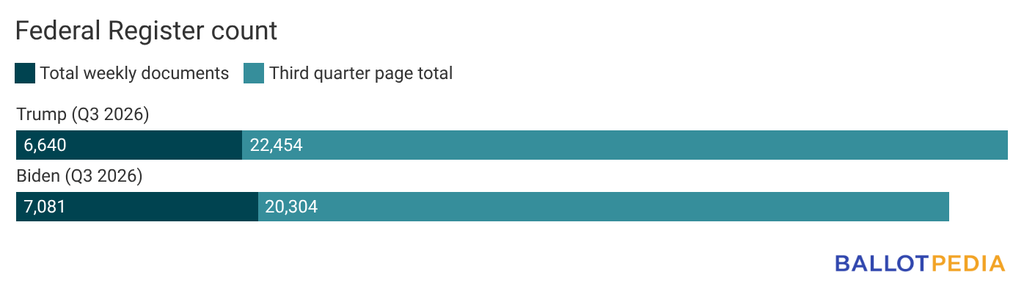
The federal government added 22,454 pages to the Federal Register in the third quarter of 2026, spanning from July 1 to Sept. 30. This is the second-highest number of pages that the government added during the second Trump administration. The second quarter of 2026 had the highest number of pages, during which the government added 23,692 pages. The third-highest was the third quarter of 2025, during which the government added 19,256 pages.
The 22,454 pages make up 6,640 documents that the government added to the Federal Register during the quarter. Four years earlier, during the Biden administration, the government added 7,081 documents and 20,304 pages in the third quarter of 2022.
Here's a breakdown of the 6,640 documents added last quarter:
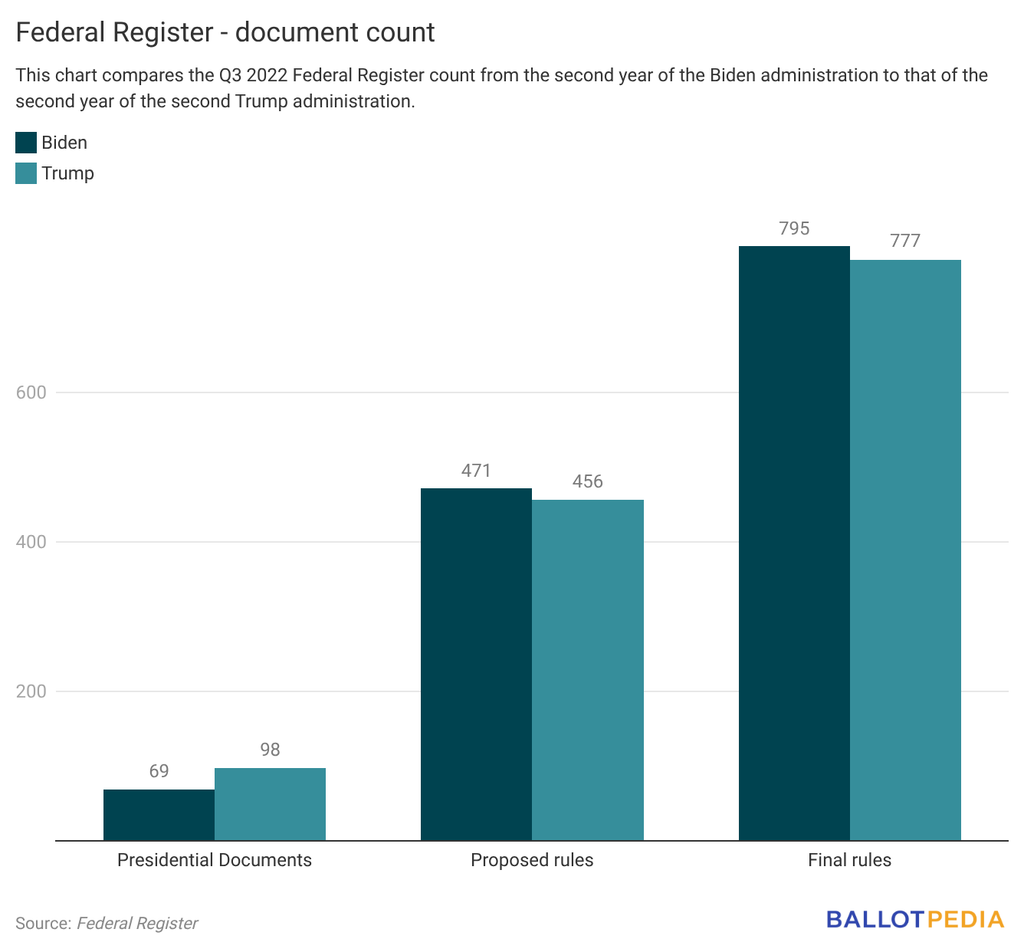
- 5,327 notices
- 98 presidential documents
- 456 proposed rules
- 777 final rules
In the third quarter of 2026, administrative agencies proposed 37 significant rules, issued 56 significant final rules, and issued no significant notices. A 1993 executive order defines significant rules as those that could have large effects on the economy, environment, public health, or state or local governments.
The Office of Information and Regulatory Affairs (OIRA) determines which rules meet this definition and are subject to its review. Significant actions may also conflict with presidential priorities or other agency rules.
The Trump administration issued 71 significant proposed rules, 110 significant final rules, and 10 significant notices in 2025.
The Federal Register is a daily journal of federal government activity that includes presidential documents, proposed and final rules, and public notices. It is a common measure of an administration's regulatory activity, accounting for both regulatory and deregulatory actions.
Ballotpedia maintains page counts and other information about the Federal Register as part of our coverage of the administrative state. Click here to see our full coverage of changes to the Federal Register.