


Welcome to the Wednesday, Oct. 14, 2026, Brew.
By: Briana Ryan
Here’s what’s in store for you as you start your day:
- Republicans cannot lose more than two seats to keep control of the U.S. House, Democrats need to gain three for a majority
- Pennsylvania could gain a Democratic or Republican trifecta, or remain divided, after Nov. 3
- Incumbent John McCann and Francisco Tamayo are running for mayor of Chula Vista, one of 21 top-100 U.S. cities with a Republican mayor
Republicans cannot lose more than two seats to keep control of the U.S. House, Democrats need to gain three for a majority
Welcome to the next installment of our series previewing the Nov. 3 elections by office. Next up: the U.S. House of Representatives.
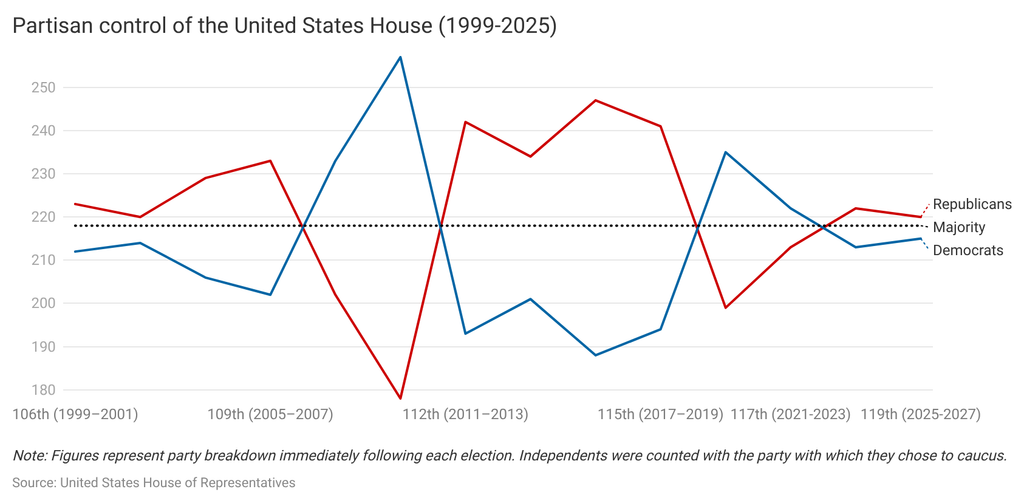
Ahead of this year's general elections, the U.S. House is made up of 218 Republicans, 214 Democrats, and one independent who caucuses with Republicans. Two districts are vacant — one last held by a Democrat, and one by a Republican.
The elections will determine whether Republicans can hold on to the majority they gained in the chamber in the 2022 general elections or whether Democrats will regain a majority. Democrats need a net gain of three districts to gain control of the chamber, while Republicans can afford to lose only two districts and still maintain control.
Democrats are defending 22 districts that President Donald Trump (R) would have won in the 2024 presidential election under the district lines in effect for the 2026 general elections. Republicans are defending eight districts that Kamala Harris (D) would have won under those same lines.
One of the biggest storylines we've been following this election cycle is the number of retirements. The 60 incumbents — 23 Democrats and 37 Republicans — not seeking re-election is the most in any election cycle since we started tracking this data in 2012.
Battlegrounds
We have identified 50 districts as battlegrounds this year. Democrats are defending 26 battleground districts, and Republicans are defending 24. Battlegrounds are the elections that we expect to have a meaningful effect on the balance of power or to be particularly competitive or compelling.
Key trends to watch
- Special elections: There were seven special elections between one Democrat and one Republican to fill vacancies in the U.S. House during the 119th Congress. None of those special elections resulted in a change in partisan control. In the three Democratic-held districts, Democratic candidates had larger margins of victory (MOVs) than Harris had in those districts in the 2024 presidential election. In the four Republican-held districts, Republicans had smaller margins of victory than Trump had in the 2024 presidential election. According to Boise State University's Charlie Hunt, "Because fewer people turn out for special elections, they're considered an early predictor of partisan enthusiasm heading into regularly scheduled elections." Hunt also said that "special elections, while useful metrics, are far from perfect barometers of public opinion. They take place at different times, and could be just as reflective of hyperlocal factors, such as flawed candidates, as they are of nationalized partisan conditions."
- Mid-decade redistricting: Six states — California, Florida, North Carolina, Ohio, Tennessee, and Texas — passed new congressional maps between the 2024 and 2026 general elections, and litigation had led to new maps in Alabama, Louisiana, and Utah. Before 2025, only two states had conducted voluntary mid-decade redistricting since 1970. Based on the 2024 presidential election results, the new maps could result in Republicans gaining a net of nine districts.
- Presidential election aftermath: This year's general elections will be the first since the 2024 presidential election. In the lead-up to Election Day, there has been some media speculation about whether there will be a wave election. In 2018, we published a study of wave elections examining the results of the 50 election cycles between 1918 and 2016. In that study, we defined wave elections as the 20% of elections resulting in the greatest swing against the president's party. For the U.S. House, the president's party needed to lose 48 districts in a given year to qualify as a wave election historically. Including both presidential and midterm years, the president's party has lost 48 or more districts in 11 of the 50 election cycles between 1918 and 2024.
- Round two: This year, 44 general elections are rematches between the same candidates who ran in 2024. Democrats won 23 of those districts in 2024, and Republicans won 21. Ten of those 44 races were decided by 10 percentage points or fewer in 2024.
Recent election history
In the 2024 general elections, Republicans won 220 districts, maintaining control of the chamber, and Democrats 215.
For more information on this year's U.S. House general elections, click here.
Pennsylvania could gain a Democratic or Republican trifecta, or remain divided, after Nov. 3

Welcome to our next installment of our 50 States in 50 Days series, covering Pennsylvania. To view our archive of past editions, click here.
The Nov. 3 elections could result in Pennsylvania having a Democratic or Republican state government trifecta. It could also result in Pennsylvania remaining a divided state government. Incumbent Gov. Josh Shapiro (D), Stacy Garrity (R), and Ken Krawchuk (L) are running for governor. Additionally, 25 seats in the Pennsylvania Senate and all 203 seats in the Pennsylvania House of Representatives are up for election.
Republicans have a 27-23 majority in the state Senate, and Democrats have a 103-100 majority in the state House. Because the governor is a Democrat, Pennsylvania is one of 11 states with a divided government.
We assessed a moderate possibility that either party could form a trifecta in Pennsylvania. Democrats would need to maintain the governorship, and Republicans would need to gain it. Democrats would need to win at least three seats to gain control of the state Senate, and Republicans would need to lose no more than one seat to maintain their majority. Republicans would need to win at least two seats to gain control of the state House, and Democrats would need to lose no more than one seat to maintain their majority.
Want to see what’s on your ballot this November? Click here to use our Sample Ballot Lookup Tool. Now let’s take a closer look at what’s happening in Pennsylvania.
Voters must register online, in person, or via mail by Oct. 18.
Early voting opens when ballots are finalized and available, which varies by county. Early voting ends Oct. 27. For more information on early voting in Pennsylvania, click here.
Polling places open on Election Day at 7:00 a.m. and close at 8:00 p.m.
Voter ID is not required to vote in Pennsylvania in most cases. The federal Help America Vote Act requires that individuals in all 50 states who register to vote by mail and who have not voted previously in a federal election in their state must provide either their driver's license or a paycheck, bank statement, current utility bill, or government document showing their name and address.
Absentee/mail-in ballots must be requested by Oct. 27 and received by Nov. 3.
Current party control
Republicans represent 10 congressional districts, and Democrats represent seven. One of Pennsylvania's U.S. Senators is a Democrat, and the other is a Republican.
In addition to having a divided state government, Pennsylvania is one of five states in which neither party has a triplex. That’s because the state's governor is a Democrat while its attorney general and secretary of the commonwealth are Republicans. There are four Democrats, two Republicans, and one unaffiliated justice on the Pennsylvania Supreme Court.
Offices on the ballot
Elections are taking place for the U.S. House of Representatives.
In addition to the gubernatorial and legislative offices mentioned above, voters will also elect a lieutenant governor.
There will also be a special election for the Whitehall Borough Council.
Notable elections
Pennsylvania Senate and Pennsylvania House of Representatives: Both the Democratic Legislative Campaign Committee (DLCC) and the Republican State Leadership Committee (RSLC) are targeting the Pennsylvania General Assembly this year. Republicans have a 27-23 majority in the state Senate, and Democrats have a 103-100 majority in the state House. Twenty-five seats in the state Senate and all 203 seats in the state House are up for election.
Democrats would need to win at least three seats to gain control of the state Senate, and Republicans would need to lose no more than one seat to maintain their majority. Republicans would need to win at least two seats to gain control of the state House, and Democrats would need to lose no more than one seat to maintain their majority.
The incumbents running in the following districts had the three smallest margins of victory (MOV) in the state in the 2024 general elections:
7th Congressional District: Incumbent Rep. Ryan Mackenzie (R) and Bob Brooks (D) are running. In 2024, Mackenzie defeated then-Rep. Susan Wild (D) 50.4% to 49.4%.
8th Congressional District: Incumbent Rep. Rob Bresnahan Jr. (R) and Paige Cognetti (D) are running. In 2024, Bresnahan defeated then-Rep. Matt Cartwright (D) 50.7% to 49.1%.
10th Congressional District: Incumbent Rep. Scott Perry (R) and Janelle Stelson (D) are running. In 2024, Perry defeated Stelson 50.5% to 49.3%.
Statewide ballot measures
There are no statewide measures on the ballot this year. This is the 16th year since 2000 with no measures on the ballot. Between 2000 and 2025, Pennsylvania voters decided on 37 measures, or an average of three per even-numbered year. During that period, voters approved 20 measures and defeated 17.
Local ballot measures
Voters will decide local ballot measures in Allegheny, Delaware, Lancaster, and Lehigh Counties. Voters will also decide on local ballot measures in the following municipalities: East Whiteland Township, Malvern, Tredyffrin Township, North Whitehall Township, Hatfield Township, and Philadelphia.
Join us again in our next edition when we'll preview elections in West Virginia, the Mountain State.
Click here to see every edition of 50 States in 50 Days as we publish them, and here to use our Sample Ballot Lookup Tool.
Incumbent John McCann and Francisco Tamayo are running for mayor of Chula Vista, one of 21 top-100 U.S. cities with a Republican mayor
Incumbent Mayor John McCann (R) and Francisco Tamayo (D) are running in the Nov. 3 general election for mayor of Chula Vista, California, one of 21 of the 100 most populous U.S. cities with a Republican mayor.
The race is officially nonpartisan, but McCann is a Republican and Tamayo is a Democrat. In the June 2 primary, McCann received 56.1% of the vote, Tamayo received 39.5%, and Yair Gersten received 4.4%. The top two finishers advanced to the general election.
In the 2024 presidential election, Kamala Harris (D) defeated Donald Trump (R) in the city 57.2% to 40.3%.
Chula Vista is the 77th most populous city in the U.S. Currently, 67 of the 100 largest cities have Democratic mayors, 21 have Republican mayors, one has a Libertarian mayor, three have independent mayors, six have nonpartisan mayors, and one has an unaffiliated mayor. One mayor’s partisan affiliation is unknown.
Both McCann and Tamayo completed Ballotpedia's Candidate Connection survey. Below is a selection from their surveys. Click here (McCann) and here (Tamayo) to read their full responses.
McCann was first elected in 2022 and served on the Chula Vista City Council from 2002 to 2010 and from 2014 to 2022. In his survey response, McCann wrote, "Mayor McCann's solution-oriented approach focuses on making Chula Vista safer, more affordable, and more prosperous, prioritizing public safety, expanding housing affordability and homeownership, getting people experiencing homelessness off the streets, creating high-quality jobs, and reducing traffic congestion."
Tamayo was first elected to the Chula Vista Elementary Board of Education in 2014. In his survey response, Tamayo wrote, "I'm running for Mayor because our middle class and Chula Vista's teachers, first responders, nurses, seniors, and small businesses deserve a mayor who puts working families first. My Heroes Plan would build an east-side police substation, fully staff Fire Station 10, and build homes on city-owned land that the people who serve us can afford to own. I'll help seniors age in place with dignity and make permitting faster for small businesses."
Ballotpedia's Candidate Connection helps voters better understand how their candidates think about the world and how they intend to govern — information they need to feel confident in their choice. Click here to learn more about our survey, and here to learn more about elections happening in Chula Vista this year.