This edition of Checks and Balances features the Trump administration’s second use of pocket rescission, and a roundup of recent administrative actions that state governments have used in data center policy
In Washington
Trump administration uses pocket rescission power for second time
On September 25, President Donald Trump (R) sent a letter to Speaker of the House Mike Johnson (R), informing him that the administration would not spend $810 million in funds appropriated for fiscal year 2026. This is the second time Trump has refrained from spending appropriated funds using a practice known as pocket rescission, and the second time a president has used the power since the 1970s.
What is pocket rescission?
Rescission, in the context of presidential power, is the process by which the president can request the cancellation of funds previously appropriated by Congress. The president can propose rescission of funds in their annual budget request, or, under the Congressional Budget and Impoundment Control Act of 1974 (ICA), the Office of Management and Budget (OMB) may send a special message to Congress requesting the rescission of funds. When Congress receives either type of rescission request, it has 45 days of continuous session to vote to approve, disapprove, or amend the request. Under the ICA, if Congress does not approve the request within 45 days, the OMB must release the funds.
A pocket rescission happens when the president requests the rescission of unspent funds fewer than 45 days before the funds are scheduled to expire (usually Sept. 30, the end of the federal fiscal year). The OMB may withhold funds proposed for rescission for up to 45 days while Congress considers the request. If Congress does not vote against the rescission before the funds expire, they will lapse unspent, having been effectively cancelled by the president without needing congressional approval. This practice is called pocket rescission in an analogy to the (unrelated) pocket veto power, under which the president can use the end of a congressional session to disapprove of a bill without formally vetoing it.
In 2025, President Trump used pocket rescission on $4.9 billion of foreign aid appropriations set to expire on Sept. 30 of that year. On Sept. 3, 2025, a federal district court judge issued an injunction requiring the administration to spend $11.5 billion in appropriated foreign aid, including the $4.9 billion, by the Sept. 30 end of the fiscal year. The US Supreme Court temporarily lifted this injunction on Sept. 9, and on Sept. 22 extended their order, allowing the rescission to proceed.
The executive branch Office of Management and Budget (OMB) and the legislative branch Government Accountability Office (GAO) disagreed on the legality of pocket rescission in 2025. Responding to an Aug. 6 GAO blog post arguing that pocket rescissions are invalid under the ICA, OMB General Council Mark Paoletta wrote on X that “GAO is wrong on pocket rescissions (the Impoundment Control Act text specifically allows for them).”
Before 2025, the last time a president had used pocket rescission was in 1977, when President Jimmy Carter (D) submitted rescission requests to Congress for two accounts that were set to expire within the 45-day window. In 1975, President Gerald Ford (R) also sent a rescission request to Congress for two accounts that were set to expire. In both cases, Congress later voted on the rescissions after the funds expired, rejecting the 1975 rescissions and approving the 1977 ones. In the 1975 case, Congress also later voted to extend the lapsed appropriations for another fiscal year, overriding a presidential veto in the process.
The largest of the rescissions listed in the Sept. 25 letter was $567 million appropriated for a refugee assistance program run by the Department of Health and Human Services. The rescission package also includes funds appropriated for the Departments of Homeland Security, Education, Justice, Treasury, Commerce, and Housing and Urban Development.
What were the reactions?
After the Sept. 25 pocket rescission letter, the OMB and GAO reiterated their 2025 positions on its legality. In a Sept. 29 letter to Congress, GAO General Council Edda Emmanuelli Perez wrote that “the rescission proposals contained in the President’s September 25, 2026, special message to Congress do not permit the President to withhold the appropriations beyond the end of fiscal year 2026.” Responding on X, OMB Director Russell Vought wrote that this position was “not a surprise… GAO changed its long-time opinion on this very issue from the 1970s when they specifically noted the tool was available to the president. They make their legal assessments based on whether Democrats are in the White House.”
A White House statement on the rescission said that “President Trump is committed to utilizing all possible tools to cut wasteful and harmful government spending that does not benefit American citizens… This year, he is continuing his commitment to the American taxpayer by utilizing a pocket rescission for another nearly $1 billion of the most harmful government spending.” Sen. John Kennedy (R) said “Congress ought to get up off its ice-cold lazy butt and cut it itself. But since we’re not, I’m glad that [OMB Director] Russ Vought’s doing it.”
Opposing the action, Sen. Susan Collins (R) said “the independent Government Accountability Office has concluded that pocket rescissions are unlawful and not permitted by the Impoundment Control Act. I will work with my colleagues to address these illegal actions.” In a statement, Sen. Jeff Merkley (D) said “what the President signaled late Friday night was essentially an illegal line-item veto that would cancel funding for several programs that Congress passed, and the President signed into law. The President does not—nor will he ever—have the unilateral authority to cancel this funding.”
Want to learn more?
- Congressional Budget and Impoundment Control Act of 1974
- Office of Management and Budget
- Government Accountability Office
Pick of the news
OPM proposes revised federal hiring regulations. On Sept. 18, the Office of Personnel Management published proposed regulations in the Federal Register that would revise the regulations governing federal hiring. The proposed regulations would codify hiring procedures for Schedules E, G and Policy/Career. Schedule E, a hiring schedule for administrative law judges, was created under the first Trump administration. Schedules G and Policy/Career (which is similar to the now-defunct Schedule F) were created during the second Trump administration. Fedweek
Department of Defense plans to change accounting standards to GAAP. On Sept. 15, Deputy Secretary of Defense Steve Feinberg released a memo which said that the Department of Defense will change its accounting standards. The Department currently uses a Cost Accounting Standards system which is unique to the federal government. According to Feinberg’s memo, the Department will move to using the Generally Accepted Accounting Principles (GAAP) standard that is commonly used in the private sector. Federal News Network
Agencies using AI to redact FOIA documents. Some federal agencies are using AI to recommend passages for redaction in documents requested by members of the public under the Freedom of Information Act (FOIA). Agencies may redact specific passages in documents requested under the Act if they meet various exemptions established in statute. Agencies currently using AI as part of this process include the Department of Homeland Security. Washington Post
OPM halts hiring question about executive orders after court ruling. On Sept. 18, the Office of Personnel Management instructed federal agencies to stop using a hiring question that asked applicants to “identify one or two relevant Executive Orders or policy initiatives that are significant to you, and explain how you would help implement them if hired.” OPM implemented the question for hiring above the GS-5 level in May 2025. The move comes after a Sept. 11 order by a district court judge to discontinue the question for future job applicants. Federal News Network
In the states
State governments use various administrative actions for data center policy
Data centers are emerging as a political issue, with eight states considering ballot measures on the subject this November. Ballotpedia has tracked stories across the country in which officials have used administrative tools to manage data center construction and operation. Here are a selection of stories we tracked in recent months:
Tracking water usage
In a Sept. 14 letter, Texas Gov. Greg Abbott (R) directed the Texas Water Development Board to penalize data centers that do not report their water usage. Under Texas law, it is a misdemeanor for a data center to fail to report its water usage to the Board annually. However, less than a third of data centers in the state reported their 2025 usage by the March 1, 2026 deadline. The Board has traditionally not sought to prosecute data center officials’ noncompliance, arguing that it does not have enforcement authority to do so. Abbott's letter directs the Board to change this policy and seek prosecutions for noncompliance. The Board must also report its enforcement actions to the governor by Oct. 14.
On Sept. 21, California Gov. Gavin Newsom (D) signed AB 2619 into law. The law, which is one of seven bills on data centers signed by Newsom, requires data center operators to estimate and report the expected water use of new projects when applying for local permits. It also requires operators to annually report their water usage to local permitting authorities.
At least five other states in 2026 have enacted statutes regarding data center water use:
- Virginia’s HB 496 and SB 553 require data center operators to report on water usage monthly (quarterly if monthly data is unavailable), and to differentiate between potable and reclaimed water usage in the reports.
- Utah’s HB 76 requires operators of large data centers to annually report their water usage to state officials.
- Florida’s SB 484 requires data center applicants who expect to use 100,000 gallons of water or more daily to develop a water conservation plan.
- Oklahoma’s SB 259 prohibits data centers from using open-air evaporative cooling systems using groundwater, instead requiring recirculation systems for groundwater usage.
- New Jersey’s S3379 requires data centers to report their water usage to state regulators every six months.
Executive orders
At least six governors — five Democrats and a Republican — issued executive orders on data centers in the past two months:
In Maryland, Gov. Wes Moore (D) issued an executive order on Sept. 23 creating a state task force on new data centers. The task force will be staffed by officials from seven state agencies, and will provide advice to local governments on new data center permits. The task force will assess data center proposals based on their alignment with criteria established in the executive order. The criteria include environmental protections, economic benefits for the local community, and preventing local electricity rate hikes. The task force’s determination will be advisory, with local governments retaining the power to approve or disapprove data center proposals.
Elsewhere
- Executive Order 2026-005, issued by Nevada Gov. Joe Lombardo (R), requires data center operators seeking a tax abatement to sign a Nevada Community Support Commitment. Among other provisions, this Commitment would require operators to pay electricity costs at a price that prevents retail customers’ rates from rising.
- Executive Order 2026-05, issued by Pennsylvania Gov. Josh Shapiro (D), prohibits state officials from issuing permits for a new data center unless the operator demonstrates compliance with local plans and approval by local officials.
- Executive Order 2026-494, issued by Kentucky Gov. Andy Beshear (D), requires data center developers to submit an energy usage plan demonstrating that the center will not raise retail customers’ electricity rates to the state’s Energy and Environment Cabinet.
- Executive Order 22, issued by Virginia Gov. Abigail Spanberger (D), implements her “Data Center Accountability Framework,” prohibiting nondisclosure agreements between data center operators and executive branch agencies, as well as requiring data center operators to develop water, electricity, and land use standards.
- Executive Order 658, issued by Massachusetts Gov. Maura Healey (D), prohibits state agencies from issuing permits for new data centers unless operators demonstrate compliance with environmental and other criteria established in a previous executive order. EO 658 also specifies which state agencies will be responsible for assessing compliance.
New York Gov. Kathy Hochul’s (D) Executive Order 62 from July, is another notable recent executive order on data centers. This order established a one-year statewide moratorium on construction of data centers using more than 50 megawatts of power.
While a number of other states as well as local jurisdictions have issued similar moratoria in recent months, officials in states like West Virginia, Michigan, and Indiana have approved plans for new data center projects. With data centers growing in importance as a political issue that does not always follow partisan divides, Ballotpedia is continuing to track administrative actions by jurisdictions at all levels of government, and will be covering this important policy topic further in the near future.
Want to learn more?
- Data center-related ballot measures, 2026
- Arguments in support and opposition to right-to-compute laws
Pick of the news
Alaska Governor lifts freeze on state government hiring, new regulations. Alaska Gov. Mike Dunleavy (R) issued an administrative order lifting a freeze on state government hiring of new employees and issuing of new regulations. Dunleavy ordered the freeze in a May 2025 administrative order, in which he cited state budget concerns. With oil prices up in 2026, Alaska state revenues have increased. Alaska Beacon
California Governor issues executive order on AI safety. On Sept. 18, California Gov. Gavin Newsom issued an executive order on AI safety. The order accelerates the implementation of two state laws on AI safety that Newsom signed earlier in September. It also convenes a panel of experts to deliver further AI safety recommendations to the California state government within the next two months. CNBC
Federal appeals court rules states can regulate prediction market. On Sept. 25, the Sixth Circuit Court of Appeals ruled that Ohio and Tennessee may regulate the prediction market company Kalshi under their gambling laws, rejecting Kalshi’s argument that these state laws were preempted by federal statute. This ruling deepens a circuit split on state regulation of prediction markets, which may make a Supreme Court hearing on the question more likely. The Third Circuit Court of Appeals ruled in April that New Jersey could not use its gambling laws to regulate Kalshi, but the Ninth Circuit Court of Appeals ruled in August that Nevada could do so. Reuters
Featured commentary
What role does the GAO play in the Congressional Review Act? Jack Jones and Richard L. Revesz of the New York University School of Law discuss their research on the Congressional Review Act (CRA). This 30-year old law allows Congress to review and disapprove of new agency rules, and Congress has used it more frequently in recent years. Jones and Revesz argue that the Government Accountability Office, a legislative branch agency, has played an important role in this expanded usage of the CRA by reviewing agency actions that executive branch agencies had not considered ‘rules’ subject to the Act. Click here to read the full article.
In the Media:
- Bloomberg Law, “Court Deference to Agencies Endures Via Loper Bright Off-Ramp”
- New York Times, “How Minnesota Became the Front Line in the Fight Over Prediction Markets”
- Mass Live, “Mass. Governor’s Council: what voters need to know about this quiet but powerful board”
Regulatory highlight
In this section, we highlight a few of the several regulations reviewed by the Office of Information and Regulatory Affairs (OIRA) each month and discuss an aspect of the federal Congressional Review Act (CRA), an increasingly used mechanism for repealing executive agency regulations. In this edition, we provide an update on how federal legislators have used the Congressional Review Act in the 119th Congress and how it looks for the rest of the legislative session.
Notable regulations
- The Office of Information and Regulatory Affairs concluded its review of an Internal Revenue Service (IRS) regulation implementing the Federal Scholarship Tax Credit program, which was enacted in the One Big Beautiful Bill Act in 2025. The IRS issued a proposed rule and a temporary regulation, which implemented some of the proposed provisions early. Read more about the regulations here.
Congressional Review Act
The Congressional Review Act (CRA) allows Congress to repeal executive agency rules with joint resolutions of disapproval. Under the CRA, Congress has 60 working days after a rule has been submitted to Congress to introduce a joint resolution of disapproval.
Since the last edition, two resolutions to nullify federal regulations passed the U.S. House and are in the Senate for consideration. The resolutions aim to nullify two EPA notices of decision – one from 2023 and another from 2025 under the Biden administration – authorizing California to amend its pollution regulations. For more about how Congress has used the CRA to nullify California pollution policies, read a prior edition here.
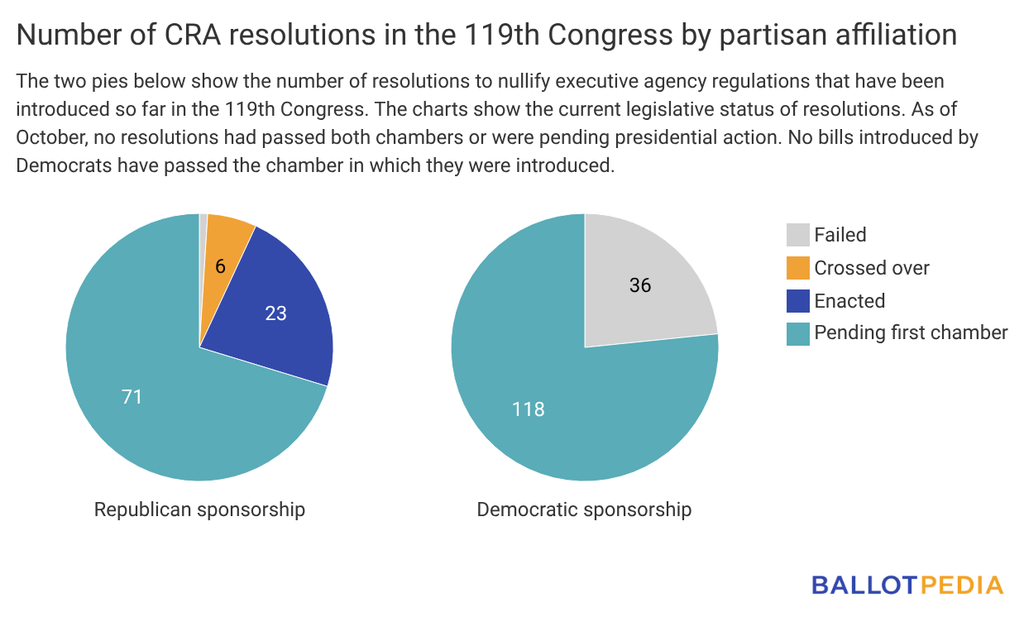
As of Oct. 13, federal legislators have introduced 232 resolutions of disapproval to nullify agency regulations so far in the 119th Congress. Thirty-seven (37) resolutions have failed – 36 of which aimed to nullify Trump administrative actions – and President Donald Trump (R) has signed 23.
Want to learn more?
- Federal Scholarship Tax Credit rule (2026)
- Congressional Review Act
- California State Nonroad Engine Pollution Control Standards; Ocean-Going Vessels At-Berth; Notice of Decision rule (2023)
- California State Nonroad Engine Pollution Control Standards; Commercial Harbor Craft Regulations; Notice of Decision rule (2025)
Legislative Tracking Update
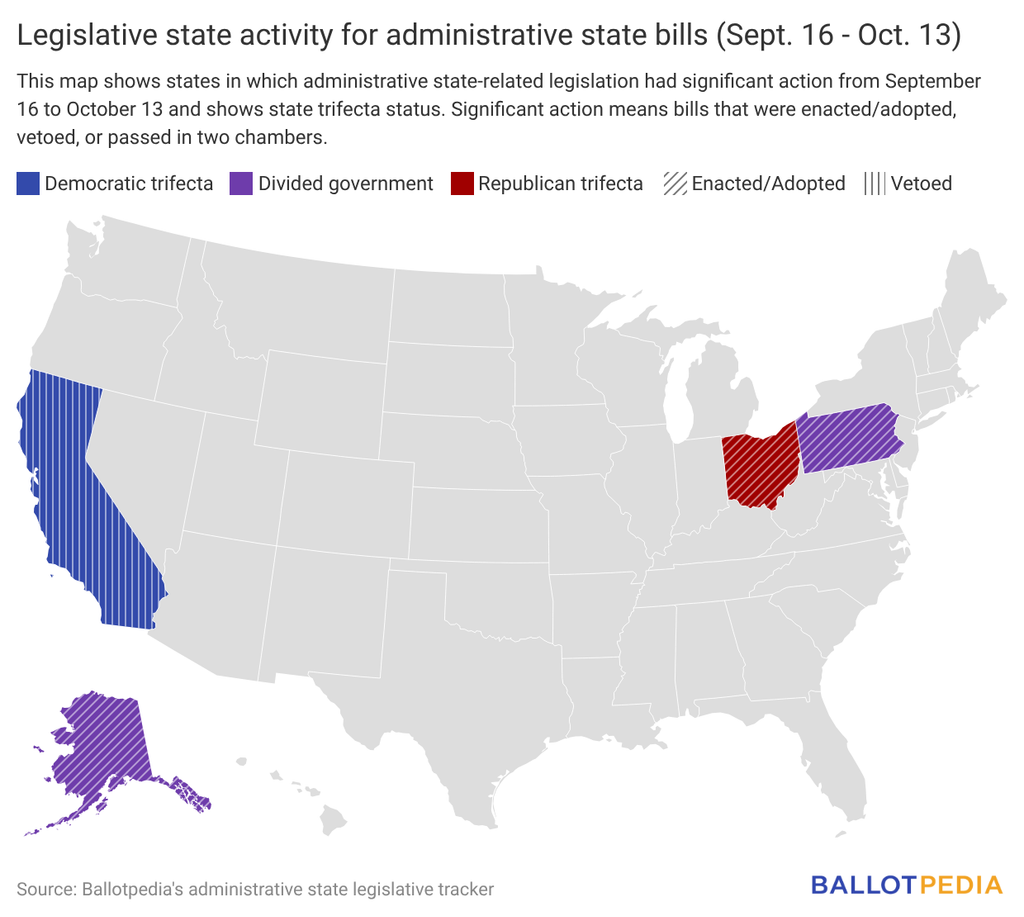
Since our last newsletter edition, Ballotpedia tracked significant legislative action (enactments, vetoes, and passage through both chambers) in four states on twelve bills related to the administrative state, as of Oct. 13.
Alaska Gov. Mike Dunleavy (R) signed three bills. California Gov. Gavin Newsom (D) signed six bills and vetoed one bill. Ohio Gov. Mike DeWine (R) signed one bill. Pennsylvania Gov. Josh Stein (D) signed one bill.
Ballotpedia tracked a total of 1,918 bills related to the administrative state in 2026, as of Oct. 13.