


Welcome to the Monday, Oct. 19, 2026, Brew.
By: Lara Bonatesta
Here’s what’s in store for you as you start your day:
- A look at wave elections since 1918 and the thresholds needed for a wave election in 2026
- Supermajority status is at stake in Delaware’s state legislative elections on Nov. 3
- Democrats need to gain three attorney general offices to have a majority nationally, and Republicans cannot lose more than one
A look at wave elections since 1918 and the thresholds needed for a wave election in 2026
The term wave election is frequently used to describe an election cycle in which one party makes significant electoral gains. As is often the case with midterms, pundits have speculated about whether or not this year's elections will amount to a wave election.
How many offices need to change party control, though, for an election to be a wave election?
According to our 2018 study, examining the results of 50 election cycles from 1918 to 2016, a wave election occurs when a party:
- Gains seven U.S. Senate seats
- Gains 48 U.S. House seats
- Gains seven gubernatorial offices
- Gains 494 state legislative seats
The definition is based on the results of the 20% of elections in that period that resulted in the greatest seat swings against the president's party.
A 2026 wave election for each office type, then, would result in Democrats holding:
- Fifty-four U.S. Senate seats
- Two hundred sixty-two U.S. House seats
- Thirty-one gubernatorial offices
- Three thousand seven hundred thirty-two state legislative seats
Using these definitions, the most recent wave election for the U.S. Senate was in 2014, when Republicans gained nine Democratic-held seats. The most recent for U.S. House and state legislatures was in 2010, when Republicans won 63 Democratic-held U.S. House seats and 702 Democratic-held state legislative seats. The most recent wave election for governors was in 2018, when Democrats gained seven offices.
The most recent wave years for Democrats were 1974 (48 House seats and 695 state legislative seats), 2008 (eight Senate seats), and 2018 (seven gubernatorial offices).
The number of times the president's party has gained seats in a midterm election
While wave elections are often thought of as in opposition to the president's party, the president's party has gained seats in historical midterm years. In midterm election years since 1918, the president’s party gained seats in the U.S. House once and in the U.S. Senate five times. The president’s party gained gubernatorial offices four times and gained seats in state legislatures once.
Here’s a breakdown of the presidential party’s gains in each of those years by office:
U.S. House: In 1934, Democrats gained nine seats in the U.S. House during President Franklin D. Roosevelt’s (D) first midterm in office.
U.S. Senate:
- In 1934, Democrats gained 10 seats during Franklin D. Roosevelt’s first midterm
- In 1962, Democrats gained four seats during President John F. Kennedy’s (D) first midterm
- In 1970, Republicans gained three seats during President Richard Nixon’s (R) first midterm
- In 1982, Republicans gained two seats during President Ronald Reagan’s (R) first midterm
- In 2018, Republicans gained two seats during President Donald Trump’s (R) first midterm
Governors:
- In 1926, Republicans gained seven governorships during President Calvin Coolidge’s (R) first midterm
- In 1934, Democrats gained one governorship during Franklin D. Roosevelt's first midterm
- In 1986, Republicans gained eight governorships during Reagan’s second midterm
- In 2022, Democrats gained two governorships during President Joe Biden’s (D) midterm
State legislatures: In 2002, Republicans gained 110 state legislative seats during President George W. Bush’s (R) first midterm
To read more about wave elections, click here.
Supermajority status is at stake in Delaware’s state legislative elections on Nov. 3

Welcome to our next installment of our 50 States in 50 Days series, covering Delaware. To view our archive of past editions, click here.
Delaware’s state legislative elections on Nov. 3 will determine whether the Democrats maintain their three-fifths supermajorities or whether Republicans will break it.
Currently, Democrats have a 15-6 supermajority in the state Senate and a 27-14 supermajority in the state House. In both chambers, Democrats can lose no more than two seats to maintain the supermajority. Republicans would need to gain three seats in either chamber to break the Democratic supermajority.
Want to see what’s on your ballot this November? Click here to use our Sample Ballot Lookup Tool. Now let’s take a closer look at what’s happening in Delaware.
Early voting opens Oct. 22 and ends Nov. 1.
Polls open on Election Day at 7:00 a.m. and close at 8:00 p.m.
Voter ID is required. Acceptable forms of ID include a Delaware driver’s license or ID card, a U.S. passport, a Social Security card, or a signed vehicle registration. Voters who are unable to provide ID can instead sign an affidavit of voter identity. Click here for more information on voter ID in Delaware.
Absentee/mail-in ballots must be requested by Oct. 30 and received by Nov. 3. A 2026 law codified a provision allowing a voter to cure their absentee ballot by the close of polls on election day if they failed to sign the absentee ballot oath or properly seal the ballot.
Current party control
A Democrat represents Delaware’s At-large Congressional district. Both of its U.S senators are also Democrats.
As we mentioned above, Democrats have majorities in both state legislative chambers. Because the governor is a Democrat, Delaware is one of 16 states with a Democratic trifecta. Delaware’s attorney general and secretary of state are also Democrats. As a result, Delaware is one of 21 states with a Democratic triplex. Democratic governors appointed all five members of the Delaware Supreme Court.
Offices on the ballot
Elections are taking place for the U.S. Senate, the U.S. House of Representatives, the state’s attorney general, auditor, and treasurer.
Eleven seats in the state Senate and all 41 seats in the state House are up for election.
Delaware is one of 32 states this year in which we are covering all local elections for school boards and municipal offices.
Notable elections
U.S. Senate: Incumbent Chris Coons (D) and Michael Katz (R) are running. Coons first took office in 2010. Previously, he worked as a nonprofit executive and attorney. He served as president of the New Castle County Council from 2001 to 2005 and as executive of New Castle County from 2005 to 2010. Katz is a physician and anesthesiologist. He was a member of the state Senate representing District 4 from 2009 to 2013. Katz completed Ballotpedia’s Candidate Connection Survey. Click here to read his response. Major election forecasters have rated the election Solid/Safe Democratic.
U.S. House: Incumbent Sarah McBride (D) and Joseph Arminio (R) are running. McBride first took office in 2025. She was a national press secretary with the Human Rights Campaign, the Center for American Progress, the White House during the Obama administration, former Gov. Jack Markell (D), and former Delaware Attorney General Beau Biden (D). She also served in the state Senate from 2020 to 2024. Arminio worked in public policy, as a teacher, and is an author. He has done contract work for the Defense Department, the American Enterprise Institute, and High Frontier. Arminio has also taught at American University, Lincoln University, and the Statesman Debate Institute – an organization that he founded. Major election forecasters have rated the election Solid/Safe Democratic.
Statewide ballot measures
Delaware has no statewide ballot measures on its 2026 general election ballot. From 1850 through 2025, Delaware voters decided on five statewide measures — the fewest of any state — approving three and rejecting two. The most recent appeared in 1984.
Statewide ballot measures are rare in Delaware because the state has no citizen initiative process and is the only state that does not require voter approval for constitutional amendments. The General Assembly can amend the state constitution without placing an amendment on the ballot.
Ballotpedia covers local ballot measures in the state’s capital, Dover, but there are none on the ballot this year.
Join us next edition when we'll preview elections in Michigan, the Wolverine State.
Click here to see every edition of 50 States in 50 Days as we publish them, and here to use our Sample Ballot Lookup Tool.
Democrats need to gain three attorney general offices to have a majority nationally, and Republicans cannot lose more than one
Welcome to the next installment of our series previewing the Nov. 3 elections by office. Next up: Attorneys General.
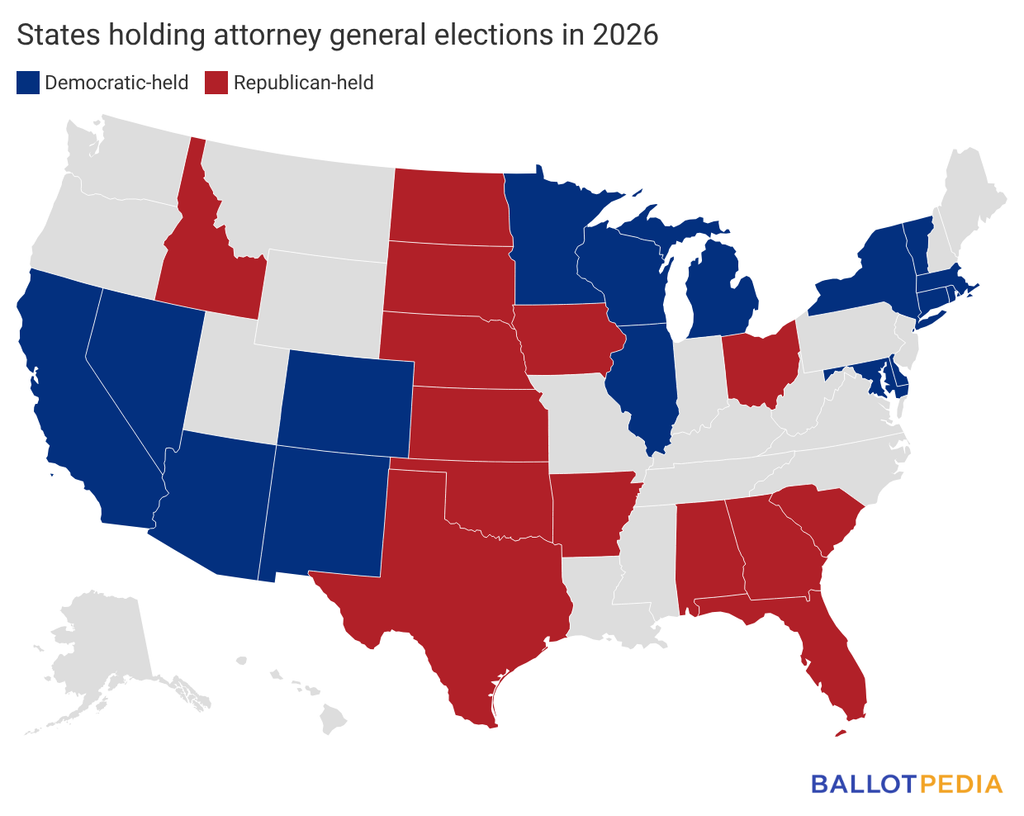
Thirty states are holding elections for attorney general this year. Of those, Democrats currently control 16 offices and Republicans 14.
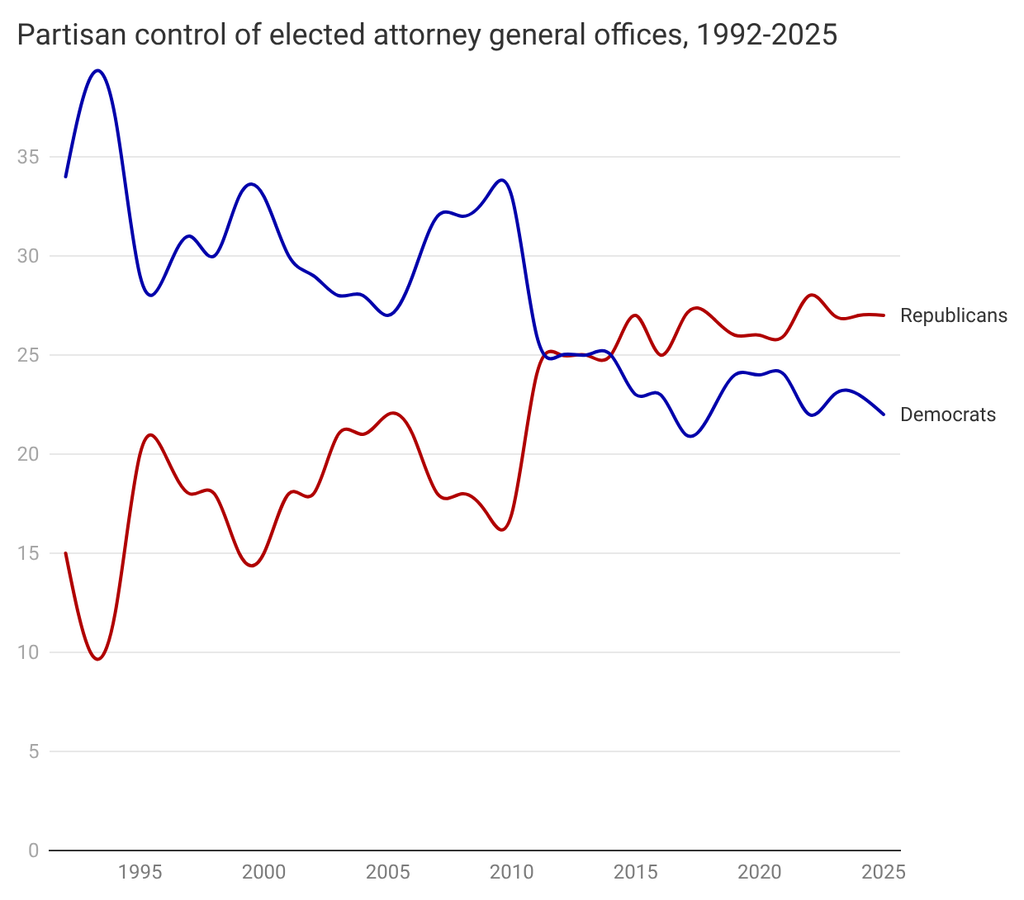
Nationally, there are 27 Republican attorneys general and 23 Democratic attorneys general. (Note: Hawaii Attorney General Anne Lopez is included in the number of Democratic attorneys general because Hawaii Gov. Josh Green (D) appointed her. The office is officially nonpartisan.)
This means Democrats would need to gain four offices to have more attorneys general than Republicans nationally. Republicans cannot lose more than one office.
Democrats are defending four offices in states that President Donald Trump (R) won in the 2024 presidential election. Republicans aren’t defending any offices in states that Kamala Harris (D) won in the 2024 presidential election.
The attorney general serves as a state's chief legal officer. The attorney general is responsible for enforcing state law and advising the state government on legal matters. In many states, attorneys general play a large role in the law enforcement process.
Battlegrounds:
Ballotpedia identified four states’ elections for attorney general as battlegrounds.
Arizona: Incumbent Kris Mayes (D) and Warren Petersen (R) are running. Mayes was elected in 2022, 50.00% to 49.98%, or by a margin of 511 votes. Mayes and Peterson have both completed Ballotpedia’s Candidate Connection survey, click here (Mayes) and here (Peterson) to read their responses.
Iowa: Incumbent Brenna Bird (R) and Nate Willems (D) are running. Bird is the first Republican to serve as Iowa’s attorney general since 1979. In 2022, Bird defeated then-incumbent Tom Miller (D) 50.8% to 49.1%.
Nevada: Nicole Cannizzaro (D) and Adriana Guzmán Fralick (R) are running. Incumbent Aaron Ford (D) is term-limited and running for governor. Cannizzaro has represented the 6th District in the Nevada Senate since 2016 and served as the Senate majority leader since March 2019. Before entering politics, Cannizzaro was a prosecutor in the Clark County District Attorney's Office. Guzmán Fralick is an attorney and counselor at law. She served as legal counsel to the Nevada Commission on Ethics, as general counsel to former Gov. Jim Gibbons (R), as assistant general counsel to the Nevada Public Utilities Commission, and chaired the Nevada Cannabis Compliance Board.
Wisconsin: Incumbent Josh Kaul (D) and Eric Toney (R) are running. This is a rematch of the 2022 election, when Kaul defeated Toney 50.6% to 49.3%. Kaul and Toney have both completed Ballotpedia’s Candidate Connection survey, click here (Kaul) and here (Toney) to read their responses.
Key Trends to watch:
- Triplex control: Attorneys general play a role in determining triplex control. Nationally, there are 24 Republican triplexes, 21 Democratic triplexes, and 5 divided governments where neither party holds triplex control. State government triplex is a term that describes when one political party holds the following three positions in a state's government: governor, attorney general, and secretary of state. Ballotpedia highlights these offices because they are typically the most visible positions in states and serve important administrative functions.
- Open offices: Ten attorney general offices are open, up from nine in 2022 and down from 12 in 2018. Six attorneys general are term-limited this year, three were term-limited in 2022, and five were term-limited in 2018.
Recent election history:
In 2022, the last time this set of offices was up for election, three offices changed party hands. Republicans gained the office in Iowa. Democrats gained control of the offices in Arizona and Vermont.
Click here to learn more about attorney general elections in 2026.