


Voters in New York City will decide on five ballot measures on Nov. 3, 2026. All five measures are charter amendments and were placed on the ballot by the city’s Commission on Government Efficiency (COGE).
In May 2026, Mayor Zohran Mamdani (D) created COGE to review the New York City charter, with a focus on “improving efficiency, modernizing city government and ensuring government keeps pace with New Yorkers’ needs.” On July 23, COGE unanimously approved its final report and five proposed charter amendments for the citywide ballot.
Here’s a closer look at the five measures:
- Question 1 - The charter amendment would remove the requirement that the city hold a mandatory hearing before approving the use of public space. It would also remove the specification that the city council review permits for sidewalk cafes after they are approved by the city’s Department of Transportation.
- Question 2 - The charter amendment would allow the city’s Procurement Policy Board to reduce the questionnaire requirements for prospective contractors depending on the contract in question. It would also permit the mayor to delegate contract approval for some contracts valued at over $5 million. The amendment would require the Procurement Policy Board to meet at least once every three months.
- Question 3 - The charter amendment would change the required steps for the review and approval of street safety projects, such as allowing construction without a formal review in certain cases to protect public safety. Additionally, the amendment would expedite the process for leasing office spaces for city workers and allow the mayor to sell or lease some city property without a public auction or sealed bids.
- Question 4 - The charter amendment would require the Department of Buildings (DOB) to create a centralized system for submitting permit applications, authorize the DOB to oversee waterfront permitting, and allow the Commissioner of the DOB to expand construction approval power to a greater number of DOB officials.
- Question 5 - The charter amendment would create a target for annual contributions to the city’s rainy day fund, specifically 12% of the tax revenue received in the previous fiscal year, and require the city to develop a methodology for calculating future contributions. In 2019, New York City voters approved Question 4, which allowed the city to create a rainy day fund. As of 2026, there are no required annual contributions to the fund.
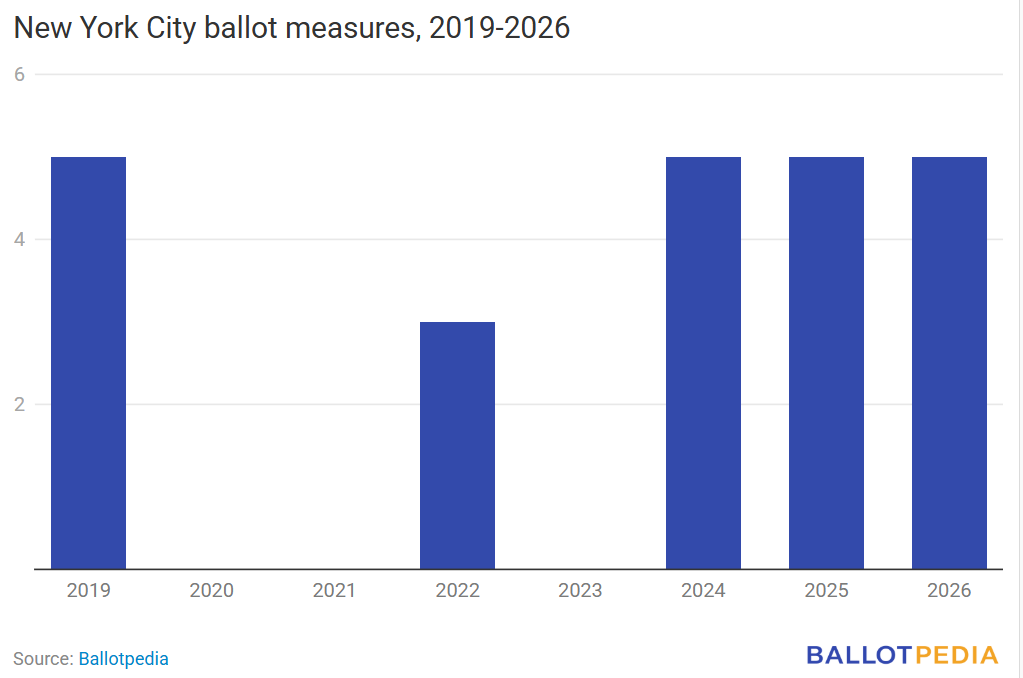
Between 2019 and 2026, the average number of measures on the ballot was about 3. With five measures on the ballot, 2026 ties with three other years for the greatest number of measures on the citywide ballot since 2019.
In 2026, Ballotpedia is covering local ballot measures that appear on the ballot for voters within the 100 largest cities in the U.S., within state capitals, and throughout California and Virginia. Ballotpedia is also covering local ballot measures related to electoral systems, like ranked-choice voting, and data centers outside of the largest cities.
Additional reading: