


Welcome to Ballot Bulletin: Ballotpedia's Weekly Election Policy Digest. Every Tuesday, we deliver the latest updates on election policy around the country, including nationwide trends and recent legislative activity.
In this week’s edition, we cover two bills state legislatures acted on last week and look at how recount laws work in each of the 50 states.
The state of election legislation in the U.S.
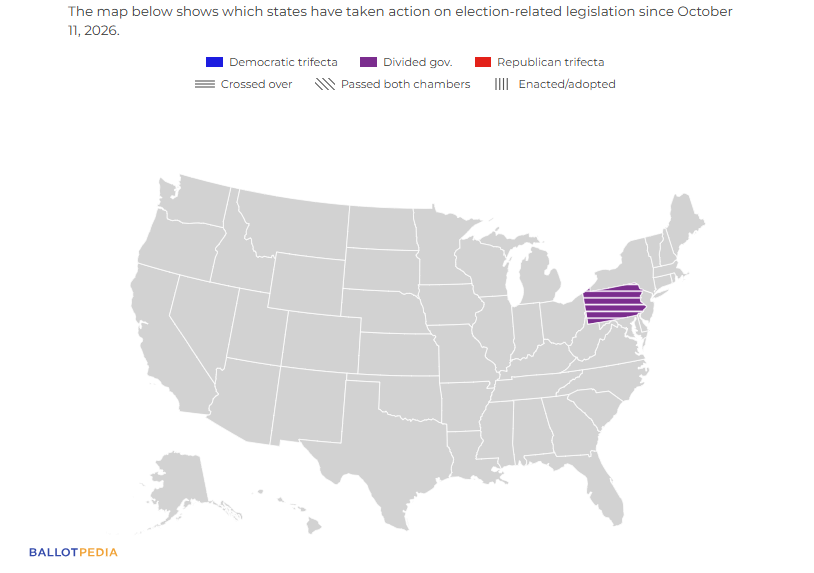
Lawmakers in one state acted on two election-related bills last week. Five state legislatures are in regular or special sessions. Last week, no bills were enacted, no bills passed both chambers of a state legislature, and no bills were vetoed.
Of the bills acted on last week, none are in states with Democratic trifectas, none are in states with Republican trifectas, and two (100%) are in states with divided government. The most active bill categories last week were counting and certification (one) and election types and stages (one).
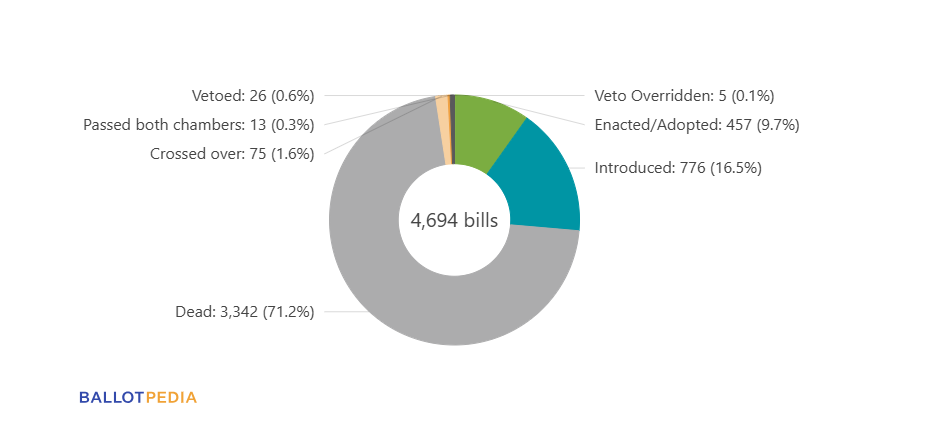
We are currently tracking 4,694 election-related bills across the country. The chart below breaks down the status of those bills based on where they stand in the legislative process:
Enacted bills
No bills were enacted or adopted last week.
Bills passing both chambers
No bills passed both chambers of a state legislature last week.
To see a full list of bills awaiting gubernatorial action, click here.
Vetoed bills
No bills were vetoed last week.
To see a list of all bills vetoed this session, click here.
All bills
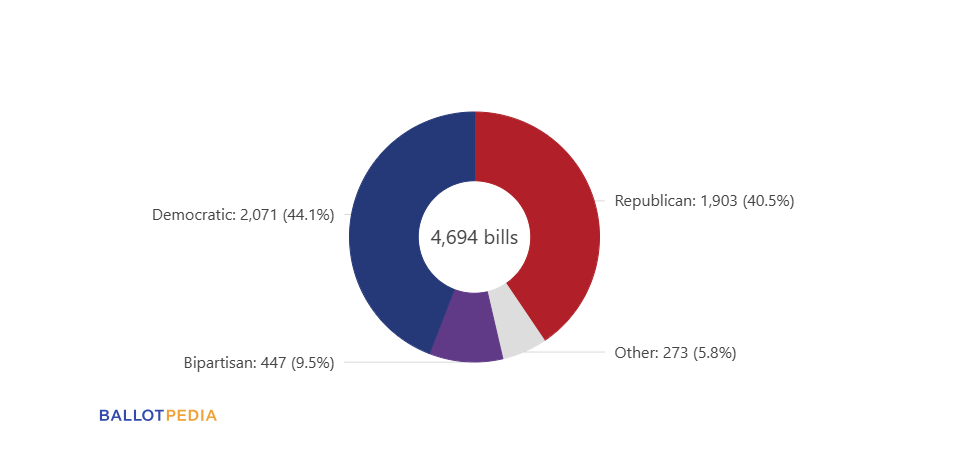
The chart below shows all bills Ballotpedia is currently tracking, broken down by partisan sponsor.
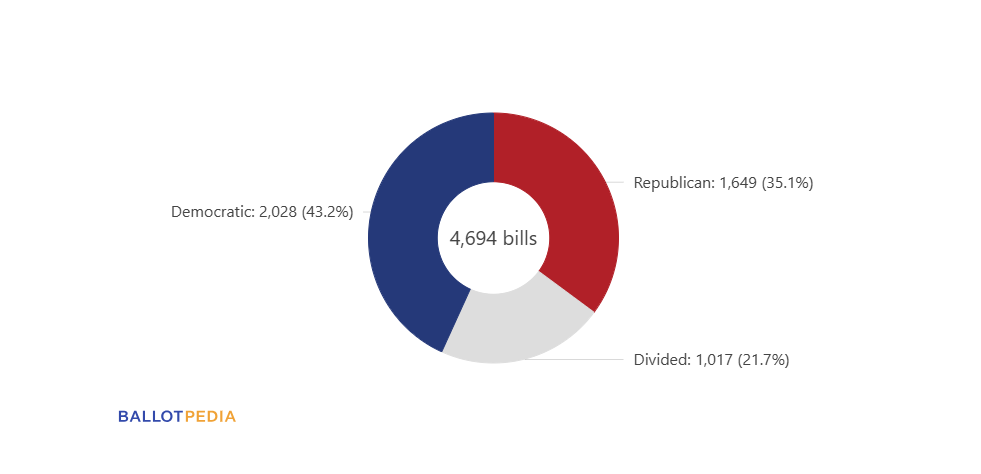
The chart below shows all bills Ballotpedia is currently tracking, broken down by trifecta status.
In the news
On Oct. 15, the U.S. Department of Justice (DOJ) filed a lawsuit in U.S. district court to block California from counting mail ballots from individuals it alleges are likely noncitizens.
In the lawsuit, the DOJ said it had alerted California that noncitizens may be on the state’s voter rolls and “asked California to review the list and, in partnership with federal agencies, to determine whether citizens were listed.” The DOJ filed the lawsuit after California failed to meet the department’s deadline. The lawsuit asks that the state set aside and not count mail ballots cast by possible noncitizens unless the state verified a person’s citizenship status.
“The State knows that noncitizens might be registered to vote, and it knows the names of such individuals,” the lawsuit said. “But it still intends to count their vote without verifying the voter’s citizenship. California’s actions thus knowingly facilitate unlawful voting.”
In an Oct. 15 letter to the DOJ, California Secretary of State Shirley Weber (D) said her office believed the DOJ’s request violated federal and state law. In the letter, Weber said that “I will not disenfranchise thousands of Californians—or order any county elections official to do so—based solely upon an unsupported and likely inaccurate ‘belie[f]’ that certain voters are ‘likely’ noncitizens.”
Here are other news stories from across the country:
- On Oct. 16, the Nebraska Supreme Court upheld a state law allowing U.S. citizens who were born and live overseas and have never resided in Nebraska to register to vote if they have a parent registered to vote in the state and are not registered elsewhere. The Republican National Committee and two Lancaster County voters filed a lawsuit challenging the law’s constitutionality in June. In an unsigned 6-1 ruling, the court held that the plaintiffs failed to prove the law was unconstitutional. All seven judges on the court were appointed by a Republican governor.
- On Oct. 16, the Wisconsin Elections Commission approved guidance stating that the state’s municipal clerks are prohibited from using the federal Systematic Alien Verification for Entitlements (SAVE) database. The memo said that state law “prohibits election officials disclosing voters’ personally identifiable information, which makes it impossible for election officials to use SAVE as it is currently constructed.” U.S. Citizenship and Immigration Services, which operates SAVE, says it “provides point in time immigration status and U.S. citizenship information to federal, state, local, territorial, and tribal agencies.”
- On Oct. 14, the League of Women Voters of Texas and MOVE Texas Civic Fund sued the state of Texas, alleging it failed to process 500,000 voter registration applications submitted through an online portal. Under a 2021 settlement agreement, the Texas Department of Public Safety allows voters to register to vote when updating or renewing their driver’s license or ID card. In the lawsuit, the organizations argued that the state was not processing online applications in a timely manner and asked a U.S. district court judge to order the state to comply with the settlement agreement.
- On Oct. 13, a New Jersey judge denied a request to block the Ocean County Board of Elections from removing a group of Bay Head voters from the voter rolls. As reported in the Oct. 13 edition of Ballot Bulletin, the New Jersey League of Women Voters and a group of voters alleged that some Bay Head residents were sent notices stating they may not be eligible to vote in the municipality because their tax bills were sent to an address in another town. State Superior Court Judge Robert Lougy ruled the plaintiffs did not prove the notices irreparably harmed them.
Policy spotlight: Georgia could have an automatic recount in 2026 under new law
The story below is adapted from a recent Ballotpedia News story by Andrew Bahl.
A close race for governor in Georgia could trigger the state’s new automatic recount law, which will be in effect for the first time during the 2026 elections. Cook Political Report, Inside Elections, and Sabato’s Crystal Ball have all classified the 2026 gubernatorial race as a toss-up.
Under SB 3EX, which was enacted in June, the secretary of state must automatically order a manual recount in the first or second state executive races listed on the ballot if the margin separating the top two candidates is less than or equal to 0.5%. The first and second state executive races in 2026 are governor and lieutenant governor.
A recount must be ordered within two days of the results being certified. There is no deadline in state law for completing the recount, but counties must finish a recount within 17 days of when it was ordered to be eligible for reimbursement of their costs.
Georgia is one of 29 states to require automatic recounts. Automatic recounts typically must occur if a set margin separates two candidates or ballot measure positions, or if errors are discovered during vote counting or post-election auditing.
Five states only provide for automatic recounts. Two states, Illinois and Tennessee, do not allow recounts apart from an election contest, while one state, Mississippi, does not allow election recounts. Forty-two states allow candidates and, in some cases, voters to request a recount. In 21 states, a specific margin of votes is required before an interested party may request a recount for some or all elections. In other states, a recount can be requested no matter the circumstances.
Who can request a recount varies by state and by circumstances. In most states with requested recount procedures, an interested party is either a candidate or a voter. Some states allow political party chairs to request a recount.
Forty-two states allow candidates to request a recount in at least some elections. In four states, voters may request a recount for any election. In 32 states, voters can request recounts only in some elections or only for ballot measures.
While state and county governments generally pay for automatic recounts, states have different laws about who pays for a requested recount.
In 22 states, the person seeking a recount pays the costs, while in six states the state pays. In 12 states, who pays depends on the circumstances of the election or the recount. In those states, the government may pay for a recount in close races or in races for certain offices, and the requester pays in all other circumstances. In three states, state law does not address which party pays for the recount.
In 27 states, a refund is available for a requested recount if it changes the election results or meets other criteria. In four states, a refund depends on the circumstances of the recount, and in six states, no refund is available. Six states have state-funded recounts and seven states do not have requested recounts.
In 27 states, a partial recount may be requested.
Seven states, including Georgia, enacted nine laws in 2026 related to recounts. Notable laws include:
- Connecticut HB 5001, which requires recounts depending on the results of a post-election audit.
- Iowa HF 2501, which amends recount procedures for ballot measures.
- Nebraska LB 1075, which requires a recount request to be filed within three days of the canvass, rather than five days.
- Rhode Island H 7782 and S 3113, which require a recount to be requested within nine days of the results being declared, rather than seven days.
For more information on recount laws, click here.