


Welcome to Ballot Bulletin: Ballotpedia's Weekly Election Policy Digest. Every Tuesday, we deliver the latest updates on election policy around the country, including nationwide trends and recent legislative activity.
In this week’s edition, we cover 11 bills state legislatures acted on last week and look at election policy ballot measures in the Nov. 3 elections.
Editor’s note: There will be no edition of Ballot Bulletin on Nov. 3 due to Election Day. Our coverage of election-related legislation and news will resume on Nov. 10.
The state of election legislation in the U.S.
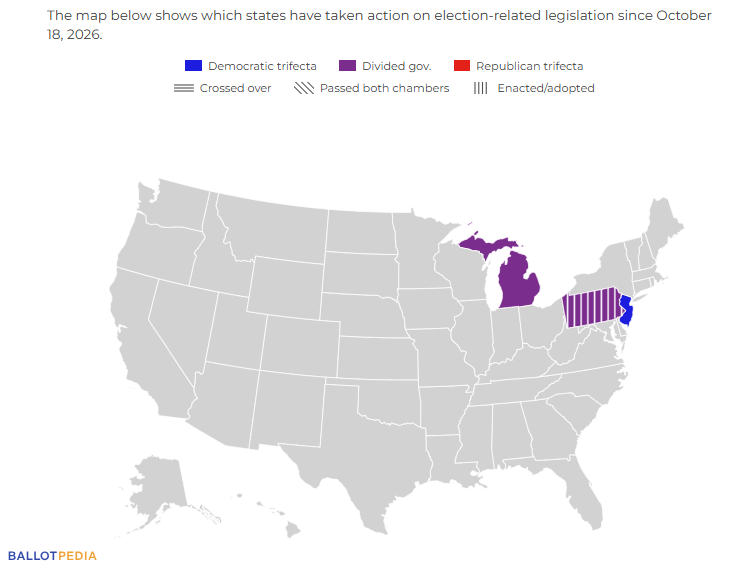
Lawmakers in three states acted on 11 election-related bills last week. Five state legislatures are in regular or special sessions. Last week, one bill was enacted, no bills passed both chambers of a state legislature, and no bills were vetoed.
Of the bills acted on last week, eight are in states with Democratic trifectas (73%), none are in states with Republican trifectas, and three (27%) are in states with divided government. The most active bill category last week was election types and stages (two).
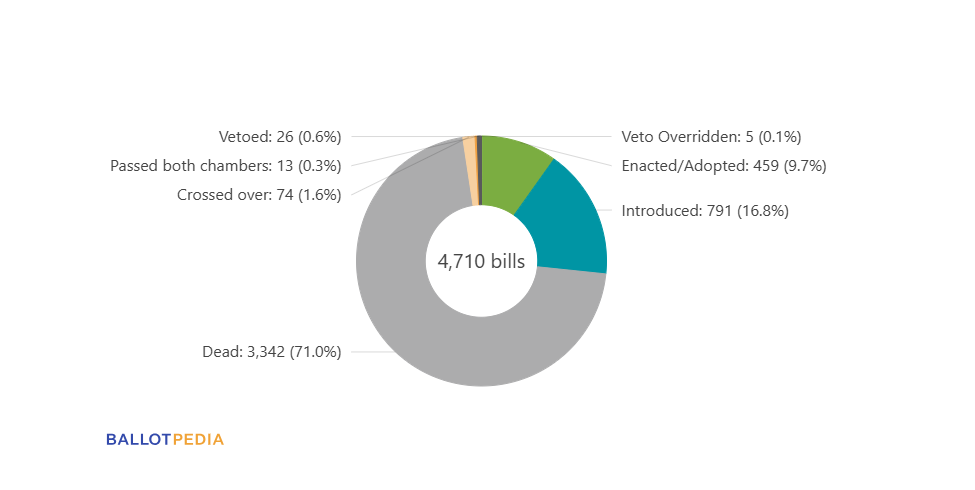
We are currently tracking 4,710 election-related bills across the country. The chart below breaks down the status of those bills based on where they stand in the legislative process:
Enacted bills
One bill was enacted or adopted last week.
- Pennsylvania (Divided government)
Bills passing both chambers
No bills passed both chambers of a state legislature last week.
To see a full list of bills awaiting gubernatorial action, click here.
Vetoed bills
No bills were vetoed last week.
To see a list of all bills vetoed this session, click here.
All bills
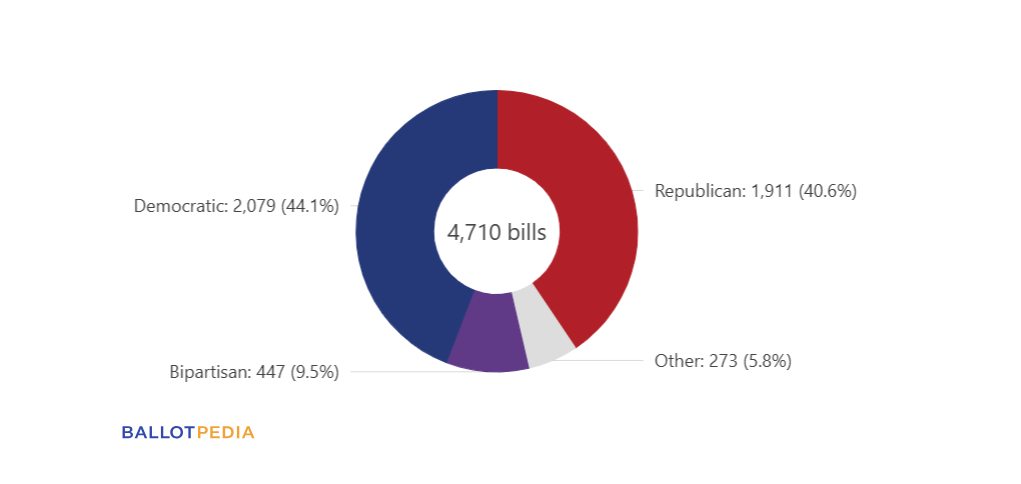
The chart below shows all bills Ballotpedia is currently tracking, broken down by partisan sponsor.
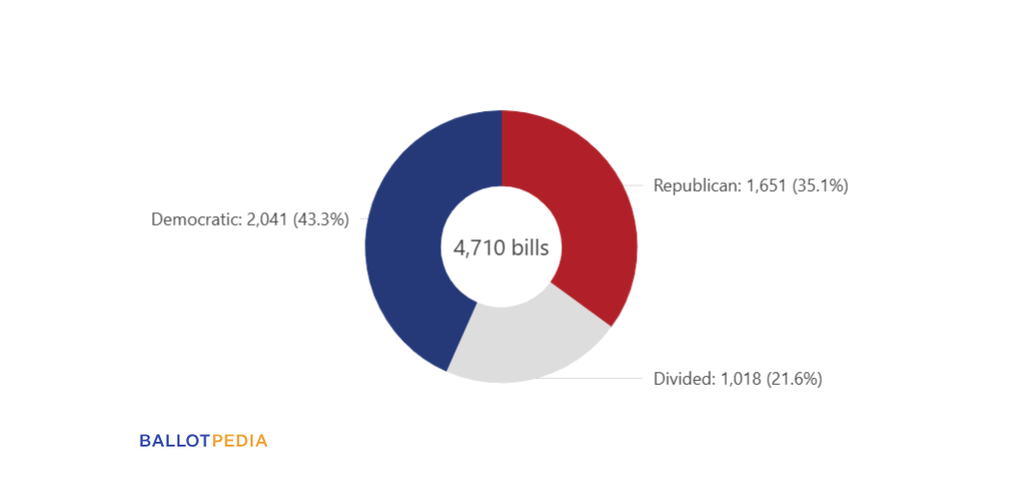
The chart below shows all bills Ballotpedia is currently tracking, broken down by trifecta status.
In the news
On Oct. 23, the U.S. Department of Justice filed a lawsuit to block the certification of Alaska’s U.S. Senate results if U.S. Sen. Dan S. Sullivan (R) does not win and “had all votes cast for Daniel J. Sullivan been cast instead for Senator Sullivan and Alaska’s rank-choice process played out accordingly, Senator Sullivan would have won the election.”
After Dan J. Sullivan filed for the primary election, the National Republican Senatorial Committee asked the state to investigate whether Sullivan entered the race to confuse voters and siphon votes from the incumbent to help another candidate, former U.S. Rep. Mary Peltola (D).
On June 10, 2026, Division of Elections Director Carol Beecher issued a preliminary decision that Dan J. Sullivan could not appear on the ballot, stating that it would violate a state law prohibiting candidates from appearing on the ballot “in a manner that is confusing or misleading to voters or compromises the fairness or neutrality of the ballot.”
On June 22, 2026, Dan J. Sullivan filed a lawsuit challenging the decision. On June 26, 2026, Alaska Superior Court Judge Thomas A. Matthews ruled that Sullivan must appear on the ballot. The Division of Elections then appealed to the Alaska Supreme Court, which upheld the lower court decision. Dan S. Sullivan is listed as an incumbent and a registered Republican on the ballot, while Dan J. Sullivan has no party affiliation listed.
In the lawsuit filed last week, the DOJ argued that the potential confusion would damage the integrity of the election in violation of the National Voter Registration Act. The lawsuit said, “Given the substantial likelihood that the inclusion of Daniel J. Sullivan will confuse or mislead voters looking to cast a vote for Senator Sullivan, and thus distort the will of Alaskan voters, there is a substantial likelihood that a certification of the election will reflect an electoral process that lacked integrity.”
Attorneys representing Peltola have sought to intervene in the lawsuit, saying that “the federal government has no power to impose that Hobson’s choice on the people of this State. Daniel J. Sullivan’s presence on the ballot raises a question of Alaska law that was litigated and definitively resolved by the Alaska Supreme Court months ago.”
Here are other news stories from across the country:
- On Oct. 25, the U.S. Court of Appeals for the Ninth Circuit dismissed the U.S. Department of Justice’s motion for emergency relief to block California from counting mail ballots from individuals it alleges are likely noncitizens. As reported in the Oct. 20 edition of Ballot Bulletin, the lawsuit asks that the state set aside and not count mail ballots cast by individuals who the DOJ said are possible noncitizens unless the state verifies a person’s citizenship status. The Department filed the lawsuit in U.S. district court on Oct. 15. It then appealed to the Ninth Circuit on Oct. 22, arguing the district court’s scheduling had effectively denied its request for a temporary restraining order. In a 2-1 ruling, the court held that it lacked jurisdiction over the appeal because the district court had not yet issued a ruling. A district court hearing on the temporary restraining order is scheduled for Oct. 27. On Oct. 26, the DOJ requested that election officials in Washington set aside ballots cast by 400 individuals it believed to be noncitizens.
- On Oct. 22, the U.S. Supreme Court allowed New Hampshire to prohibit the use of student IDs as proof of identity for the Nov. 3 election by temporarily blocking an Oct. 2 district court ruling. That ruling held that an April directive from New Hampshire Secretary of State David Scanlan’s office implementing a 2026 law prohibiting the use of student IDs for voting was likely unconstitutional. The district court required the state to allow voters to use student IDs to register to vote or to prove their identity if they had no other form of acceptable ID. In an unsigned order, the Supreme Court held that the lower court decision violated the Purcell Principle, a legal doctrine that federal courts should not alter election laws near an election. Justice Ketanji Brown Jackson was the only justice to write a dissent.
- On Oct. 21, North Carolina Gov. Josh Stein (D) asked the North Carolina Supreme Court to overturn a lower court decision and strike down a 2025 law that transferred the power to appoint members of the state and county election boards to the state auditor. Previously, the governor had the power to appoint those officials. The North Carolina Court of Appeals upheld the 2025 law in a 2-1 decision on Sept. 16, ruling that it did not violate the state constitution.
- On Oct. 21, the state of California and plaintiffs in a 2024 lawsuit reached a settlement agreement that would allow blind voters to return their mail-in ballot electronically, starting in 2028. The agreement came after a U.S. magistrate judge ruled that California’s current system of mail-in ballot return violates the Americans with Disabilities Act and the state constitutional right to a secret ballot. Currently, voters with disabilities may receive and mark their ballots electronically but must print them out and have a third party seal and return them.
Policy spotlight: Voters will determine 15 election policy ballot measures on Nov. 3
Voters in 13 states will decide on 15 ballot measures related to election policy in the Nov. 3 election.
Voter ID laws
Six states will vote on ballot measures related to voter ID. Measures in two of those states, California and Nevada, would enact new voter ID laws. Both measures would require in-person voters to provide ID at the polls and vote-by-mail voters to provide the last four digits of an identification number when returning their ballot.
In Colorado, Amendment 84 would require voters casting a mail ballot to provide their signature and an identification number, such as a Social Security or driver’s license number.
Three additional states, Arizona, North Carolina and Ohio, will vote on whether to add existing voter ID laws to their state constitutions. Oklahoma approved adding its voter ID requirement to the state constitution on Aug. 25.
The seven measures represent the largest number of statewide ballot measures related to voter identification in a single year. From 2004 through 2025, voters decided 13 measures requiring voter ID, approving 10 (77%) and defeating three (23%). The previous single-year high was in 2022, when voters decided on three measures.
Citizenship requirements for voting
Six states will decide ballot measures related to citizenship requirements for voting. Each measure would establish that only U.S. citizens may vote in state and local elections.
Alaska, Arkansas, Kansas, South Dakota, and West Virginia do not currently have constitutional prohibitions on noncitizens voting in local elections. No localities in those five states allow noncitizen voting.
Arizona’s measure would amend the constitution to state that “only citizens may register and vote in Arizona elections.” Unlike the other five states, Arizona has existing constitutional language prohibiting noncitizen voting.
Between 2018 and 2025, voters decided on 15 measures prohibiting noncitizen voting and approved all 15, with an average of 73% voting in favor. Eight of the 15 appeared on the ballot in 2024.
Nationally, 18 state constitutions explicitly prohibit noncitizen voting. Three states — California, Maryland, and Vermont — have localities that allow noncitizens to vote in municipal or school board elections.
Voter registration
Massachusetts voters will decide on a measure that would institute same-day voter registration in the state. Currently, voters must register to vote 10 days before the election. The registration period overlaps with the early voting period for eight days.
Twenty states and the District of Columbia offer same-day voter registration on Election Day. Connecticut offers same-day voter registration for general elections only. Six states offer same-day registration during at least part of the early voting period, but not on Election Day. Alaska and Rhode Island allow same-day registration to vote for president and vice president.
Between 2010 and 2025, voters in four states decided ballot measures to implement or reinstate same-day voter registration. Measures in Maine, Maryland, and Michigan were approved, and one in New York was defeated.
Voting rights for people with felony convictions
In Virginia, voters will decide on a constitutional amendment to automatically restore political rights, including the right to vote, of individuals convicted of a felony upon release from incarceration.
Virginia is one of three states where individuals with felony convictions never regain the right to vote without state action to restore their rights. People must apply for restoration to the governor's office upon completion of their sentence, including any prison time, parole, and probation, and their applications will be considered on a case-by-case basis.
The Virginia Department of Elections published guidance in September stating that, in response to a federal court ruling, only individuals convicted of three crimes — murder, voluntary manslaughter, and involuntary manslaughter — would need to petition the governor to have their rights restored. Individuals convicted of all other felonies may register to vote and vote if they have been released from prison.
Electoral systems
Voters in Alaska and Massachusetts will decide whether to change their state’s electoral system.
In Alaska, Ballot Measure 2 would repeal the state’s top-four primary system and the use of ranked-choice voting (RCV) in general elections.
Currently, Alaska uses top-four primaries and RCV in general elections. Under this system, candidates run in a single primary election, regardless of party affiliation. The four candidates that receive the most votes advance to the general election.
At the general election, voters elect state and federal candidates using RCV. For state executive, state legislative, and congressional elections, voters rank the four candidates that advanced from their top-four primaries. A candidate needs a simple majority of the vote (50%+1) to be declared the winner of an election. If no candidate wins a simple majority of the vote, the candidate with the fewest votes is eliminated. People who voted for the eliminated candidate as their first choice have their votes redistributed to their second choice. The tabulation process continues until two candidates remain, and the candidate with the most votes is declared the winner.
If the measure is approved, the state would switch to a party-choice primary system, where parties could decide whether to hold open or closed primaries.
In 2020, Alaska voters adopted RCV by approving Ballot Measure 2 50.6%-49.5%.
In 2024, voters decided on another measure related to RCV, also called Ballot Measure 2. This measure would have repealed the top-four primaries and ranked-choice voting system voters approved in 2020. On Nov. 5, 2024, voters rejected the measure 50.1% to 49.9%.
In Massachusetts, voters will decide whether to implement top-two primaries. Currently, the state uses a semi-closed primary system. This means that voters who are affiliated with a political party and unaffiliated voters may vote in that party's primary.
If the top-two primary initiative is approved, all candidates would be listed on the same ballot, regardless of their party affiliation. All registered voters would participate in the same primary. The top two vote-getters would advance to the general election, regardless of their partisan affiliations. This system would not be used for presidential primaries.
California, Nebraska, and Washington use a top-two primary for at least some elections. Alaska and Louisiana use some variation of top-two primaries for their elections.
For more on 2026 ballot measures, click here.