


Welcome to the Thursday, Oct. 29, 2026, Brew.
By: Lara Bonatesta
Here’s what’s in store for you as you start your day:
- Ballot measure campaigns raised more than $1.2 billion so far in 2026 and spent a record-high $193 million on signature drives
- Alabama to use a new congressional map in this year’s elections
- There are 163 city council elections happening in the 100 most populous cities on Nov. 3
Ballot measure campaigns raised more than $1.2 billion so far in 2026 and spent a record-high $193 million on signature drives
Campaigns supporting and opposing the 164 statewide ballot measures in 2026 raised more than $1.2 billion. Initiative campaigns spent a record $193 million on signature gathering.
Here's a look at the five states where campaigns supporting and opposing measures raised the most as of Oct. 26:
- The 14 measures in California raised $798.9 million, or more than 66% of the 2026 total and the most in state history.
- The four measures in Virginia raised $107.6 million, or 8.9%
- The nine measures in Missouri raised $67.9 million, or 5.6%
- The 14 measures in Colorado raised $43.1 million, or 3.6%
- The two measures in Kansas raised $29.4 million, or 2.4%
In 2024, the top three states were California (29.5%), Florida (24.3%), and Missouri (8.2%). In 2022, the top three states were California (65.8%), Michigan (9.3%), and Massachusetts (6.5%).
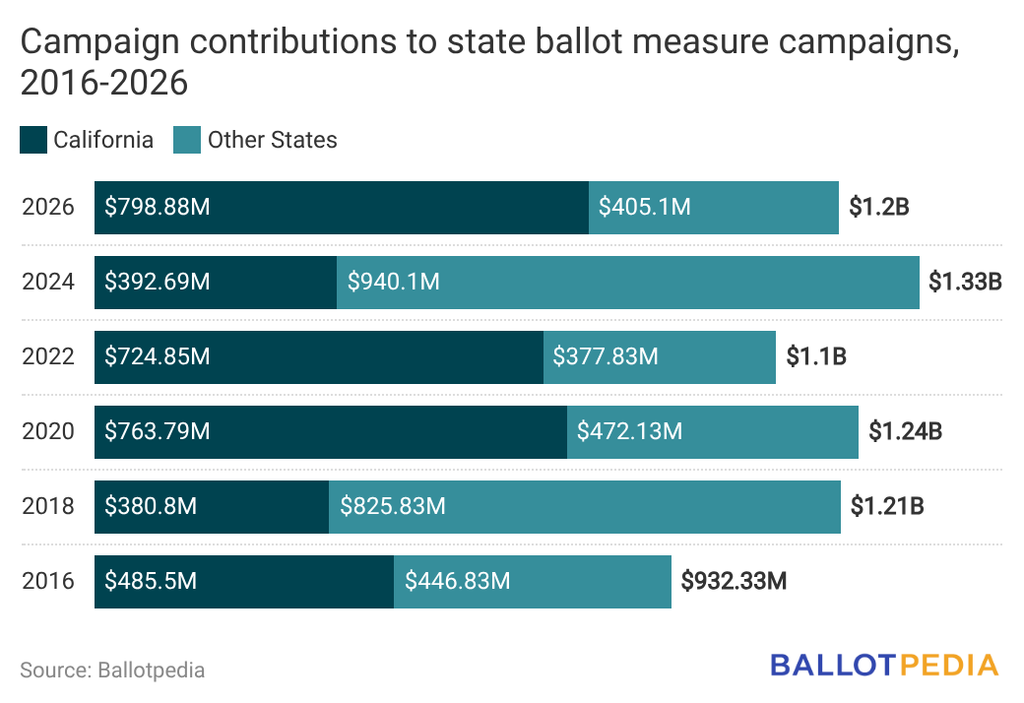
A closer look at ballot measure campaign finance in California
The two costliest campaigns were both in California.
Campaigns for and against Proposition 40 – which would levy a 5% wealth tax on the state’s billionaires – raised the most money. Those supporting the measure raised $33.2 million, and those opposing it raised $140.5 million. The Service Employees International Union (SEIU) - United Healthcare Workers West was the largest donor in support of the measure, contributing $32 million. Sergey Brin, a co-founder of Google, was the top donor to the opposition campaign, contributing $102 million.
Campaigns for and against Proposition 42 – which would prohibit new taxes on retirement holdings, personal assets, and savings – raised the second most. Those supporting the measure raised $138.5 million, and those opposing it raised $34.2 million. Sergey Brin was the largest donor in support of the measure, contributing $102 million. The SEIU - United Healthcare Workers West was the top donor to the opposition campaign, contributing $32 million.
Proposition 42 is one of two measures that were filed to compete with Proposition 40. The other, Proposition 41, would prohibit excluding new state taxes from the state’s spending limit, which Proposition 40 authorizes, and require special financial and performance audits for tax initiatives.
Campaigns for and against Propositions 40, 41, and 42 account for about 45% of the state’s total contributions. Across the three measures, campaigns raised more than $360 million in cash and in-kind contributions — putting the measures collectively in the top 10 costliest ballot measure campaigns in California’s history. The record for the most campaign fundraising for and against a pair of measures in California was Propositions 26 and 27 in 2022, which would have legalized sports betting in the state. Campaigns raised more than $463 million supporting and opposing the issue.
Signature drives
Campaigns nationwide spent $193.4 million on signature gathering, the most since Ballotpedia began tracking signature campaign spending in 2010.
While total signature drive spending hit a record high, the average cost-per-required-signature (CPRS) was $13.51, down from $14.87 in 2024.
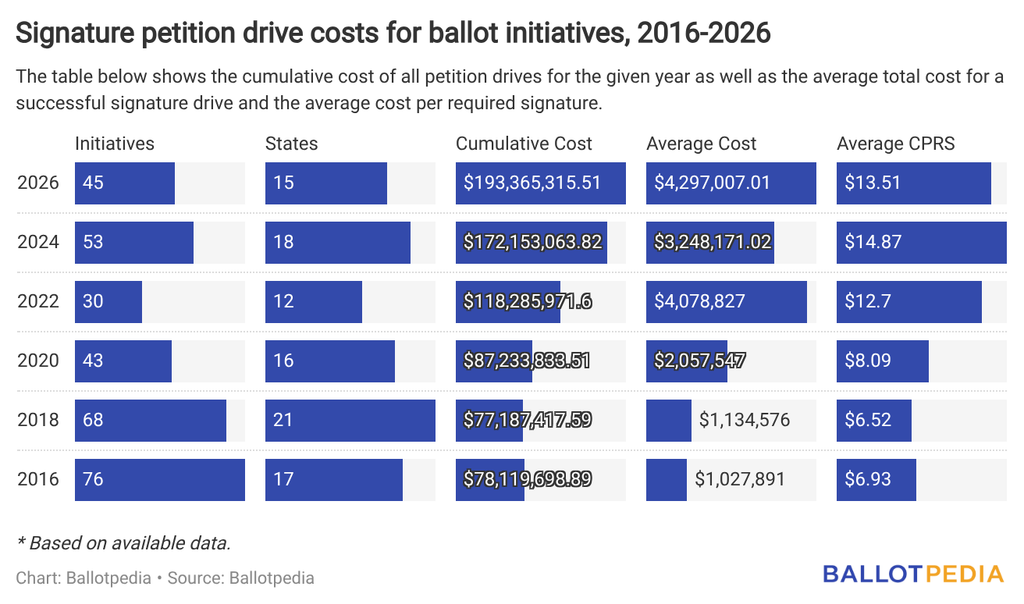
The CPRS ranged from $0 for volunteer efforts to $51.10 for Nebraska Initiative Measure 441, which would authorize online sports betting in the state.
The average cost of a successful signature drive this year was $4.3 million — more than the average of $3.25 million in 2024 and the record-high average of $4.08 million in 2022.
Of the $1.2 billion that campaigns supporting and opposing measures raised as of Oct. 26, the $193.4 million spent on signature drives represents 16.1% of the total contributions.
Campaigns for all nine initiatives in California spent a combined $152.7 million on signature-gathering efforts, accounting for approximately 79% of all petition drive costs in 2026.
A total of $32.3 million was spent on signature gathering for California Proposition 42, making it the most expensive signature drive of 2026.
Click here to learn more about ballot measures campaign finance in 2026
Alabama to use a new congressional map in this year’s elections
Welcome to our next installment of our 50 States in 50 Days series, covering Alabama. To view our archive of past editions, click here.
Alabama will use a different congressional map in the 2026 elections than it did in 2024. Based on the 2024 presidential election results, the state's new map could result in Republicans gaining control of one Democratic-held district. Nationally, nine states will use different congressional maps in this year’s elections than they used in 2024.
The redistricting in Alabama came after the U.S. Supreme Court ruled 6-3 in Louisiana v. Callais that Louisiana’s congressional map that added a second majority-Black district was an unconstitutional racial gerrymander.
Alabama’s 1st, 2nd, 6th, and 7th Congressional Districts will have different boundaries than they did in 2024. One district – the 2nd Congressional District – is more Republican than it was in 2024. According to the district lines used in 2024, Kamala Harris (D) defeated President Donald Trump (R) 54% to 45%. According to the district lines that will be used in 2026, Trump would have defeated Harris 56.8% to 42.4%.
Want to see what’s on your ballot this November? Click here to use our Sample Ballot Lookup Tool. Now let’s take a closer look at what’s happening in Alabama.
Alabama does not offer no-excuse early voting. Some jurisdictions may offer excuse-required early voting during the absentee voting period.
Polls open on Election Day at 7:00 a.m. and close at 7:00 p.m.
Voter ID is required. Acceptable forms of ID include a valid Alabama driver’s license or non-driver ID, a photo voter ID card, a passport, and a valid student or employee ID from a public or private college or university in Alabama. Under a 2026 law, digital IDs issued by the Alabama State Law Enforcement Agency are not acceptable for voting. For more information on voter ID in Alabama, click here.
Absentee/mail-in ballots must be requested by Oct. 27 and received by Nov. 3.
Current party control
Republicans represent five congressional districts, and Democrats represent two. Both of Alabama’s U.S. Senators are Republicans.
Republicans have a 27-8 majority in the Alabama Senate and a 76-29 majority in the Alabama House of Representatives. Because the governor is a Republican, Alabama is one of 23 states with a Republican trifecta. Alabama’s attorney general and secretary of state are also Republicans. As a result, Alabama is one of 24 states with a Republican triplex. All nine justices on the Alabama Supreme Court are Republicans.
Offices on the ballot
Elections are taking place for the U.S. Senate, the U.S. House of Representatives, 13 state executive offices, 35 state senate seats, and 105 state House seats.
The state executive offices up for election include the governor, lieutenant governor, attorney general, secretary of state, auditor, agriculture commissioner, treasurer, two seats on the public service commission, and four seats on the state board of education.
Two state supreme court seats and four seats on intermediate appellate courts are also up for election.
Notable elections
U.S. House: As we mentioned above, four Districts’ boundaries changed as a result of redistricting ahead of the 2026 elections. Here’s a closer look at each of those districts.
- District 1: Clyde Jones (D) and former U.S. Rep. Jerry Carl (R) are running. According to the district lines used in 2024, Trump defeated Harris 77% to 22% in the district. According to the district lines that will be used in 2026, Trump would have defeated Harris 67.6% to 31.5%.
- District 2: Incumbent Shomari Figures (D) and Rhett Marques (R). As mentioned above, Kamala Harris would have won in this district under the lines used in 2024, but Trump would have won under the lines that will be used in 2026. In the 2024 election in the district, Figures defeated Caroleene Dobson (R) 54.6% to 45.4%.
- District 6: Incumbent Gary Palmer (R) and Maurice Mercer (D) are running. According to the district lines used in 2024, Donald Trump (R) defeated Kamala Harris (D) 69% to 30% in the district. According to the district lines that will be used in 2026, Trump would have defeated Harris 66.8% to 32.1%.
- District 7: Incumbent Terri Sewell (D) and Ammie Akin (R) are running. According to the district lines used in 2024, Harris defeated Trump 61% to 38% in the district. According to the district lines that will be used in 2026, Harris would have defeated Trump 58.5% to 40.7%.
Statewide ballot measures
This year, there are four statewide measures on the ballot in November. From 2000 to May 19, 2026, voters decided on 101 ballot measures, or seven per even-numbered year. Of these, 83 (82.2%) were approved, and 18 (17.8%) were defeated.
Here's a closer look at the four measures.
- Amendment 1 would require the office of lieutenant governor to be filled by election if a vacancy occurs more than 60 days before the next general election. Currently, an election is held only if both the governor's and lieutenant governor's offices are vacant for more than 60 days before the next general election. The measure would also authorize the Legislature to set the salaries of both the lieutenant governor and members of the Legislature. Currently, the lieutenant governor’s salary must be equal to the state House speaker's salary, and legislators' salaries are tied to the state's median annual household income. Amendment 1 would remove those requirements.
- Amendment 2 would establish a process for two or more public county school boards to consolidate into a single, multi-county board of education.
- Amendment 3 would require public schools to conduct and give all students the opportunity to voluntarily recite the Pledge of Allegiance at the beginning of the school day and allow student-initiated and student-led prayer at that time.
- Amendment 4 would require public schools to broadcast or arrange for the performance of the first stanza of the Star-Spangled Banner at least once per week.
Join us next edition when we'll preview elections in New Hampshire, the Granite State.
Click here to see every edition of 50 States in 50 Days as we publish them, and here to use our Sample Ballot Lookup Tool.
There are 163 city council elections happening in the 100 most populous cities on Nov. 3
Welcome to the next installment of our series previewing the Nov. 3 elections by office. Next: city councils.
There are 163 city council elections happening in the 100 most populous cities on Nov. 3. This includes elections for 183 seats in 45 cities. An additional 68 seats are also up for election in the 10 state capitals that fall outside of the 100 largest cities.
City councils have different powers and responsibilities depending on the type of municipal government in a locality. These city government structures predominantly fall into one of the following types:
- Strong mayor: The city council serves as the city's primary legislative body, and the mayor serves as the city's chief executive.
- Council-manager: An elected city council — which includes the mayor and serves as the city's primary legislative body — appoints a chief executive called a city manager to oversee day-to-day municipal operations and to implement the council's policy and legislative initiatives.
- City commission: A city council, composed of an elected mayor and a board of elected commissioners, serves as the city's primary legislative and administrative body.
- Hybrid: The city council serves as the city's primary legislative body, and the mayor serves as the city's chief executive. The mayor, however, appoints a city manager to oversee the city's day-to-day operations and to implement city policies.
Among the 45 cities in the top 100 that are holding city council elections this year, 29 have council-manager governments, 12 have strong-mayor governments, and four have hybrid governments.
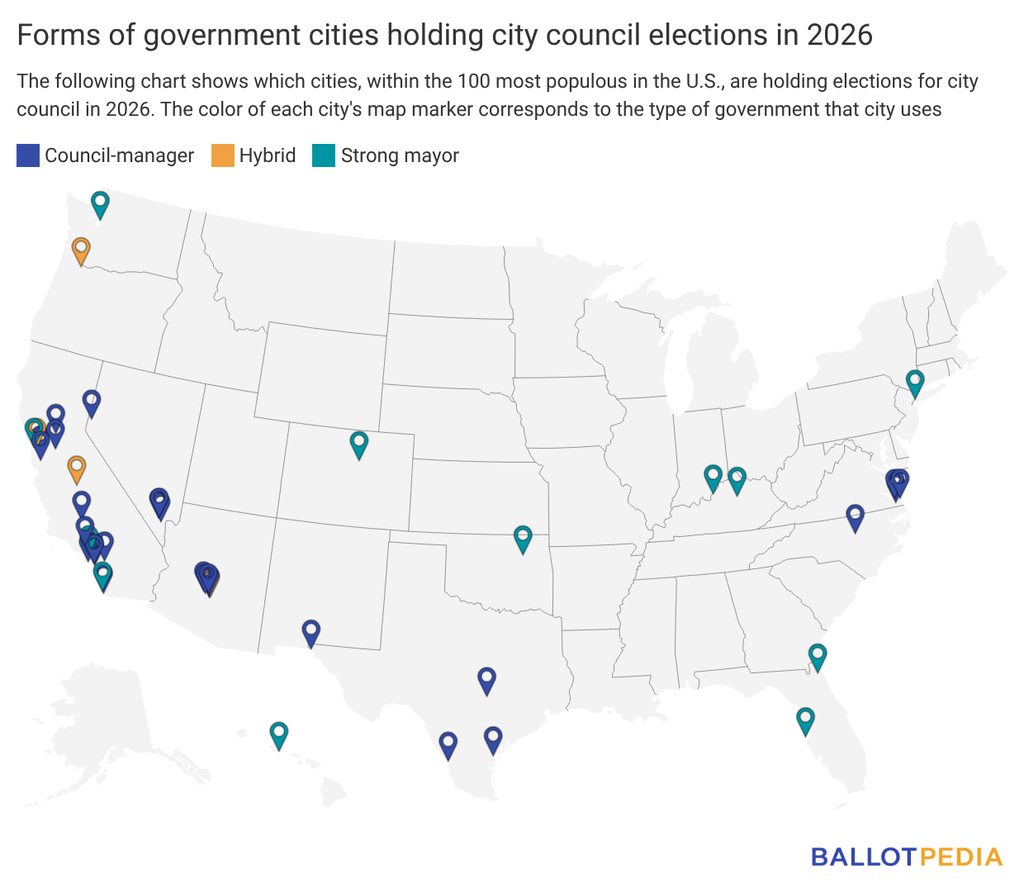
Notable elections:
- Los Angeles: General elections are taking place for Districts 3 and 9 of the Los Angeles City Council. All of the other districts’ general elections were canceled after candidates won outright in the June 2 primaries. Timothy Gaspar and Barri Worth Girvan are running in District 3. Gaspar’s campaign website lists endorsements from several local police and labor unions. Former Mayor Antonio Villaraigosa endorsed Worth Girvan. Estuardo Mazariegos and Jose Ugarte are running in District 9. The Democratic Socialists of America (DSA) endorsed Mazariegos. The Los Angeles Democratic Party endorsed Ugarte.
- Tallahassee, Florida: Elections are taking place for mayor and Districts 3 and 5 on the City Commission. The mayor also has a vote on the city commission. According to Bolts, “Tallahassee’s five-member city council is split between a bloc of three centrists and two progressives, a divide that’s shown up in votes from policing to real estate development.” In the mayoral election, City Commissioner Jeremy Matlow and former state Sen. Loranne Ausley are running. Tom Derzypolski and PJ Perez are running in District 3, Matlow’s current seat. Incumbent Dianne Williams-Cox and Dorothy Inman-Johnson are running in District 5.
- Louisville, Kentucky: Thirteen of the 26 seats on the Louisville Metro Council are up for election. Heading into the elections, Democrats have a 14-12 majority on the Council and have had a majority since the Council was formed in 2003. This means Democrats cannot lose any seats and maintain their majority, and Republicans would need to gain two seats to win a majority. This year is also the first time Louisville is holding nonpartisan elections for mayor and metro council. A 2024 law, HB288, required the city to switch to nonpartisan elections.
- Portland, Oregon: Six of the 12 seats on the Portland City Council – three in District 3 and three in District 4 – are up for election. Twenty-one candidates are running in District 3, and 12 are running in District 4. All six incumbents are running for re-election. According to Bolts, the city council is evenly split “between a moderate faction aligned with the mayor and a progressive or socialist bloc.” Three members of each bloc are up for election. This means if any of the incumbents lose their bids for re-election, ideological control could shift.
Key Trends to watch:
- Forms of government: Voters in Oakland, California are deciding on a local ballot measure that would change the city's form of government from a hybrid system to a mayor-council (or strong mayor) system and make the mayor the city's chief executive officer. Currently, Oakland is one of seven cities, among the 100 most populous, with a hybrid government. Forty-seven of the 100 largest cities have strong-mayor governments. Forty-six have council-manager governments.
- Six city council members are facing recalls on Nov. 3. City council members had more recall petitions filed against them than any other office group this year, with 214. As we mentioned in our Oct. 7 edition of the Daily Brew, from 2010 to 2025, city council members had the most recall petitions filed against them, except in 2021 when school board members had the most.
- On Nov. 3, voters in Irvine, California, Honolulu, Hawaii, and Longmont, Colorado, will decide on ballot measures that would require ranked-choice voting (RCV) in mayoral and city council elections. City councils put all three measures on the ballot.
Recent election history:
Ballotpedia covered an average of about 380 city council elections between 2018 and 2025, and an average of about 1,190 candidates ran in those races each year.
Click here to learn more about our coverage of municipal elections in 2026.