

Welcome to the Monday, Nov. 2, 2026, Brew.
By: Lara Bonatesta
Here’s what’s in store for you as you start your day:
- State Democratic and Republican parties took opposing positions on 70 ballot measures and agreed on six in 2026
- 28 local ballot measures on Nov. 3 would limit data center development if approved, 13 would facilitate it
- On the Ballot’s Midterm Mania series breaks down who’s running and what’s at stake in the Nov. 3 elections
State Democratic and Republican parties took opposing positions on 70 ballot measures and agreed on six in 2026
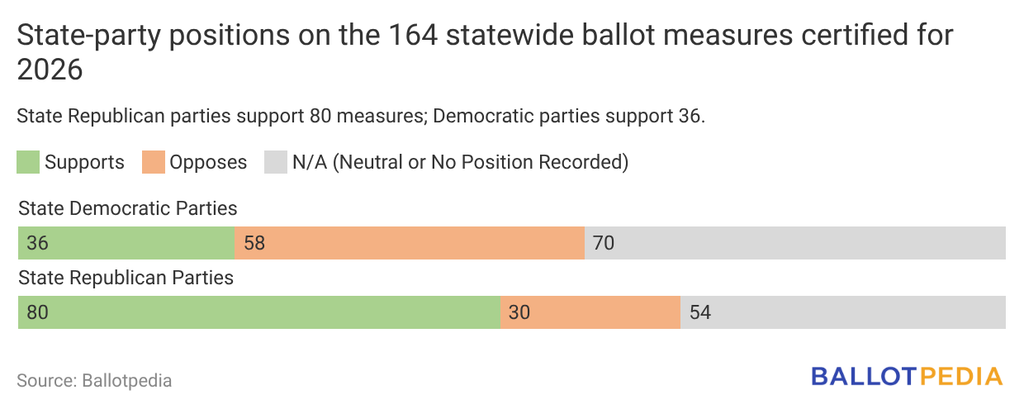
Of the 164 statewide ballot measures that voters have or will decide this year, there were six that state Democratic and Republican parties agreed on and 70 that they disagreed on. Fifty-two measures received support or opposition from only one party. Thirty-six measures did not receive support or opposition from either party.
Republicans supported 50 that Democrats opposed, and Democrats supported 20 that Republicans opposed. Both parties agreed in their support of three measures and opposition to three others.
Overall, Republican parties supported 80 measures (48.8%), opposed 30 (18.3%), and were neutral or had no position on 54 (32.9%). Democratic parties supported 36 measures (22.0%), opposed 58 (35.4%), and were neutral or had no position on 70 (42.7%).
Voters will decide 145 measures on Nov. 3. The other 19 appeared on ballots earlier this year.
Of the 70 measures state parties disagreed on, legislators put 41 (58.6%) on the ballot, and 29 (41.4%) were citizen initiatives, including veto referendums. Some common issues the parties disagreed on were:
- Voter ID: Republicans supported and Democrats opposed measures in Arizona, California, Colorado, North Carolina, and Ohio that would establish or expand voter identification requirements in state constitutions. The Nevada Republicans supported Question 7, with no position recorded for Democrats. The Oklahoma Democratic Party opposed State Question 846, with no position recorded for Republicans.
- Abortion policy: Democrats supported and Republicans opposed measures in Idaho and Virginia, which would establish statutory and constitutional rights related to abortion, respectively. Republicans supported, and Democrats opposed, Missouri Amendment 3, which would repeal the constitutional right to reproductive freedom voters approved in 2024 and prohibit abortion with specified exceptions, among other changes. The Nevada Democratic Party supported Question 6, which would establish a constitutional right to abortion, with no position recorded for the Republican Party.
- Sex-based school sports requirements: Republicans supported and Democrats opposed all four measures that would establish sex-based requirements for school sports in Arizona, Colorado, Nebraska, and Washington.
- Medical procedures for transgender minors: Republicans supported and Democrats opposed Colorado Proposition 135 and Missouri Amendment 3, both of which would prohibit certain medical procedures for transgender minors.
- Income and wealth taxes: Democrats supported and Republicans opposed California Proposition 3, which would extend higher-income tax rates for education funding; California Proposition 40, which would impose a one-time wealth tax; and Colorado Amendment 87, which would replace the flat income tax with graduated rates. Republicans supported and Democrats opposed measures to restrict, reduce, or repeal income or wealth taxes in California, Colorado, Iowa, Missouri, North Carolina, and Washington.
Democratic and Republican parties in the same state supported:
- California Proposition 38, which would authorize $8.4 billion in general obligation bonds for immunology and immunotherapy research.
- Louisiana Amendment 7, which would amend the state constitution to authorize public funds for maintaining drinking water utility service lines affected by hazardous materials on property owned by utility customers.
- Massachusetts Question 1, which would make records that the Legislature and governor’s office hold subject to the state’s public records law with certain exceptions.
Democratic and Republican parties in the same state opposed:
- California Proposition 44, which would require nonprofit federally qualified health centers to spend at least 90% of their annual total revenue on expenses that advance the health center’s mission.
- Colorado Proposition 137, which would allow the state to retain and spend sales tax revenue from sporting goods and equipment on water, land, forests, wildfire prevention, and outdoor recreation rather than refunding it under the Taxpayer’s Bill of Rights (TABOR).
- Massachusetts Question 3, which would replace separate political party primaries for state elections with a single top-two primaries listing all candidates on the same ballot, regardless of political affiliation.
Legislative votes and party positions differed on five measures
State Democratic parties opposed two measures that Democratic state legislators largely supported in placing on the ballot. 96.3% of Democratic legislators supported California Proposition 43. It would require two-thirds voter approval for citizen-initiated local special taxes and prohibit local jurisdictions and ballot initiatives from enacting certain property taxes. 100% of Democratic legislators supported Utah Constitutional Amendment A. It would require proposed constitutional amendments to be published for 60 days before the election in a manner that the legislature specifies. It would replace the requirement for newspaper publication in each county.
State Republican parties opposed three measures that Republican state legislators largely supported in placing on the ballot. 100% of Republican legislators supported New Mexico’s Bond Question 2 and Bond Question 3. Question 2 would authorize up to $20 million in bonds for academic, public school, tribal, and public library acquisitions. Question 3 would authorize up to $230 million in bonds for capital improvements and acquisitions at higher education institutions, special schools, and tribal schools. A statewide property tax would fund both bonds. 95.1% of Republican legislators supported Constitutional Amendment 3. It would establish regents nominating committees, require student appointees to come from lists that student governing bodies provide, and prohibit non-student appointees from changing political parties during the 12 months preceding appointment.
No measures received state-party support when a majority of that party’s legislators voted against putting them on the ballot.
Click here to read more about state Democratic and Republican party positions on ballot measures in 2026.
28 local ballot measures on Nov. 3 would limit data center development if approved, 13 would facilitate it
On Nov. 3, voters in 10 states will vote on 41 ballot measures affecting local data center policy.
A “yes” vote on 28 of these measures would limit data center development through policies such as bans or moratoriums. A “yes” vote on the remaining 13 measures would facilitate data center development through policies like zoning.
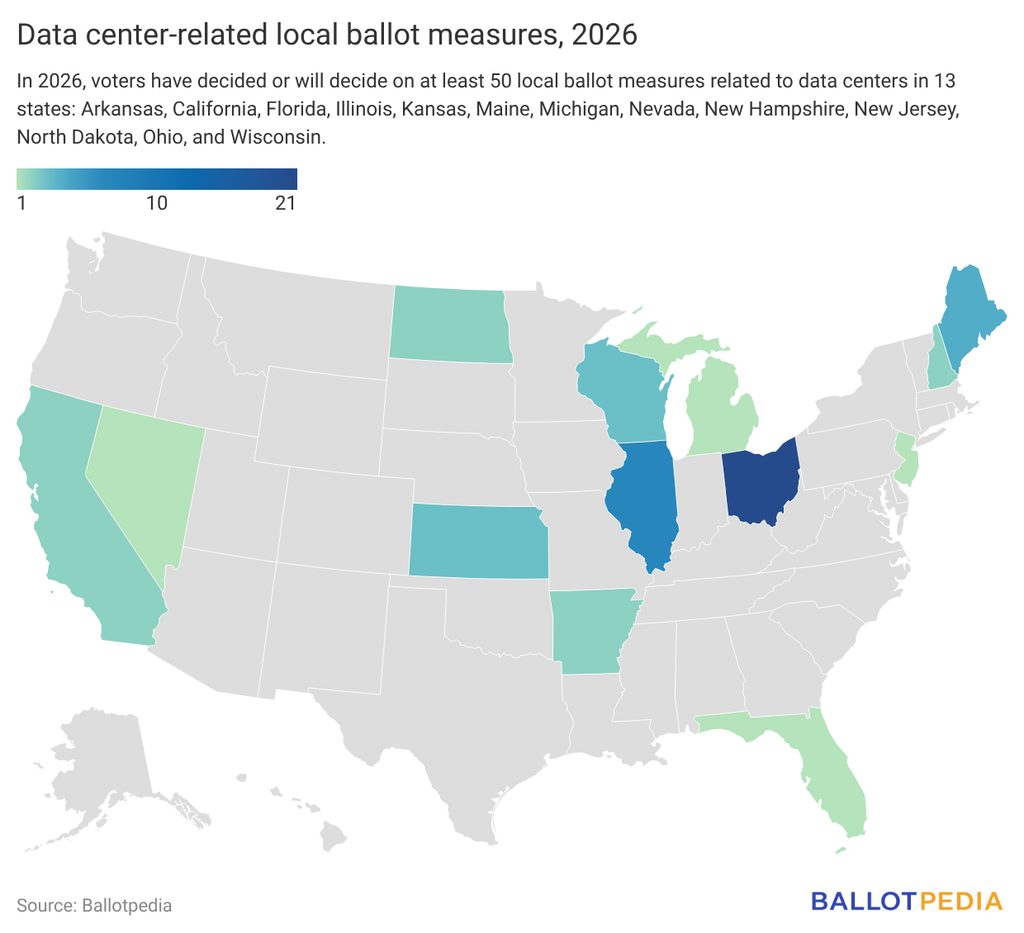
Voters have already decided six measures this year and, in each case, a majority of voters favored greater limits on data center development, either by approving new restrictions or requirements or by rejecting a measure that would have facilitated or supported development. Including these measures, and three that voters will decide after Nov. 3, Ballotpedia is covering 50 local ballot measures in 13 states related to data centers this year.
Ohio voters will decide on 21 measures, more than any other state. Illinois follows with seven measures. Maine voters will decide four, and Kansas voters will decide three. Voters in California, Florida, Nevada, New Jersey, North Dakota, and Wisconsin will decide one each.
State policies on data centers
State and local governments can affect data center construction through policy actions like permitting, zoning, and tax incentives. As of April 2026, 38 states had created tax incentives to encourage data center construction.
State and local governments can also use some of these policy actions to prevent or limit data center construction, for example through moratoriums (temporary halts) on issuing permits for new projects. In July, New York Gov. Kathy Hochul (D) issued an executive order for the first state-level moratorium on data center construction. This one-year moratorium barred state regulators from issuing permits for new data centers expected to use 50 megawatts or more of electricity. Other states have also issued moratoriums on administrative measures like tax breaks and environmental permits for data center construction.
What the Nov. 3 ballot measures would do
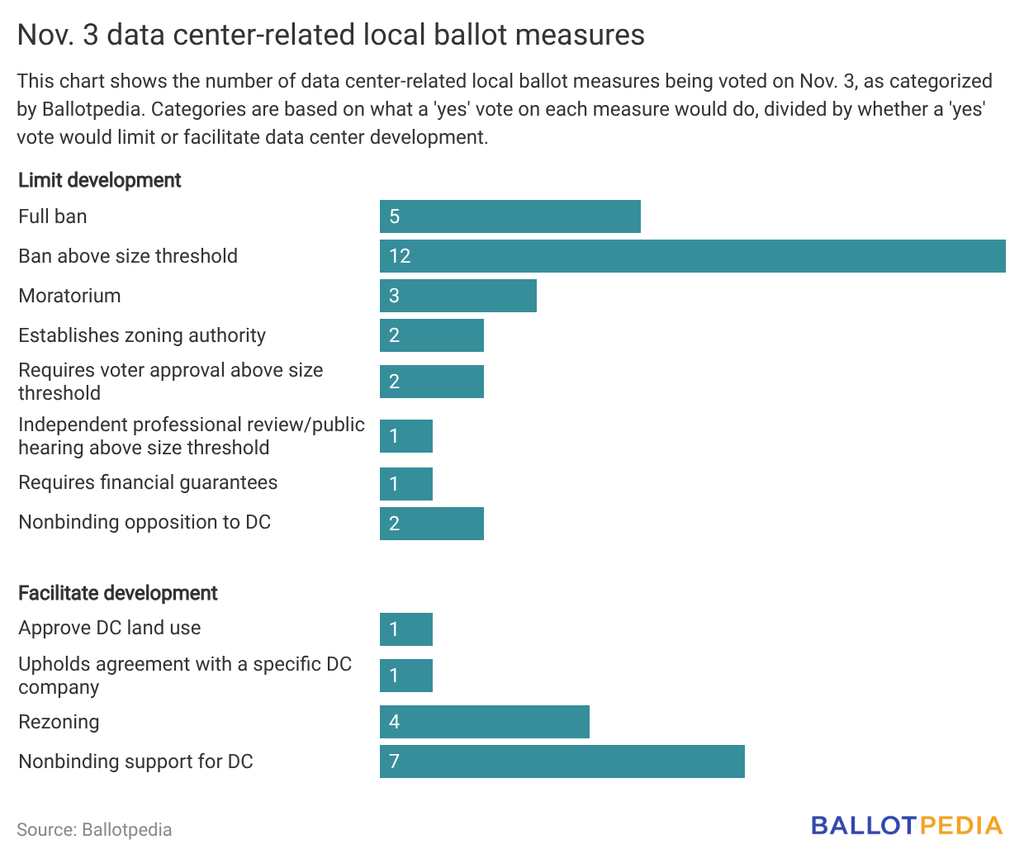
Twenty-eight measures, if approved, would limit data center development:
- Seventeen would ban data centers. Twelve of these would ban data centers above a certain size threshold. For example, one measure in Kansas would ban data centers using more than 25 megawatts of electricity. Five would ban all data centers.
- Three would issue six-month moratoriums on data center development. One measure for a moratorium in Wells, Maine, would also retroactively "nullify any final permit, license, or other approval of a new or expanded Data Center issued by a municipal reviewing authority within 45 days of the effective date."
- Two measures in Ohio would establish zoning regulations for unincorporated areas of the local jurisdictions. If the measures are successful and the areas are covered by zoning regulations, they would have to be zoned for a use consistent with data center construction (such as industrial) for a project to be built there.
- One measure in Ohio would require voter approval for data center projects above land, water, and power use thresholds, while another measure in Wisconsin would require voter approval for a specific data center project if it costs more than $450 million.
- A measure in North Dakota would require independent professional review and a public hearing for projects exceeding various land area, power, and water use thresholds, as well as projects requiring a major air quality permit.
- A measure in Ohio would require data center developers receiving tax incentives to provide financial guarantees to the community.
- Two non-binding measures in Illinois would express voter disapproval of data center projects.
Thirteen measures, if approved, would facilitate data center development:
- One measure in Nevada would add data centers as an approved use for a particular area of land.
- One measure in Ohio would uphold a town agreement with a specific data center company.
- Four measures in Wilmington, Ohio would rezone specific areas of land from residential to industrial uses, allowing data center construction at these sites. According to WCPO News, a specific data center company may build on this land if it is rezoned.
- Seven non-binding measures in Illinois, New Jersey, and Ohio would express voter approval of data center projects.
Voters in four states have already voted on six data center-related measures.
- On March 10, voters in Canterbury, New Hampshire, approved a ban on data centers 83.6% to 16.4%.
- On April 7, voters in Port Washington, Wisconsin, approved an initiative 66.4% to 33.6% requiring voter approval for the city to create a Tax Incremental District if projects in the district cost $10 million or more.
- On June 2, voters in Monterey Park, California, approved a ban 88.3% to 11.7%.
- On Aug. 4, voters in Augusta Township, Michigan, defeated a measure 89.6% to 10.4% that would have rezoned specific areas of land for a proposed data center.
- On Aug. 11, voters in the village of Wrightstown, Wisconsin, defeated a nonbinding measure 87.3% to 12.8% that would have recommended village actions to support data centers.
- On Sept. 8, voters in Nottingham, New Hampshire, approved a one-year moratorium on data center permitting 90.3% to 9.7%.
On Dec. 1, voters in Clarksville, Arkansas will decide whether to uphold two different city bond issue ordinances intended to support a data center project. On Dec. 15, voters in Mandan, North Dakota will vote whether to ban data centers using 25 megawatts or more.
Click here to learn more about data center-related ballot measures in 2026.
On the Ballot’s Midterm Mania series breaks down who’s running and what’s at stake in the Nov. 3 elections
As you prepare to head to the polls tomorrow, make sure to check our Midterm Mania series of On the Ballot for everything you need to know before you vote. Election analysts, journalists, and Ballotpedia’s own team members joined host Norm Leahy to discuss what they’re watching in this year’s elections from the candidates running to the policy issues at stake. Here’s a list of the episodes in this series and a sneak peek at what you can expect in each.
Oct. 9 - Kyle Kondik of Sabato’s Crystal Ball Kicks Off Midterm Mania
Kyle and Norm discuss how gas prices, populist sentiments, and presidential approval are shaping the midterms, competitive Senate contests in Texas, Ohio, Iowa, and Kansas, and how redistricting matters for the House.
Oct. 14 - Texas Tribune’s Jayme Lozano on data centers, rural voters, and the Texas races to watch
Jayme shares what’s on Texas voters’ minds, from affordability to data centers. She also discusses the race for agriculture commissioner, how rural Texans could shape the governor’s and U.S. Senate races, and the under-the-radar races she’s watching.
Oct. 16 - Senate Races to Watch with Cook Political Report’s Jessica Taylor
Jessica breaks down each party’s path to a Senate majority, how Cook rates races, and why states like Kansas, Nebraska, and South Carolina are on Cook's radar.
Oct. 19 - Down-Ballot Races Explained: Leslie Graves on Closing the Local Information Gap
Exploring the school boards, judges, county offices, and special districts that make up more than 500,000 elected offices nationwide. They discuss Ballotpedia’s long-term plan to cover every contest on every ballot.
Oct. 21 - Covering 116,000 Candidates with Ballotpedia’s Doug Kronaizl
Doug offers a behind-the-scenes look at our local election coverage, which spans about 55,000 elections and 116,000 candidates in 2026, a record for Ballotpedia. They discuss how the team tracks down candidate lists and the unusual offices they’ve found along the way.
Oct. 23 - 2026 Ballot Measures and Elections to Watch, with Ballotpedia’s Lara Bonatesta and Victoria Rose
Lara and Victoria break down what’s further down the ballot this November. Victoria discusses trends behind this year’s 164 statewide ballot measures, from voter ID to California’s proposed billionaires tax, and Lara talks about the secretary of state and attorney general races we’re watching and how data centers have become an issue at every level of the ballot.
Oct. 27 - Federal Reserve Actions in Election Years with Former Richmond Fed President Jeffrey Lacker
Jeffrey shares how the Federal Reserve weighs the timing of its moves and how past chairs navigated their relationships with presidents and Congress. He also breaks down what happened when the Federal Reserve raised rates ahead of the 1978 and 2022 midterms, what Federal Reserve independence looks like in practice, and the long-term challenge of bringing inflation back to the Federal Reserve’s 2% target.
Oct. 28 - Forecaster Chaz Nuttycombe on 6,000+ State Legislative Races and Trust in Polling
A look at the national mood shaping thousands of state legislative races, which chambers and trifectas could change hands, and what State Navigate’s polling in states like Georgia and Vermont is showing. Chaz and Norm also talk about why shifts in turnout can make comparisons to past elections tricky, the rise of fake polls, and what it means for trust in polling.
Oct. 29: Money in Politics, Explained with OpenSecrets’ Hilary Braseth
How OpenSecrets got its start as a 1,500-page book in the post-Watergate era, how two 2010 court decisions gave rise to super PACs and satellite spending, what’s driving the rising cost of elections, the growing role of mega donors and industries like crypto and AI, why spending on state and local races and ballot measures deserves more attention, and where campaign finance could be headed next.
Click here to subscribe to On the Ballot. Plus, make sure to check out Ballotpedia’s 2026 Voter Toolkit for everything you need to vote confidently, and click here to use our Sample Ballot Lookup Tool to see what’s on your ballot.