


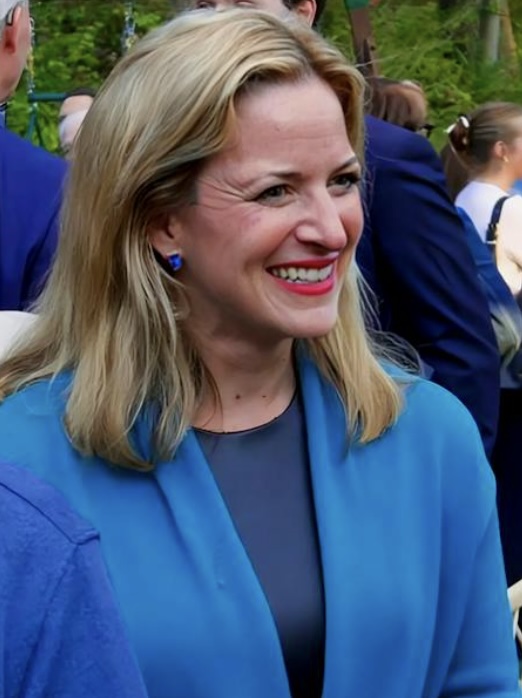
Jocelyn Benson (D) defeated John James (R) and 13 other candidates in the general election for governor of Michigan on November 3, 2026.
Incumbent Gretchen Whitmer (D) was term-limited and could not seek re-election. Bridge Michigan's Simon D. Schuster wrote, "James heads to the general election looking to extend a streak: It’s been about 35 years since the same party held onto the Michigan governor’s office for more than two terms, something Benson is attempting to do by succeeding Whitmer, a fellow Democrat. But Republicans have not won a statewide office in Michigan in more than a decade, and midterm elections tend to serve as a referendum on the White House, where Trump’s popularity has plummeted."
In 2024, President Donald Trump (R) defeated Kamala Harris (D) 49.7%–48.3% in the presidential election and Elissa Slotkin (D) won the senatorial election 48.6%–48.3%.
Both Benson and James had run statewide in recent elections. Benson won the 2022 Secretary of State election 55.9%–41.9%. Incumbent Gretchen Whitmer (D) won that year's gubernatorial election 54.5%–43.9%. James lost the 2020 senatorial election 49.9%–48.2% to incumbent Gary Peters (D). That year, Joe Biden (D) defeated President Donald Trump (R) 50.6%–47.8% in the presidential election in Michigan.
As of November 2026, major election forecasters rated the general election Likely Democratic, Lean Democratic, or Tilt Democratic.
Benson was elected Secretary of State in 2018 after unsuccessfully running for the office in 2010. She earlier worked as an attorney with a focus on civil rights. Benson's campaign website said, "Jocelyn has a proven track record of transforming broken government systems and fixing them to save Michiganders time and money while protecting their rights and freedoms. As governor, she will make Michigan more affordable, take our public schools to the top 10 in the nation, and make government work for Michiganders." Benson's running mate was Winnie Brinks (D).
James was first elected to represent the 10th Congressional District in 2022. He was a U.S. Army veteran and former executive at a logistics company. James' campaign website said, "John’s vision for Michigan is clear and disciplined: academic excellence, economic opportunity, and safe communities where families feel secure. He’ll put kids and families first when it comes to education, cut job-killing regulations, fully fund and support law enforcement, and prioritize Michigan workers and families." James' running mate was Jay DeBoyer (R).
Minor party candidates included Douglas Campbell (G), Anthony Hudson (L), and Donna Brandenburg (U.S. Taxpayers Party). Campbell's running mate was Bobbie Clay (G), Hudson's was Beau Parmenter (L), and Brandenburg's was Robert Cowper II (U.S. Taxpayers Party). Write-in candidates included Cecelia Adkins (I), Timothy Badgley (I), Justin Blackburn (I), Angelo Brown (I), Joe Hunt (I), Henry Lester (I), Evan Space (I), William Stahl (I), and Kim Thomas (I).
The election influenced Michigan's trifecta and triplex status. Heading into the election, Democrats had a triplex in Michigan because the governor, attorney general, and secretary of state were all Democrats. Neither party had a trifecta because Republicans had a majority in the Michigan House of Representatives while Democrats had the governorship and a majority in the Michigan Senate.
In 2026, Michigan held elections for all three triplex offices, all 38 seats in the Michigan Senate, and all 110 seats in the Michigan House of Representatives. Because Democrats won all three elections for triplex offices, they maintained their triplex in Michigan. Because Benson won the gubernatorial election and Democrats maintained their Senate majority while gaining a House majority, Democrats gained a trifecta in Michigan. If James had won the gubernatorial election, Democrats would have lost their triplex and been unable to gain a trifecta.
In Michigan, the gubernatorial nominee is selected in the primary. Major and minor party lieutenant gubernatorial nominees are chosen at party conventions and run on a joint ticket with the gubernatorial nominee.
This was one of 36 gubernatorial elections taking place in 2026.