


Welcome to the Monday, Nov. 9, 2026, Brew.
By: Briana Ryan
Here’s what’s in store for you as you start your day:
- How state party-backed ballot measures fared, and where they outperformed the party's candidates
- When winning state executives and legislators will be sworn in
- Partisan control of state boards of education in two states could change as a result of the midterm elections
How state party-backed ballot measures fared, and where they outperformed the party's candidates
When state Democratic and Republican parties took opposite sides on statewide ballot measures this year, voters sided with Democrats more often. Of the statewide measures called as of Nov. 6, the Democratic position had a 61% success rate, and the Republican position had a 39% success rate. Below, we’ll also compare these results to how each party’s candidates performed in statewide races.
Our analysis of state party positions on ballot measures identified endorsements across the 164 statewide measures voters decided in 2026.
The state parties took opposing positions on 70 statewide measures this year, with Republicans backing 50 and Democrats backing 20. Voters decided on 64 statewide measures on Nov. 3 and six earlier in the year.

Of the 59 measures called so far this year, the Democratic position prevailed on 36 (61.0%), and the Republican position prevailed on 23 (39.0%). As of Nov. 6, 11 measures remain uncalled. Available results favor the Democratic position on six and the Republican position on five.
Among the issues voters decided:
Voter ID: Republicans supported five measures requiring voter ID, and Democrats opposed them. Voters approved those Republican-backed measures in North Carolina and Ohio and defeated those in Arizona, California, and Colorado.
- The Democratic position prevailed in Virginia, which approved a right to an abortion, and in Missouri, which defeated a measure that would have repealed the constitutional right to reproductive freedom that voters approved in 2024 and prohibited abortion with exceptions. The measure in Missouri would have also prohibited gender transition surgeries and certain other procedures for minors.
- The Republican position prevailed in Idaho, where voters rejected statutory abortion rights.
Sex-based sports requirements: Republicans supported, and Democrats opposed all four sex-based school sports measures. Voters approved those Republican-backed measures in Arizona, Colorado, Nebraska, and Washington.
- Voters approved California’s Democratic-backed extension of higher income tax rates and Colorado’s Democratic-backed move from a flat to a graduated income tax. Another Democratic-backed measure in California remained uncalled.
- Republicans backed six measures to restrict, reduce, or repeal income or wealth taxes. Voters approved those Republican-backed measures in Iowa and North Carolina, and defeated them in Colorado, Missouri, and Washington. A measure in California remained uncalled.
On measures where at least one state party took a side, Republican positions prevailed on 44 of the 97 called measures (45.4%), and Democratic positions prevailed on 53 of 82 (64.6%). Where the parties agreed, their shared position prevailed on four of five called measures.
Where results on party-backed ballot measures differed from statewide candidate results
Nevada voters elected a Democratic governor and approved both a constitutional right to abortion and a voter ID requirement. Those results show how ballot measures can tell us more about voters’ policy preferences than candidate races alone.
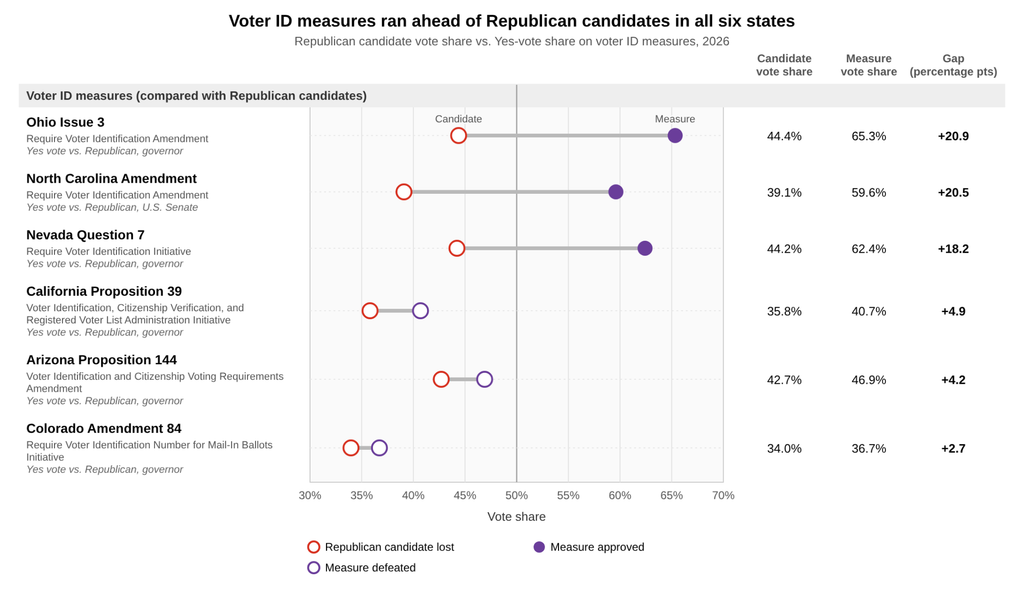
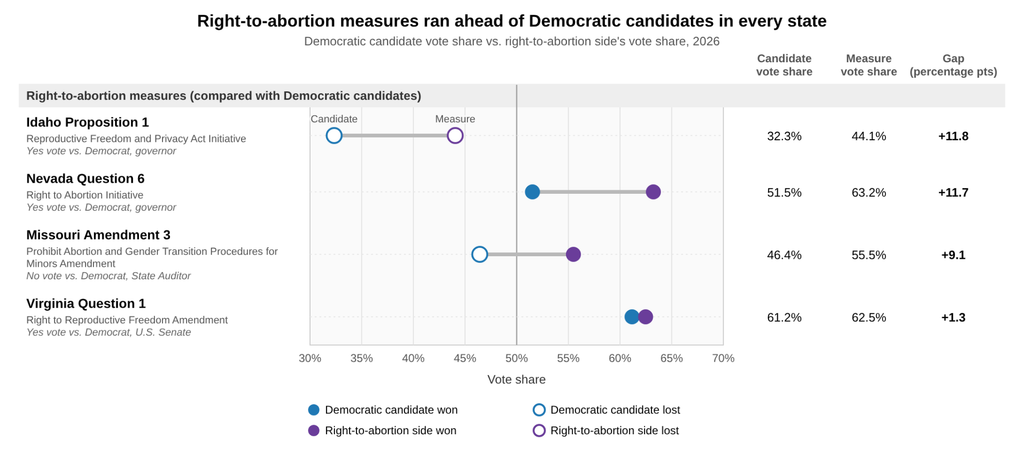
Voters approved Question 6, the abortion measure, with 63.2%, and Question 7, the voter ID measure, with 62.4%. Attorney General Aaron Ford (D), who supported Question 6 and opposed Question 7, defeated incumbent Gov. Joe Lombardo (R), who took the opposite positions, 51.5% to 44.2%.
Let’s take a look at how party-backed ballot measure results compare with statewide candidate results. Results are unofficial and current as of Nov. 6, 2026.
Our comparison of statewide ballot measure and candidate results examines five policy areas: income and wealth taxes, voter ID, abortion, sex-based requirements for school sports and medical procedures for transgender minors, and criminal justice. We compared those results to each state’s governor’s race or, where there was none, its U.S. Senate race. Additionally, we used the secretary of state race to compare results in Indiana and the state auditor race to compare results in Missouri.
Voter ID: State Republican Party-backed voter ID measures, all designed to establish or expand voter identification requirements in state constitutions, received larger vote shares than Republican candidates in all six states with comparable races. The comparison races were gubernatorial races, except in North Carolina, where it was the state's U.S. Senate race. Democrats won each of those races, while the measures passed in Nevada, North Carolina, and Ohio and failed in Arizona, California, and Colorado.
Abortion: The state Democratic Party-backed abortion position received a larger vote share than the Democratic candidate in all four states that decided abortion measures. That includes Idaho, where the measure failed, and Missouri, where voters rejected a proposal to repeal the constitutional right to reproductive freedom.
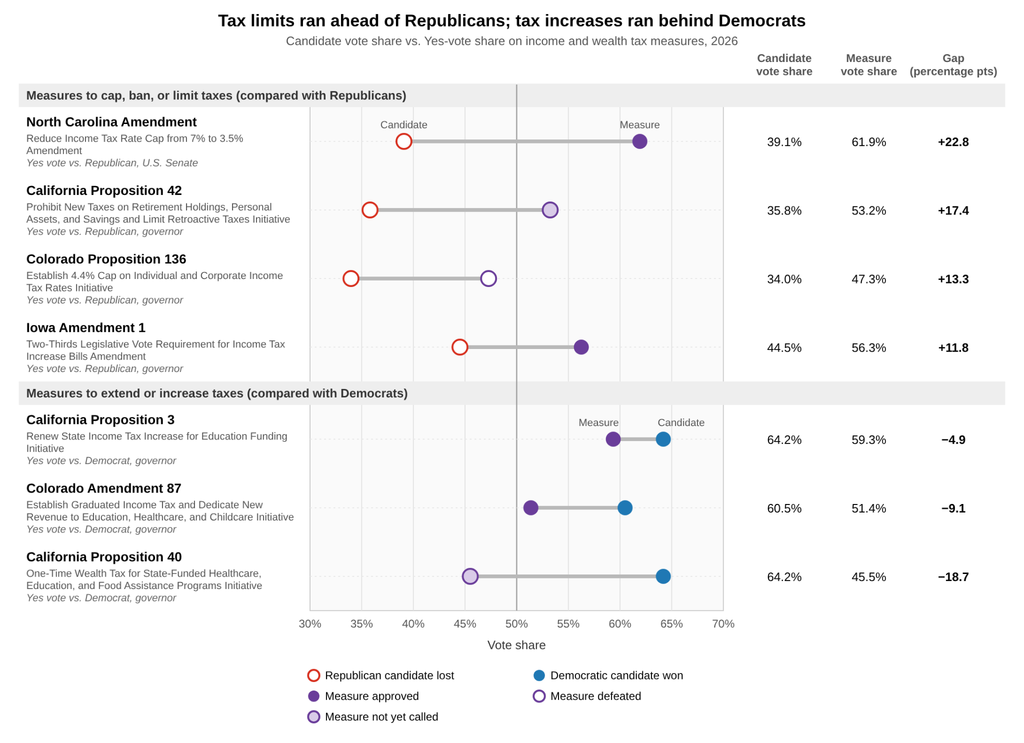
Taxes: State Republican Party-backed measures limiting income or wealth taxes received larger vote shares than Republican candidates in California, Colorado, Iowa, and North Carolina. Democrats won all four comparison races. State Democratic Party-backed measures to extend or increase income or wealth taxes received less support than Democratic candidates in California and Colorado. Democrats won both comparison races.
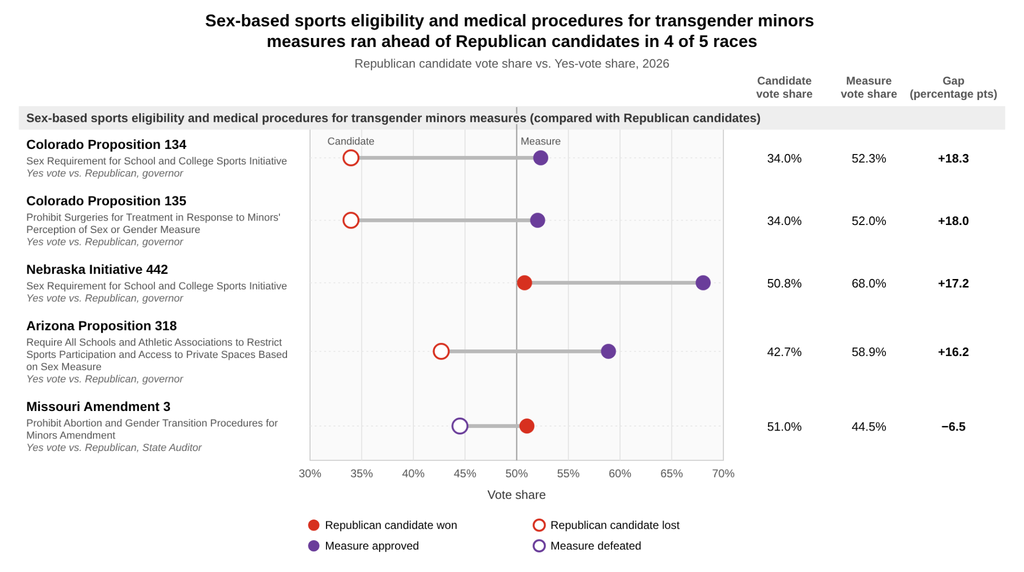
Sports and transgender minors: State Republican Party-backed measures in Arizona, Colorado, and Nebraska outperformed the Republican candidates. The measure in Missouri, which also addressed abortion, received less support than the Republican candidate.
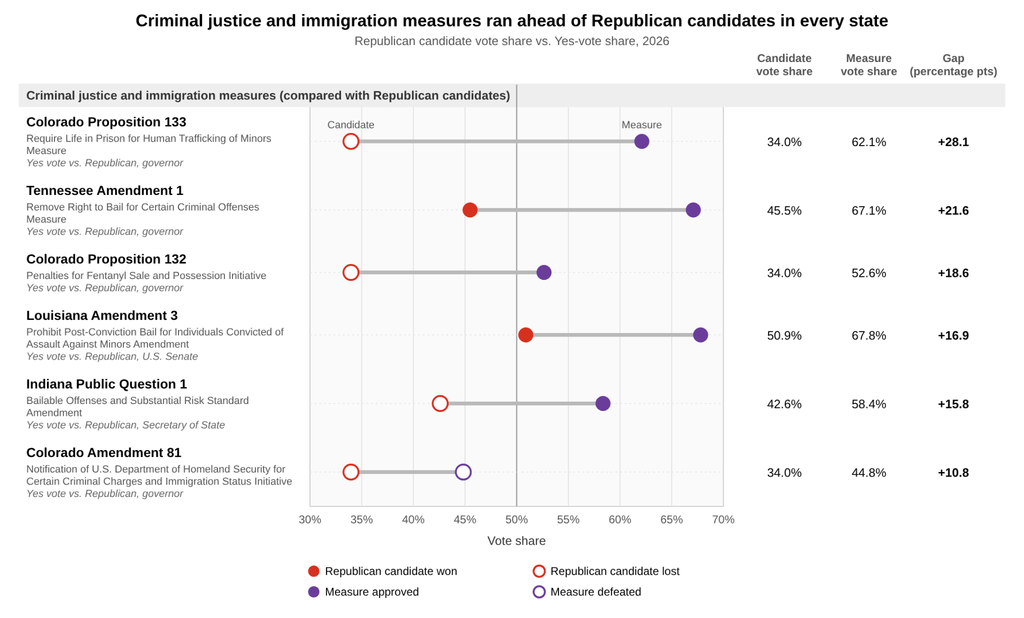
Criminal justice: State Republican Party-backed measures to increase penalties or expand the circumstances for denying bail outperformed the Republican candidates in Colorado, Indiana, Louisiana, and Tennessee.
Click here for a comparison of statewide ballot measures and candidate results, and here to read about state Democratic and Republican party positions on ballot measures.
When winning state executives and legislators will be sworn in
Candidates who won elections on Nov. 3 will be sworn in over the coming weeks and months, including thousands of state legislators and hundreds of state executives.
Forty-six states held regular state legislative elections on Nov. 3, and in some states, winning candidates have already been sworn in. Victorious candidates in Florida, Hawaii, and Tennessee were sworn in on Election Day. Winners in Alabama, Delaware, Indiana, and Nevada joined their respective legislatures on Nov. 4. Two other states will swear in legislators before the end of the month — South Carolina on Nov. 9 and Oklahoma on Nov. 18 — while seven more will do so in December.
The majority of states (30) do not swear in legislators until January 2027, with Jan. 1 the most common date (eight states), followed by Jan. 11 (seven). Alaska will be the last state to swear in legislators, on Jan. 19.
The timeline for swearing in state executives — governors, attorneys general, secretaries of state, and other statewide officials — is different. Forty-three states had a state executive race on the ballot on Nov. 3.
Alaska and Hawaii are the only states that will swear in state executive candidates before the end of the year. Hawaii swore in members of the Hawaiian Affairs Board of Trustees on Election Day, while Alaska — the last state to swear in legislators — will be the first to swear in a lieutenant governor on Dec. 1. Both states will both swear in governors on Dec. 7.
The most common day for states to swear in a new governor this cycle is Jan. 4, when eight governors will take the oath of office. The next most common date is Jan. 11, when six winning candidates will do so. The last gubernatorial candidate to be sworn in will be Gov. Wes Moore (D) of Maryland, who won re-election and will begin his new term on Jan. 20.
Swearing-in dates determine when newly elected officials can begin making decisions. This year, one example is the federal scholarship tax credit, which provides tax credits for donations to organizations that fund educational scholarships for eligible students. In most states, governors have until Feb. 15, 2027, to finalize their state’s participation in the program. The timing means an outgoing governor may act before a successor takes office. For example, on Nov. 4, outgoing New Mexico Gov. Michelle Lujan Grisham (D), announced that she would opt the state into the program. Lujan Grisham will be succeeded by Debra Haaland (D) on Jan. 1, 2027.
Click here to see the full breakdown and to find out when your state swears in state legislators, and here to see a full breakdown of when your state swears in state executive candidates.
Partisan control of state boards of education in two states could change as a result of the midterm elections
Voters decided elections for state education officials, or the governors who appoint them, in races that will influence K-12 education policy. Here’s how elections for state boards of education and chief state school officers played out:
- If current results hold, Democrats will gain a majority of seats on the Texas State Board of Education and Republicans will gain a majority on the officially nonpartisan Nebraska State Board of Education. Some races are uncalled as of Nov. 6.
- In four states where governors appoint some or all members of the state board of education, control of the governor’s office changed from Republican to Democratic. The race for Alaska’s governor, who appoints all members of the board, is too close to call as of Nov. 6.
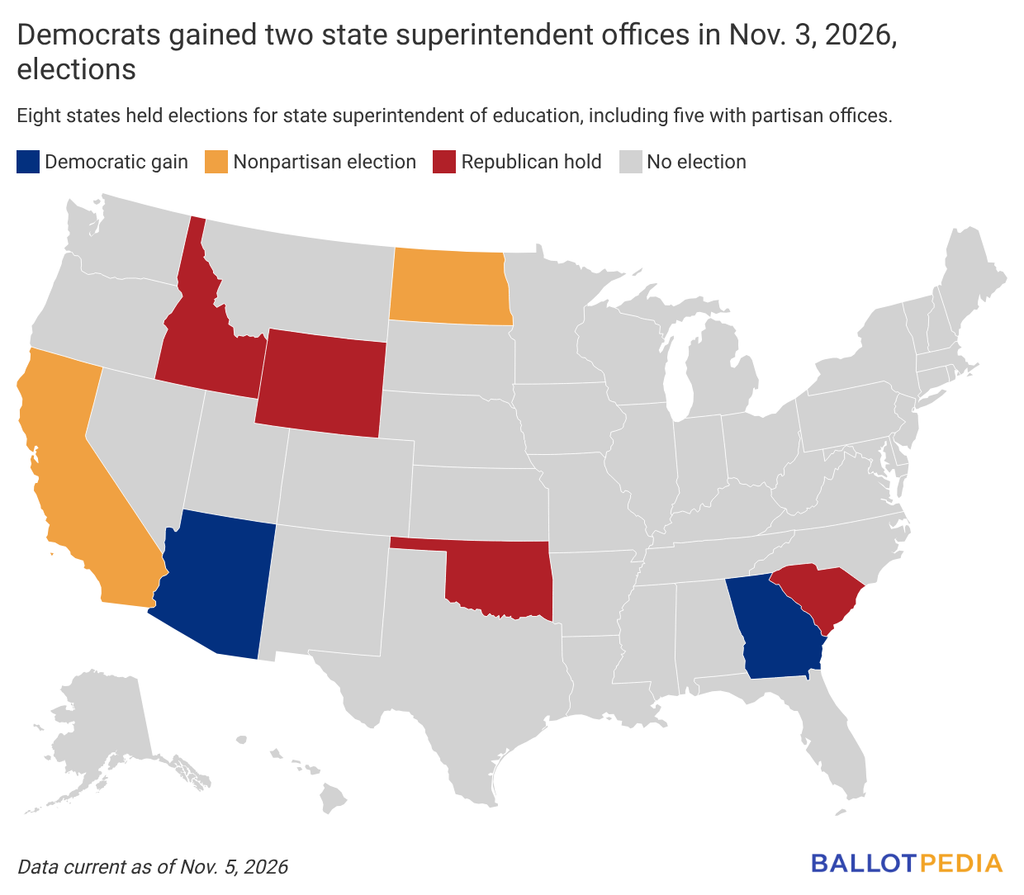
- Democrats in Arizona and Georgia won in their state superintendent elections, gaining control of offices currently held by Republicans.
- Democrats will replace Republicans in governors’ mansions in Iowa, Nevada, and Texas, where governors appoint the state superintendent.
State boards of education
Voters in Alabama, Colorado, Kansas, Louisiana, Michigan, Nebraska, Texas, Utah, and D.C. decided elections for 40 state board of education seats. Races for some seats in the Colorado, Kansas, Nebraska, Texas, and Utah elections are uncalled as of Nov. 6.
According to the National Association of State Boards of Education (NASBE), state boards across the country share the following responsibilities: “(1) authority for adopting and revising policies that promote educational excellence and equity, (2) convening experts and stakeholders to serve as a bridge between policymakers and citizens, and (3) the power to raise questions as the citizens’ voice in education.”
Here’s a more detailed look at elections in a few of those states:
- Kansas (divided government): Republicans held a 7-3 majority on the board going into the election. Republicans held five of the seats up for election, and Republicans won four of them on Nov. 3. The race for District 3, between Amy Diediker (D) and Jim McMullen (R), was uncalled as of Nov. 6. The seat is currently held by Republican Michelle Dombrosky, who did not run for re-election. As of Nov. 6, Diediker led McMullen 55-45%. A victory for Diediker would narrow the Republican majority to 6-4.
- Nebraska (Republican trifecta): Four of eight seats on the Nebraska State Board of Education were up for election on Nov. 3. The board is officially nonpartisan, but according to the Nebraska Examiner, Republicans and Democrats held an equal number of seats going into the election. The race for District 8, between Lou Ann Goding, a Republican, and Sherrye Hutcherson, a registered nonpartisan, was too close to call. As of Nov. 6, Goding led Hutcherson 51-49%. If Goding were to win, Republicans would hold a 5-3 majority.
- Texas (Republican trifecta): Nine of the board’s 15 seats were up for election this year. Republicans have held a majority on the board since 1994. With the District 8 election the only one still uncalled, Democrats and Republicans hold seven seats apiece. The race for District 8 features incumbent Audrey Young (R) and Dana Van De Walker (D). As of Nov. 6, Van De Walker leads Young 50.05-49.95%, or 564 votes. If Van De Walker wins, Democrats would hold an 8-7 majority. Republicans would hold an 8-7 majority if Young wins.
The seven states that held state board of education elections this year are the only ones where voters elect all board members. In 38 states, governors appoint all or some board members — including in 26 that held gubernatorial elections on Nov. 3. In states where governors appoint some or all members of the state board of education, party control of the governor’s mansion changed in Georgia, Iowa, Nevada, and Ohio, in each case going from Republican to Democratic.
The gubernatorial election in Alaska, where the governor appoints all members of the board, remains too close to call as of Nov. 6.
Chief state school officer
Elections for chief state school officer were held in Arizona, California, Georgia, Idaho, North Dakota, South Carolina, Oklahoma, and Wyoming on Nov. 3. In California and North Dakota, those offices are officially nonpartisan. In the other six states, Republicans held the office heading into the election. Democrats gained control of the office in Arizona and Georgia.
Voters elect the chief state school officer in 12 states. The chief state school officer is known as the superintendent of public instruction or the superintendent of education (or schools), depending on the state. But in each case, the chief state school officer generally oversees the public school system and directs the state department of education.
In 19 other states, the governor appoints the chief state school officer, including in 15 that held gubernatorial elections on Nov. 3. Of those 15, the governorships in Iowa, Nevada, and Texas changed party control.