


Welcome to Ballot Bulletin: Ballotpedia's Weekly Election Policy Digest. Every Tuesday, we deliver the latest updates on election policy around the country, including nationwide trends and recent legislative activity.
In this week’s edition, we cover the one bill state legislatures acted on last week and recap election policy ballot measures in the Nov. 3 elections.
The state of election legislation in the U.S.
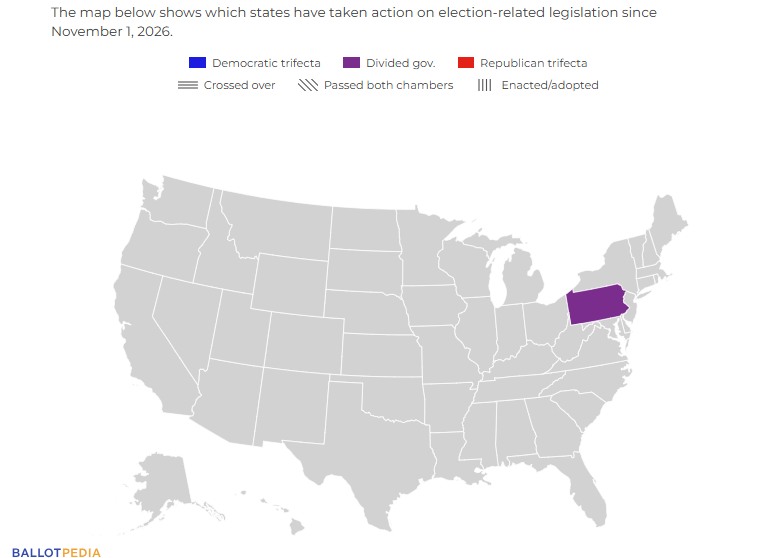
Lawmakers in one state acted on one election-related bill last week. Five state legislatures are in regular or special sessions. Last week, no bills were enacted, no bills passed both chambers of a state legislature, and no bills were vetoed.
Of the bills acted on last week, none are in states with Democratic trifectas, none are in states with Republican trifectas, and one was in a state with divided government. The most active bill category last week was ballot measures (one).
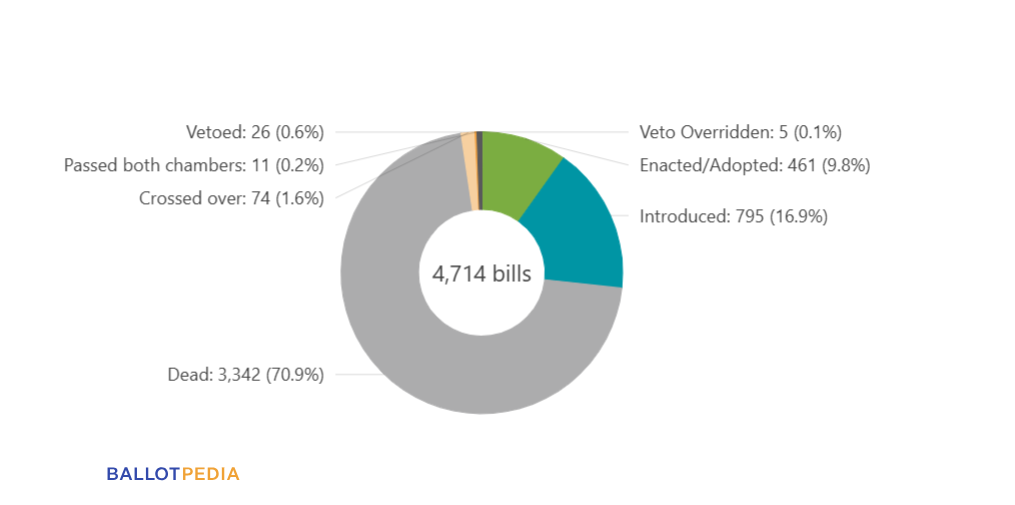
We are currently tracking 4,714 election-related bills across the country. The chart below breaks down the status of those bills based on where they stand in the legislative process:
Enacted bills
No bills were enacted or adopted last week.
Bills passing both chambers
No bills passed both chambers of a state legislature last week.
To see a full list of bills awaiting gubernatorial action, click here.
Vetoed bills
No bills were vetoed last week.
To see a list of all bills vetoed this session, click here.
All bills
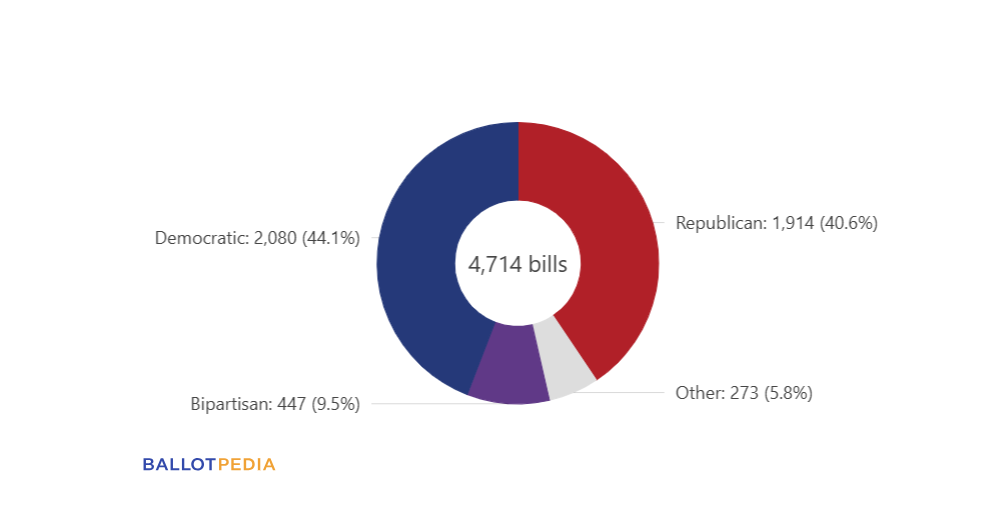
The chart below shows all bills Ballotpedia is currently tracking, broken down by partisan sponsor.
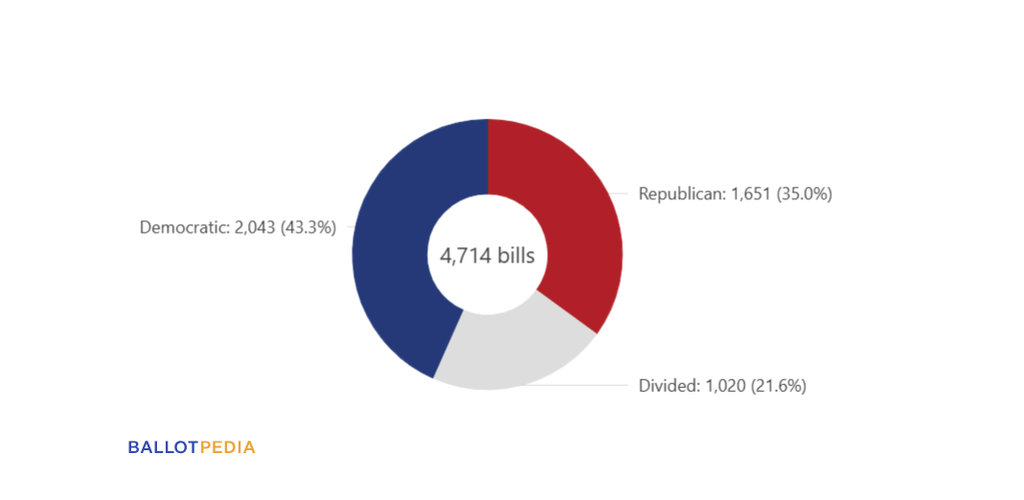
The chart below shows all bills Ballotpedia is currently tracking, broken down by trifecta status.
In the news
On Nov. 6, the U.S. Department of Justice moved to dismiss a lawsuit that sought to require the state of California to segregate mail ballots cast by individuals whom the DOJ alleged were likely noncitizens.
As reported in the Oct. 20 edition of Ballot Bulletin, the lawsuit asked that the state set aside and not count the ballots allegedly cast by likely noncitizens unless the state verified the voter’s citizenship status. A U.S. district court judge declined the DOJ’s request for a temporary restraining order that would have required the state to set the ballots aside. The DOJ appealed to the U.S. Court of Appeals for the Ninth Circuit, where a three-judge panel ruled 2-1 against the department. The U.S. Supreme Court then rejected the DOJ’s request for relief on Nov. 2.
In the motion to dismiss, the DOJ wrote that the relief the federal government sought was no longer available, as “California will have already commingled the challenged ballots with lawful ones. There is then no way to get the challenged ballots segregated.”
Here are other news stories from across the country:
- On Nov. 5, attorneys representing U.S. Sen. Cindy Hyde-Smith (R) sent a letter to county election officials in Mississippi, asking that all affidavit ballots — provisional ballots cast if a person isn’t on the voter rolls or does not present ID — be segregated in the event of a potential election contest. As of Nov. 9, Democratic challenger Scott Colom led Hyde-Smith by roughly 2,700 votes. Colom’s lawyers sent a separate letter to county officials stating that Hyde-Smith’s request was unlawful.
- On Nov. 5, Arkansas Attorney General Tim Griffin (R) asked a U.S. district court judge to terminate a 1991 consent decree that required 10 majority-Black judicial districts in Arkansas. In the motion, Griffin argued that the U.S. Supreme Court’s ruling in Louisiana v. Callais meant that the state could not be required to draw majority-minority districts under Section 2 of the Voting Rights Act. In Louisiana v. Callais, the Supreme Court ruled that Louisiana’s congressional map, which added a second majority-Black district, was an unconstitutional racial gerrymander.
- On Nov. 3, five Montana groups filed a federal lawsuit challenging the constitutionality of Initiative 194, which the state’s voters approved 65.45%-34.55% earlier that day. The ballot measure prohibits artificial persons, such as nonprofits, trusts, corporations, or trade associations, and all entities doing business in Montana from contributing to campaigns, ballot-measure elections, or political parties. The lawsuit argues the initiative harms the free speech rights of organizations in Montana and is unconstitutionally vague and overly broad.
Policy spotlight: Voters approve 10 election policy ballot measures on voter ID, noncitizen voting, and more
Voters decided 15 election policy-related statewide ballot measures on Nov. 3, covering issues ranging from voter ID and same-day voter registration to automatically restoring the voting rights of individuals convicted of a felony. As of Nov. 9, voters had approved 10 measures, rejected four, and the result of one was too close to call.
Voter identification
Nevada voters approved Question 7 62.2% to 37.9%, making Nevada the 37th state to require voters to present identification to cast a ballot in person, and the 25th state to require photo ID.
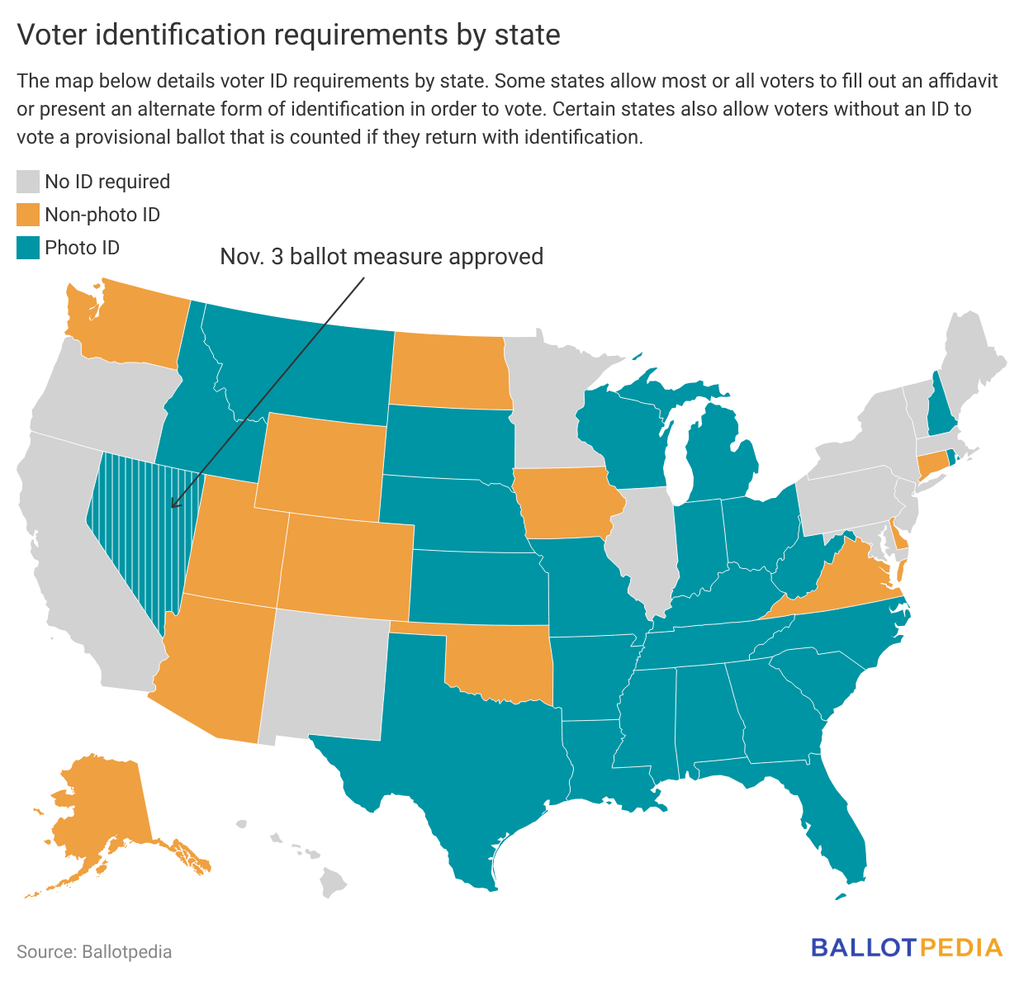
Previously, Nevada was one of 14 states that did not require ID to vote in most cases. The measure requires voters to provide a photo ID, such as a driver’s license, ID card, or tribal ID, to vote in person.
Voters must also provide the last four digits of their driver's license or Social Security number "in the block provided next to the voter’s signature for election officials to use in verifying the voter’s identity" when returning an absentee ballot. Previously, Nevada had no identification requirements for voting by mail. Nevada is now the 41st state to require voters to provide an ID or ID number when requesting or returning an absentee/by-mail ballot.
Nevada is the eighth state with a pre-election divided government to have a voter ID law. Nationally, all 23 states that had a Republican trifecta before the Nov. 3 election also have voter ID requirements, as do six Democratic trifecta states.
Ohio approved a constitutional amendment on Nov. 3 placing its voter ID laws in the state constitution, 65.3%-34.7%. North Carolina voters approved a constitutional amendment 59.6%-40.4% that required photo ID for all voters. The constitution previously required photo ID for in-person voting, and existing state law required photo ID when returning an absentee ballot by mail.
Voters in Arizona, California, and Colorado rejected measures related to voter ID. The three measures defeated in 2026 match the total number of defeated voter ID measures between 2004 and 2025.
- Arizona voters rejected Proposition 144, which would have placed the state’s ID requirement in the constitution, 53.3% to 46.7%. The amendment would have also made other changes to state election law.
- California Proposition 39 would have required in-person voters to provide ID at the polls and those voting by mail to provide the last four digits of an identification number when returning their ballot. Voters rejected the measure 60.4% to 39.6%.
- Colorado voters rejected Amendment 84, 63.3% to 36.7%. The measure would have required voters to provide their signature and an identification number, such as a Social Security or driver’s license number, when casting a mail ballot.
Citizenship requirements for voting
Four states — Arkansas, Kansas, South Dakota, and West Virginia — approved constitutional amendments on Nov. 3 stating that only U.S. citizens can vote, bringing the number of states with language explicitly prohibiting noncitizen voting in their state constitutions to 22.
Alaska voters also approved an indirect initiated state statute that says only U.S. citizens may vote in the state’s elections. Alaska does not have a constitutional prohibition on noncitizen voting.
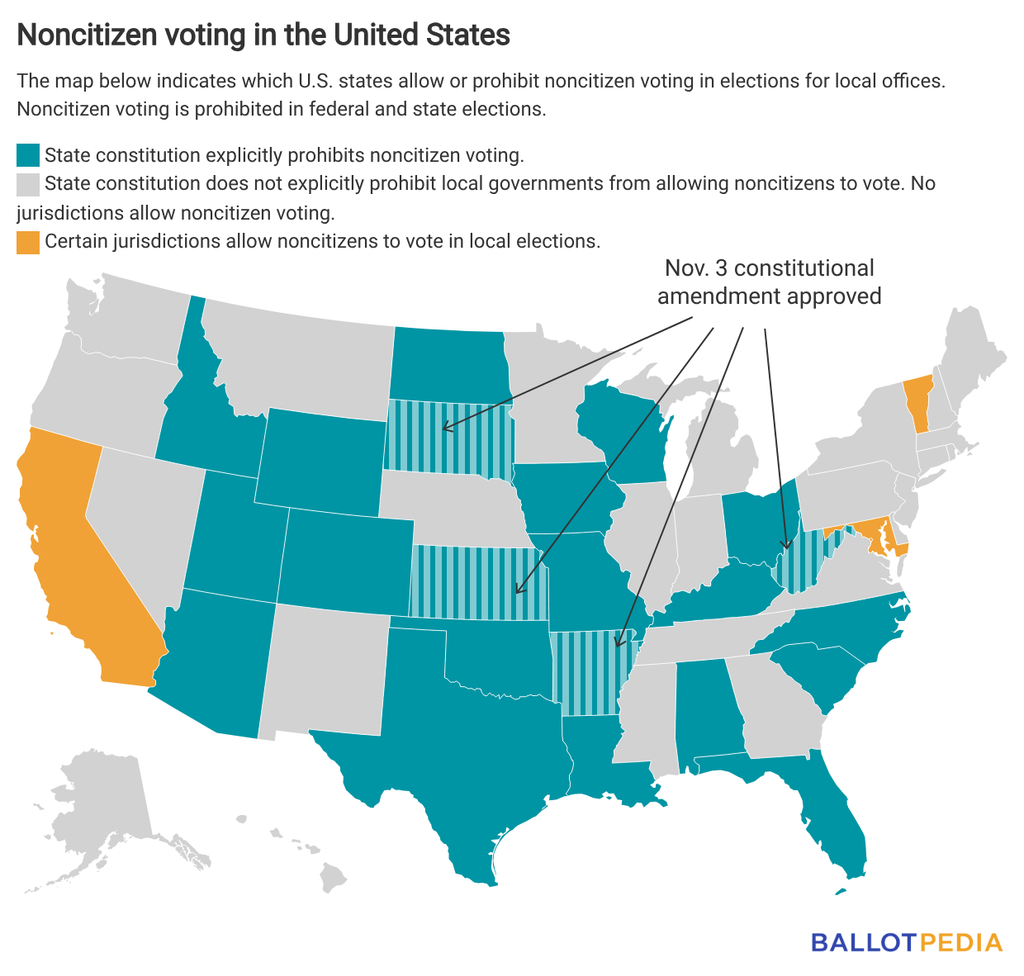
Sixteen of the 22 states with constitutional prohibitions on noncitizen voting had Republican trifectas heading into the election. Five had divided governments, and one, Colorado, had a Democratic trifecta. A majority of those states added those prohibitions in the last three years.
Arizona Proposition 144, which voters rejected, would have stated, in addition to other changes to election law, that “only citizens may register and vote in Arizona elections.” Unlike the other five states which approved citizenship ballot measures, Arizona has existing constitutional language prohibiting noncitizen voting.
Voting rights for individuals convicted of a felony
Virginia voters approved Question 3 56.6%-43.4%, making Virginia one of 40 states to restore voting rights for individuals convicted of a felony at a certain point after the completion of a sentence, which may include prison, probation, or parole, depending on the state. Virginia is now one of 24 states that restore a person’s voting rights upon completion of their prison sentence. Under the amendment, voting rights are automatically restored without any action required of the voter aside from registration.
In two states — Maine and Vermont — individuals convicted of a felony never lose the right to vote. In seven states, voting rights are not restored to individuals convicted of some or all felonies without state action to restore those rights. In Tennessee, individuals convicted of some felonies never regain the right to vote.
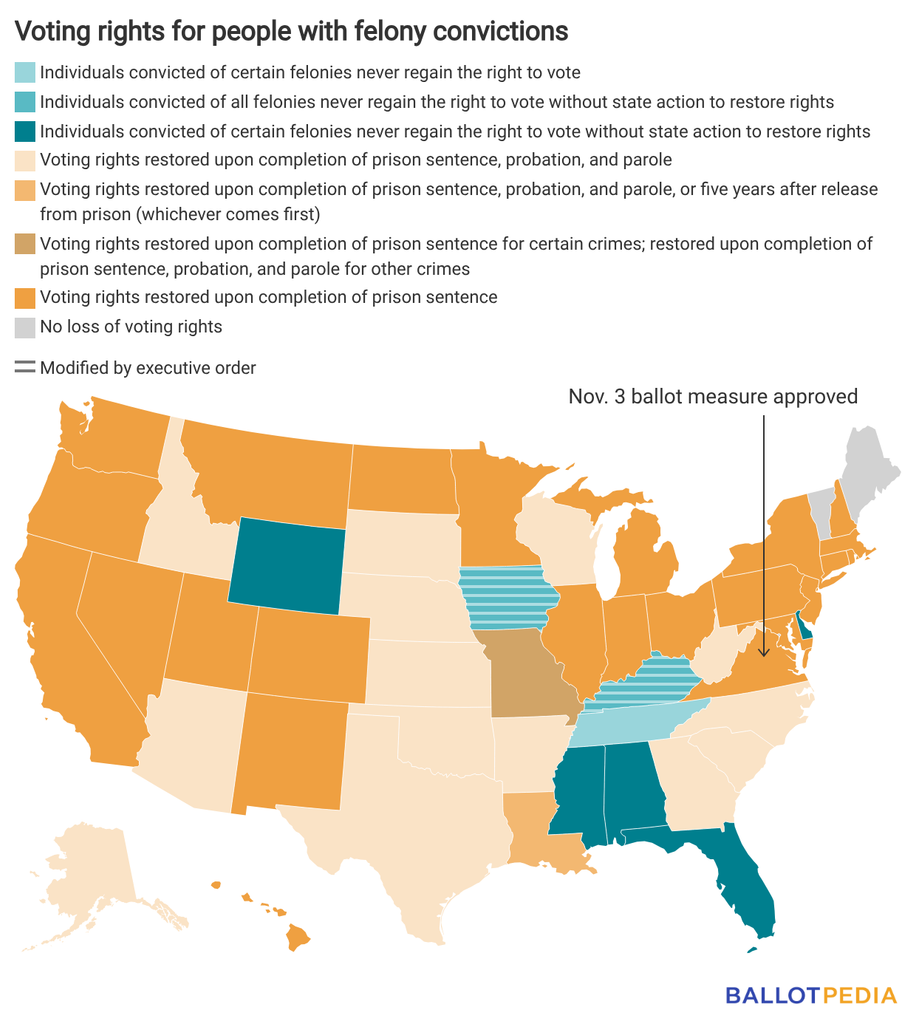
Previously, Virginia was one of eight states where individuals convicted of some or all felonies could not regain the right to vote without state action to restore their rights. In order for a person with a felony conviction to vote, the governor or another state authority would have to restore their civil rights. Some governors, including current Gov. Abigail Spanberger (D), restored voting rights to people with felony convictions without requiring individuals to apply for restoration.
Same-day voter registration
Massachusetts voters approved Question 4 56.3% to 43.7%, making Massachusetts the 21st state with same-day voter registration. The policy takes effect on Jan. 1, 2028.
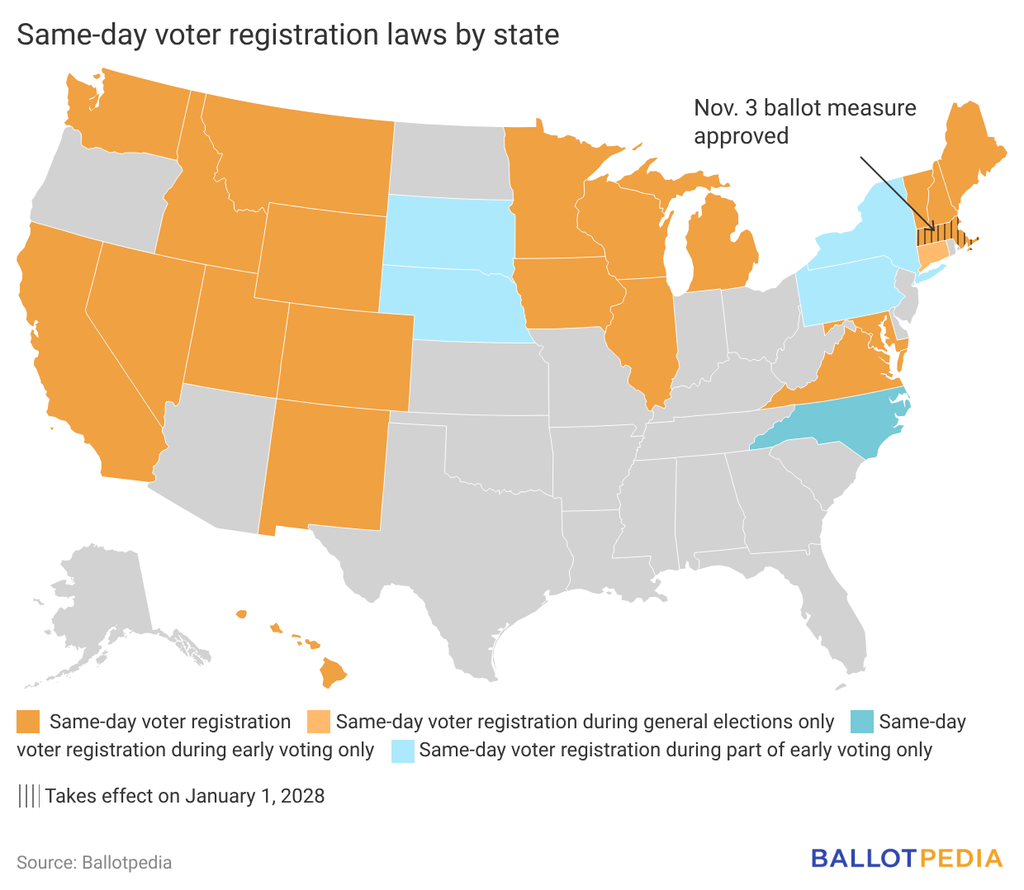
Twelve states with same-day voter registration had a pre-election Democratic trifecta, six states had a Republican trifecta, and three states had divided government.
Currently, Massachusetts allows voters to register at the polls during the eight days when the early voting and voter registration windows overlap.
Massachusetts is the first state to approve a same-day voter registration measure since Maryland and Michigan in 2018.
Electoral systems
Voters in Massachusetts rejected a measure 61% to 39% that would have implemented top-two primaries in the state.
A measure to repeal Alaska’s RCV and top-four primary system was still too close to call. As of Nov. 9, the measure was failing 51.8% to 48.1%, with 73% of precincts reporting.
In addition to statewide ballot measures, Ballotpedia covered three Nov. 3 local ballot measures related to ranked-choice voting:
- Longmont, Colorado, approved the use of ranked-choice voting (RCV) in mayoral and city council elections, starting in 2029. That makes Longmont the 41st locality in the country to use or plan on using RCV in some or all local elections. Five other localities in Colorado also use or are scheduled to use RCV, the second-most of any state in the country, behind California.
- Voters in Honolulu, Hawaii, defeated a measure to use RCV for mayoral, city council, and prosecuting attorney elections. It is the first time a locality has rejected a measure to adopt RCV since Clark and San Juan counties in Washington did so in 2022.
- In Irvine, California, a measure to use RCV for local elections, starting in 2028, was leading 51.5% to 48.5% as of Nov. 9, with all precincts reporting. California counts mail ballots postmarked by Election Day, provided they are received within seven days of the election.
Click here to read more on ballot measures in the 2026 election.