


Welcome to the Thursday, Nov. 12, 2026, Brew.
By: Lara Bonatesta
Here’s what’s in store for you as you start your day:
- Four new Democratic legislatures will be able to refer constitutional amendments to the ballot in a single session
- New Democratic trifectas in five states could provide enough electoral votes for National Popular Vote Interstate Compact
- Democrats – still divided on federal scholarship tax credit – gain control of five governorships
Four new Democratic legislatures will be able to refer constitutional amendments to the ballot in a single session
Democrats have gained control of 12 state legislative chambers, as a result of the Nov. 3 elections, while control of the North Carolina Senate and the Alaska House remains uncalled. These changes could affect which constitutional amendments reach voters in each state.
Four states that allow lawmakers to refer constitutional amendments to voters in one session moved to Democratic legislative control: Arizona, Michigan, Minnesota, and New Hampshire. Michigan previously had divided control, Arizona and New Hampshire had Republican control, and Minnesota had a tied House and Democratic Senate. Georgia and Texas, which also have one-session requirements, shifted from Republican to divided control, as would North Carolina if Republicans retain the Senate.
Arizona and Minnesota require a simple majority in each chamber to put an amendment on the ballot, allowing Democrats to act without Republican support or a second approval after the 2028 elections. In Arizona, Democrats won both chambers for the first time since 1966, giving them the power after legislators are sworn in to refer constitutional amendments on party-line votes.
Michigan and New Hampshire both require supermajorities in each chamber to place an amendment on the ballot. Democrats won enough seats to do this without Republican votes in New Hampshire but fell short in Michigan.
New Hampshire requires a three-fifths supermajority in each chamber, which is equivalent to 15 seats in the Senate and 240 seats in the New Hampshire House. Democrats won a 15 to 9 majority in the New Hampshire Senate. Democrats have won at least a 261 to 80 majority in the New Hampshire House, with 58 races still uncalled. Michigan requires a two-thirds supermajority in each chamber, which is equivalent to 26 seats in the Senate and 74 in the House. Democrats won a 23 to 15 majority in the Michigan Senate and a 63 to 47 majority in the Michigan House.
Most states (36 of 49) require legislatures to approve the amendments during one legislative session. Delaware is the exception because voter approval is not required for constitutional amendments. Eight states allow this with a simple majority. The other 28 require a supermajority. An additional four states – Connecticut, Hawaii, New Jersey, and Pennsylvania – require amendments to be passed during one or two successive legislative sessions, depending on whether the amendment receives a simple majority or supermajority. The Pennsylvania Legislature can refer amendments during one session with a two-thirds supermajority upon finding that a "major emergency threatens or is about to threaten the Commonwealth."
The map below shows requirements for referring a new constitutional amendment in states where legislative control changed after the 2026 elections. In two-session states, a future legislature must approve the amendment again.
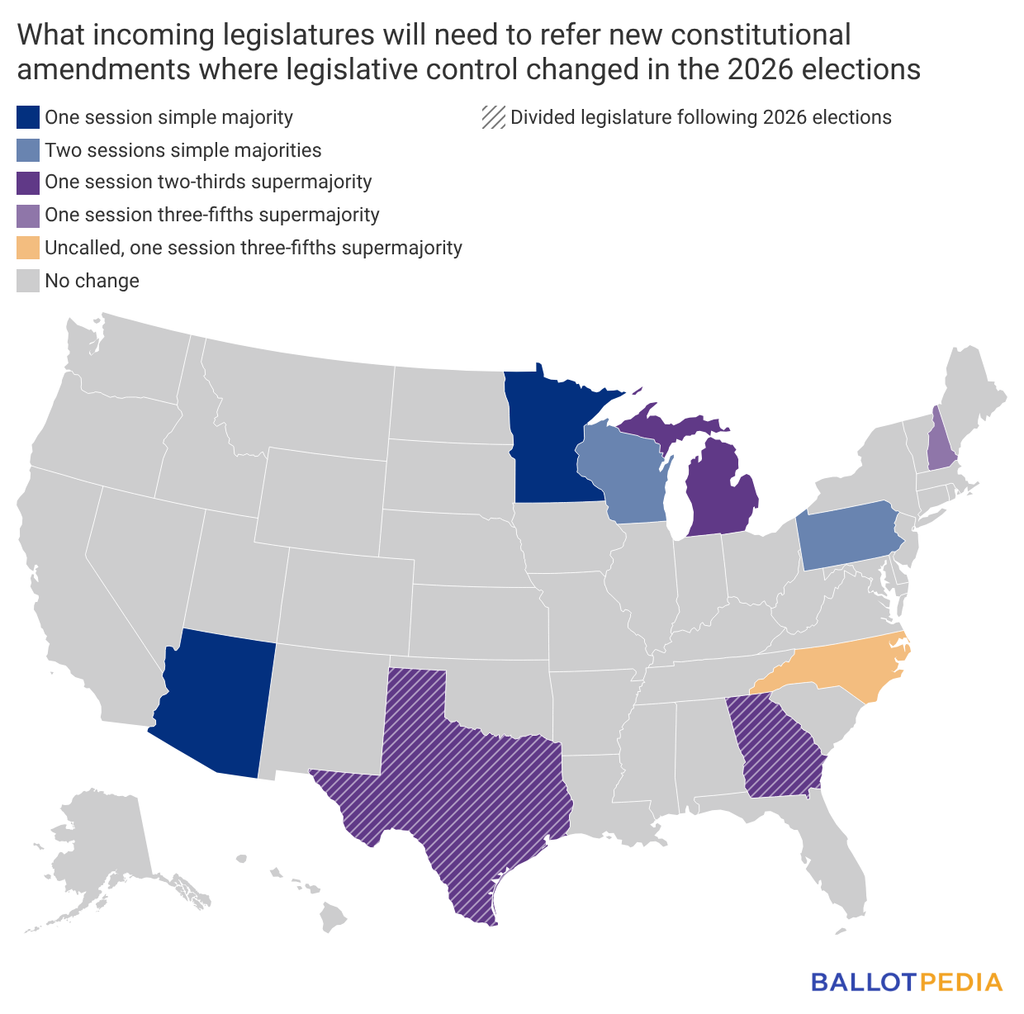
In two additional states where Democrats will control both chambers – Wisconsin and Pennsylvania – legislators will need simple majorities in two sessions with a legislative election between the votes, before placing it on the ballot. Democrats won control of the Wisconsin Legislature in the Nov. 3 election, ending Republican control that began in 2011. In Pennsylvania, Democrats won control of both chambers, ending divided control that began in 2023.
Wisconsin’s incoming Legislature will decide whether to advance an amendment approved before the election. Both states will also consider new proposals. To put new amendments on the ballot, Democrats would need to retain control after the 2028 election or secure Republican support for the second vote.
Nine states – Indiana, Iowa, Massachusetts, Nevada, New York, Tennessee, Vermont, Virginia, and Wisconsin – require lawmakers to approve amendments twice—once during one legislative session and then again during the next legislative session.
Wisconsin: A pending Republican-passed constitutional amendment
The incoming Democratic-controlled Wisconsin Legislature will decide whether to advance a constitutional amendment that Republicans approved earlier this year. The amendment would give the Legislature the authority to suspend any rule or part of a rule established by state executive agencies, either indefinitely or for specified periods of time. If approved, the amendment would re-establish a legislative veto over executive agency rules. A legislative veto is a type of oversight that allows legislatures to block or modify executive actions or agency regulations without gubernatorial approval. Wisconsin previously had a legislative veto, but the state supreme court overturned the legislature's ability to block rules in a 2025 case. As of December 2025, 34 states require legislative review of all or some agency regulations. Click here to read more about legislative review in Wisconsin.
Both chambers approved the amendment in February. The Assembly approved the amendment 52 to 45 and the Senate approved it 18 to 15. In both cases, all votes in favor came from Republicans, and all votes against came from Democrats. The newly elected Legislature must approve it a second time before it can appear on the ballot in 2027 or 2028.
Historically, most amendments awaiting a second session vote have failed to advance after a change in partisan control. Across all states from 2010 to 2026, when legislative party control changed between sessions, 17 of 21 constitutional amendments (81%) approved in the first session failed in the second. The remaining four (19%) passed and were certified for the ballot.
Amendments that advanced after a change in partisan control generally received bipartisan support in the first vote. One example was a 2020 redistricting amendment in Virginia. In 2019, the General Assembly first approved the amendment with bipartisan support, when Republicans held majorities in both chambers. Then, in the 2019 elections, Democrats won majorities in both chambers and in 2020, enough Democrats voted with Republicans to approve the amendment a second time.
Wisconsin had a similar shift before, with the parties reversed. Democrats approved three constitutional amendments while they controlled the Legislature in 2010. Republicans took control in 2011, and none of the amendments received a floor vote, meaning none went to voters.
In Wisconsin, an amendment first approved in the 2027-2028 session could reach the ballot as early as the April 3, 2029, primary if the Legislature elected in 2028 approves it again in time to meet the state’s passage and advertising deadlines.
Pennsylvania: No pending amendments, but Democrats proposing new ones
Pennsylvania has also had amendments stall after a change in legislative control. In 2021-2022, Republican majorities in both chambers approved six proposed constitutional amendments, including proposals on abortion, voter ID, and administrative regulations. Democrats won the House in 2022, dividing control of the Legislature. None of the six passed both chambers in 2023-2024.
No amendments passed both chambers during the most recent session (2025-2026), either.
An amendment first approved in the 2027-2028 session could reach the ballot as early as the May 15, 2029, primary if the Legislature elected in 2028 approves it again in time to meet the state’s passage and advertising deadlines.
Democrats would need to retain control of both chambers in the 2028 elections to pass an amendment without Republican support. If either chamber changes hands, passage would require votes from both parties. As we mentioned above, Pennsylvania also allows emergency amendments to pass in one session if the Legislature finds that a major emergency threatens or is about to threaten the state. This process requires a two-thirds vote in each chamber. The emergency process was last used to refer an amendment to voters in 1977, for disaster relief following flooding.
Besides Wisconsin, lawmakers in four states have approved six proposed constitutional amendments: one in Indiana, one in Iowa, two in Nevada, and two in New York. Legislative party control did not change in those four states. If lawmakers approve the amendments again, they could reach voters in 2027 or 2028, depending on states' election timing rules.
Click here to read more about two-session requirements for legislatively referred constitutional amendments.
New Democratic trifectas in five states could provide enough electoral votes for National Popular Vote Interstate Compact
Five of the six new state government trifectas that Democrats won on Nov. 3 have not adopted the National Popular Vote Interstate Compact (NPVIC), an agreement by member states to award their Electoral College votes to the presidential ticket that receives the most votes nationwide. Sixteen of the 18 states that have adopted the compact were Democratic trifectas at the time the legislation was enacted.
The compact takes effect if states representing at least 270 Electoral College votes adopt it. Eighteen states and Washington, D.C., have adopted the compact, together representing 222 Electoral College votes. If all five non-member states with new Democratic trifectas — Arizona, Michigan, Nevada, Pennsylvania, and Wisconsin — were to adopt the NPVIC, the participating states would represent 283 electoral votes. Four of the five states could bring the compact past the 270-vote threshold if Michigan and Pennsylvania were among them.
Lawmakers in all five states introduced NPVIC legislation in 2025 or 2026. Following the election, multiple Democratic legislators have said they plan to do so again. As of this writing, none of the bills introduced in 2025 or 2026 had received a vote in any chamber, and seven of the ten were considered dead.
Incoming Arizona Senate President Priya Sundareshan (D) told Politico that her caucus planned on taking up NPVIC legislation, saying, "We certainly are and have been prepared to join the compact, and we also want to make sure that we are showing that our priorities are reflective of what we really focused on on the campaign trail."
Wisconsin state Sen. Kelda Roys (D) told the New York Times, “National popular vote will be something that we’ll prioritize early in the session." Incoming Wisconsin Gov. David Crowley (D) told the Associated Press that he was “interested in having those conversations with the state Legislature” regarding the compact.
Pennsylvania Gov. Josh Shapiro (D) said in an interview on Nov. 7, "I’ll work with lawmakers to figure out what the right mechanism is for moving forward on that. But look, we’re the ultimate swing state in Pennsylvania … I think Pennsylvania can still play a massive role even in a national popular vote."
Arizona Gov. Katie Hobbs (D), Michigan Gov.-elect Jocelyn Benson (D), and Nevada Gov.-elect Aaron Ford (D) have not publicly commented since the election on whether they would support joining the compact.
Michigan did not adopt legislation to join the compact when Democrats held a trifecta in the state in 2023 and 2024. Incoming Michigan Senate Majority Leader Darrin Camilleri (D) told Politico, "Other states that have done this are not going to be the tipping-point states. We very well could be one of those tipping point-states, and so I want to ensure that everybody is on the same page."
In Nevada, Democratic legislators approved a bill to join the NPVIC in 2019. Gov. Steve Sisolak (D) vetoed the legislation, stating at the time, "Once effective, the National Popular Vote Interstate Compact could diminish the role of smaller states like Nevada in national electoral contests and force Nevada’s electors to side with whoever wins the nationwide popular vote, rather than the candidate Nevadans choose."
In four elections between 1876 and 2024, a presidential candidate won the Electoral College and did not receive the most individual votes across all states. Proponents of the NPVIC have pointed to these instances as evidence that the current system of awarding electors is flawed, arguing that the candidate who receives the most votes nationally should win the presidency.
Supporters of the compact argue that it encourages presidential candidates to attract voters in all 50 states, rather than just in certain swing states. Patrick Rosenstiel, a Minnesota-based consultant for National Popular Vote, a group supporting the compact, told the Associated Press, "I don’t believe I’ve ever been relevant in the outcome of a presidential election. National popular vote forces campaigns to focus on every persuadable voter in every precinct across the nation."
Opponents of the NPVIC have said that electing the president by popular vote would lead candidates to target densely populated areas and ignore rural or less populous states.
In addition, critics have said that the NPVIC may be unconstitutional. Hans von Spakovsky, senior legal fellow with Advancing American Freedom, told Fox News that “In the past, the only kind of compacts that have been agreed on between states have been things like water sharing — when rivers run between states, they enter into compacts to agree on that. But a compact that changes a fundamental structural given in the Constitution, I think the Supreme Court would say you can’t do that."
Derek Muller, a professor of law at the University of Notre Dame, wrote in Election Law Blog that he believes the compact would require congressional approval and would be subject to a presidential veto. Muller also said that the compact could violate state constitutional requirements that voters be in-state residents.
Click here for more information on the National Popular Vote Interstate Compact.
Democrats – still divided on federal scholarship tax credit – gain control of five governorships
Before Feb. 15, 2027, governors must take action to finalize their states' participation in the Federal Scholarship Tax Credit (FSTC). The results of Nov. 3 elections raise new questions about what states will do.
Democrats — who gained control of governorships in five states that have opted into the FSTC — have been less likely to indicate participation in the program. While some Democratic governors have opted in or decided not to participate, others are undecided.
On Oct. 22, Democratic Governors Maura Healey (D-Mass.), Gavin Newsom (D-Calif.), Ned Lamont (D-Conn.), Gretchen Whitmer (D-Mich.), and Mikie Sherrill (D-N.J.) wrote to the IRS, seeking clarification on aspects of the program.
A look at election results
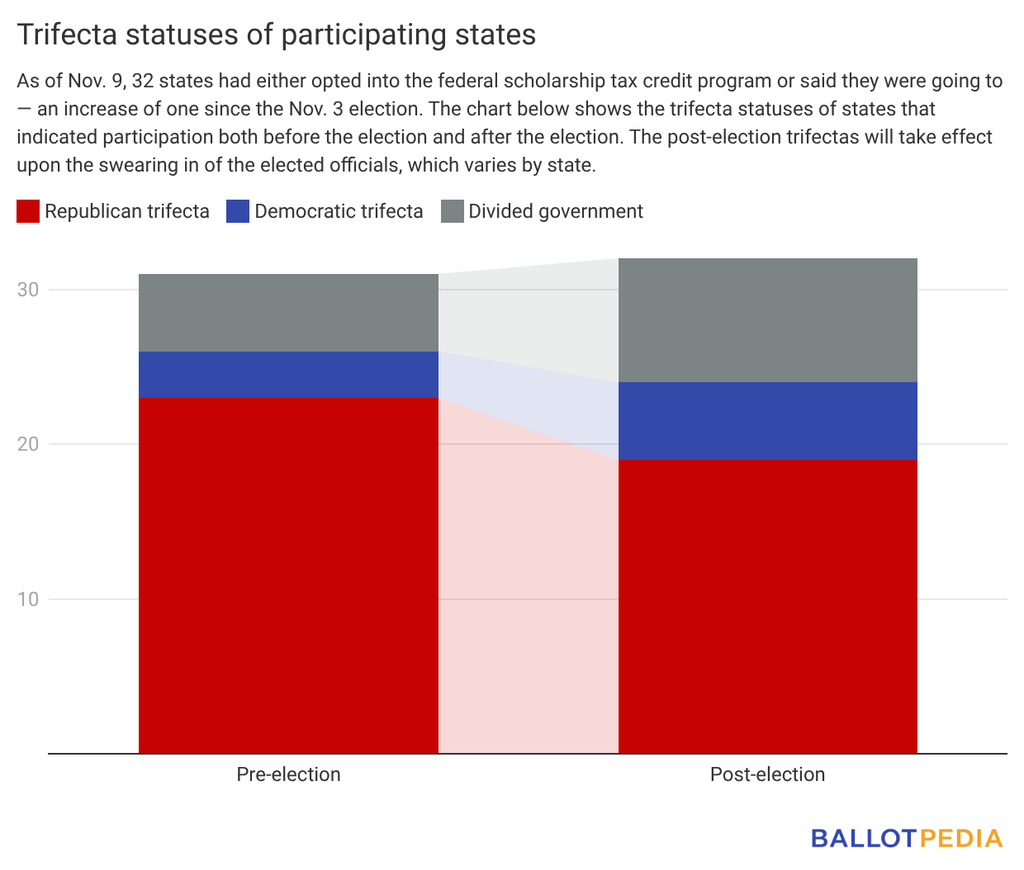
Before Election Day, 30 states, including 23 with Republican trifectas, had formally opted into the FSTC program. New York Gov. Kathy Hochul (D) also said her state would participate, but had not formally opted in. Gubernatorial elections took place in 19 of those 30 states, and participation in the program was a campaign issue in several of them, including Michigan and Arizona. As a result of the election, control of the governorship in five states that had opted into the FSTC — Georgia, Iowa, Nevada, Ohio, and Texas — changed from Republicans to Democrats.
While the program officially begins on Jan. 1, 2027, states have until Feb. 15, 2027, to submit a list of eligible scholarship granting organizations (SGOs) and complete their election to participate.
Outgoing governors may choose to submit the required forms and submit SGO list before they're sworn out, or leave this choice to their successor. Incoming governors who take office after Jan. 1 — all but five — cannot opt in if their predecessor doesn't submit the paperwork by Jan. 1. They may have the option to not finalize participation before the February deadline if the outgoing governor has not submitted an SGO list. That would leave their state's participation incomplete. Taxpayers in states that do not participate can still donate and claim the tax credit, but SGOs will not be authorized to disburse or award scholarship funds in that state.
Sixteen of the 19 states that had not indicated they would participate in the program before Nov. 3 had gubernatorial elections. Partisan control did not change in any of those states: Democrats maintained control in 16 states, and Gov. Phil Scott (R) won re-election in Vermont.
On Nov. 4, New Mexico Gov. Michelle Lujan Grisham (D), who was term-limited, announced that she would opt the state into the program and her administration would certify SGOs for participation. Debra Haaland (D) will assume office on Jan. 1, 2027. No other states or governors had moved to participate in the program after the election, as of Nov. 9.
With the addition of New Mexico, 32 states have indicated they will participate, and 30 have formally opted in by submitting Form 15714 to the IRS. Hochul – who won re-election on Nov. 3 – announced on Oct. 9 that the state would participate, but New York has not submitted the paperwork. New Mexico has also not yet submitted the required forms. It is unclear whether any state has finalized their participation by submitting an SGO list to the IRS.
Participation along partisan lines
All 23 states with Republican trifectas, three states with Democratic trifectas, and five states with divided governments opted into the program (or said they would) in 2026. Virginia, which now has a Democratic trifecta, opted in under a Republican governor.
Democrats have been slower to opt into the program, though some have. Several Democratic governors indicated they would wait on the regulations before deciding if their states would participate. After the IRS issued regulations on Oct. 2, Hochul confirmed New York’s intention to opt in to the program and one other Democratic governor – Oregon Gov. Tina Kotek, who won re-election on Nov. 3 – said the state would not participate. Lujan Grisham is the first Democratic governor to opt in to the program after the release of regulations that had not previously said their state would participate.
The IRS will issue further guidance defining eligible expenses, but Democrats for Education Reform, a political action committee, said Democrats should opt in as soon as possible.
Background
The FSTC is a dollar-for-dollar nonrefundable tax credit, meaning individuals can lower their federal tax liability by $1 for every $1 donated to accredited SGOs up to certain limits. SGOs distribute the donated scholarship funds to eligible families for a variety of private or public educational expenses, including private school tuition, tutoring services, textbooks, and more. To qualify for scholarships, students had to live in households earning no more than 300% of the area's median gross income and be eligible to enroll in K-12 schools. The program will begin on Jan. 1, 2027.
States that elect to participate must submit a list of SGOs that taxpayers can donate to in order to receive the federal tax credit. Students in states that do not opt in cannot receive scholarships funded under the program, but donors in those states can still receive a federal tax credit by donating to SGOs in participating states.
The IRS is finalizing proposed rules for the program — with a public hearing on Dec. 15 — and expects to issue further guidance defining eligible expenses. In addition to changes in state government, election results may affect the program's future in Congress where legislation in the Senate to repeal the program has 36 co-sponsors, and a House version has 116, all Democrats.
Click here to read more about state participation in the Federal Scholarship Tax Credit.