


Welcome to the Nov. 16 edition of Robe & Gavel, Ballotpedia’s newsletter about the Supreme Court of the United States (SCOTUS) and other judicial happenings around the U.S.
Besides the autumn poets sing,
A few prosaic days
A little this side of the snow
And that side of the haze.
- Emily Dickinson
“Besides the Autumn poets sing (131)”
Follow Ballotpedia on X and Bluesky or subscribe to the Daily Brew for the latest news and analysis.
Let’s gavel in, shall we?
We #SCOTUS and you can, too!
Grants
SCOTUS has accepted three new cases to its merits docket since our Nov. 2 edition. To date, the court has granted 39 cases and agreed to hear 37 for October Term 2026. One case, Genalo v. Black, was dismissed after it was granted. Nine cases have yet to be scheduled for arguments.
Nov. 6
The Court accepted Goldman Sachs Bank USA v. Brown to its merits docket on appeal from the Fourth Circuit. The case involves the U.S. Bankruptcy Code's automatic stay statute barring creditor debt collection when in conflict with arbitration proceedings under the Federal Arbitration Act. An automatic stay temporarily pauses debt collection and recovery actions like wage garnishment, lawsuits, and foreclosures in order to preserve the debtor’s estate while reorganizing their assets under court supervision. Click here to learn more about the case's background.
Nov. 13
The Court granted certiorari, or review of the lower court’s rulings, in two cases, Mullin v. Refugee and Immigrant Center for Education and Legal Services and Robinhood Markets, Inc. v. Sodha.
- Mullin is an immigration law case appealed from the U.S. Court of Appeals for the District of Columbia Circuit. Specifically, the Court is being asked to review the legality of Presidential Proclamation No. 10888 and a class action lawsuit challenging the proclamation’s guidance on the right to apply for asylum.
- Robinhood concerns the Securities Act of 1933 governing public offerings and whether a company can be held liable for misleading omissions. The case is appealed from the Ninth Circuit.
Arguments
This week, the Supreme Court heard arguments in three cases to close out the November sitting. Click the links below to learn more about these cases, review the transcripts, and listen along to the arguments before the Court:
Nov. 9
- Nielsen v. Watanabe concerns a federal prisoner's lawsuit against prison officials. The question presented to the Court was, “Whether the Ninth Circuit here erred in recognizing a Bivens (1971) cause of action.” In Webster Bivens v. Six Unknown Named Agents of Federal Bureau of Narcotics (1971), SCOTUS held that, “While there is no explicit right to file a civil lawsuit against federal government officials who have violated the Fourth Amendment, this right can be inferred.”
- Hoffmann v. WBI Energy Transmission, Inc. involves eminent domain claims under the Natural Gas Act and just compensation determinations. The question presented to the Court was whether, "In private condemnations under the Natural Gas Act, should just compensation be determined by reference to state law?"
Nov. 10
- Department of Labor v. Sun Valley Orchards, LLC was appealed from the Third Circuit. The question presented to the Court was, “Whether Article III of the Constitution precludes Congress from assigning to the Secretary of Labor the initial adjudication of proceedings to collect monetary remedies from employers who violate the terms and conditions of participating in the H-2A visa program.”
In its October 2025 term, SCOTUS heard arguments in 58 cases. Click here to read more about last year’s term.
Opinions
On Nov. 9, SCOTUS issued one per curiam opinion granting an application for stay in Mullin v. Friends of the Ruidosa Church (2026). In per curiam rulings, opinion authorship is not specified.
U.S. Department of Homeland Security (DHS) Secretary Markwayne Mullin (R) and U.S. Customs and Border Protection (CBP) applied to the Court to stay, or stop, the U.S. District Court for the Western District of Texas’ preliminary injunction which halted construction at the U.S.–Mexico border of a federal border wall. DHS cited a waiver provision of the Illegal Immigration Reform and Immigrant Responsibility Act of 1996, “The provisions of the Endangered Species Act of 1973 and the National Environmental Policy Act of 1969 are waived to the extent the Attorney General determines necessary to ensure expeditious construction of the barriers and roads under this section.”
Friends of the Ruidosa Church—an individual river guide, an environmental nonprofit, and a nonprofit organization dedicated to preserving a historic church in Ruidosa, Texas—opposed the construction, challenging the waiver’s legality.
Justice Ketanji Brown Jackson indicated that she would deny the application for stay, but did not issue a written opinion. The case was decided without argument.
The Court has issued rulings in two cases so far this term, both decided without arguments. One case was dismissed without arguments. Thirty-six cases are still under consideration.
The Federal Vacancy Count
The Federal Vacancy Count tracks vacancies, nominations, and confirmations to all U.S. Article III federal courts in a one-month period. This month’s edition includes nominations, confirmations, and vacancies from Oct. 2 to Nov. 1.
Highlights
- Vacancies: There was one new judicial vacancy since the October 2026 report. There are 28 vacancies out of 870 active Article III judicial positions on courts covered in this report. Including the U.S. Court of Federal Claims and the U.S. territorial courts, 28 of 890 active federal judicial positions are vacant.
- Nominations: There were no new nominations since the October 2026 report.
- Confirmations: There were no new confirmations since the October 2026 report.
Vacancy count for Nov. 1, 2026
A breakdown of the vacancies at each level can be found in the table below. For a more detailed look at the vacancies in the federal courts, click here.
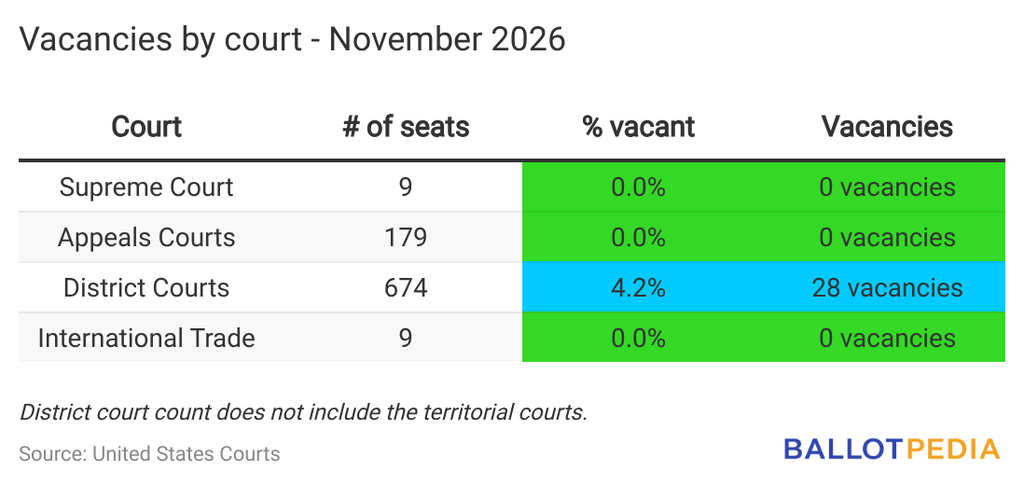
Though the U.S. territorial courts are named as district courts, they are not Article III courts. They are created in accordance with the power granted under Article IV of the U.S. Constitution. Click here for more information.
New vacancies
One judge left active status since the previous vacancy count, creating Article III life-term judicial vacancies. The president nominates individuals to fill Article III judicial position vacancies. Nominations are subject to U.S. Senate confirmation.
- Judge Thomas Varlan assumed senior status on the U.S. District Court for the Eastern District of Tennessee.
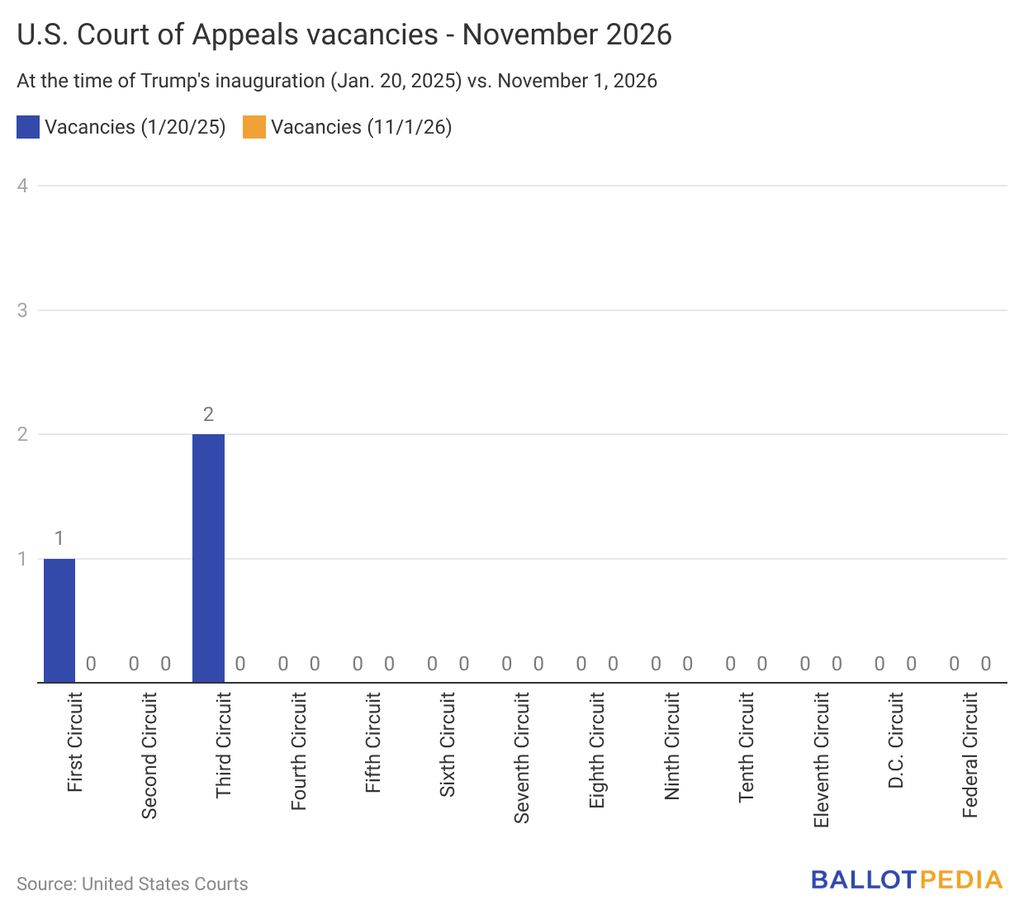
The following chart tracks the number of vacancies in the U.S. Courts of Appeals from President Donald Trump's (R) inauguration to the date indicated on the chart.
U.S. District Court vacancies
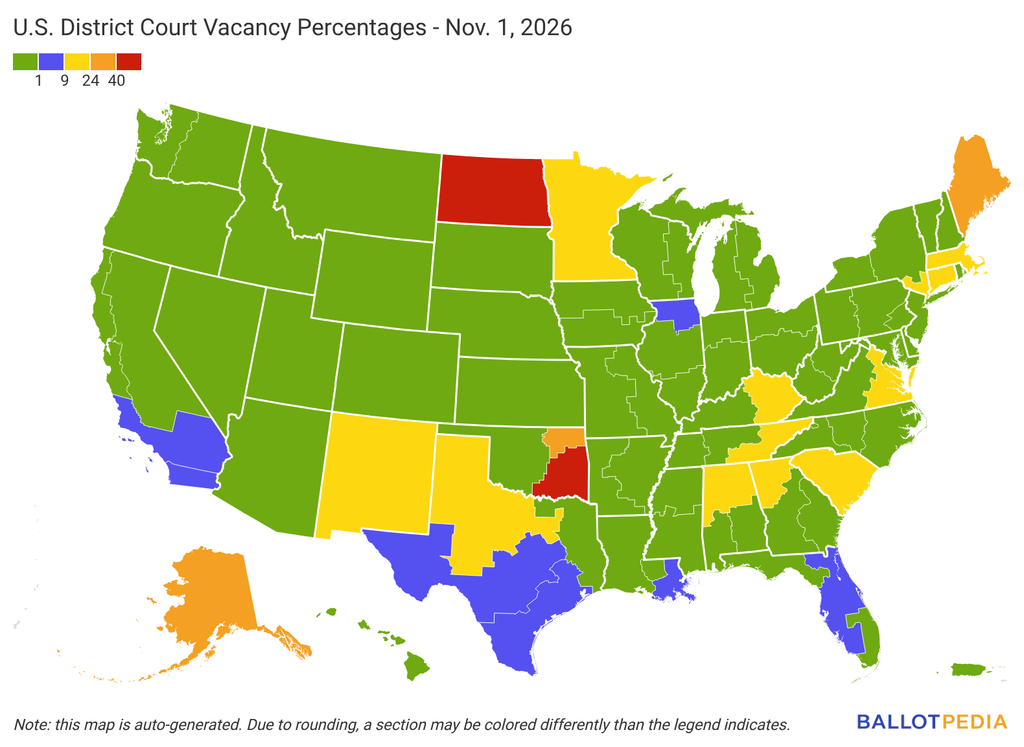
The following map shows the number of vacancies in the U.S. District Courts as of Nov. 1.
New nominations
After Nov. 1, Trump made one new nomination:
- James Hiland, to the U.S. Court of Appeals for the Eighth Circuit
The president has made 80 Article III judicial nominations since taking office on Jan. 20, 2025. For more information on the president’s judicial nominees, click here.
New confirmations
As of Nov. 16, the Senate has confirmed 57 of Trump’s judicial nominees—46 district court judges, 10 appeals court judges, and one Court of International Trade judge—since January 2025. The senate confirmed one nominee on Nov. 12.
Comparison of Article III judicial appointments over time by president’s second term (1981-Present)
- Presidents have made an average of 79 judicial appointments through November 1 of their second year in office. President Barack Obama (D) had the most appointees confirmed with 107, and President George W. Bush (R) had the fewest confirmations with 53.
- President Bill Clinton (D) made the most appointments through four years with 174. W. Bush made the fewest through four years with 122.
- Obama made the most appointments through two years with 134. W. Bush made the fewest with 54.
- Obama made the most appointments through one year in office with 45. W. Bush made the fewest with 22.
Need a daily fix of judicial nomination, confirmation, and vacancy information? Click here for continuing updates on the status of all federal judicial nominees.
Or, keep an eye on this list for updates on federal judicial nominations.
Looking ahead
We’ll be back on Dec. 7 with a new edition of Robe & Gavel. Until then, gaveling out!
Contributions
Myj Saintyl and Kate Carsella compiled and edited this newsletter, with contributions from Ellie Mikus, and Sam Post.