


Welcome to the Tuesday, Nov. 17, 2026, Brew.
By: Briana Ryan
Here’s what’s in store for you as you start your day:
- Voters remove 14 local officials in Nov. 3 recall elections
- Voters to decide four measures related to data centers in December after deciding 47 earlier this year
- With the midterm elections over, the U.S. Congress turns to choosing its leaders
Voters remove 14 local officials in Nov. 3 recall elections
On Nov. 3, voters in five states decided on recall elections against 21 local officials, removing 14 from office and keeping seven.
At least four of the recall elections were related to government decisions on data center development. Voters removed all four of those officials from office. In total, there were 46 recall efforts against 83 officials in 10 states related to data center development this year.
Including the Nov. 3 elections, voters have removed 10.7% of the 475 officials who faced recall efforts this year, below the 16% average from 2010 through 2025.
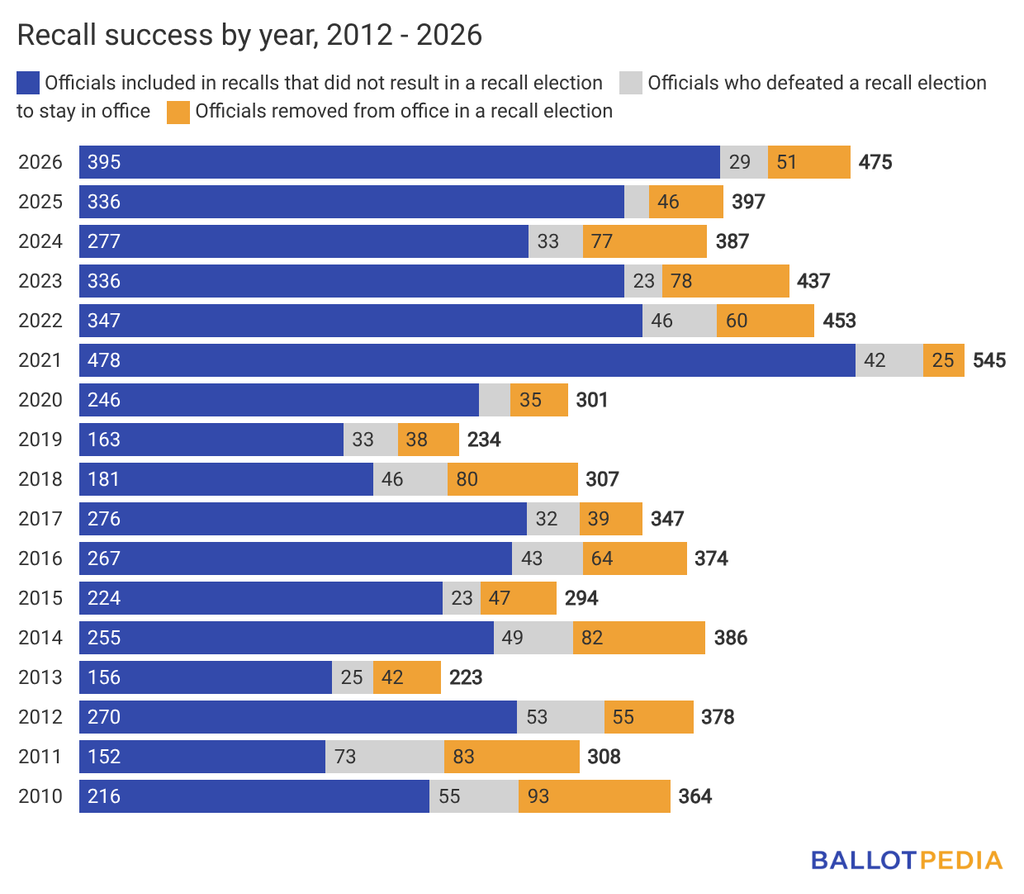
Here’s a closer look at some of the Nov. 3 recall elections.
Data center recalls
In Yukon, Oklahoma, Joe Phillips defeated Mayor Brian Pillmore 81.8% to 18.2%. Recall organizer Joe Horn cited Pillmore’s support for a contract to sell land near State Highway 66 and Frisco Road to Belt Line Energy for a data center project as grounds for the recall. The recall effort originally included Vice Mayor Jeff Wootton, who resigned after being named in the recall petition. On the recall, Pillmore said, "Every Yukon resident has the right under our City Charter to petition for recall, and I respect that right." Pillmore also said, "Article VII sets out a clear process the City will follow."
In Mason, Michigan, Pamela Oliver defeated Councilmember Elaine Ferris 58.4% to 28.1%. A third candidate, Daniel Giganti, received 13.5%. Recall petitions cited Ferris’ vote to establish the M-3 technology innovation district, which aimed to set guidelines for data center development in Mason, among the grounds for the recall. On her vote, Ferris said, "The whole point was I was voting for the ordinance that was protecting the citizens of Mason."
In San Angelo, Texas, voters recalled Councilmember Harry Thomas 67.9% to 32.1%. Recall organizers with the San Angelo Data Center Citizen Coalition cited their opposition to a proposed data center called Skybox as grounds for the recall. Following the recall vote, Thomas said, “Certainly I’m disappointed. I was going to be termed out in May of ’27 anyway, so six months where I’m not able to serve the citizens of both District 3 and the citizens of San Angelo, and that’s the reason I ran to begin with in 2016.”
In Urbana, Ohio, voters recalled Mayor Bill Bean 73.3% to 26.7%. Recall organizer James Cropper cited plans to build a $1 billion data center in Urbana as grounds for the recall. On the recall, Bean said, “Let me be clear: I have not violated my oath of office. I have not lied to the public. I have not abused my authority. And I have never sought personal benefit from any development project in Urbana. These accusations are not supported by evidence, by documentation, or by any official finding.”
Other recalls
In Piqua, Ohio, voters recalled three of the city’s five commissioners: Commissioner and Mayor Jim Vetter (73.0% in favor of recall), Commissioner William Walker (70.3%), and Commissioner Frank DeBrosse (70.2%). Recall petitions cited disregard for residents’ interests, failure to address matters of public health, safety, and welfare, and a lack of transparency in decision-making as grounds for the recall. Ahead of the recall, Vetter said, "I am not ashamed about votes I have taken. I am very proud of the votes I have taken." Walker said, "I have based every decision on what is best for all residents of Piqua and I hope to have your continued support as we address key issues, complete our work and keep our city moving forward." DeBrosse said, "Growth brings change and not everyone is okay with change and we need to do a better job of communicating with the citizens on these economic development projects."
In Liberty Township, Michigan, Clerk Amanda Kimbel-Sparks defeated Thomas Williams 66.7% to 33.3%. Recall supporters cited Kimbel-Sparks’ removal of antique cups belonging to the Liberty Ladies’ Aid from Liberty Township Hall in spring 2025 as grounds for the recall. Kimbel-Sparks said she discarded the cups during a spring cleaning event after noticing that they were chipped and was unaware that they didn't belong to the township. She also said she believed the recall effort stemmed from disagreements over a township hall rental policy, not the removal of the cups.
Click here to learn more about this year’s political recall efforts.
Voters to decide four measures related to data centers in December after deciding 47 earlier this year
In December, voters in three states — Arkansas, Maine, and North Carolina — will decide on four local ballot measures related to data centers.
As of Nov. 13, voters have decided on 47 such measures throughout the year, with 46 (98%) limiting their development and one (2%) favoring it.
Here’s a closer look at the four measures that voters will decide in December.
Arkansas
On Dec. 1, voters in Clarksville, Arkansas, will decide on two measures on financing for a single data center project owned by Serverfarm. Each measure covers a different part of the project.
The first ballot measure asks voters whether to uphold an ordinance that authorized up to $50 billion in taxable industrial development bonds to finance data center equipment and improvements. It also leased that part of the Serverfarm project to Hatchbo LLC.
The second measure asks voters whether to uphold an ordinance that authorized up to $5 billion in taxable industrial development bonds to finance land acquisition for data center operations. It also leased that part of the Serverfarm project to SF ARK1, LLC.
Both ordinances also authorized agreements under which Hatchbo LLC and SF ARK1, LLC would make agreed-upon payments to local governments instead of paying regular property taxes on their parts of the project.
The Clarksville City Council initially approved two ordinances for both projects in July, with residents submitting 425 signatures to put each measure for a referendum vote. While the measures are about the project's bond financing, they are not a direct vote on whether the data center will be built.
Maine
On Dec. 8, voters in Hollis, Maine, will decide on Article 2. It would establish a 180-day moratorium, beginning Dec. 8, on new or expanded data centers with at least 2,500 square feet of data center area, including associated impervious surfaces such as access roads and parking lots.
While the proposed moratorium originally had a threshold of 25,000 square feet, the Hollis Select Board voted to lower it to 2,500 on Nov. 4.
North Dakota
On Dec. 15, voters in Mandan, North Dakota, will decide on Measure 1. It would prohibit both large-scale and multiple data centers within the city and its territories that have an aggregate electrical demand of 25 megawatts or more.
The measure is in response to a planned data center from Stark Power, a company that develops such facilities. However, construction has not begun, and it still must go through the city planning and approval process.
Click here for a full list of data center-related ballot measures on the ballot this year.
With the midterm elections over, the U.S. Congress turns to choosing its leaders
With this year's elections for the U.S. Congress decided, members of the incoming 120th Congress — which runs from Jan. 3, 2027 through Jan. 3, 2029 — are now tasked with choosing their leaders.
On Nov. 10, Republicans in the U.S. Senate and the U.S. House of Representatives decided their leadership elections. Democrats in the U.S. House will vote on Nov. 18 and 19, while Democrats and independents who caucus with them in the U.S. Senate will vote on Dec. 1.
According to the Congressional Research Service (CRS), leaders in the U.S. House are typically "elected by the [minority or majority] party caucus or conference at organizational meetings prior to the start of a new Congress." The U.S. Senate follows the same model. Candidates in both chambers must win a simple majority of the caucus or conference.
Each caucus or conference sets its own rules. Members who will serve in the next Congress typically use a secret ballot to vote. A caucus or conference can also elect an unopposed candidate without casting ballots.
The majority party in each chamber elects a majority leader, a whip, and a caucus or conference chair. Meanwhile, the minority party elects a minority leader, a whip, and its own chair. Democrats will be in the majority in both chambers in the 120th Congress, and Republicans will be the minority.
All of the members of each chamber choose one officer.
In the U.S. Senate, that officer is the president pro tempore, who presides when the vice president is absent and is third in the presidential line of succession. The president pro tempore is typically the longest-serving member of the majority party.
In the U.S. House, that officer is the speaker, who is second in the presidential line of succession. The U.S. House holds the floor vote on the first day of a new Congress, which is on Jan. 3, 2027. The clerk of the U.S. House presides until members choose a speaker. Members may vote for anyone, naming their choice aloud as the clerk calls the roll.
To win, a candidate must receive a simple majority of the votes members cast for a candidate by name. If no candidate wins a majority on the first ballot, the U.S. House votes again and keeps voting until someone does win, with no limit on the number of ballots.
Click here to learn about leadership elections this year in the U.S. Senate, and here to learn about leadership elections in the U.S. House.