


Welcome to Ballot Bulletin: Ballotpedia's Weekly Election Policy Digest. Every Tuesday, we deliver the latest updates on election policy around the country, including nationwide trends and recent legislative activity.
In this week’s edition, we cover the seven bills state legislatures acted on last week and look at how new Democratic trifectas could affect the National Popular Vote Interstate Compact.
The state of election legislation in the U.S.
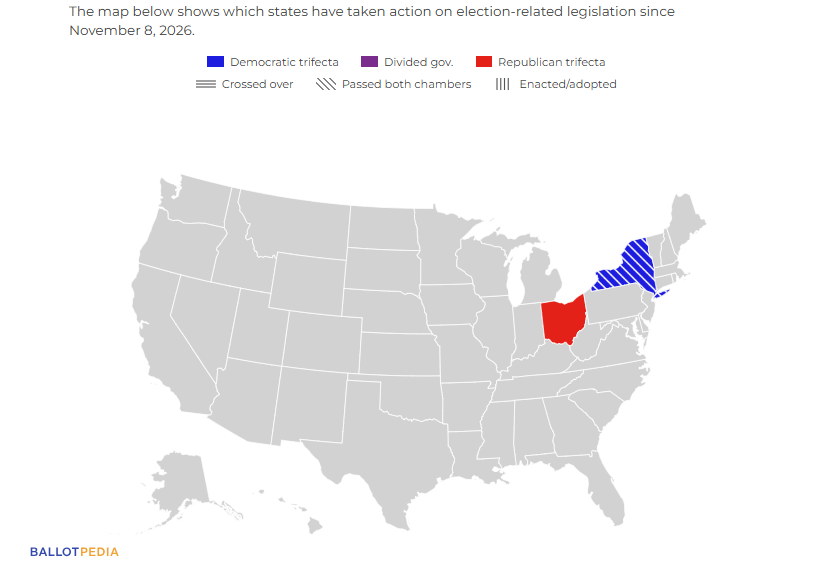
Lawmakers in two states acted on seven election-related bills last week. Five state legislatures are in regular or special sessions. Last week, no bills were enacted, no bills passed both chambers of a state legislature, and no bills were vetoed.
Of the bills acted on last week, three are in states with Democratic trifectas (42.9%), four are in states with Republican trifectas (57.1%), and none were in states with divided government. The most active bill categories last week were ballot access and election types and stages (two each).
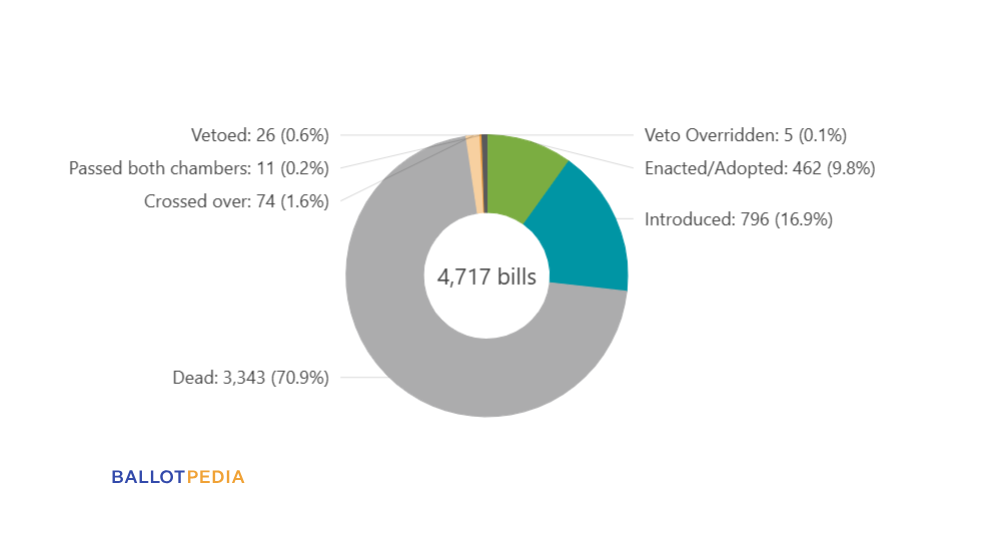
We are currently tracking 4,717 election-related bills across the country. The chart below breaks down the status of those bills based on where they stand in the legislative process:
Enacted bills
No bills were enacted or adopted last week.
Bills passing both chambers
No bills passed both chambers of a state legislature last week.
To see a full list of bills awaiting gubernatorial action, click here.
Vetoed bills
No bills were vetoed last week.
To see a list of all bills vetoed this session, click here.
All bills
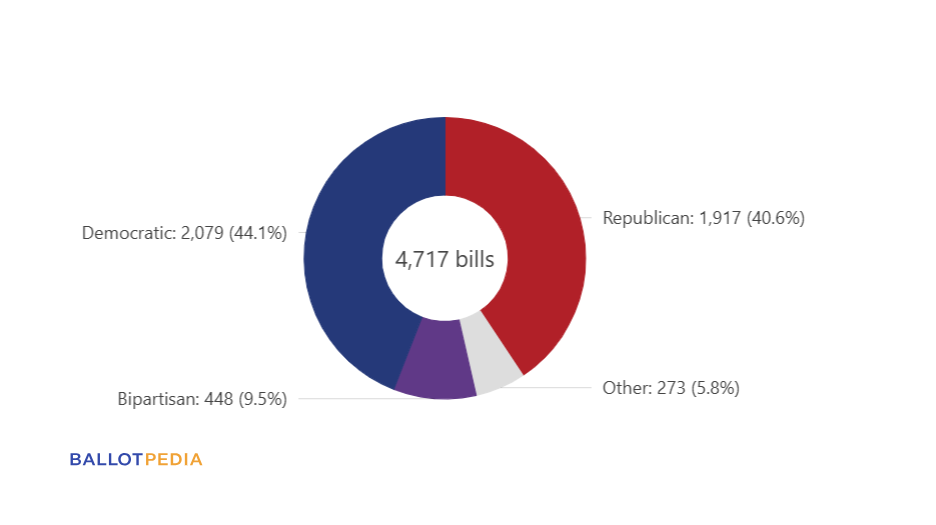
The chart below shows all bills Ballotpedia is currently tracking, broken down by partisan sponsor.
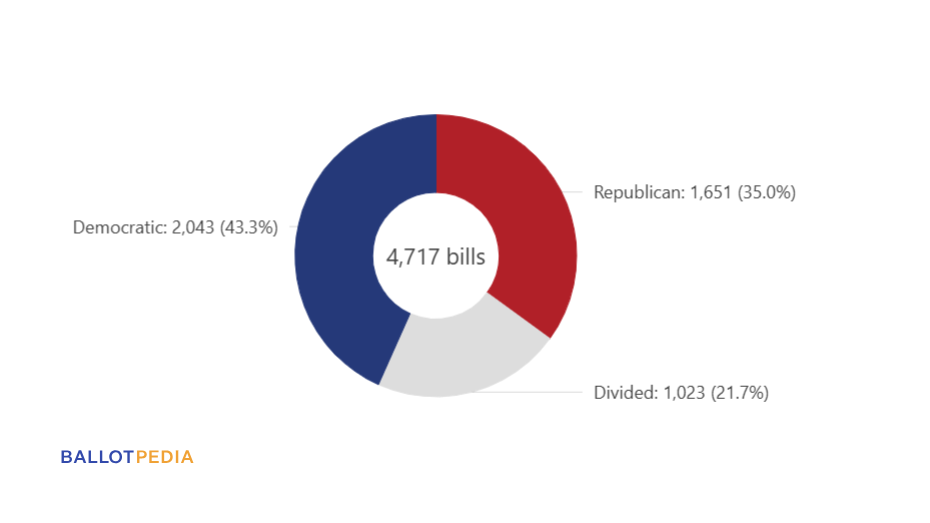
The chart below shows all bills Ballotpedia is currently tracking, broken down by trifecta status.
In the news
Voters in Alaska rejected a ballot measure in the Nov. 3 election to repeal the state’s ranked-choice voting (RCV) system.
Alaska Ballot Measure 2 would have replaced top-four primaries and ranked-choice general elections with party primaries and single-choice voting, and repealed certain campaign finance disclosure rules. The measure was defeated 54% to 46%, with Decision Desk HQ calling the race on Nov. 12.
Currently, Alaska uses top-four primaries and RCV in general elections. Under this system, candidates run in a single primary election, regardless of party affiliation. The four candidates that receive the most votes advance to the general election.
At the general election, voters elect state and federal candidates using RCV. For state executive, state legislative, and congressional elections, voters rank the four candidates that advanced from their top-four primaries.
A candidate needs a simple majority of the vote (50%+1) to be declared the winner of a general election. If no candidate wins a simple majority of the vote, the candidate with the fewest votes is eliminated. People who voted for the eliminated candidate as their first choice have their votes redistributed to their second choice. The tabulation process continues until two candidates remain, and the candidate with the most votes is declared the winner.
Voters adopted the RCV and top-four primary system by a 50.6% to 49.5% vote in 2020. They rejected a measure to repeal the system in 2024, 50.1% to 49.9%.
Alaska and Maine are the only two states that use RCV for regular federal or statewide elections. Hawaii uses RCV for special federal elections and county council vacancies. An additional four states have laws specifically authorizing the use of RCV in local elections.
Here are other news stories from across the country:
- On Nov. 12, 12 states appealed U.S. District Court Judge Carl Nichols’ Sept. 13 order blocking the implementation of rules related to President Donald Trump’s executive order regarding absentee/mail-in voting. The rules would require state officials to enroll voters in a USPS portal in order for them to receive a ballot in the mail. The physical mail must also meet set standards and contain certain information, such as a unique barcode for each ballot envelope. The states, all of which have Republican attorneys general, are asking the United States Court of Appeals for the D.C. Circuit to allow the rules to take effect.
- On Nov. 12, a U.S. district court judge dismissed a lawsuit from the U.S. Department of Justice seeking Delaware’s unredacted voter rolls. U.S. District Court Judge Richard G. Andrews wrote in his ruling that Title III of the Civil Rights Act of 1960, which pertains to records retention, did not apply to the voter registration rolls. For a list of federal lawsuits seeking access to statewide voter lists, click here.
- On Nov. 11, an Alaska judge ruled in favor of the Alaska Division of Elections and denied a request by U.S. Senate candidate Mary Peltola (D) to obtain records related to absentee ballots. Peltola’s campaign filed the lawsuit on Nov. 6, arguing that they should have access to absentee ballot detail reports under the state’s public records law. Superior Court Judge Thomas A. Matthews ruled that the reports were not a public record.
Policy spotlight: New Democratic trifectas in five states could provide enough electoral votes for National Popular Vote Interstate Compact
Five of the six new state government trifectas that Democrats won on Nov. 3 have not adopted the National Popular Vote Interstate Compact (NPVIC), an agreement by member states to award their Electoral College votes to the presidential ticket that receives the most votes nationwide, rather than the candidate who receives the most votes in that state or districts in the state. Sixteen of the 18 states that have adopted the compact were Democratic trifectas at the time the legislation was enacted.
The compact takes effect if states representing at least 270 Electoral College votes adopt it. Eighteen states and Washington, D.C., have adopted the compact, together representing 222 Electoral College votes. If all five non-member states with new Democratic trifectas — Arizona, Michigan, Nevada, Pennsylvania, and Wisconsin — were to adopt the NPVIC, the participating states would represent 283 electoral votes. Four of the five states could bring the compact past the 270-vote threshold if Michigan and Pennsylvania were among them.
Lawmakers in all five states introduced NPVIC legislation in 2025 or 2026. Following the election, multiple Democratic legislators have said they plan to do so again.
Incoming Arizona Senate President Priya Sundareshan (D) told Politico that her caucus planned on taking up NPVIC legislation, saying, "We certainly are and have been prepared to join the compact, and we also want to make sure that we are showing that our priorities are reflective of what we really focused on on the campaign trail."
Wisconsin state Sen. Kelda Roys (D) told the New York Times, “National popular vote will be something that we’ll prioritize early in the session." Incoming Wisconsin Gov. David Crowley (D) told the Associated Press that he was “interested in having those conversations with the state Legislature” regarding the compact.
Pennsylvania Gov. Josh Shapiro (D) said in an interview on Nov. 7, "I’ll work with lawmakers to figure out what the right mechanism is for moving forward on that. But look, we’re the ultimate swing state in Pennsylvania … I think Pennsylvania can still play a massive role even in a national popular vote."
Nevada Gov.-elect Aaron Ford (D) said he would support joining the compact, telling a Reno TV station on Nov. 12 that “we’ve seen several times now the person who wins the popular vote not win because of the electoral college.”
Arizona Gov. Katie Hobbs (D) and Michigan Gov.-elect Jocelyn Benson (D) have not publicly commented since the election on whether they would support joining the compact.
Michigan did not adopt legislation to join the compact when Democrats held a trifecta in the state in 2023 and 2024. Incoming Michigan Senate Majority Leader Darrin Camilleri (D) told Politico, "Other states that have done this are not going to be the tipping-point states. We very well could be one of those tipping point-states, and so I want to ensure that everybody is on the same page."
In Nevada, Democratic legislators approved a bill to join the NPVIC in 2019. Gov. Steve Sisolak (D) vetoed the legislation, stating at the time, "Once effective, the National Popular Vote Interstate Compact could diminish the role of smaller states like Nevada in national electoral contests and force Nevada’s electors to side with whoever wins the nationwide popular vote, rather than the candidate Nevadans choose."
In four elections between 1876 and 2024, a presidential candidate won the Electoral College and did not receive the most individual votes across all states. Supporters of the compact have pointed to these instances as evidence that the current system of awarding electors is flawed, arguing that the candidate who receives the most votes nationally should win the presidency. Opponents argue that the country’s founders intended the Electoral College to be a federalist structure in which states choose the president.
Supporters of the compact argue that it encourages presidential candidates to attract voters in all 50 states, rather than just in certain swing states. Opponents argue that the compact could cause presidential candidates to ignore smaller or more rural states, focusing instead on densely populated areas.
Supporters argue that it allows voters to choose candidates directly, rather than through a state’s electors, and is thus more democratic. Opponents argue that voters in states that have adopted the NPVIC could be dissatisfied if their electoral votes were counted for a different candidate than the one who won their state.
Opponents argue that the compact is unconstitutional, violating the Equal Protection Clause of the 14th Amendment, the Compact Clause of the U.S. Constitution, and Article V of the Constitution. Supporters argue that the compact is constitutional and is consistent with past U.S. Supreme Court rulings on the Electoral College.
Click here for more information on the National Popular Vote Interstate Compact.