


Welcome to the Wednesday, Nov. 18, 2026, Brew.
By: Lara Bonatesta
Here’s what’s in store for you as you start your day:
- Alaska voters keep ranked-choice voting and cities in California and Colorado adopt it
- Ninth Circuit rules against parts of California climate disclosure requirements
- The candidates in this Austin, Texas City Council runoff were 70 votes apart on Nov. 3, here’s a closer look at their campaigns
Alaska voters keep ranked-choice voting and cities in California and Colorado adopt it
Voters in Alaska rejected a ballot measure in the Nov. 3 election to repeal the state’s ranked-choice voting (RCV) system, and two localities adopted the use of RCV for local elections.
Alaska Ballot Measure 2 would have replaced top-four primaries and ranked-choice general elections with party primaries and single-choice voting, and repealed certain campaign finance disclosure rules. Voters defeated the measure 53.6% to 46.4%.
Alaska uses top-four primaries and RCV in general elections. Candidates run in a single primary election, regardless of party affiliation. The four candidates that receive the most votes advance to the general election.
At the general election, voters elect state and federal candidates using RCV. For state executive, state legislative, and congressional elections, voters rank the four candidates that advanced from their top-four primaries.
A candidate needs a simple majority of the vote (50%+1) to be declared the winner of a general election. If no candidate wins a simple majority of the vote, the candidate with the fewest votes is eliminated. People who voted for the eliminated candidate as their first choice have their votes redistributed to their second choice. The tabulation process continues until two candidates remain, and the candidate with the most votes is declared the winner.
Voters adopted the RCV and top-four primary system by a 50.6% to 49.5% vote in 2020. They rejected a measure to repeal the system in 2024, 50.1% to 49.9%.
Based on the unofficial 2026 election results as of Nov. 16, 37 of the 53 elections in Alaska in which RCV was used on Nov. 3 were decided in the first round. The other 16 required a second round after no candidate received more than 50% of first-choice votes.
- Two of the three statewide elections advanced to a second round: the race for U.S. Senate and the race for Alaska’s At-large Congressional District. Jonathan Kreiss-Tomkins (D) won the gubernatorial election in the first round after receiving 50.9% of first-choice votes.
- Six of the 10 state Senate elections were decided in the first round, while the other four required a second round.
- Thirty of the 40 state House elections were decided in the first round, while the other 10 required a second round.
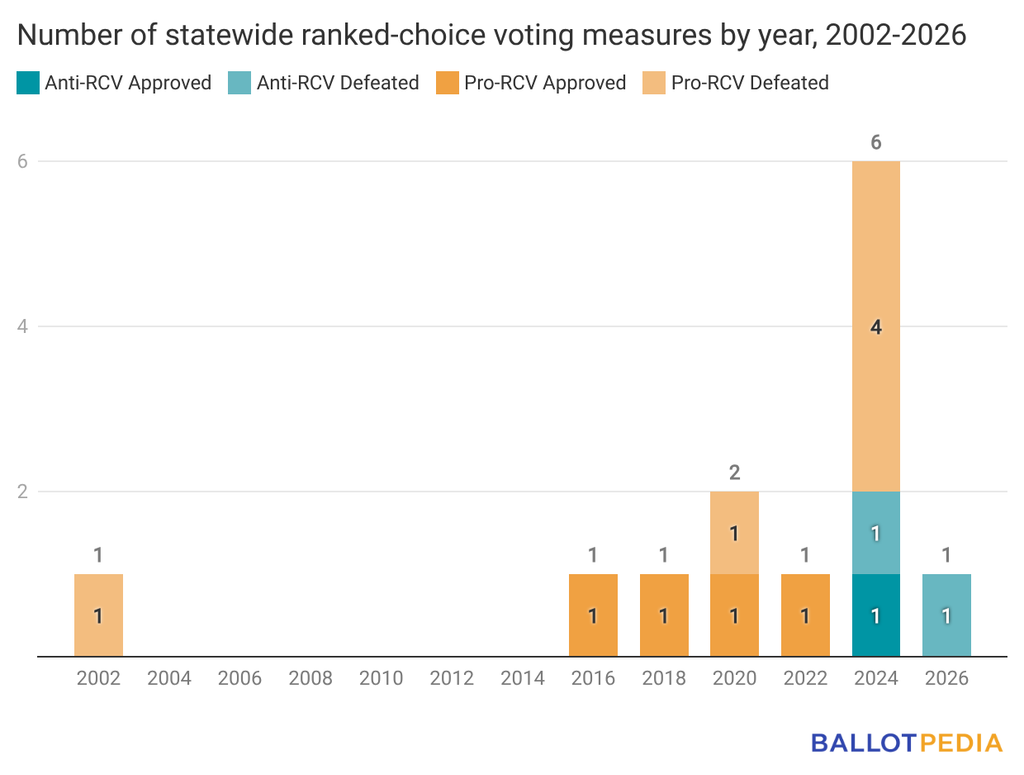
Alaska and Maine are the only two states that use RCV for regular federal or statewide elections. Hawaii uses RCV for special federal elections and county council vacancies. An additional four states have laws specifically authorizing the use of RCV in local elections. Between 2002 and 2024, voters in eight states decided on 12 state ballot measures related to ranked-choice voting. Of these, 10 were to adopt RCV, and two were to repeal or preempt RCV. Of the 10 measures to adopt RCV, voters approved four and defeated six. Of the two measures to repeal or preempt RCV, voters approved one and defeated the other.
As of November 2026, seven states have adopted laws authorizing or requiring the use of RCV in certain elections and 19 states have adopted laws banning its use statewide.
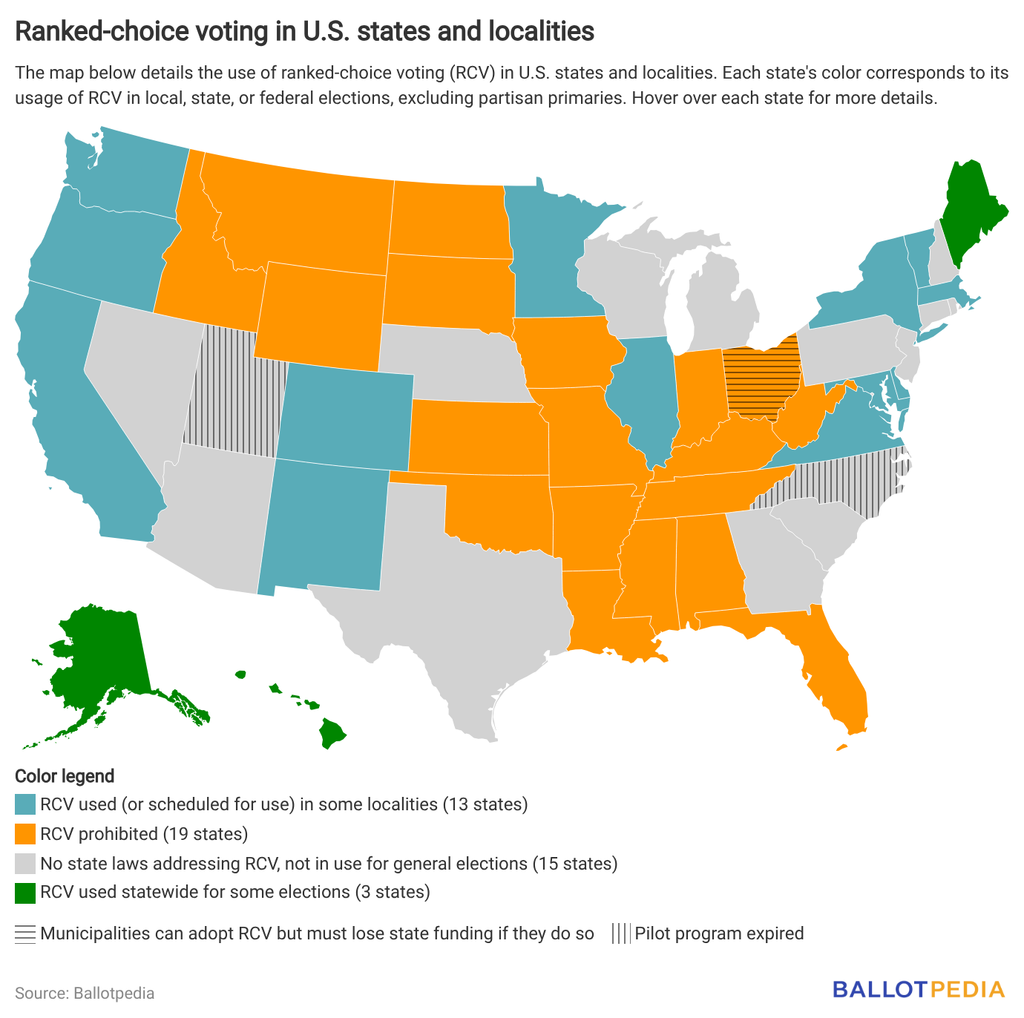
Irvine, California and Longmont, Colorado approved measures on Nov. 3 requiring the use of RCV for certain local races. Nationally, 42 localities in 14 states, as well as Washington, D.C., use or are scheduled to use RCV for local elections.
Irvine voters approved Measure D 53.3% to 46.7%. The measure implements RCV for mayoral and city council elections “to the extent technically and financially feasible” after Jan. 1, 2028. Irvine is the eighth locality in California to use or plan on using RCV.
Longmont voters approved Question 3C, which requires RCV for mayor and city council elections where possible starting in November 2029, 56% to 44%. Longmont is the sixth locality in Colorado to use or plan on using RCV.
Voters in Honolulu, Hawaii, rejected a measure to adopt RCV for mayor, city council, and prosecuting attorney elections 55.4% to 44.6%.
2026 had the same number of local RCV measures (three) as 2024. That is a decrease from the previous five years, when there were between four and nine pro-RCV ballot measures. The nine local RCV measures in 2022 were the most in a single year since 1966.
Click here to learn more about ranked-choice voting.
Ninth Circuit rules against parts of California climate disclosure requirements
On Nov. 9, the U.S. Court of Appeals for the Ninth Circuit ruled that parts of California's corporate climate disclosure laws likely violate the First Amendment, reversing in part a lower court's denial of a preliminary injunction business groups had sought.
The appeals court upheld the district court's refusal to block Scope 1 and Scope 2 emissions reporting requirements under SB 253 but reversed its decision concerning Scope 3 emissions disclosures and climate-related financial risk reporting under SB 261.
SB 253 requires certain companies doing business in California to report direct and indirect greenhouse gas emissions associated with their businesses. Scope 1 emissions come from sources a company owns or controls, Scope 2 emissions result from the generation of purchased electricity and other energy, and Scope 3 emissions come from other activities throughout the company's supply chain and broader value chain.
The two laws, enacted in 2023, established different reporting requirements:
- SB 253 requires U.S.-based companies doing business in California with annual revenues exceeding $1 billion to disclose greenhouse gas emissions, including emissions from their operations, purchased energy, and value chains.
- SB 261 requires companies doing business in California with annual revenues exceeding $500 million to publish biennial reports on climate-related financial risks and measures taken to address them.
California is the only state with a broad corporate greenhouse gas emissions disclosure law requiring qualifying companies to report emissions regardless of where they are headquartered. Although other states have statutory greenhouse gas reporting requirements, those programs generally focus on specific industries, facilities, or sources.
The three-judge panel found that Scope 1 and Scope 2 disclosures constitute commercial speech and satisfy intermediate scrutiny under the First Amendment. It determined that Scope 3 disclosures and SB 261 compel noncommercial speech, making them subject to strict scrutiny, which the requirements failed to satisfy.
The ruling was issued one day before California's Nov. 10 deadline for initial Scope 1 and Scope 2 emissions reports, which remains in effect.
The decision distinguishes between emissions disclosures tied to a company's own operations and broader reporting requirements involving its supply chain and assessments of future climate-related financial risks. The court found that the latter requirements likely violate the First Amendment, potentially limiting California's ability to mandate those disclosures.
The case now returns to the district court to determine whether SB 253's Scope 3 provisions can be separated from the rest of the law. The appellate ruling does not constitute a final judgment on the constitutional challenge, but its findings support preliminary injunctive relief against Scope 3 reporting and SB 261.
Several business associations, including the U.S. Chamber of Commerce, challenged the laws on First Amendment grounds. A U.S. district court denied their request for a preliminary injunction, finding that the reporting requirements were unlikely to violate the Constitution.
The Ninth Circuit temporarily blocked enforcement of SB 261 in November 2025 while the appeal was pending but declined to block SB 253 at that time.
Ballotpedia tracks support for and opposition to the environmental, social, and corporate governance (ESG) investing movement. To learn more about arguments for, against, and about ESG, click here. For more information on reform proposals related to ESG policy, click here.
Read more about the requirements of SB 253 and SB 261, and the Office of the Comptroller of the Currency’s (OCC) objections to them, here.
Ballotpedia by the numbers
The candidates in this Austin, Texas, City Council runoff were 70 votes apart on Nov. 3, here’s a closer look at their campaigns
Amber Goodwin and Misael Ramos advanced to a Dec. 12 runoff for District 1 on the Austin, Texas, City Council after finishing 70 votes apart in the Nov. 3 election. Goodwin and Ramos received the most votes out of the six candidates who ran for the open seat. Goodwin received 34.3% of the vote (10,191 votes) and Ramos received 34.1% (10,121 votes).
Goodwin is a lawyer, organizer, and assistant district attorney in Travis County. U.S. Reps. Greg Casar (D), Joaquin Castro (D), three current city council members, and several labor unions endorsed Goodwin.
Ramos is a former business analyst and union activist. The national and local chapters of the Democratic Socialists of America (DSA), the Austin Sierra Club, CAIR Action TX, Progressive Victory, and the Coalition of South Austin Neighborhood Associations endorsed Ramos. The national chapter of the Democratic Socialists of America or one of its local chapters endorsed 101 candidates in local elections in 2026.
Both Goodwin and Ramos completed Ballotpedia’s Candidate Connection survey. Here’s how each candidate described their goals as a city council member.
In her survey response, Goodwin wrote about how she would use the city budget to create an economic opportunity fund, a community health hub, and an eviction prevention and community safety initiative. She said the fund “would have public and private partnerships for one coordinated strategy for affordability, which would include supporting community-based organizations working on harm reduction,” the hub “would connect and refurbish clinics, mobile outreach, and food access alongside a community-led Youth Mental Health Guarantee: free care for every child who needs it, ” and the initiative “would combine legal aid and rental assistance with violence intervention, and would be tracked publicly through a Safety Dashboard.”
In his survey response, Ramos said he would focus on housing affordability, public infrastructure, and responsive governance. On housing, Ramos said, “Austin needs to provide more direct support to working families in need of housing, and must approach land use & zoning with economic and historical equity top of mind. Our city should also do a housing bond focused on 0-30% MFI units.” On infrastructure, Ramos said, “Our district should have the same mass transit connections and the same high caliber of telecommunication interconnection as the rest of our city, and power lines and water pipes in District 1 and throughout Austin require modernization and environmentally-conscious modifications.” On government responsiveness, Ramos said, “One important way to achieve this is establishing a satellite district office and investing in mobile office hours to bring City Hall to the community. … We also need to hear our city's cry for justice: ICE must leave Austin, and the City should do everything possible to avoid acquiescence to a hostile state government.’
Five seats of the 10 seats on the city council were up for election in 2026. Districts 1, 3 and 5 all advanced to runoff. Selena Xie won in District 8 and incumbent Zohaib Qadri won in District 9.
Click here to learn more about Austin’s 2026 city council elections.