


This edition of Checks and Balances features a proposed regulation governing Schedule G amidst ongoing hiring under the classification, and a roundup of selected state administrative actions and local ballot measure results affecting data center policy
In Washington
Schedule G regulation proposed, at least 25 employees hired under the classification
On September 18, the Office of Personnel Management (OPM) published a proposed regulation in the Federal Register that would govern employment under three politically appointed federal job classifications. President Donald Trump (R) created two of these classifications, Schedules Policy/Career and G, through executive orders in 2025. In June 2026, about 8,000 federal employees were reclassified under Schedule Policy/Career. At least 25 employees have already been hired under Schedule G according to an Oct. 13 Partnership for Public Service (PPS) report.
Chris Piper, the author of the PPS report, wrote that according to data included on OPM’s Periodically Listing Updates to Management (PLUM) website, at least 25 employees were hired under Schedule G beginning in August 2025 (22 of them by the Department of Veterans Affairs). Piper also wrote that “in the case of Schedule G, for more than a year, officials served in a new appointment category with no public record, and the only acknowledgment came through an unannounced data update rather than a report or a press release.”
President Trump established Schedule G by executive order on July 17, 2025. Employees hired under Schedule G are considered political appointees, and serve without some of the job protections that are enshrined in law for career federal employees. The Office of Personnel Management (OPM) issued a guidance document for agencies shortly after the order on July 29. The OPM says that the job classification came into effect with these actions and pushed back on the idea that hiring under the classification began too early. OPM spokesperson Kiki Nyoh said in a statement that “the claim that there were no formal guardrails governing use is not accurate. The schedule took effect under the executive order, which itself modified the regulations, and OPM issued implementing guidance to agencies on July 29, 2025. The pending proposed rule would make conforming amendments. It does not establish the underlying authority for Schedule G.”
What is Schedule G?
Schedule G is an excepted service job classification, which differs from the competitive service job classification under which the majority of federal employees work. Schedule G specifically includes politically appointed officials, and employees in this classification are not subject to formalized hiring, disciplinary, and termination protections set in law for competitive service positions. According to a 2025 White House fact sheet released when Schedule G was announced, employees in this classification are "expected to leave when the President who appointed them leaves office." The OPM guidelines released shortly afterward state that new Schedule G employees would receive White House review and approval before being hired. Schedule G is similar to Schedule C, a job classification for senior political appointees first created in 1956.
Supporters of Schedule G argue that by making it easier to terminate employees in policy-related roles, they will ensure accountability when federal employees carry out presidential directives. When Schedule G was created in 2025, the White House said the job classification “will improve operations, particularly in agencies like the Department of Veterans Affairs, by streamlining appointments for key policy roles." In opposition to the executive order, Loren DeJonge Schulman, a former Biden administration official, said, "this administration is taking a number of steps to politicize what were once known career positions throughout government, and add a level of partisanship to the work that was once seen as a nonpartisan, cross-administration body of work."
Background
The second Trump administration also created Schedule Policy/Career in 2025. Employees in this classification can also be terminated more easily than those in competitive service positions. Career employees working in policy-influencing positions may be reclassified as Schedule Policy/Career under a February 2026 OPM rule. Schedule Policy/Career was created by a Jan. 20 executive order, and is similar to the Schedule F job classification created by the first Trump administration. Schedule F was revoked by President Joe Biden (D) on Jan. 22, 2021.
On June 3, 2026, Trump issued an executive order implementing Schedule Policy/Career that reclassified about 8,000 employees under the schedule. The proposed rule that OPM issued on Sept. 18 would codify hiring procedures for Schedules G, Policy/Career, and E, a hiring schedule for administrative law judges created under the first Trump administration.
Want to learn more?
- Executive Order: Creating Schedule G in the Excepted Service (Donald Trump, 2025)
- Executive Order: Restoring Accountability to Policy-Influencing Positions Within the Federal Workforce (Donald Trump, 2025)
Pick of the news
Circuit court upholds EPA grant of state environmental program authority over tribal lands. On Oct. 16, a panel of the Tenth Circuit Court of Appeals ruled 2-1 to uphold an Environmental Protection Agency decision that granted Oklahoma authority over environmental programs on tribal lands in the state. This decision was based on a provision added to the 2005 federal Safe, Accountable, Flexible, Efficient Transportation Equity Act, which allowed Oklahoma to seek this authority. Oklahoma invoked this provision in 2020, and the Environmental Protection Agency (EPA) granted the state’s request the same year. Under the administration of President Joe Biden (D) the EPA withdrew the approval and later restored it with the condition that Oklahoma seek consensus with the affected tribes. Under the second Trump administration, the EPA issued a new decision eliminating this condition. The circuit court ruling upheld this decision. Reuters
Supreme Court allows termination of NLRB board member. On Oct. 19, the U.S. Supreme Court declined to review a December 2025 ruling by the District of Columbia Circuit Court of Appeals that allowed the termination of Gwynne Wilcox from the National Labor Relations Board (NLRB). President Donald Trump (R) terminated Wilcox earlier in 2025 without citing a reason specified in statute. In June 2026, the Supreme Court ruled in Trump v. Slaughter that the president could remove a commissioner of the Federal Trade Commission (which, like the NLRB, is an independent agency led by a group of officials) without statutory cause. While the Supreme Court did not provide a reason for its denial of Wilcox’s petition, the government brief responding to her petition cited the Slaughter case. CNBC
Supreme Court will hear case on DOGE records. On Oct. 13, the U.S. Supreme Court agreed to hear a case on public access to records from the Department of Government Efficiency (DOGE) service. The group Citizens for Responsibility and Ethics in Washington (CREW) sued under the Freedom of Information Act (FOIA) to obtain records from the organization, which President Trump created in 2025. CREW argues that DOGE is an agency covered by FOIA, while the Trump administration argues that it is a presidential advisory body which is not subject to public records requests. The Washington Post
Settlement says government funding lapses are not cause for RIFs. On Sept. 26, the Justice Department reached a settlement in a lawsuit brought by a coalition of federal employee unions against an Office of Management and Budget (OMB) policy on reductions-in-force (RIFs). In the settlement, the Justice Department agreed that the provisions of a September 2025 OMB memo “have been rescinded in full and are no longer operative.” The memo instructed agencies to issue reduction-in-force notices (RIFs) when funding lapsed due to the 2025 government shutdown. Various agencies issued RIF notices to about 4,000 employees during that shutdown. Courts subsequently blocked and rescinded these RIFs. FEDweek
OPM publishes final regulation allowing administrative leave for workforce realignment. On Oct. 19, the OPM published a final regulation in the Federal Register governing “administrative leave for workforce realignment and other purposes.” Under the regulation, agencies may use paid administrative leave to pay employees who agree to leave their positions as part of workforce reduction efforts like a deferred resignation program. Agencies may also use paid administrative leave during RIF periods and for some physical fitness activities. In 2025, about 144,000 federal employees left their positions as part of a deferred resignation program using paid administrative leave. Federal News Network
CFTC instructs prediction markets to remove state-based access restrictions. On Nov. 5, the Commodity Futures Trading Commission (CFTC) issued guidance instructing prediction markets that they may not restrict access to their website in particular states. The CFTC guidance gave markets 30 days to remove existing state-based access restrictions or to provide a reason why they cannot do so. These restrictions were ordered by various state courts. Regulatoryoversight.com
FEMA strategy memo emphasizes state, local role in disaster management. On Oct. 15, Federal Emergency Management Agency (FEMA) Administrator Cameron Hamilton issued an internal memo which details a strategy for the agency to “strengthen state and local emergency management capacity.” According to the memo, this would entail increasing the disaster management role of regional FEMA offices as well as that of state and local governments. The memo says that this strategy would “reduce unnecessary centralization in Washington, D.C.” Politico
White House nominates OMB deputy for Comptroller General. On Nov. 16, President Trump nominated Eric Ueland, who currently serves as OMB Deputy Director, to serve as Comptroller General. At time of writing, the Senate Homeland Security and Governmental Affairs Committee was scheduled to hold hearings on Ueland along with other candidates for the position on Nov. 19. The Comptroller General is the head of the Government Accountability Office (GAO), a legislative-branch organization with oversight responsibilities. The position has been held by an acting official since December 2025, when Gene Dodaro retired after finishing his 15-year term. Federal News Network
In the states
Most local ballot measures join state administrative actions in restricting data center development
Data center policy has seen significant developments in the past month, in the form of various state administrative actions and votes on 41 local ballot measures. Here is a roundup of some of these actions:
An environmental permitting moratorium
On Oct. 9, Oregon Gov. Tina Kotek (D) ordered the Department of Environmental Quality to stop approving environmental permits for new data center projects until July 1, 2027. Because these permits are necessary for construction to begin on a project, this pause on permitting is effectively a moratorium on data center construction.
This move followed Kotek’s Sept. 8 announcement of a moratorium on easements, sales, and other transfers of state property for data center construction. This state land moratorium also extended until July 1, 2027.
Kotek sent a letter announcing the Oct. 9 decision to Oregon Department of Environmental Quality Director Leah Feldon. In the letter, Kotek wrote that “this time limited pause will provide an opportunity for me to evaluate and digest recommendations forthcoming from the Advisory Committee, and to provide space for policy and/or regulatory reforms that may be considered in the upcoming 2027 session of the Legislature with my support.” In Umatilla, Oregon, where at least five data center campuses have received state permits, the City Council met to discuss potential moves to oppose the moratorium. In a report discussing a potential city emergency declaration, City Manager Dave Stockdale wrote that “the City should not be required to wait until investments are abandoned, jobs are lost, or essential services are compromised before taking action.”
In July, New York Gov. Kathy Hochul (D) issued the first state-level moratorium on data center construction through an executive order barring state regulators from issuing permits for new data centers expected to use 50 megawatts or more of electricity for one year. Other states have also issued moratoriums on administrative measures like tax breaks and environmental permits for data center construction.
State agencies change administrative procedures
On Nov. 2, the Kentucky Cabinet for Economic Development published policy documents which increase the number of requirements for data center developers to receive state sales and use tax incentives. Among these is a requirement that developers receive approval from the Kentucky Economic Development Finance Authority before receiving a sales tax break. According to the documents, the length of the tax breaks received may depend on whether a developer meets economic development goals or receives local tax breaks.
The Cabinet’s stated authority for these changes was an Aug. 6 executive order issued by Gov. Andy Beshear (D), which detailed requirements for new data center projects in the state. These included commitments that a project would not raise local electricity rates, would meet local and school tax requirements, and engage in public discussions with local communities.
In Wisconsin, on Oct. 19, the state Department of Natural Resources reached a settlement in a lawsuit against previous data center permitting brought by various environmental organizations. Under the settlement, the Department agreed to increase environmental impact assessment requirements in future permitting decisions, and to begin a statewide review of data center resource usage. This statewide review will analyze the effects of data centers on agriculture, energy, air and water quality, the state economy, and other criteria. Under the settlement, the permits that the plaintiffs initially challenged will remain in effect.
Local ballot measures were mostly unfavorable to data center development
Voters in ten states voted on 47 local ballot measures related to data center policy on Nov. 3.
Voters favored limiting data center development, or rejected measures that, if successful, would have supported it on 46 of these measures. In one North Dakota jurisdiction voters rejected a proposed review requirement for certain developments.
The measures took a variety of policy approaches to data center development:
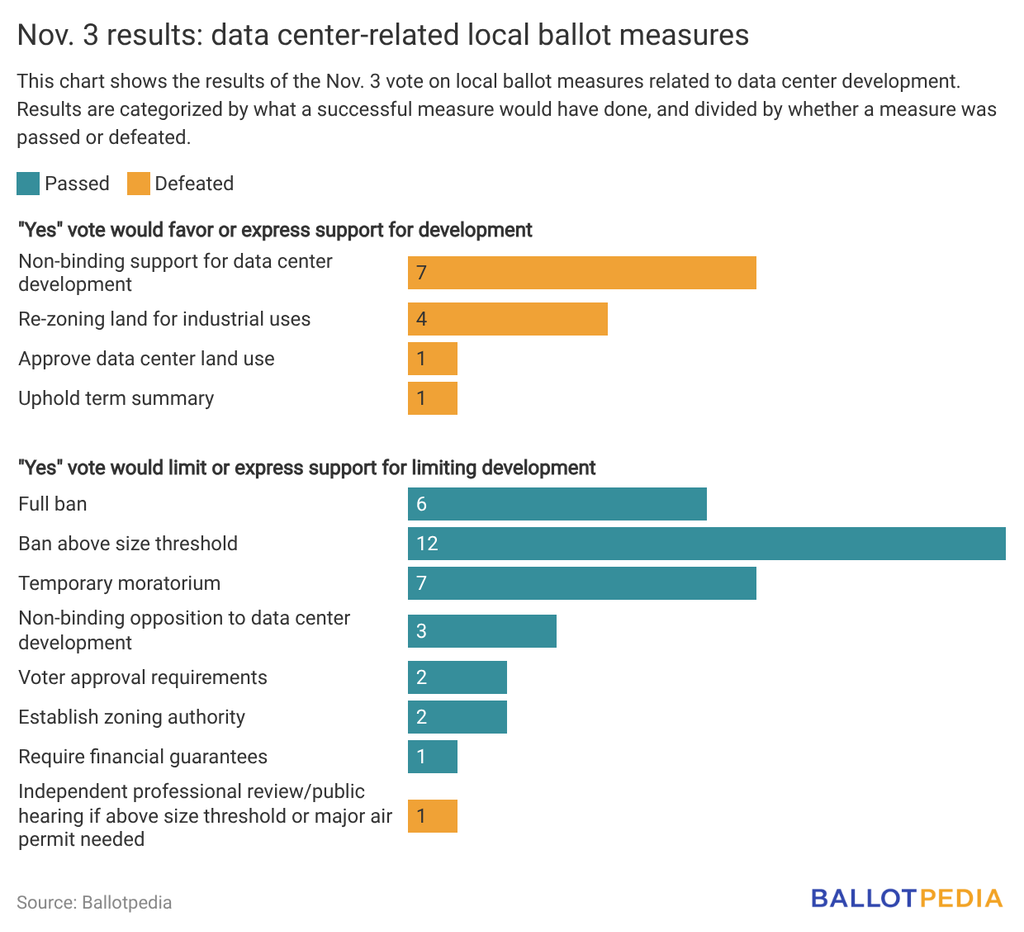
- Opposition to non-binding support for data center development: Seven non-binding measures in Illinois, New Jersey, and Ohio, would have expressed voter approval of data center projects. Voters defeated all seven measures.
- Opposition to re-zoning land for industrial uses: Four measures in Wilmington, Ohio, would have rezoned specific areas of land from residential to industrial uses, allowing data center construction at these sites. According to WCPO News, TAC Data Centers planned to build on this land if it was rezoned. Voters defeated all four measures.
- Opposition to data center land use: A Boulder City, Nevada measure would have added data centers as an approved use for a particular area of land. It was defeated 29.4% to 70.6%.
- Opposition to upholding a term summary: An Ashville, Ohio measure would have upheld Resolution 06-2026, a term summary guiding the Village of Ashville’s negotiations with the data center company EdgeConneX. It was defeated 18.4% to 81.6%.
- Full bans: Six measures prohibited all data centers in the jurisdictions. All five passed.
- Bans above size thresholds: Voters approved twelve partial data center bans based on size thresholds measured in electricity, water, or land used. These size thresholds varied from a near-total ban with exceptions to one on data centers covering 25,000 square feet or more. All twelve passed.
- Temporary moratoriums: Voters approved seven temporary moratoriums in Maine, each lasting approximately six months.
- Support for non-binding opposition to data center development: Three non-binding measures expressed voter disapproval of data center projects. Voters passed all three measures.
- Support for voter approval requirements: A measure in Grove City, Ohio required voter approval for data center projects using more than 20 megawatts of electricity or 500,000 gallons of water a day. A Janesville, Wisconsin measure required voter approval if a specific data center project costs more than $450 million. Both measures passed.
- Support for establishing zoning authority: Two measures in Adams County, Ohio established zoning regulations for unincorporated areas of the jurisdictions. Areas covered by zoning regulations would have to be zoned for a use consistent with data center construction (such as industrial) for a project to be built there. Voters approved both measures.
- Support for requiring financial guarantees: A Perry, Ohio measure which required data center developers receiving tax incentives to provide financial guarantees to the community passed 87.1% to 12.9%.
Voters approved one measure that favors data center development
Harwood, North Dakota, was the only jurisdiction that Ballotpedia classifies as voting to favor data center development. If passed, the Harwood Industrial Development Review Initiative would have required independent professional review and a public hearing for industrial projects (including data centers) exceeding various land area, power, and water use thresholds, as well as for projects requiring a major air quality permit. Voters rejected it 24.4% to 75.6%.
51 data center-related local ballot measures in 2026
Including the 41 measures just decided on Nov. 3, voters have decided or will decide 57 data center-related local ballot measures in 2026. Before Nov. 3, a majority of voters favored greater limits on data center development in six ballot measures. In December, voters will decide on two local ballot measures related to data centers in Clarksville, Arkansas, one in Hollis, Maine and one in Mandan, North Dakota. With potential state-level ballot measures collecting signatures in Ohio and Massachusetts, data centers continue to be an active policy topic.
Want to learn more?
Pick of the news
Arizona joins Nevada water lawsuit against Department of the Interior. On Oct. 16, Arizona petitioned to join a lawsuit against the Interior Department first filed by Nevada in August. The suit challenges a Colorado River water management plan by the Interior Department’s Bureau of Reclamation. The Bureau plan would cut the water usage of the three states that use the Lower Basin of the river. Nevada, Arizona, and California, the three Lower Basin states, failed to reach a water-use agreement with the four Upper Basin states of New Mexico, Utah, Colorado, and Wyoming earlier this year. Washington Post
Indiana Gov. appoints new head of public access office. On Oct. 2, Indiana Gov. Mike Braun (R) announced the appointment of Brittney Long to serve as Public Access Counselor. As head of the Office of the Public Access Counselor, Long will be responsible for responding to public access requests and addressing public grievances. Reporting from the Indianapolis Star said that under Jennifer Ruby, Braun’s previous appointee to the position, the Office took an average of 200 days to issue opinions for which a 30-day turnaround was legally required. Indiana Public Radio
Washington Gov. announces six-month pause on new regulation. On Nov. 4, Washington Gov. Bob Ferguson (D) issued an executive order that established a pause on state agency rulemaking. Under the order, which will take effect Dec. 4, agencies may not initiate new rulemaking which would add regulatory requirements for businesses, individuals, or other regulated entities for six months. The order also requires agencies to review their existing regulations to identify candidates for elimination, and to report on their findings within eight months of the order taking effect. KOMO News
Featured commentary
Is there a dichotomy in deference jurisprudence? Lewis & Clark Law School Professor Nicholas Fromherz and Washington Litigation Group Deputy General Council Joseph Mead argue that there is a dichotomy in judicial deference jurisprudence in the wake of the U.S. Supreme Court’s 2024 Loper Bright decision (which struck down Chevron deference). They argue that in a post-Loper world courts show administrative agencies little if any deference under the Major Questions Doctrine, while showing large amounts of deference to executive actions through non-statutory ultra vires review (which focuses on whether a government action exceeds its legal authority). They argue that to resolve this dichotomy, “courts should be careful to avoid making the ultra vires standard more favorable to the government than it ought to be.” Yale Journal on Regulation
In the Media:
Regulatory highlight
In this section, we highlight a few of the several regulations reviewed by the Office of Information and Regulatory Affairs (OIRA) each month and discuss an aspect of the federal Congressional Review Act (CRA), an increasingly used mechanism for repealing executive agency regulations. In this edition, we provide an update on how federal legislators have used the Congressional Review Act in the 119th Congress and how it looks for the rest of the legislative session.
Notable regulations
- The Office of Information and Regulatory Affairs concluded its review of a proposed Office of Postsecondary Education (OPE) regulation that would allow postsecondary educational institutions to pursue new accreditors without approval from the U.S. Department of Education (ED). According to the regulation's statement of need, the rule would align department policies with Executive Order 14279, titled Reforming Accreditation To Strengthen Higher Education. The proposed rule came out of several months of negotiated rulemaking. ED began the rulemaking process with negotiations in January, in tandem with other accreditation policy changes.
Congressional Review Act
The Congressional Review Act (CRA) allows Congress to repeal executive agency rules with joint resolutions of disapproval. Under the CRA, Congress has 60 working days after a rule has been submitted to Congress to introduce a joint resolution of disapproval.
So far in the 119th session, President Donald Trump (R) has signed more resolutions – 23 – into law than any other Congress, all nullifying Biden-era regulations. With incoming Democratic majorities in both chambers for the 120th Congress, Democrats may try to use the CRA as a tool to nullify Trump administration regulations.
Nullifying regulations under the CRA is simpler than other lawmaking procedures. Joint resolutions of disapproval bypass the Senate filibuster by limiting debate to 10 hours, sometimes less. They are not subject to proposals for amendments, motions to postpone, or motions to proceed to other business.CRA resolutions need a simple majority to pass, but – like other legislation – need a two-thirds majority to override a likely Trump veto.
Enacted CRA resolutions have mostly nullified regulations issued during prior administrations during the CRA's lookback period, as all of those signed during the current session have. Presidents Barack Obama (D), Donald Trump (R), and Joe Biden (D) all vetoed CRA resolutions from a Congress controlled by parties opposing theirs, with no Congresses overriding their vetoes.
Want to learn more?
Legislative Tracking Update
Since our last newsletter edition, Ballotpedia tracked no significant legislative action (enactments, vetoes, and passage through both chambers) on administrative state-related bills.
Ballotpedia tracked a total of 1,925 bills related to the administrative state in 2026, as of Nov. 17.