


Welcome to Ballotpedia’s Weekly Brew. Each week, we’ll bring you a collection of the most-viewed stories from the Daily Brew, condensed, along with other content from across Ballotpedia that we think you’ll like.
Today’s Weekly Brew brings together content from the week of November 16 - November 20.
This week’s top stories
Here are the Daily Brew stories our subscribers clicked on most this week.
Voters remove 14 local officials in Nov. 3 recall elections
On Nov. 3, voters in five states decided on recall elections against 21 local officials, removing 14 from office and keeping seven.
At least four of the recall elections were related to government decisions on data center development. Voters removed all four of those officials from office. In total, there were 46 recall efforts against 83 officials in 10 states related to data center development this year.
Including the Nov. 3 elections, voters have removed 10.7% of the 475 officials who faced recall efforts this year, below the 16% average from 2010 through 2025.
Campaigns submit signatures for 2027 Maine sex-based sports eligibility initiative and 2028 Massachusetts abortion referendum
With the November 2026 election concluded, where voters decided 145 state ballot measures across 39 states, one veto referendum has been certified for the 2028 ballot in Massachusetts. Supporters of a 2027 initiative in Maine are working to qualify it for that ballot.
Maine Birth Certificate Sex Requirement for Public School Sports Initiative
Supporters of an initiative to require that public school sports teams designated for girls or boys be limited to students of the corresponding sex as recorded on their birth certificates submitted a second round of signatures in an attempt to place the measure on the 2027 ballot. In 2026, voters decided at least four measures concerning sex-based requirements for school sports — approving all of them.
The proposed sports restrictions have an exception allowing girls to join a boys’ team when no girls’ team is available in that sport. The measure also addresses private spaces and civil lawsuits.
Massachusetts Abortion Regulations Veto Referendum
On Nov. 17, Massachusetts Secretary of State William Galvin (D) announced that sponsors of the veto referendum had submitted 80,412 valid signatures, surpassing the 37,287 required. The measure was placed on the Nov. 7, 2028, ballot.
The veto referendum would repeal House Bill 5595 (H. 5595), the Massachusetts law that permits abortions after 24 weeks gestation "based upon the professional judgment of the physician." A group called the Compassionate Care Coalition had submitted 113,477 signatures by the Nov. 6 submission deadline.
Also on Nov. 6, Massachusetts Gov. Maura Healey (D) signed an emergency statement to block the suspension of H. 5595. The law took effect Nov. 8, 2026, and will remain in effect until voters decide the referendum.
Click here to learn more about Maine 2027 ballot measures and here to learn more about Massachusetts 2028 ballot measures.
Alaska voters keep ranked-choice voting and cities in California and Colorado adopt it
Voters in Alaska rejected a ballot measure on Nov. 3 to repeal the state’s ranked-choice voting (RCV) system, and two localities adopted the use of RCV for local elections.
Alaska Ballot Measure 2 would have replaced top-four primaries and ranked-choice general elections with party primaries and single-choice voting, and repealed certain campaign finance disclosure rules. Voters defeated the measure 53.6% to 46.4%.
Irvine, California and Longmont, Colorado approved measures on Nov. 3 requiring the use of RCV for certain local races. Irvine voters approved Measure D 53.3% to 46.7%. The measure implements RCV for mayoral and city council elections “to the extent technically and financially feasible” after Jan. 1, 2028. Longmont voters approved Question 3C, which requires RCV for mayor and city council elections where possible starting in November 2029, 56% to 44%.
28 runoffs and 15 Louisiana general elections to happen over the next four weeks
At least 28 runoff elections for 29 offices that were up for election on Nov. 3 will take place between Nov. 20 and Dec. 12. The contests include three state legislative races, 23 local races, and two races for three territorial executive offices.
Louisiana voters will also decide 15 general elections on Dec. 12 in races where no candidate won a majority on Nov. 3.
Steeped in History
Welcome to Steeped in History, a column where every week we'll share a story from America's political past.
Establishing self-governance in early America: Virginia
Americans spend a lot of time and resources focused on national politics and issues. But much of our political and civic life happens close to home and among the roughly 500,000 local elected officials who decide on issues ranging from property taxes to education and public safety.
The roots of our system of local government are older and deeper than the United States itself. It got started soon after the first colonists arrived from England, bringing with them an understanding of how representative government should work and the issues it should address. And some of the early local governing bodies they created are, in one form or another, still with us today.
One of those is what is today known as the Virginia General Assembly. It traces its roots back to 1619, when the Virginia Company, established to fund and run the Virginia colony as a profit-making enterprise for its investors, instructed the colonists to create a House of Burgesses to enact “just Laws for the happy guiding and governing of the people there inhabiting.” It was composed of the governor, his four councilors, and 22 elected burgesses from across the colony. It first met in the church in Jamestown on July 30, 1619 — making it the oldest continuously serving elected representative body in the Western Hemisphere.
But Virginia’s approach, in which colonists elected representatives to make laws on their behalf, wasn’t the only model taking shape in early America. In New England, colonists were trying something quite different, a story we’ll pick up next time.
In other news
Go beyond the Daily Brew with Ballotpedia News. Explore this week's headlines below:
- OCC urges California to exempt national banks from climate disclosure laws
- How the 2026 elections affected state supreme courts: Ohio
- Virginia governor says state won't participate in federal scholarship tax credit, Treasury says it must
- Mary Peltola defeated incumbent Sen. Daniel S. Sullivan (R) and two other candidates in the general election for the U.S. Senate in Alaska
This week’s read
This week’s read comes from the November Edition of Checks and Balances, a monthly newsletter featuring highlights from Ballotpedia’s administrative state coverage.
Schedule G regulation proposed, at least 25 employees hired under the classification
On September 18, the Office of Personnel Management (OPM) published a proposed regulation in the Federal Register that would govern employment under three politically appointed federal job classifications. President Donald Trump (R) created two of these classifications, Schedules Policy/Career and G, through executive orders in 2025. In June 2026, about 8,000 federal employees were reclassified under Schedule Policy/Career. At least 25 employees have already been hired under Schedule G according to an Oct. 13 Partnership for Public Service (PPS) report.
Chris Piper, the author of the PPS report, wrote that according to data included on OPM’s Periodically Listing Updates to Management (PLUM) website, at least 25 employees were hired under Schedule G beginning in August 2025 (22 of them by the Department of Veterans Affairs). Piper also wrote that “in the case of Schedule G, for more than a year, officials served in a new appointment category with no public record, and the only acknowledgment came through an unannounced data update rather than a report or a press release.”
President Trump established Schedule G by executive order on July 17, 2025. Employees hired under Schedule G are considered political appointees, and serve without some of the job protections that are enshrined in law for career federal employees. The Office of Personnel Management (OPM) issued a guidance document for agencies shortly after the order on July 29. The OPM says that the job classification came into effect with these actions and pushed back on the idea that hiring under the classification began too early. OPM spokesperson Kiki Nyoh said in a statement that “the claim that there were no formal guardrails governing use is not accurate. The schedule took effect under the executive order, which itself modified the regulations, and OPM issued implementing guidance to agencies on July 29, 2025. The pending proposed rule would make conforming amendments. It does not establish the underlying authority for Schedule G.”
This week’s watch
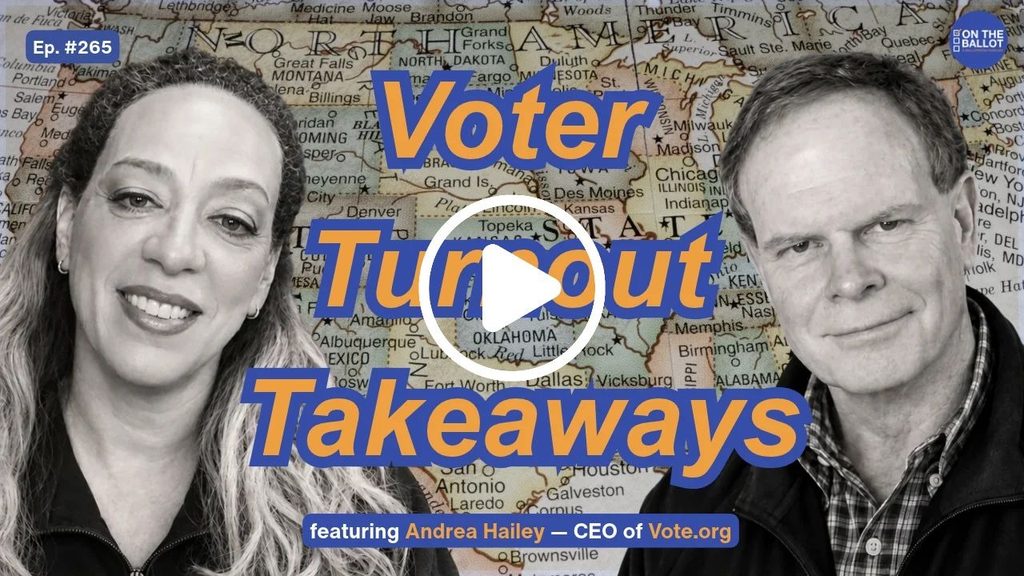
Vote.org’s Andrea Hailey on Youth Turnout, Voter Registration, and the 2026 Midterms
On this episode of On the Ballot: Vote.org CEO Andrea Hailey returns to talk with host Norm Leahy about who showed up to vote in the 2026 midterms. They discuss the surge of 18-year-old voters and what motivated them, from affordability to AI and the job market, why voter registration jumped across Southern states like Mississippi in what she calls “the year of the defensive voter,” how voters decided ballot measures on voting itself, from same-day registration to voter ID, the questions voters asked most this cycle, and what people can do now to be ready for the next election.