



In response to federal changes related to noncitizens' eligibility for Medicaid, Democratic states were more likely to provide state-funded coverage for affected noncitizens, while Republican states were more likely to implement additional steps to verify or report on beneficiaries’ immigration status.
On Oct. 1, 2026, new Medicaid eligibility rules took effect that made certain noncitizens ineligible to receive federally-funded care through Medicaid. The changes were enacted as part of the One Big Beautiful Bill Act (OBBBA), which President Donald Trump (R) signed on July 4, 2025.
States were required to implement changes by updating eligibility systems, redetermining eligibility, and notifying affected noncitizens by Oct 1. Beyond these federal requirements, some states chose to take additional actions, such as providing state-funded coverage to affected noncitizens, conducting more extensive outreach, or implementing supplemental procedures to verify beneficiaries' citizenship status.
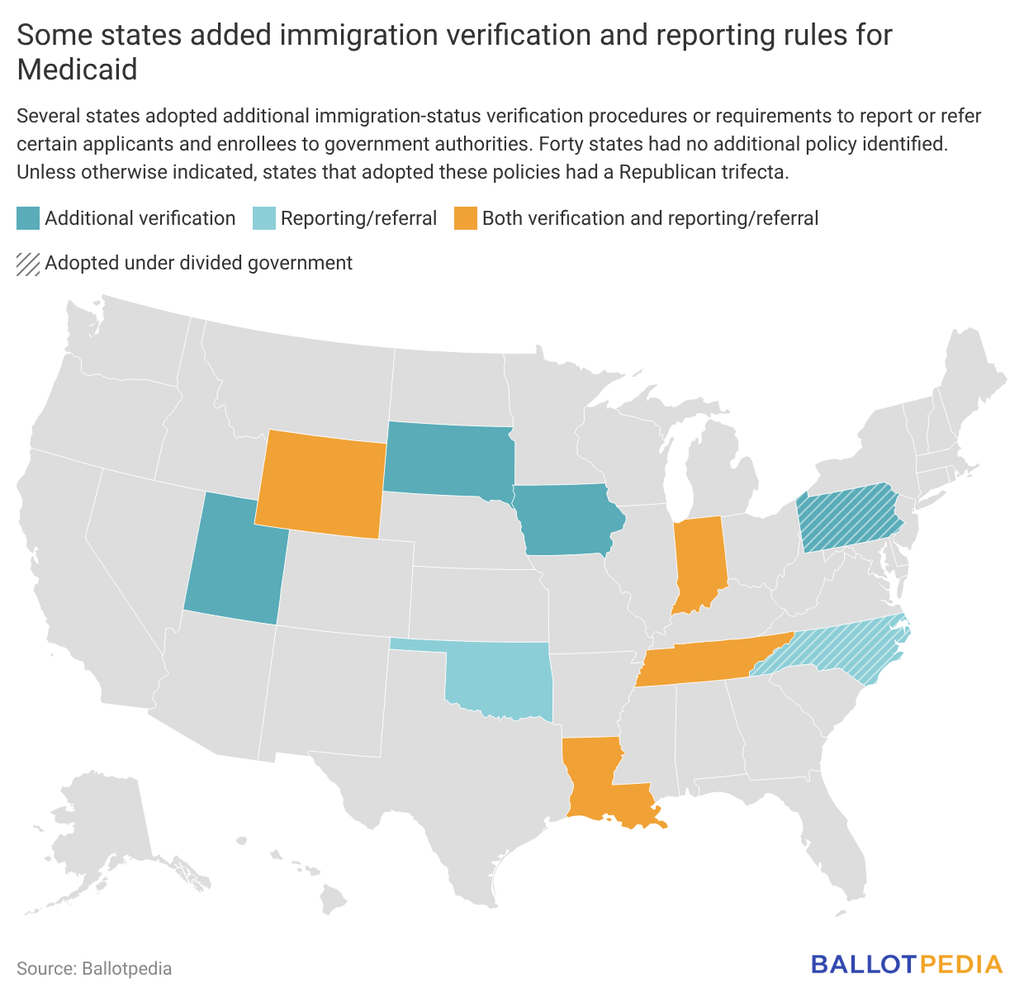
Ballotpedia research found that the majority of states did not take additional action beyond implementing federal requirements, except in the case of outreach where 31 states took at least one additional step to contact or notify affected noncitizens. Eight states — including six Democratic trifectas — provided state-funded coverage for affected noncitizens. A similar number of states — ten, including eight with Republican trifectas — implemented additional verification procedures or requirements to report instances where the state could not verify an individual's citizenship status to the federal government.
New rules limit the noncitizen categories eligible for Medicaid
Medicaid is a joint federal-state program that provides health coverage primarily for low-income individuals and families. Funding comes from states and the federal government Medicaid, but states administer their own programs within a broad set of federal rules. As of June 2026, roughly 66 million people were enrolled in Medicaid, according to the Centers for Medicare and Medicaid Services (CMS).
Section 71109 of the OBBBA eliminated federal matching funds for full Medicaid coverage for many lawfully present noncitizens.
Under the Oct. 1 changes, states can now generally offer Medicaid only to lawful permanent residents (such as green card holders), Cuban and Haitian immigrants, and individuals admitted as part of the Compacts of Free Association (COFA). Green card holders are eligible following a five-year-waiting period. Federal funding for lawfully residing pregnant women and children remains available, but generally only in states that have chosen to cover one or both groups under section 214 of the Children’s Health Insurance Program Reauthorization Act of 2009 (CHIPRA 214).
The following noncitizens generally no longer qualify for federally funded Medicaid (this list is not exhaustive):
- Refugees
- Asylees
- Certain victims of sex or labor trafficking
- People with special immigrant visas from Iraq or Afghanistan
- Amerasian entrants
There is no national estimate for the affected population, but nine states and D.C. told KFF Health News that they expected more than 281,000 noncitizens could be ineligible for Medicaid as a result of the change.
States have the option of using their own money to cover some or all of the newly ineligible populations of noncitizens. Regardless of their immigration status, noncitizens can still receive emergency medical care through Emergency Medicaid in all 50 states.
State responses
Ballotpedia examined state responses to the Oct. 1 eligibility changes by asking three questions: (1) Did states act to replace Medicaid with state-funded coverage for at least some affected noncitizens? (2) Did states adopt new or expanded protocols for verifying or reporting on enrollees’ or applicants’ immigration statuses that went beyond the federal requirements? (3) Did states go beyond the federal requirements for communicating the Oct. 1 changes to affected populations?
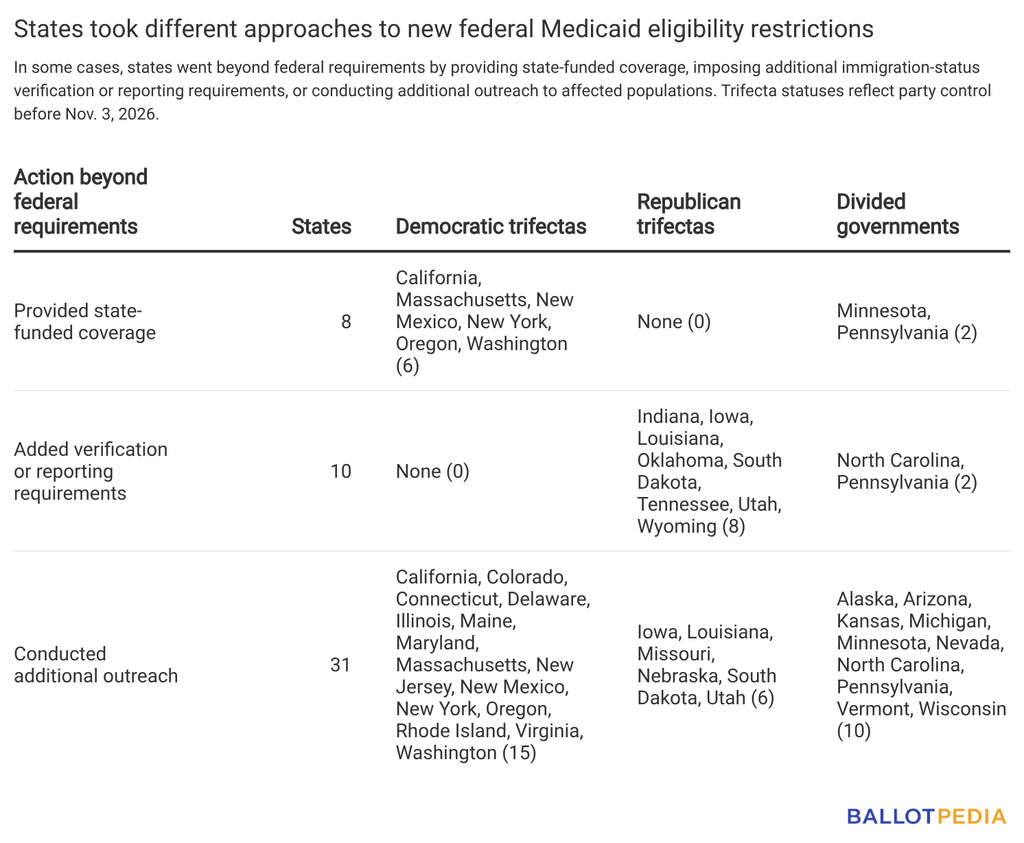
- Eight states were providing coverage to some or all newly ineligible immigrants through state-funded programs. Six of the states had Democratic trifectas and two had divided governments. Accounting for the 2026 midterm elections, all eight will have Democratic trifectas in January when new and re-elected lawmakers are sworn in.
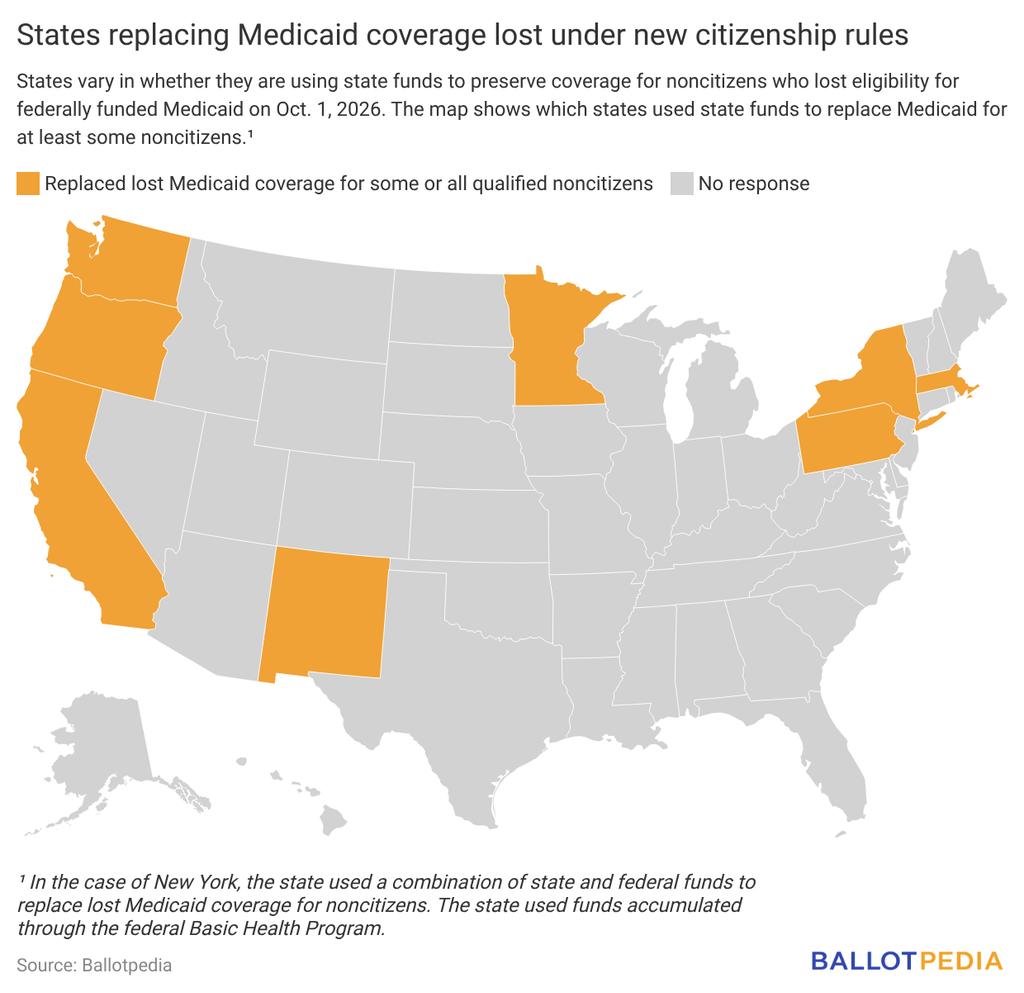
- Ten states, including eight that had a Republican trifecta, implemented verification or reporting requirements, or both, above and beyond the ones required by the federal government.
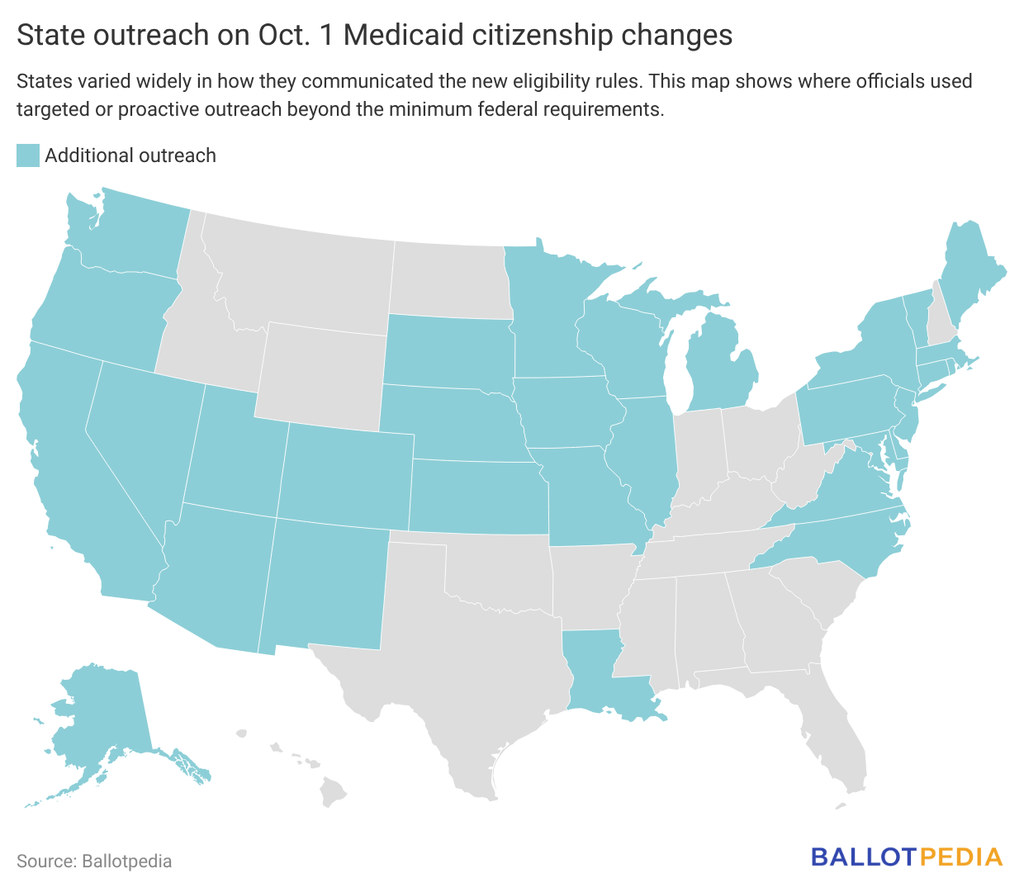
- Thirty-one states engaged in outreach that went beyond the federal minimum requirements to affected populations in the run-up to the Oct. 1 deadline. That outreach included mailers, emails, text messages, video outreach, webinars, and public events. Fifteen of the 31 states had Democratic trifectas, six had Republican trifectas, and 10 had divided governments.
State-funded replacement coverage
The new eligibility requirements prohibit federal Medicaid dollars from covering certain noncitizens; however, they don’t prevent states from using their own funds to replace lost coverage. To date, at least eight states replaced what had been the federal share of Medicaid funding with state dollars for at least some previously enrolled noncitizens.
State plans for replacing lost Medicaid coverage vary. California, Oregon, New Mexico, and New York are providing coverage for most or all noncitizens who are no longer eligible for Medicaid. In California, the state is fully replacing lost Medicaid coverage for noncitizens through June 2027. Beginning July 2027, some beneficiaries will be required to pay a premium to preserve their full-scope Medi-Cal coverage, while others will be moved to a coverage plan limited to emergency care and pregnancy-related services. The New Mexico State Legislature created a new program through BeWell, the state’s healthcare exchange, to cover noncitizens who lost Medicaid.
Massachusetts, Minnesota, Pennsylvania, and Washington are providing state-funded coverage to narrower groups of noncitizens. Massachusetts, for example, placed older adults (65 and older) and adults with disabilities into MassHealth Family Assistance, a state-funded plan similar to the state’s Medicaid program but without coverage for long-term services and supports or non-emergency medical transportation. Pennsylvania moved noncitizens receiving Supplemental Security Income (SSI) to a fully state-funded plan. The Washington State Legislature appropriated roughly $18 million for the Limited Benefit Community Access Program (LBCAP), which provides state-funded coverage for LTSS patients.
Verification and reporting
CMS set forth requirements for how states must verify an individual’s immigration status. That involves using the federal SAVE database. If that method isn't sufficient to determine an individual's immigration status of whether they meet other criteria for Medicaid, the state is required to request additional information from the individual.
We looked to see if states implemented additional verification policies, and whether they shared information about noncitizens with the federal government. We found that at least four states have implemented additional verification policies, two states have implemented additional policies regarding communicating information to the federal government, and four states have done both.
Louisiana, which has a Republican trifecta, offers a distinctive example of a state that adopted additional verification and reporting policies. On June 1, 2026, Gov. Jeff Landry (R) signed SB 194, a bill that enshrined the OBBBA’s narrower eligibility categories for Medicaid, SNAP, and other public benefits programs, in state law. In cases where states cannot determine eligibility based on an immigrant’s documentation, SB 194 prohibits the state from extending the federally required 90-day period, known as the reasonable opportunity period, during which enrollees remain covered under Medicaid while the verification issues are resolved. The law also prohibits the state from granting individuals additional opportunity periods if their eligibility could not be verified.
When it comes to reporting requirements, SB 194 mandates that state agencies report individuals who do not have a qualifying immigration status to U.S. Immigration and Customs Enforcement (ICE).
SB 194 took effect Aug. 1.
Indiana also enacted a law in 2026 that addresses verification and reporting requirements for Medicaid and other public assistance programs. Signed by Gov. Mike Braun (R) on March 4, SB 1 took effect on Oct. 1 and requires the state to verify the citizenship or immigration status of all Medicaid applicants, beneficiaries, and identified household members. It also requires the state to alert the Department of Homeland Security whenever an individual’s citizenship or immigration status cannot be established after an opportunity period or the person was determined to have illegally entered the country or overstayed their visa.
Pennsylvania, which has a divided government, implemented new immigration status verification procedures for Medicaid enrollees in 2026, but without the federal reporting requirement that Louisiana and Indiana adopted. The Pennsylvania Department of Human Services announced a new policy on March 3 requiring that County Assistance Offices (CAOs) verify noncitizens’ immigration status using the federal Verify Lawful Presence (VLP) platform or, if that fails, the SAVE database whenever they apply for Medicaid, report a change in immigration status, or renew their Medicaid coverage. Previously, CAOs were only required to verify immigration status if a change to status was reported or expected.
Outreach
At least 31 states went beyond the federal guidelines in how they communicated the new eligibility rules to affected noncitizens. Guidance released by CMS stated: “States must attempt to redetermine satisfactory immigration status without the involvement of the beneficiary, if possible, and must contact the beneficiary if they are unable to reverify the satisfactory immigration status without additional information.”
Once state agencies figure out who is no longer eligible for Medicaid, federal law requires them to provide the affected beneficiaries with at least 10 days’ notice before ending their coverage. Individuals who, in response, submit evidence of their eligibility that the state is unable to verify are entitled to a 90-day period during which they won’t lose coverage while verification is pending.
Depending on the state, additional outreach included multiple rounds of targeted outreach, webinars, video resources, translation services, and partnerships with local immigrant-focused nonprofits.
Examples include the following:
- Rhode Island (Democratic trifecta): The state’s Executive Office of Health and Human Resources, which manages its Medicaid program, notified “noncitizens who may be impacted by these changes through mailed notices, digital notices in HealthyRhode accounts, emails, and text messages.” The state sent its first set of notices in multiple languages in July 2026.
- Vermont (divided government): The Department of Vermont Health Access engaged in several different methods of outreach to potentially affected populations. The Department sent notices in English, Arabic, Dari, French, Nepali, and Spanish to individuals whose eligibility couldn’t be established, and partnered with the Vermont Justice Language Project, a nonprofit, to produce a video in multiple languages explaining the Oct. 1 changes. The Department also put up a webpage listing resources and options for noncitizens who are no longer eligible for Medicaid.
- Iowa (Republican trifecta): The Iowa Department of Health and Human Services published a Q&A guide to the Oct. 1 changes for refugee resettlement organizations, healthcare providers, organizations serving refugees, and community agencies. It also created a checklist for refugees and other newcomers for understanding and navigating the changes and a set of resources for finding alternative care options.
If you know of a state response we missed, please email editor@ballotpedia.org.