


Welcome to the Tuesday, Nov. 24, 2026, Brew.
By: Lara Bonatesta
Here’s what’s in store for you as you start your day:
- Democrats on track to net 16 to 18 U.S. House seats in nine states that used new congressional maps this year
- Four mayors of top-100 cities have announced retirements in 2027
- 67% of Trump-endorsed candidates won their general elections, with seven still uncalled
Democrats on track to net 16 to 18 U.S. House seats in nine states that used new congressional maps this year
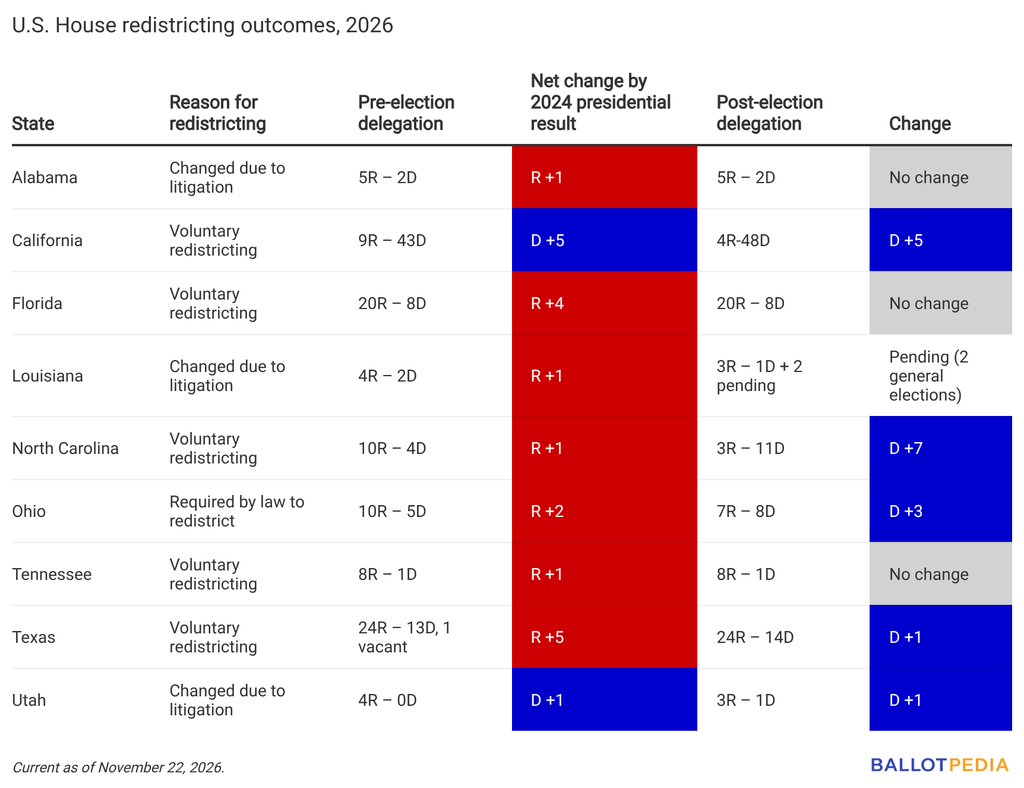
The nine states that used new Congressional maps in this year's general election are on track to send 16 to 18 more Democrats to Washington than they did in the last Congress, even though the states enacted new maps that included a net of nine new Republican-leaning districts that President Donald Trump (R) would have won in the 2024 presidential election. As of Nov. 23, Democrats have netted 17 seats in the eight states other than Louisiana. Louisiana’s two Dec. 12 general elections will decide whether the final total is 16, 17, or 18.
One common way to measure how a map may favor one party is to compare districts by how their voters cast ballots for president in recent elections. Because most of the new districts did not exist in 2024, this comparison uses 2024 presidential results recalculated for the 2026 boundaries, not votes actually cast in those districts. By that measure, Democrats won 26 districts across those states that Trump would have won, and Republicans did not win any districts that Kamala Harris (D) would have won. Those figures could change because both Louisiana general elections are in Trump-won districts.
The total could still shift depending on how Louisiana voters decide races for the 5th and 6th Congressional Districts — each between a Democrat and a Republican — on Dec. 12. Before the election, Louisiana’s six-member delegation had four Republicans and two Democrats. Of the four seats already decided under the new map, Republicans won three and Democrats won one. If the parties split the runoffs, Louisiana’s balance will hold and the nine-state net gain will be 17. If Democrats win both, it will be 18. If Republicans win both, it will be 16.
How results compare
The presidential baseline estimates how voters in each new district cast ballots for president in 2024, recalculated using 2026 boundaries. It does not predict how they would vote in this year’s U.S. House races. The maps in California and Utah added a combined six Harris-won districts, and Democrats gained six seats — five in California and one in Utah.
In the other seven states, Democrats won more seats than the baseline suggested. In North Carolina, Ohio, and Texas, the new maps added a combined eight Trump-won districts, and Democrats gained 11 seats: seven in North Carolina, three in Ohio, and one in Texas. In Texas, Democrats gained two Republican-held seats and Republicans gained one Democratic-held seat.
In Alabama, Florida, Louisiana, and Tennessee, maps added a combined seven Trump-won districts. Alabama, Florida, and Tennessee will have the same partisan balance in their U.S. House delegations as before the election. In Tennessee, that reflects two gains that offset each other. Louisiana’s balance depends on its two general elections.
So far, the four states’ U.S. House delegations have the same partisan balance they had before the election, though Louisiana’s two general elections are still pending.
Click here to learn more about how this year's election results changed each state's delegation.
How we got here
States usually redraw congressional maps once a decade, after the U.S. Census. Before 2025, two states had voluntarily redistricted mid-decade since 1970.
That changed in August 2025 when Texas redrew its map following a request from Trump asking Republicans in the state to do so in order to help the party keep its U.S. House majority. North Carolina followed Texas in redrawing its map. California then adopted a new map through Proposition 50, which voters approved 64.4% to 35.6%. The measure replaced a commission-drawn map with a legislature-drawn one through 2030.
Other states redrew for different reasons. Ohio had to redraw its map because the previous one lacked bipartisan support. In Utah, a district court judge struck down the map, finding that the Utah Legislature unconstitutionally overrode Proposition 4, which voters approved 50.3% to 49.7%. The measure created a redistricting commission to draft maps for congressional and state legislative districts. The Utah Supreme Court later rejected an appeal.
Four more states changed their maps following a U.S. Supreme Court decision on April 29. The Court ruled 6-3 in Louisiana v. Callais that Louisiana's map, which had added a second majority-Black district in 2024 after a Voting Rights Act ruling, was an unconstitutional racial gerrymander.
While Florida started the redistricting process before the Callais decision, the Florida Legislature approved the map on the same day the Court announced its decision, and Gov. Ron DeSantis (R) signed it into law on May 4. Louisiana and Tennessee followed in redrawing their maps. Alabama reinstated a 2023 legislature-drawn map after the U.S. Supreme Court allowed it.
Maps that weren't used
Four other states considered or enacted new maps but used their old ones in the general election. Democrats gained seats in all four — two in Virginia and one each in Indiana, Missouri, and South Carolina — though those gains are not part of the nine-state total.
Three of the four would have added Trump-won districts. The Indiana Senate rejected a map that would have added two, and the South Carolina Senate adjourned without passing a map that would have added one. Missouri held its Aug. 4 primary elections under a new map that would have added one. However, the Missouri Supreme Court blocked it until voters decided on it in a veto referendum, so the state used its 2022 map in the general election. Voters then defeated Proposition A 61.8% to 38.2%.
Virginia's map would have added Harris-won districts instead. The Virginia Supreme Court, citing procedural violations, voided a constitutional amendment that voters approved 51.7% to 48.3%. It would have allowed a map adding four Harris-won districts.
What happens next
Several states could change their maps before the 2028 elections.
On Nov. 3, Maryland voters approved Question 3, 61.9% to 38.1%, removing state constitutional criteria for congressional districts and clearing the way for lawmakers to redraw the map before 2028. In New York, lawmakers gave first passage to a constitutional amendment allowing mid-decade redistricting. It must pass again in 2027 and win voter approval that November to take effect for 2028.
Court cases could also lead to new maps. In Georgia, a federal appeals court in August vacated a 2023 ruling requiring another majority-Black district, sending the case back for review under Callais. The Wisconsin Supreme Court, which has a 5-2 liberal majority, heard two challenges to the state's map in September after lower panels dismissed them.
Click here to read more about redistricting ahead of the 2026 elections, and here about redistricting ahead of the 2028 elections.
Four mayors of top-100 cities have announced retirements in 2027
Twenty-seven of the 100 most populous cities in the U.S. are holding mayoral elections in 2027. So far, the incumbent mayors of four of those cities have announced they are not running for re-election in 2027. The mayors who have announced their retirements so far are:
- Orlando, Florida, mayor Buddy Dyer
- Indianapolis, Indiana, mayor Joe Hogsett
- Madison, Wisconsin, mayor Satya Rhodes-Conway
- Charlotte, North Carolina, mayor Robert Harrington
Hogsett was the most recent of these mayors to announce his plans to retire, doing so on Nov. 22. Hogsett assumed office in 2016.
Dyer, who assumed office in 2003, is the longest-serving mayor in Orlando’s history. He is also the second longest-serving mayor currently in office in a top-100 city.
Rhodes-Conway assumed office in 2019. In her retirement announcement, she said that she had decided not to run following threats of violence against herself, her staff, and her family.
Harrington assumed office in July, 2026, after the Charlotte City Council appointed him to replace former Mayor Vi Alexander Lyles (D), who resigned saying she wanted to spend more time with family. When he was appointed, Harrington said that he would not run for re-election in 2027.
The four retirement announcements so far account for 15% of the 27 top-100 mayoral offices up for election in 2027. As of Nov. 23, 11 other mayors (41%) have announced that they will run for re-election. Nine mayors who are up in 2027 (33%) have not announced whether they will seek re-election. Three mayors (11%) cannot seek re-election due to term limits.
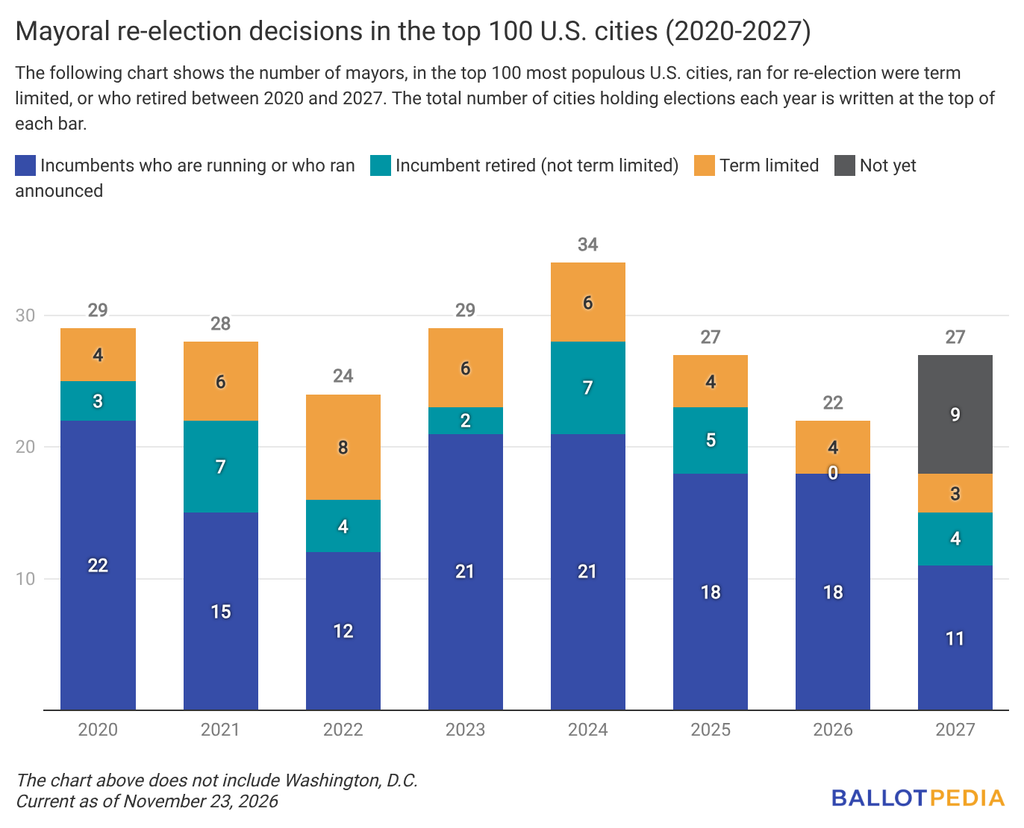
Excluding mayors who left before the end of their term, like Lyles, no mayors among the 100 most populous cities voluntarily retired in 2026. Five did so in 2025, seven did so in 2024, two in 2023, four in 2022, seven in 2021, and three did in 2020.
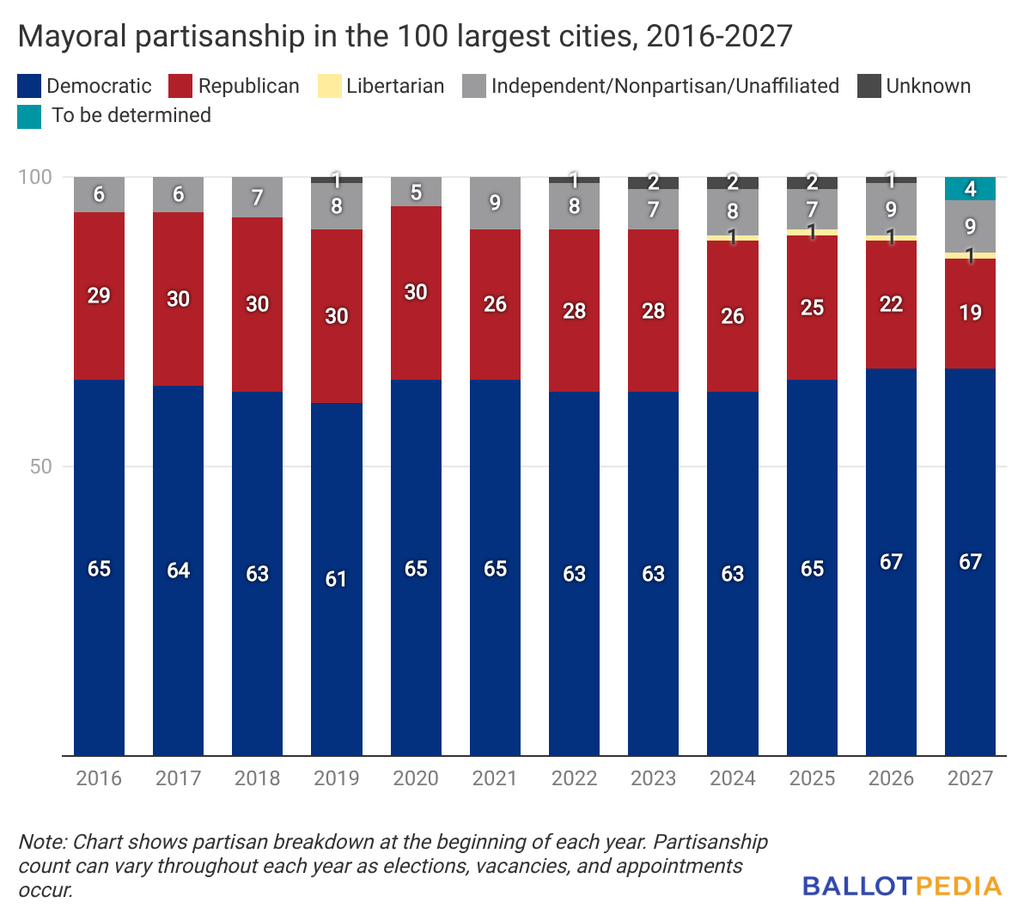
In the 27 top-100 cities holding mayoral elections in 2027, 21 have Democratic mayors, three have Republican mayors, two have nonpartisan mayors, and one has a Libertarian mayor. Click here to learn about how Ballotpedia identifies the partisan affiliation of mayors in cities with nonpartisan mayoral elections.
Nationally, as a result of the 2026 elections, Democrats will hold 67 mayoral offices, Republicans will hold 19, nonpartisans will hold four, independents will hold four, Libertarians will hold one, and one mayor will be unaffiliated. As of November 23, four cities’ mayors remain undecided. Irvine, California’s, mayoral election is uncalled. Corpus Christi and Laredo, Texas’, mayoral elections advanced to runoffs that will be held in December. Santa Clarita, California’s, city council selects its mayor each December.
Click here to learn more about mayoral elections in 2027.
67% of Trump-endorsed candidates won their general elections, with seven still uncalled
In the 2026 election cycle, President Donald Trump (R) made 334 general election endorsements. As of Nov. 20, seven races remained uncalled — six U.S. House races and one state executive race. Of the 327 decided races, 219 of these candidates won and 108 lost the general election. That means 67% of Trump’s endorsed candidates won general elections so far, the second-lowest percentage in an even year since 2018.
Republicans' loss of nine Senate seats puts the 2026 elections in the top 20% of election years in terms of seat swings against a president's party — a threshold we've previously defined as a wave election. We look at four office types when determining whether an election year qualified as a wave for either party: U.S. Senate, U.S. House, governors, and state legislatures. 2018, Trump’s first midterm, was the last time there was a wave election for either party. That year, Democrats gained seven gubernatorial offices, historically qualifying as a wave election.
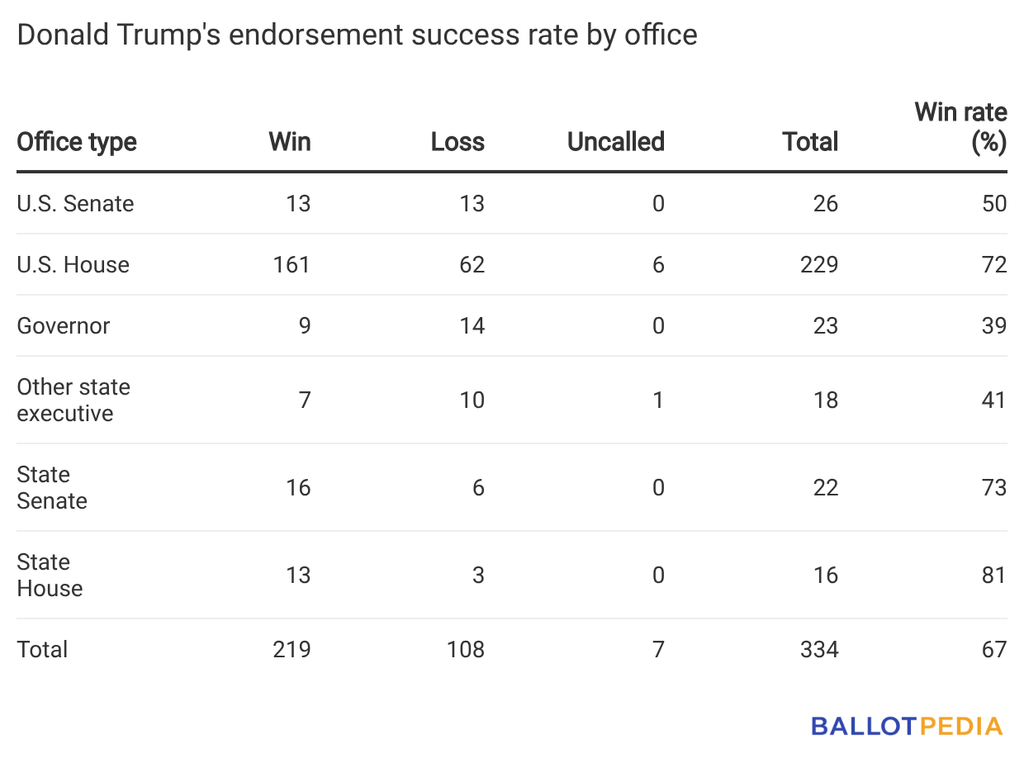
Looking at office types, Trump’s most successful office type was in state House races, where 13 of 16 candidates won, for an 81% success rate. The least successful office type was for governors. Trump endorsed 23 candidates, nine of whom won, for a success rate of 39%. Other state executives did only two percentage points better at 41%, with one race uncalled.
For federal offices, out of 26 candidates, 13 (50%) of Trump’s endorsed U.S. Senate candidates won. Trump endorsed more candidates for U.S. House than for any other office, making 229 endorsements, which made up 69% of his general election endorsements. Of the 223 decided races, 161 candidates won (72.2%) and 62 lost. Six races remain uncalled.
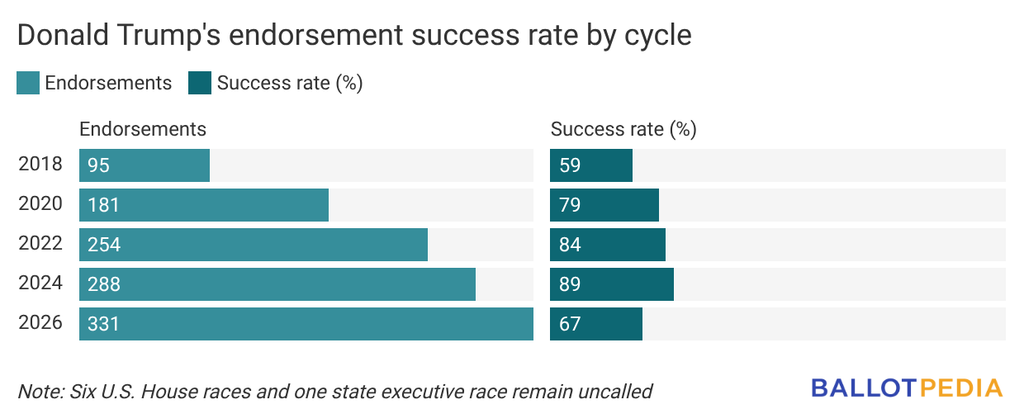
Compared with past even-year cycles, 2026 saw Trump's second-lowest success rate in the general election. The lowest success rate was in 2018, when 59% of Trump’s endorsed candidates won. His most successful even-year cycle was 2024, when 89% of Trump’s endorsed candidates won. Including off-year elections, Trump’s least successful cycle was in 2025, when only 43% of his candidates won the general election. Trump’s 2026 general election success rate is tied with 2019 at 67%.
To read more about Donald Trump’s endorsements in this cycle and past cycles, click here.