

Welcome to the Wednesday, Nov. 25, 2026, Brew.
By: Briana Ryan
Here’s what’s in store for you as you start your day:
- Here are the election policy areas legislators have recently prioritized in Democratic trifectas
- Trump administration provides states option for six more months before enforcing Medicaid work requirements
- Fort Smith, Arkansas, will pick its mayor in a Dec. 1 runoff before moving to a mayor-council government
Here are the election policy areas legislators have recently prioritized in Democratic trifectas
Six states — Arizona, Michigan, Minnesota, Nevada, Pennsylvania, and Wisconsin — gained Democratic trifectas following the Nov. 3 elections, which could affect the election legislation each state pursues during the 2027 legislative session.
In some cases, it has been years or decades since Democrats held a trifecta in some of these states. Democrats have not held a trifecta in Arizona, for instance, since 1966, while in Pennsylvania it is the first Democratic trifecta since 1993. The last time Democrats had a trifecta in Wisconsin was 2010. Michigan and Minnesota had Democratic trifectas as recently as 2024, and Nevada had a Democratic trifecta until 2022.
In the 2025 elections, Democrats gained one trifecta, in Virginia. During the 2026 legislative session, Virginia enacted the most election-related legislation of any state in the country. The 50 election bills enacted in 2026 represent a 355% increase over the 11 bills enacted in 2025, when the state had a divided government, and a 178% increase over the 18 bills enacted in 2024.
Virginia enacted legislation to join the Electronic Registration Information Center, a nonprofit whose website says its goal is to help “election officials maintain more accurate voter rolls and detect possible illegal voting.” It also expanded ranked-choice voting, extended the state’s cure period for absentee ballots, and referred a constitutional amendment to voters to expand voting rights for individuals convicted of a felony. Voters approved that amendment in the Nov. 3 elections.
In 2022, four states gained Democratic trifectas: Maryland, Massachusetts, Michigan, and Minnesota. The new Democratic trifecta states generally enacted more election legislation than they did when they were a divided government. Three of those four states enacted more election bills during the 2023 session than they did in 2022. Massachusetts enacted one election-related bill in both 2022 and 2023.
Michigan enacted 33 election bills in 2023, the most of those four states and the most of any Democratic trifecta state. That number was the third-most of any state in the country.
The five states that gained a Democratic trifecta between 2023 and 2026 focused on a range of election policy issues, some of which could also apply to the six new trifecta states.
After gaining a Democratic trifecta, Maryland, Michigan, and Virginia enacted legislation establishing a cure period for absentee/mail-in ballots or giving voters more time to cure their ballots. Four of the states with new Democratic trifectas in 2027 have cure periods, while Pennsylvania and Wisconsin allow counties or municipalities to decide whether to let voters cure their ballots.
Three of those states, Michigan, Minnesota, and Virginia, also enacted legislation to establish or consider expanding automatic voter registration. Four of the states with new Democratic trifectas in 2027 have automatic voter registration, while Arizona and Wisconsin do not.
Democratic legislators in both Arizona and Wisconsin introduced legislation in 2026 to enact automatic voter registration. State Sen. Mark Spreitzer (D), who was formerly the top Democrat on the state Senate committee that handles election bills, told Votebeat that he would like the state to enact automatic voter registration. Legislative leaders in the state have not publicly weighed in on the proposal.
Two states, Minnesota and Virginia, expanded early voting hours or required early voting on weekends. All six states currently offer no-excuse early voting. Three states with a new Democratic trifecta in 2027 require early voting on the weekends, while one state, Minnesota, requires early voting after 5 p.m. on weekdays.
Virginia was the only state to join the National Popular Vote Interstate Compact (NPVIC), an agreement among member states to award their Electoral College votes to the presidential ticket that receives the most votes nationwide, after gaining a Democratic trifecta. Governors or legislative leaders in Arizona, Michigan, Nevada, Pennsylvania, and Wisconsin have expressed interest in joining the NPVIC.
In Michigan, legislators in 2023 enacted legislation that added local government IDs to the list of acceptable voter identification and expanded the types of student IDs that may be used. Four of the six states with new Democratic trifectas in 2027 have voter ID laws, including Nevada, which enacted voter ID via ballot measure in the Nov. 3 elections.
No states enacted a new state-level voting rights act after gaining a Democratic trifecta, though Virginia expanded their existing voting rights act in 2026. Three states enacted new state-level voting rights acts in 2026, the first time that multiple states did so in the same year.
Four bills to enact the Michigan Voting Rights Act passed the state Senate, which Democrats controlled during the 2026 session, in June but have not been considered in the Republican-controlled House of Representatives. Incoming House Speaker Ranjeev Puri and Senate Majority Leader Darrin Camilleri said that one of their top priorities would be to enact a state-level voting rights act.
For more information on election legislation in the 50 states, click here.
Trump administration provides states option for six more months before enforcing Medicaid work requirements
The Centers for Medicare and Medicaid Services (CMS) announced on Nov. 13, that states with CMS approval may be able to delay enforcement of new Medicaid work requirements for up to six months.
The Medicaid work requirements, established under the One Big Beautiful Bill Act (OBBBA) of 2025, are scheduled to take effect Jan. 1, 2027. CMS' new guidance gives states the option, if they submit a plan for CMS approval, to have until July 1, 2027, to fully implement them.
The work requirements apply to certain adults ages 19 to 64 enrolled in Medicaid through the expansion authorized by the Affordable Care Act. They generally require affected beneficiaries to complete at least 80 hours of work, community service, or other qualifying activities each month, enroll in school at least half-time, or qualify for an exemption.
During the optional extended period running from Jan. 1 through June 30, states may temporarily suspend Medicaid coverage denials and terminations for individuals who fail to demonstrate compliance with the work requirements. States must still assess whether applicants and beneficiaries meet the requirements or qualify for exemptions beginning Jan. 1.
CMS said the additional flexibility would allow states to address implementation challenges involving eligibility systems, verification procedures, and staff training.
States may be penalized for failing to implement or improperly implementing Medicaid work requirements in two ways, both of which will be paused for states that use the extended option:
- CMS can initiate a compliance action for states that fail to implement work requirements, which may result in the withholding of federal funds. Authority to bring compliance actions predates the OBBBA, and they are one of CMS's primary tools for ensuring states comply with federally-approved state Medicaid plans. CMS may still initiate a compliance action unrelated to work requirements during the hold harmless period.
- Beginning in 2030, states will be responsible for repaying at least some improper Medicaid eligibility-related payments if their payment error rate is above 3%. States can incur eligibility-related payment errors by paying benefits to beneficiaries who fail to comply with work requirements. The Social Security Act (SSA) already included a payment error penalty beyond the 3% threshold, but the OBBBA limited CMS's authority to waive the penalty.
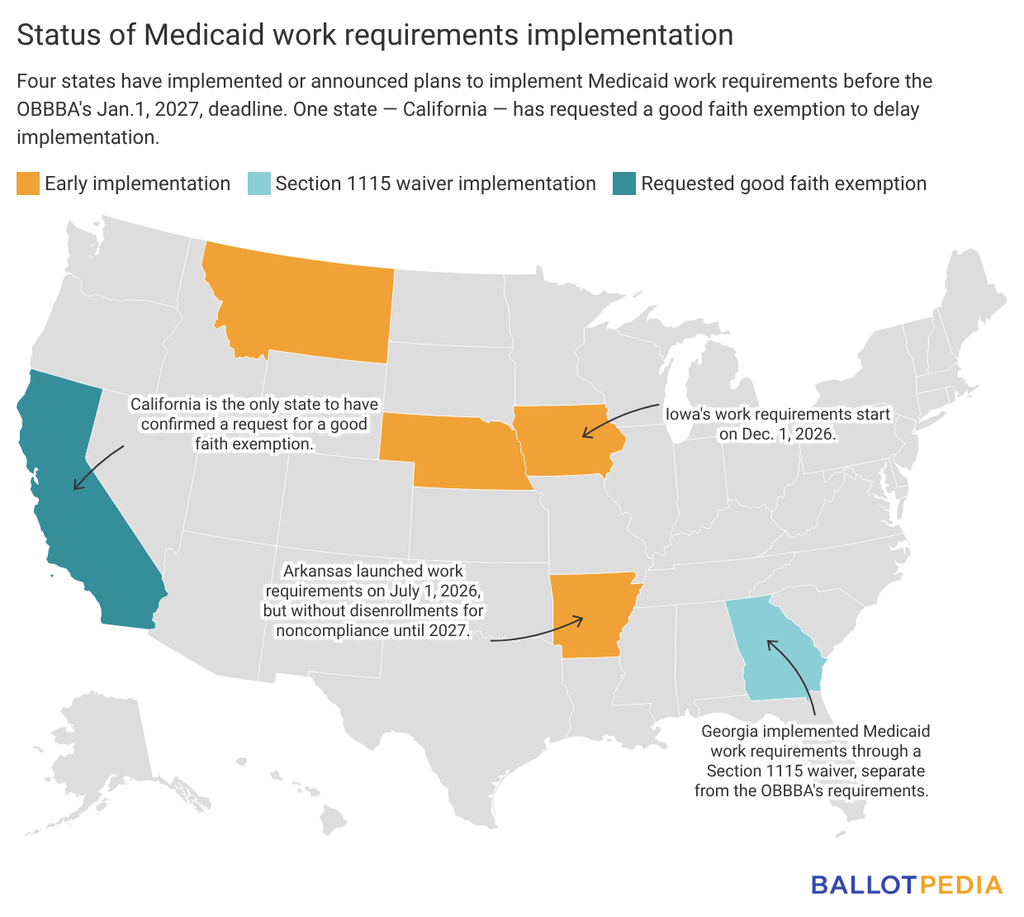
The OBBBA established the first federally mandated Medicaid work requirements, replacing a system in which states generally needed federal approval waivers to implement such policies. Four states with a Republican trifecta announced plans to partially or fully implement the federal work requirements early: Arkansas, Iowa, Montana, and Nebraska. The OBBBA also included a provision that allows CMS to delay implementation until Jan. 1, 2028, upon request from a state that they determine has made a good faith effort to comply. As of Nov. 23, one state, California, had confirmed that it requested a good faith effort exemption, but CMS had not approved the request. Five Democratic governors — in California, Maine, New Mexico, Oregon, and Virginia — sent a letter to CMS on Oct. 1 asking for more time to implement the work requirements.
Since the announcement, at least three states — Kentucky, Indiana, and Ohio — said they would not utilize the hold harmless period and would keep Jan. 1 as their target for implementation.
Ballotpedia is tracking the implementation of Medicaid provisions under the OBBBA, including federal rules and guidance, implementation deadlines, state responses, and changes to Medicaid eligibility and funding.
Click here to read more about the implementation of Medicaid provisions from the One Big Beautiful Bill Act.
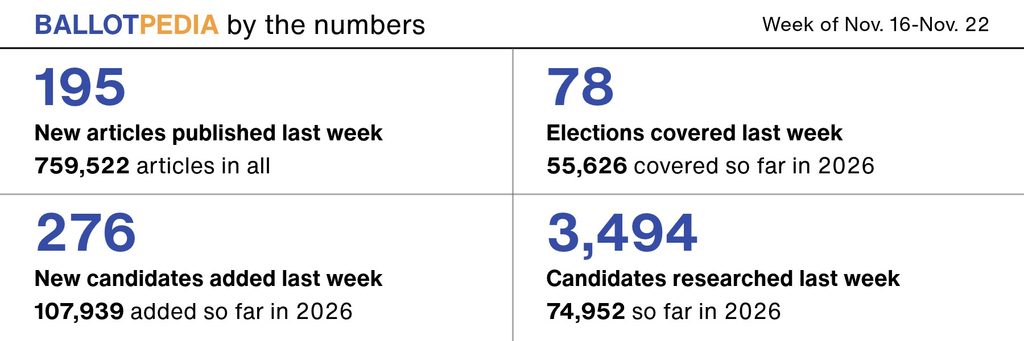
Ballotpedia by the numbers
Fort Smith, Arkansas, will pick its mayor in a Dec. 1 runoff before moving to a mayor-council government
On Dec. 1, voters in Fort Smith, Arkansas, will choose between Christina Catsavis and Daniel Williams in a mayoral runoff. The winner will be the last mayor elected under the city's current form of government before Fort Smith moves to a mayor-council system.
Fort Smith currently uses a council-manager system with a seven-member board of directors that sets policy, approves budgets, and oversees an appointed city administrator who handles daily operations. The mayor leads board meetings and serves as the city's official representative but has no vote on the board. However, the mayor can veto board actions in some cases.
On Nov. 3, voters approved a ballot measure 71% to 29% to shift the city government to a mayor-council system, under which the elected mayor will serve as the city's chief executive and run the city government. Legislative power will shift to an eight-member City Council, with two members from each of Fort Smith's four wards.
The change won't happen right away. Fort Smith will keep its current system during a two-year transition. Elections for the new offices are set for November 2028, and the mayor-council government will take effect Jan. 1, 2029. Typically, the mayor serves four-year terms.
Catsavis and Williams advanced to the runoff from the Nov. 3 general election after none of the seven candidates in the race won a majority. Catsavis and Williams were the top two finishers, receiving 35% and 26% of the vote, respectively. Incumbent Mayor George McGill, who was first elected in 2018, did not run for re-election.
Both Catsavis and Williams completed Ballotpedia's Candidate Connection survey. Below is a selection from their surveys. Click here (Catsavis) and here (Williams) to read their full responses.
Catsavis is a member of the city's Board of Directors and a business owner. In her survey response, Catsavis wrote, "I am passionate about policies that strengthen the foundations of a community: responsible fiscal management, public safety, infrastructure, workforce development, healthcare access, and creating an environment where small businesses and private investment can thrive."
Williams is a business owner and pastor. In his survey response, Williams wrote, "Public policy should answer a basic question: Are we making life better, safer, and more hopeful for the people who live in our community? I am passionate about policies that restore dignity, strengthen families, improve city services, protect neighborhoods, and create opportunity for every resident."
Ballotpedia's Candidate Connection helps voters better understand how their candidates think about the world and how they intend to govern — information they need to feel confident in their choice. Click here to learn more about our survey, and here to learn more about elections in Fort Smith this year.