


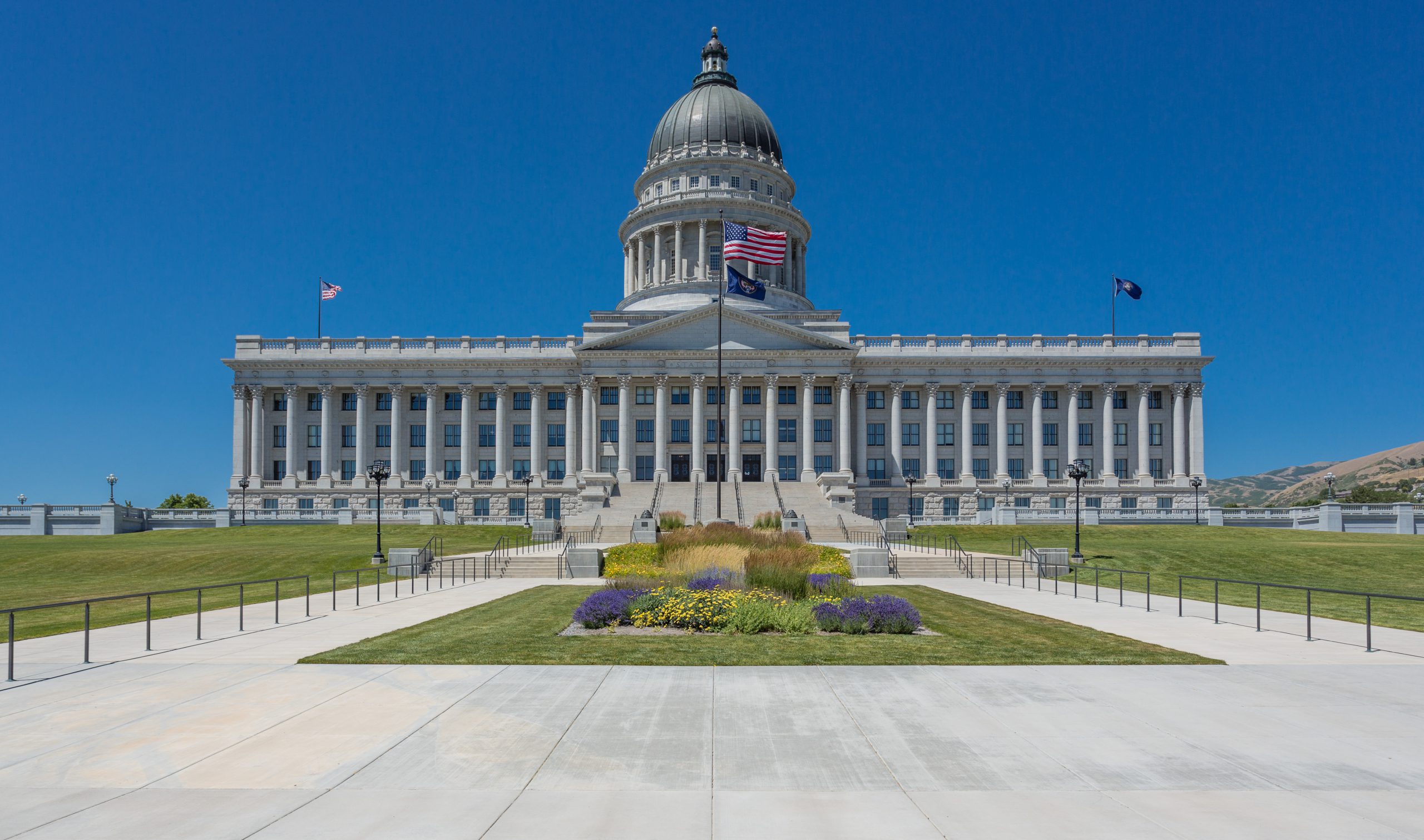
The Utah State Legislature voted to repeal HB 267 during a special legislative session on Dec. 9, 2025. In Utah, a pending veto referendum is automatically invalidated if the state legislature repeals the targeted legislation. As such, the referendum targeting HB 267 will not be on the 2026 Utah ballot.
HB 267 would have prohibited public employers from participating in collective bargaining with a labor organization or union acting as an agent of their public employees. Collective bargaining is the process by which employees, through their unions or other chosen representatives, negotiate with their employer.
In addition, HB 267 would have:
- prohibited employers from granting their employees supplemental paid time off to participate in union activity;
- repealed the Utah Fire Fighters' Negotiation Act;
- made changes to the composition of the Utah State Retirement Board and the Membership Council of the Utah Retirement Systems Administration; and
- barred future public employees from entering the Utah Retirement System, which would have resulted in the discontinuation of the system over time, among other changes.
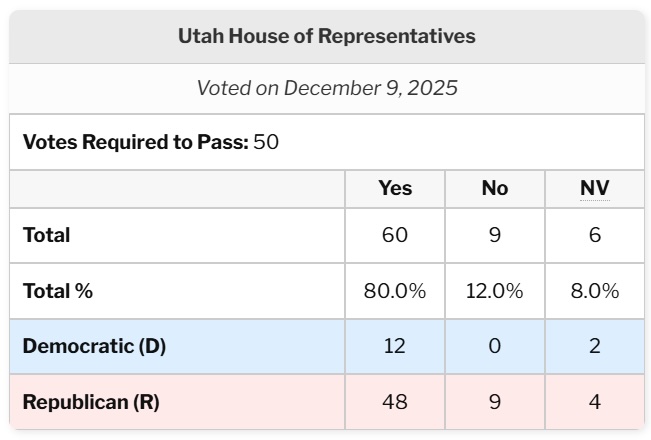
On Dec. 9, 2025, the Utah State Legislature passed House Bill 2001 (HB 2001), which repealed HB 267. The state House passed HB 2001 in a vote of 60-9, with six representatives not voting. Twelve Democrats and 48 Republicans voted yes, and nine Republicans voted no. Two Democrats and four Republicans were absent or otherwise not voting.
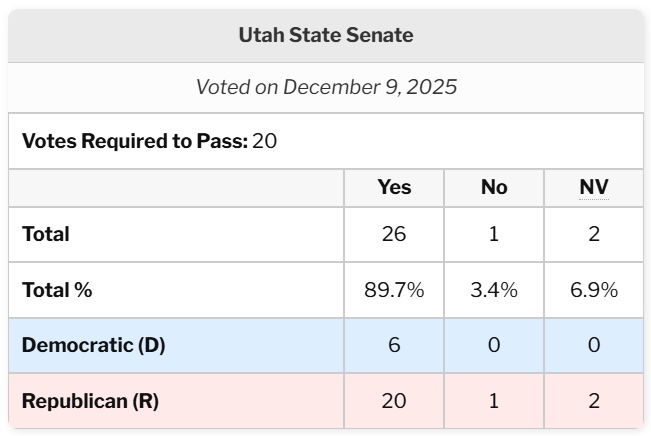
The state Senate passed HB 2001 in a vote of 26-1, with two senators not voting. Six Democrats and 20 Republicans voted yes, and one Republican voted no. Two Republicans were absent or otherwise not voting.
State Rep. Jordan Teuscher (R-44), the original sponsor of HB 267 and 2001, said he believes HB 267 is a good policy, but that the bill, “has been overshadowed by misinformation and unnecessary division.” He said, “This was never the intent behind the bill. As such, HB 2001 repeals HB 267 in its entirety. It allows us to step back, to lower the temperature and to create space for a clearer and more constructive conversation.”
Teuscher also said he plans to work closely with union leaders and public employees to move forward. He said, “My focus is on developing policies that protects public workers, supports taxpayers, and keeps Utah’s public employment practices open, responsible, and grounded in good governance.”
Protect Utah Workers, the campaign sponsoring the veto referendum to repeal the collective bargaining ban, issued a statement on their website concerning the legislature’s repeal of HB 267. It stated, “More than 320,000 people who signed the petition sent a clear message that public workers deserve a voice on the job. The coalition thanks legislative leadership for respecting the will of the people.” It also said the repeal, “preserves the rights of firefighters, police, nurses, public educators, transportation workers, airport staff, and all other critical public workers who improve the lives of Utahns every day.”
Two ballot measures will appear on the 2026 Utah ballot. Both were referred to the ballot by the state legislature. One would require a supermajority of 60% of voters to pass citizen-initiated ballot measures that create new taxes, increase existing tax rates, or adjust a property tax. The other would require that constitutional amendments be published, in a manner provided by the legislature, for 60 days immediately before the next general election. As of 2025, constitutional amendments that will appear on the ballot must be published in a newspaper in each county for two months.
Additionally, three initiatives may be placed on the ballot in 2026. The first would require the Lieutenant Governor to create and maintain a secure website for voters to file and sign initiative and referendum petitions. It would also change the deadlines and requirements for gathering signatures in support of initiatives. Sponsors must submit 140,748 valid signatures by Dec. 25, 2025, to place the initiative on the ballot.
The second proposed initiative would require Utah to use the congressional district method to assign electoral votes to presidential candidates. As of 2025, Maine and Nebraska are the only two states in the country that employ the congressional district system. Sponsors must submit signatures by Jan. 22, 2026, to place the initiative on the ballot.
The third proposed initiative would repeal Proposition 4, which passed in 2018, thereby eliminating the seven-member non-politician redistricting commission known as the Utah Independent Redistricting Commission. Sponsors must submit signatures by Feb. 14, 2026, to place the initiative on the ballot.