
Minnesota eligibility status case
On Jan. 14, a federal judge for the United States District Court for the District of Minnesota granted a preliminary injunction against the United States Department of Agriculture (USDA) in a case regarding funding and eligibility for the Supplemental Nutrition Assistance Program (SNAP) in the state. The injunction blocks the USDA from withholding certain SNAP funding to Minnesota based on the agency's verification request following fraud allegations.
On Dec. 16, the USDA requested that Minnesota conduct in-person verification interviews of 100,000 households' eligibility statuses within 30 days after U.S. Secretary of Agriculture Brooke Rollins said the agency discovered fraud in the state and Minneapolis. On Dec. 23, Minnesota Attorney General Keith Ellison (D) filed a lawsuit against the USDA, alleging the agency was attempting to enforce an impossible demand. Rollins announced on Jan. 9 that USDA was halting current and future SNAP funding to Minnesota until the state proved that fraud had ceased. On Jan. 16, the court found Minnesota's SNAP recertification procedure complied with federal law and granted the preliminary injunction.
To learn more about how the federal government funds SNAP and the types of expenses involved, click here. On Jan. 17, the USDA moved to appeal the injunction. As of Feb. 6, the case remains ongoing.
Multi-state guidance document case
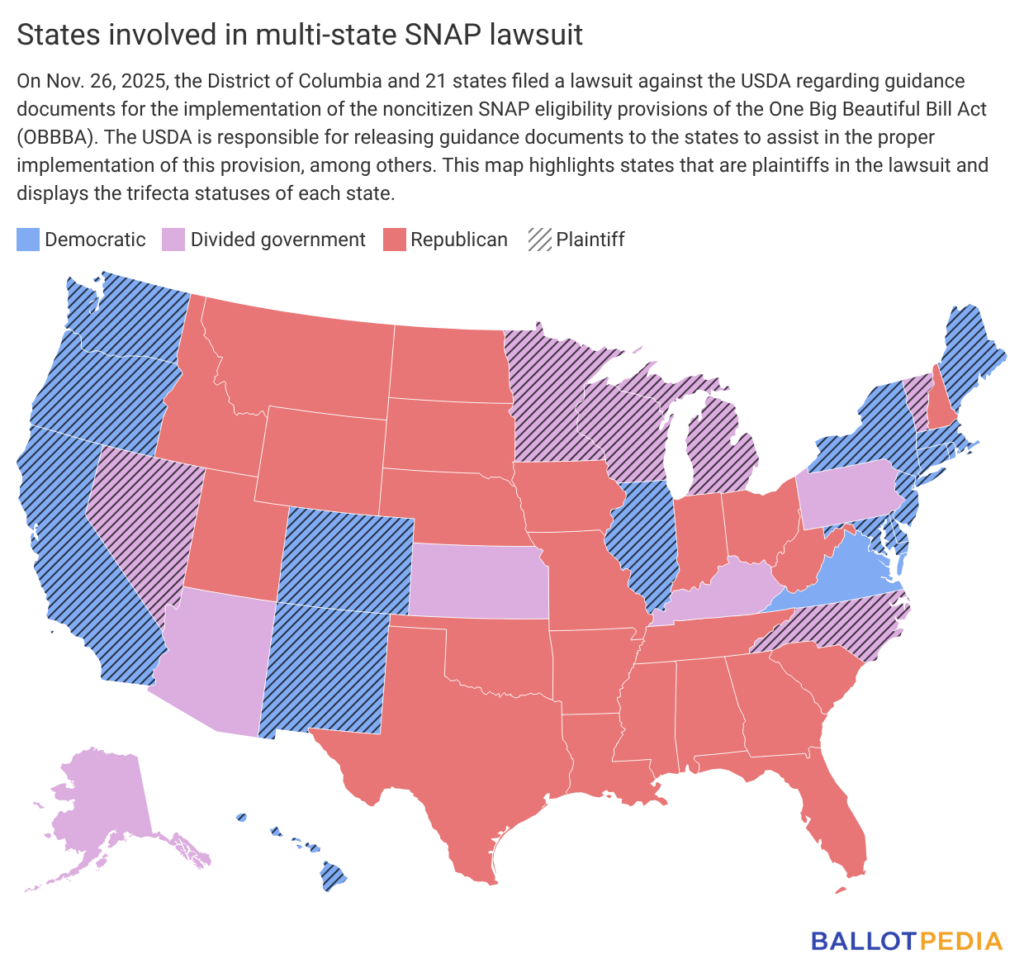
Minnesota has also been involved in additional SNAP-related litigation. On Nov. 26, 2025, the District of Columbia and 21 states, including Minnesota, filed a different lawsuit against the USDA regarding guidance documents for the implementation of the SNAP provisions of the One Big Beautiful Bill Act (OBBBA). Plaintiffs include: New York, Oregon, California, Colorado, Connecticut, Delaware, the District of Columbia, Hawaii, Illinois, Maine, Maryland, Massachusetts, Michigan, Minnesota, Nevada, New Jersey, New Mexico, North Carolina, Rhode Island, Vermont, Washington, and Wisconsin.
The lawsuit focuses on eligibility changes for certain noncitizens included in OBBBA. The USDA is responsible for releasing guidance documents to the states to assist in the proper implementation of this provision, among others.
The plaintiffs claimed that the USDA released guidance that excludes certain noncitizens from SNAP eligibility that the text of the OBBBA does not. The plaintiffs also said the USDA released the guidance one day before the hold harmless period for implementing these provisions ended. After the hold harmless period ended, incorrect applications of the noncitizen eligibility rules counted toward state error rates and could affect how much states must contribute toward SNAP benefits beginning in 2028 under other OBBBA provisions.
On Dec. 9, the USDA released updated guidance regarding the noncitizen eligibility rules and on Dec. 15, a federal judge for the United States District Court for the District of Oregon issued an order temporarily preventing the USDA from imposing penalties on the states for delayed implementation of the noncitizen eligibility provisions and giving the states until April 9 to comply.