



Lawmakers in 25 states are considering new state laws or constitutional amendments so far this year related to foreign funding in elections.
Federal law prohibits federal, state, and local candidates from soliciting, directing, or receiving contributions from individuals who are not citizens or permanent residents of the United States. The law also bans contributions from foreign governments, political parties, corporations, organizations, or groups whose principal place of business is in a foreign country.
Federal courts, however, have established that the federal ban does not apply to issue advocacy, such as lobbying or spending in ballot measure campaigns. The Federal Election Commission has affirmed that foreign individuals, corporations, and governments can contribute to ballot measure campaigns.
Beyond federal law, 37 states have enacted their own bans on foreign contributions in some types of elections:
- Twelve states have state-level prohibitions on foreign contributions to candidates.
- Six states prohibit contributions from foreign individuals and groups to ballot measure campaigns.
- Seventeen states prohibit foreign contributions to both candidate and ballot measure campaigns.
- Two states have prohibitions on foreign groups making independent expenditures.
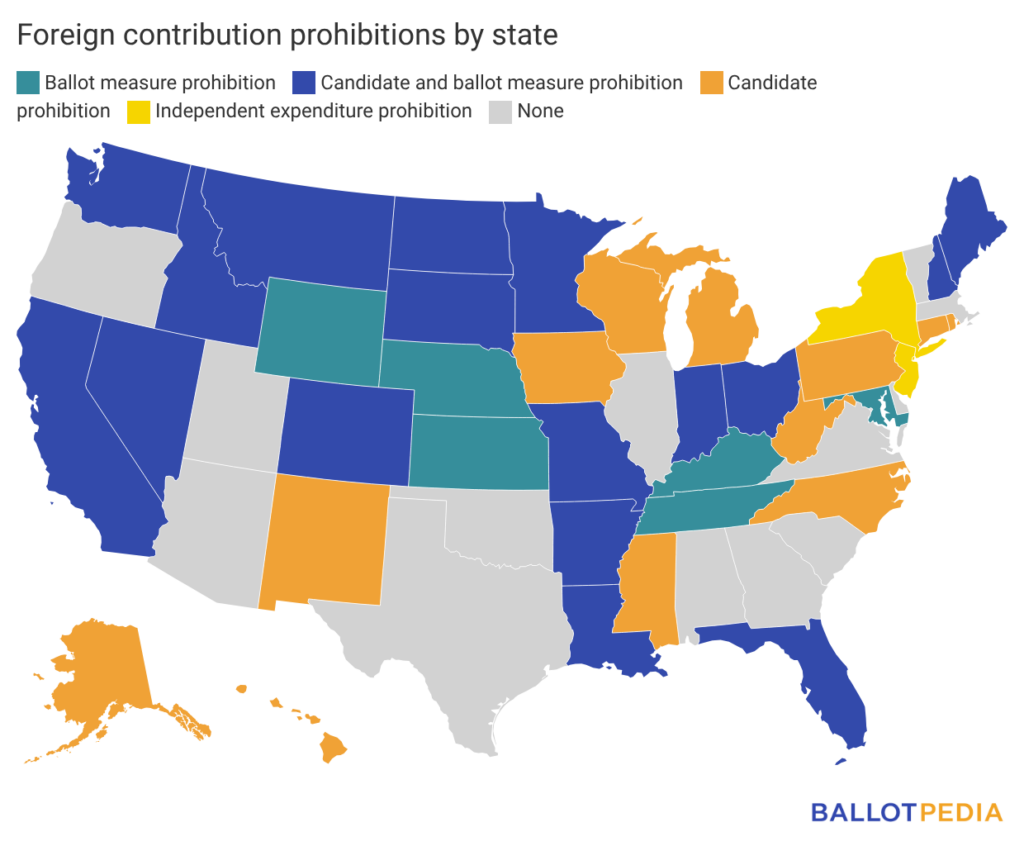
So far this year, legislators in 25 states have introduced or retained from the 2025 session 64 bills that create, modify, or repeal campaign finance regulations related to contributions from foreign individuals or entities.
Twelve of those bills have passed at least one chamber of a state legislature. Lawmakers in Alabama, Michigan, Mississippi, and West Virginia have advanced legislation banning foreign contributions to ballot measure campaigns. In Arizona, Hawaii, New York, and South Dakota, lawmakers have advanced legislation banning at least some foreign entities from giving to both candidates and ballot measure campaigns.
Other states where legislators have introduced foreign funding bans include:
- Florida (ballot measures)
- Georgia (ballot measures and candidates)
- Iowa (ballot measures)
- Massachusetts (ballot measures)
- Nebraska (ballot measures)
- Oklahoma (ballot measures and candidates)
- Tennessee (candidates)
- Wisconsin (ballot measures)
Support for and opposition to bans on foreign contributions in elections does not fall along party lines. Of the 29 states with a ban on foreign contributions to candidates, 14 have Republican trifectas, eight have Democratic trifectas, and seven have divided governments.
Fourteen of the 23 states that ban foreign contributions to ballot measures have Republican trifectas. Five have Democratic trifectas, and four have divided governments.
Speaking in favor of an Alabama bill to ban foreign contributions to ballot measures, state Rep. James Lomax (R) argued, "Elections should be decided by the people who live, work and raise their families in this state—not by foreign entities with ulterior financial or political motives."
New York State Sen. Michael Gianaris (D) and state Rep. Latrice Walker (D) said in an op-ed that they supported a bill banning state and local contributions from certain corporations deemed to be foreign-influenced, saying it would close a loophole created by the 2010 U.S. Supreme Court ruling in Citizens United v. FEC. "The result is a glaring contradiction: foreign investors may not write checks directly to political campaigns, but they can still benefit from corporate political spending carried out on their behalf," the two legislators wrote.
In a 2024 amicus brief, the U.S. Chamber of Commerce argued that a Minnesota law banning foreign donations to candidates was unconstitutional, as it set the "thresholds for identifying supposedly foreign-influenced corporations are set so low that the provision can only be understood as a broad-based attack on corporate political speech rather than a targeted strike on foreign influence."
In a lawsuit challenging Kansas' 2025 ban on foreign contributions to ballot measures, attorneys representing Kansans for Constitutional Freedom argued that the law could implicate donations from U.S. citizens if they had received funding from foreign nationals. "There is no reason why a donor should have to provide detailed and confidential information about its own funding sources,” the lawsuit said. Kansans for Constitutional Freedom describes itself as a "bipartisan coalition of reproductive rights advocates."
In 2025, nine states enacted 12 bills related to foreign funding in elections. In 2024, Ohio enacted a law related to foreign funding in elections.