


Welcome to the Thursday, March 5, 2026, Brew.
By: Lara Bonatesta
Here’s what’s in store for you as you start your day:
- A look at the March 3 primary election results
- Arizona governor vetoes bill requiring the state to lower SNAP payment error rate to 3% by December 2030
- Donald Trump issued eight executive orders in February
A look at the March 3 primary election results
Arkansas, North Carolina, and Texas held statewide elections on Tuesday, and while votes are still being tallied, here’s a look at where things stood as of 4 p.m. EST on March. 4.
Here’s a rundown on races we’re covering:
- Congressional primaries
- Statewide primary results
- State legislative primaries
- Local primaries and other elections
Congressional primaries
Arkansas, North Carolina, and Texas kicked off the 2026 congressional primaries. All three states held elections for one U.S. Senate seat and all of their U.S. House seats.
Texas’ U.S. Senate primaries were two of the night’s biggest elections. On the Republican side, incumbent John Cornyn (R) and Ken Paxton (R) advanced to a runoff on May 26 after neither received a majority of the vote. As of 4 p.m. on March 4, Cornyn had received 41.9% of the vote, and Paxton had received 40.7%. This is the lowest primary vote-share that any incumbent Republican Senator in Texas has ever received.
Meanwhile, James Talarico (D) defeated Jasmine Crockett (D) and one other candidate, clinching the Democratic U.S. Senate nomination. As of 4 p.m., Talarico received 52.4% to Crockett’s 46.2%.
Lots of eyes were also on Texas’ U.S. House primaries as Tuesday’s elections were the first to be held using the new congressional map that the state adopted in 2025. There were 31 contested Democratic House primaries and 28 contested Republican House primaries in Texas. This was the most contested primaries for both parties since 2014.
Here are some noteworthy results from Texas’ U.S. House elections:
- Steve Toth (R) defeated incumbent Dan Crenshaw (R) in Texas’ 2nd Congressional District. As of 4 p.m. EST, Toth received 55.8% to Crenshaw’s 40.7%. Crenshaw is the first incumbent member of Congress to lose a bid for re-election in the 2026 primaries.
- As of 4 p.m. on March 4, 18 House primaries were headed to runoffs on May 26. One race was still uncalled. In Texas’ 2024 U.S. House primaries, eight races went to runoffs.
- One primary, the Democratic primary in Texas’ 18th Congressional District, featured two incumbents: Christian Menefee and Al Green. That primary was among those that went to a runoff. As of 4 p.m., Menefee received 46% of the vote, and Green received 44.2%.
In North Carolina, both Senate primaries were contested. Roy Cooper (D) won the Democratic nomination, and Michael Whatley (R) won the Republican nomination.
North Carolina also redrew its congressional map ahead of the 2026 elections. There were two battleground U.S. House primaries:
- In the Republican primary for the 1st District, Laurie Buckhout (R) defeated four other candidates. Buckhout will face incumbent Donald Davis (D) in the Nov. 3 general election. The state’s new congressional map aims to shift the 1st District toward Republicans.
- The Democratic primary for the 4th District was still uncalled as of 4 p.m. As of that point, incumbent Valerie Foushee had 49.18% of the vote, and Nida Allam (D) had 48.22%. The primary was also a rematch of the 2022 primary between Foushee and Allam.
In total, there were 11 contested Democratic U.S. House primaries and eight contested Republican U.S. House primaries in North Carolina. This was the most contested Democratic primaries since 2014.
Heading into the elections, both of North Carolina’s Senators are Republicans. Four of the states' U.S. House Representatives are Democrats, and 10 are Republicans.
In Arkansas, both Senate primaries were contested. Incumbent Tom Cotton (R) won the Republican nomination, and Hallie Shoffner (D) won the Democratic nomination.
There were two contested Democratic House primaries and one contested Republican House primary.
- In the 2nd District, French Hill won the Republican primary, and Chris Jones won the Democratic primary.
- In the 4th District, James Russell (D) won the Democratic primary and will face incumbent Bruce Westerman (R) in November.
Heading into the 2026 elections, both of Arkansas’ U.S. senators and all four U.S. Representatives are Republicans.
Statewide primaries
In Arkansas, there was at least one contested primary for governor, secretary of state, and Commissioner of State Lands.
- Fred Love won the Democratic gubernatorial primary and will face incumbent Sarah Huckabee Sanders (R) and Colt Shelby (L) in the Nov. 3 general election.
- The Republican primary for Arkansas Secretary of State advanced to a runoff. As of 4 p.m., Bryan Norris received 34.3% of the vote, Kim Hammer received 33.6%, and Cathy Hardin Harrison received 32.1%. The winner of the runoff will face Kelly Grappe (D) in the Nov. 3 general election.
- Cole Jester (R) won the Republican primary for Arkansas’ Land Commissioner. He will face Christopher Olson (L) in the general election. No Democrats ran for the office.
Arkansas also held nonpartisan general elections for two seats on its Supreme Court. In those races, incumbent justices Nicholas Bronni and Cody Hiland were elected to each other's seats. Hiland was uncontested, and Bronni defeated one other candidate. According to a Bolts Magazine analysis, this was the first time two incumbent state supreme court justices have run for each other's seats in at least 25 years. Click here to learn more.
In Texas, there were contested primaries for governor, lieutenant governor, attorney general, and several other state executives.
- Incumbent Gov. Greg Abbott (R) won the Republican gubernatorial primary, and Gina Hinojosa (D) won the Democratic gubernatorial primary.
- Incumbent Lt. Gov. Dan Patrick (R) won the Republican primary for his current office. As of 4 p.m., the Democratic primary was still uncalled. At that point, Vikki Goodwin had received 48% of the vote, Marcos Velez had received 31.5%, and Courtney Head had received 20.5%.
- Both primaries for Texas Attorney General advanced to runoffs. Mayes Middleton (R) and Chip Roy (R) advanced on the Republican side. As of 4 p.m., the Democratic primary was still uncalled. At that point, Nathan Johnson (D) had received 48.1% of the vote, Joe Jaworski had received 26.4%, and Tony Box had received 25.5%.
- Incumbent James Wright (R) and Bo French (R) advanced to a runoff after no candidate received a majority in the Republican primary for Texas Railroad Commissioner. As of 4 p.m., Wright received 32.1% and French received 31.8%.
State legislative primaries
Arkansas had 28 contested state legislative primaries this year, up from 24 in 2024.
One incumbent was defeated in Arkansas’ state legislative primaries. Jeremy Wooldridge (R) defeated incumbent Blake Johnson in Arkansas Senate District 21.
There were also two special state legislative general elections in Arkansas on March 3.
- In the special general election for Arkansas House of Representatives District 70, Alex Holladay (D) defeated Bryan Renshaw (R). The seat has been vacant since Sept. 30, when Carlton Wing (R) resigned to take a position as CEO of Arkansas PBS. This is the first seat to change party hands in a special state legislative election this year. Eight seats changed party control in special elections in 2025, all from Republican to Democrat.
- In the special general election for Arkansas State Senate District 26, Brad Simon (R) defeated Adam Watson (I). The seat became vacant on Sept. 2, after the death of Gary Stubblefield (R).
North Carolina had 60 contested state legislative primaries, up from 43 in 2024. There were 21 contested Democratic primaries and 39 contested Republican primaries.
As of 4 p.m. on March 4, eight incumbent North Carolina state legislators lost in the primaries. This ties with 2018 as the most incumbents defeated in the primaries in a single year since 2010. Three Democrats and four Republicans were defeated in the House. One Republican was seated in the Senate.
- Kevin Crutchfield (R) defeated incumbent Chris Measmer (R) in Senate District 34
- Patricia Smith (D) defeated incumbent Shelly Willingham (D) in House District 23
- Seth Woodall (R) defeated incumbent A. Reece Pyrtle, Jr. (R) in House of Representatives District 65
- Darren Armstrong (R) defeated incumbent Keith Kidwell (R) in House of Representatives District 79
- Veleria Levy (D) defeated incumbent Nasif Majeed (D) in House of Representatives District 99.
- Rodney Sadler (D) defeated incumbent Carla Cunningham (D) in House of Representatives District 106
- Caroline Eason (R) defeated incumbent Kelly Hastings (R) in House of Representatives District 110
- Jimmy Rogers (R) defeated incumbent Mark Pless (R) in House of Representatives District 118
According to WUNC, the three Democrats who were defeated in the House had all voted with Republicans to override some of Gov. Josh Stein’s (D) vetoes.
As of 4 p.m., one state legislative election featuring an incumbent remained uncalled in North Carolina. In North Carolina Senate District 26, Sam Page (R) leads incumbent and current President pro tem Phil Berger (R) by two votes. Media outlets have reported that a recount is likely.
Texas had 103 contested state legislative primaries this year, up from 93 in 2024. There were 46 contested Democratic primaries and 57 contested Republican primaries.
As of 4 p.m. on March 4, one state legislator in Texas was defeated in the primaries. In the Republican primary for Texas House of Representatives District 3, Kristen Plaisance (R) defeated incumbent Cecil Bell Jr.
As of 4 p.m. on March 4, six state legislative elections featuring incumbents remained uncalled in Texas.
A total of 10 incumbents were defeated across all three states that held state legislative primaries on Tuesday. An average of roughly 16 incumbents were defeated in even years since 2010. As of 4 p.m., there were a total of seven incumbents in uncalled races. Click here to learn more about incumbents defeated in state legislative elections this year.
Local primaries and other elections
Arkansas, North Carolina, and Texas are among the 31 states in which Ballotpedia is expanding our coverage to include all local elections. Click here to learn more about that coverage.
Kansas, Massachusetts, Vermont, and Virginia also held elections on March 3. To see the full list of elections Ballotpedia covered, click here.
The next statewide primary elections will be on March 10 in Mississippi. Click here for a list of 2026 election dates.
Arizona governor vetoes bill requiring the state to lower SNAP payment error rate to 3% by December 2030
On Feb. 20, Gov. Katie Hobbs (D) vetoed Arizona House Bill 2206 (HB 2206). This was the first bill to pass a legislature in 2026 that Ballotpedia tracked that codifies changes to a state's Supplemental Nutrition Assistance Program (SNAP) in response to the One Big Beautiful Bill Act (OBBBA). HB 2206 would have required the Arizona Department of Economic Security, which administers the state’s SNAP program, to lower the state's SNAP payment error rate to 3% or less by Dec. 30, 2030.
The 2025 OBBBA established a performance-based state cost-share formula for SNAP benefits, which is tied to payment error rates and begins in FY2028.
Arizona is one of 11 states with a divided government. Republicans control both chambers of the Legislature, and Hobbs is a Democrat.
A payment error occurs when SNAP benefits are issued incorrectly, either to an ineligible household, in the wrong amount, or based on misapplied eligibility rules. Common reasons for payment errors include when individuals incorrectly report their income, their household size, or their allowable expenses.
Error rates are determined through federally required quality control reviews on sampled cases. States submit their error rates to the U.S. Department of Agriculture (USDA), which verifies the data and works with states to locate the source of errors or implement corrective action plans.
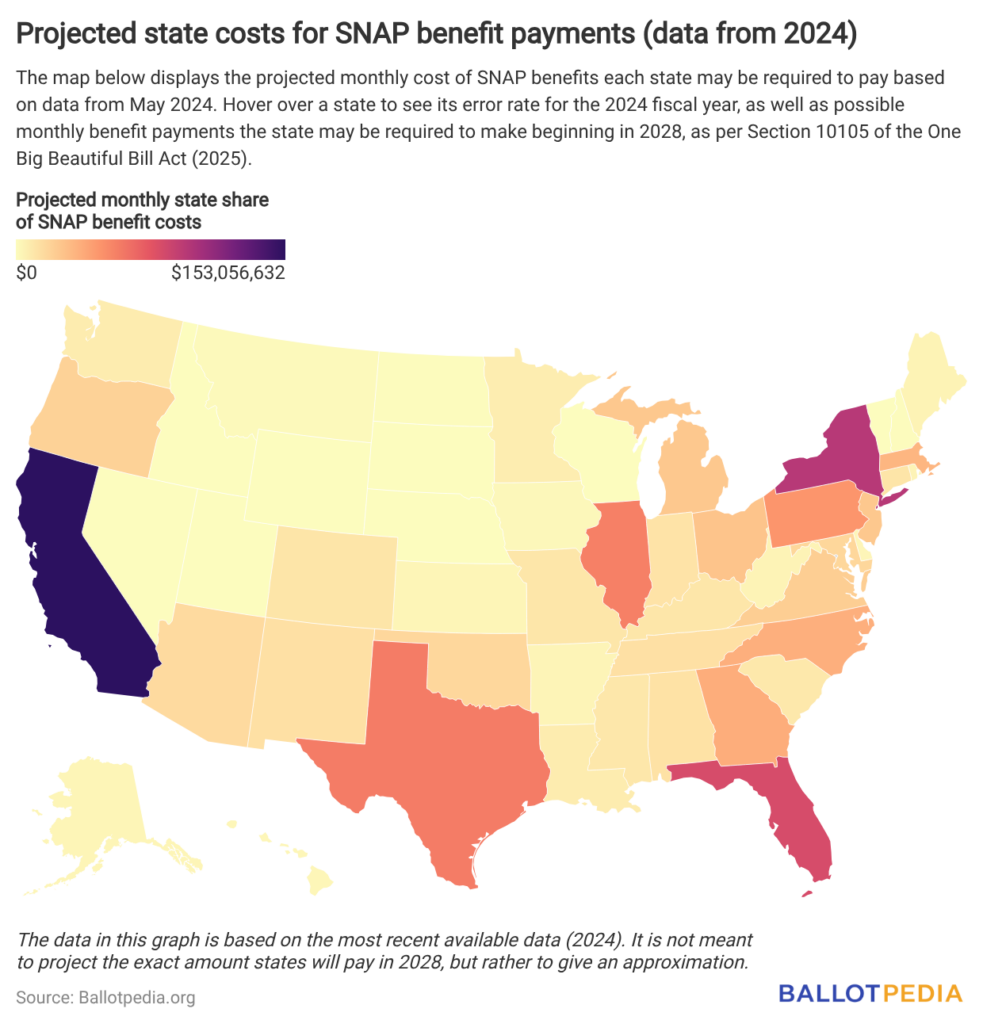
Section 10105 of the OBBBA established a performance-based cost-share system that ties state financial responsibility to payment error rates. Historically, the federal government has paid for the full cost of SNAP benefits and has split administrative costs with the states. Beginning in FY2028, states will be required to pay a share of SNAP benefit costs if their error rate exceeds 6%. States with error rates from 6% to 8% will pay 5% of benefits. States with 8% to 10% will pay 10% of benefits. States with error rates of more than 10% will pay 15% of the cost of benefits. For states with error rates of less than 6%, the federal government will continue to pay all of SNAP benefit costs.
Arizona's payment error rate for FY2024 (most recent data) was 8.84%. If the state's error rate stayed the same until FY2028, the state would be required to pay 10% of the cost of SNAP benefits. Based on the cost of Arizona's SNAP benefits in May 2024 (most recent data), paying 10% of benefits could cost the state about $16 million per month. Among other changes, HB 2206 would have required the state’s Department of Economic Security to directly pay half of any federal costs imposed as a result of the program’s payment error rate.
Bill sponsor Rep. Nick Kupper (R) said that reducing the error rate to 3% instead of 6%, the threshold below which states will not pay any benefit cost under the cost-share program, would save taxpayers $80 million. He said, “There are dozens of states that have been below 3% over the past two decades. So, this is not impossible. This is something very doable. And I put teeth in the bill, because people don’t really tend to get off their butts unless there’s something kicking them in it.”
In her veto statement, Hobbs said, "With H.R. 1 [the OBBBA] now on the books, and with significant penalties to come if operational changes are not made this year, the Arizona Department of Economic Security (DES) has already taken decisive action to improve the accuracy of SNAP benefit determinations. These include: enhancing eligibility verifications, increasing staffing and training focused on accuracy, and investing in technology solutions. This legislation would duplicate these efforts and disrupt the operations of an already overburdened agency. H.R. 1 is also full of unfunded mandates, directly contributing to significant staffing shortages at DES, resulting in delayed case decisions and frustrated callers. … The legislation you sent me contains yet more unfunded mandates and not a dollar to help our state agencies implement these changes now, or to modernize our systems for the future."
To read more about SNAP error rates, the cost-share system, and the implementation of other SNAP-related changes made by the One Big Beautiful Bill Act, click here.
Donald Trump issued eight executive orders in February
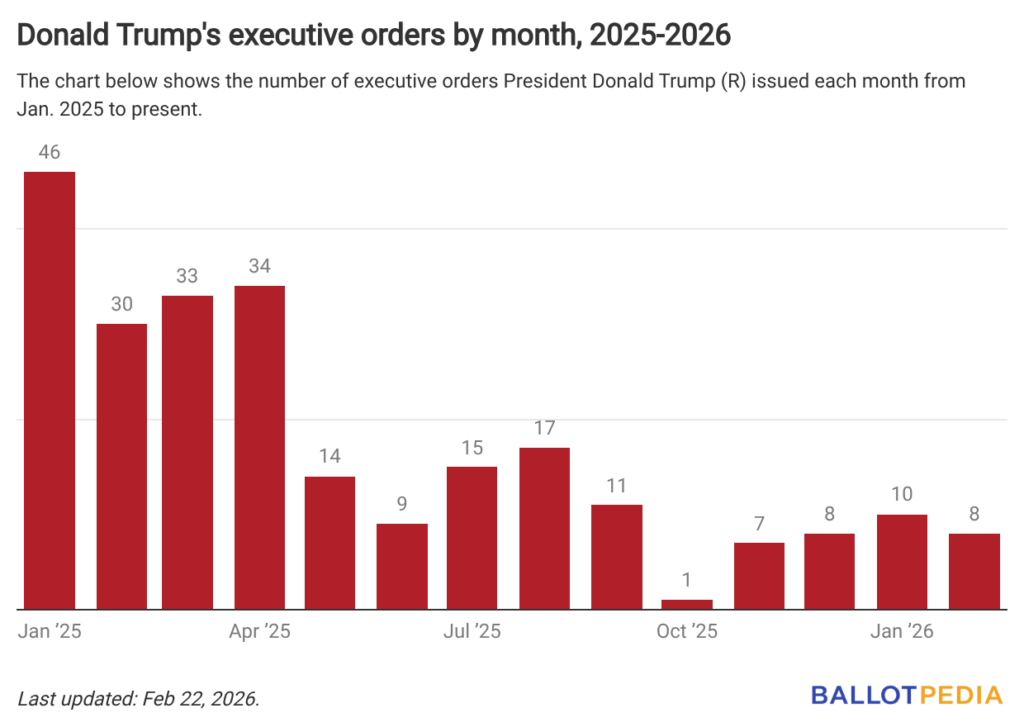
President Donald Trump (R) issued eight executive orders in February, bringing his total to 243 in his second term. This was tied for the third-lowest monthly total of his second term thus far.
Trump issued orders on tariffs, energy, and defense. Click here to read more about each order.
Trump issued the most executive orders of his second term in January 2025, when he issued 46. He issued the fewest executive orders in October 2025, issuing only one. In January 2026, Trump issued 10 executive orders.
Among all U.S. presidents, Trump has issued the 10th-most executive orders with 463 across his two terms in office. Franklin D. Roosevelt (D) issued the most of all U.S. presidents with a total of 3,721 executive orders during his time in office. William Henry Harrison (Whig), who died after serving only 32 days as president, issued no executive orders. Three presidents issued only one executive order each: James Madison (Democratic-Republican), James Monroe (Democratic-Republican), and John Adams (Federalist). Click here to learn more about Trump’s executive orders.