


Welcome to the Thursday, March 12, Brew.
By: Briana Ryan
Here’s what’s in store for you as you start your day:
- Rep. Kevin Kiley becomes the 10th member of the U.S. Congress to change party affiliation since 2000
- Colorado voters to decide on a ballot initiative requiring life in prison for human trafficking of children
- A state legislative special election resulted in a partisan change for the second time this year
Rep. Kevin Kiley becomes the 10th member of the U.S. Congress to change party affiliation since 2000
On March 9, Rep. Kevin Kiley, who represents California's 3rd Congressional District, announced that he was immediately changing his party affiliation from Republican to independent. His decision means Republicans now have a 217-214 majority in the U.S. House of Representatives, with three vacancies. Kiley is the sole independent in the chamber.
Although Kiley has changed his party affiliation to independent, he said he will caucus with Republicans until Jan. 3, 2027 — the end of the 119th Congress. On who he will caucus with if he wins re-election, Kiley said he will "do whatever is serves my constituents and so you know that's a decision that I'll make at the time."
Kiley's announcement came after he filed for re-election on March 6 with no party affiliation. Voters elected Kiley to represent California's 3rd Congressional District in 2022 and re-elected him in 2024.
However, Kiley said he will run in California's 6th Congressional District in 2026 as an independent due to mid-decade redistricting: "I reached a decision that, since gerrymandering seeks to elevate partisanship above everything else in our politics and governance, seeks to make it the sum and substance of our politics, then the best way to counter gerrymandering and its insidious impacts on democracy is simply to take partisanship out of the equation."
According to CalMatters' Maya C. Miller, California's new map "dramatically reshaped [Kiley's] current district into a solid pickup for Democrats."
Kiley is not the first member of the U.S. Congress to change party affiliation during a term.
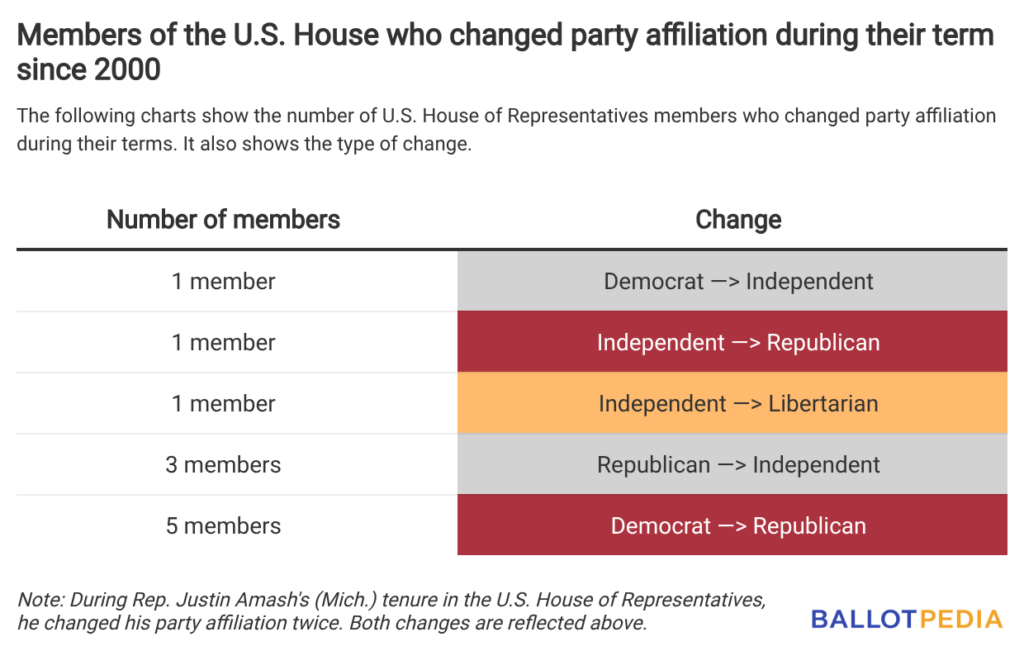
Since 2000, nine other members have changed party affiliation while serving in the U.S. House. The last to do so was former Rep. Justin Amash (Mich.), who on April 29, 2020, changed his party affiliation from independent to Libertarian. Amash previously changed his party affiliation from Republican to independent on July 4, 2019.
During this time, six Democrats, three Republicans, and two independents departed their respective parties. These departures resulted in six members becoming Republicans, one becoming a Libertarian, and four becoming independents. These figures account for Amash changing his party affiliation twice during his tenure.
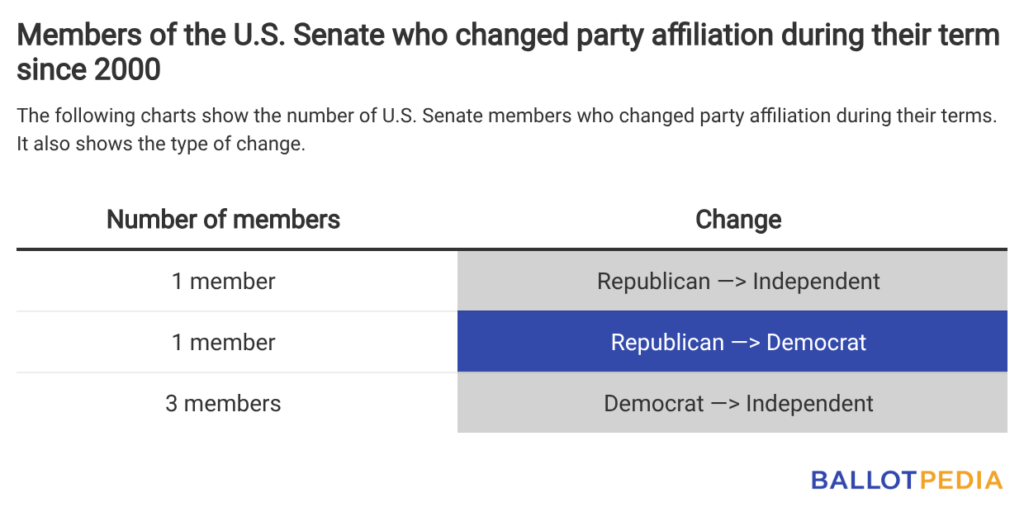
In the U.S. Senate, five members have changed their party affiliations since 2000. The last to do so was former Sen. Joe Manchin (W.Va.), who on May 31, 2024, changed his party affiliation from Democrat to independent.
During this time, three Democrats and two Republicans departed their respective parties. These departures resulted in four members becoming independents and one becoming a Democrat.
Kiley's decision also makes him the fifth member of the U.S. House to serve as an independent since 2000. The last independent member was former Rep. Paul Mitchell (Mich.), who changed his party affiliation from Republican to independent on Dec. 14, 2020, and served as an independent until he left office on Jan. 3, 2021.
In the U.S. Senate, seven members have served as independents since 2000. Currently, two members of the chamber, Sens. Bernie Sanders (Vt.) and Angus King (Maine), are independents. Both currently caucus with the Democrats.
Click here to view a list of all current independent and minor party federal and state officeholders.
Colorado voters to decide on a ballot initiative requiring life in prison for human trafficking of children
On Nov. 3, Colorado voters will decide on a ballot measure — Initiative 108 — that would establish new sentencing requirements for individuals convicted of trafficking a child.
Initiative 108 would require life in prison, without the possibility of parole or release, for individuals convicted of trafficking a child for sexual servitude. It would also change the offense from a class 2 felony to a class 1 felony. Currently, the sentence for a class 2 felony in Colorado is eight to 24 years in prison, and a class 1 felony is punishable by life imprisonment.
Currently, the crime of human trafficking of a minor for sexual servitude is defined as:
- Selling or otherwise knowingly facilitating the commercial sexual activity involving a person under 18
- Knowingly advertising, offering, or selling travel services that facilitate commercial sexual activity involving a person under the age of 18
Initiative 108 would add a third element to this definition: knowingly exchanging anything of monetary value to buy or sell sexual activity with a person under the age of 18.
The initiative's sponsor, Protect Kids Colorado, submitted signatures to the Colorado Secretary of State for verification on Feb. 17. The initiative was certified for the ballot on March 5. The organization says its mission is "[protecting] kids from becoming victims of a dangerous and false ideology."
Protect Kids Colorado also submitted signatures for Initiatives 109 and 110.
Initiative 109 would require school- and association-sponsored athletic teams to be classified in one of three categories based on biological sex: (1) males/men/boys, (2) females/women/girls, or (3) coeducational or mixed. Teams designated for females, women, or girls would not be open to male students or participants. Teams designated for males, men, or boys would not be open to female students or participants unless no corresponding female team is offered for that sport. The initiative would define females as "person[s] whose biological reproductive system is organized around the production of ova," and males as "person[s] whose biological reproductive system is organized around the production of sperm."
Initiative 110 would prohibit healthcare professionals from performing surgeries on minors "for the purpose of altering biological sex characteristics." It would also prohibit state and federal funds, Medicaid reimbursements, or insurance coverage from being used to pay for such surgeries. The phrase altering biological sex characteristics would be defined as "treatment in response to a minor's perception of sex or gender" and would exclude treatment for medically verifiable disorders of sex development or acquired physical or chemical abnormalities and male circumcision.
Protect Kids Colorado submitted signatures for both initiatives on Feb. 20. The review deadline for the Colorado Secretary of State to determine the validity of the signatures is March 20.
Click here to read more about Initiative 108, and here for more information about the other measures on the ballot in Colorado this year.
A state legislative special election resulted in a partisan change for the second time this year
March 10 was election night in Mississippi and parts of Georgia and New Hampshire. While votes are still being tallied, here's a look at where things stood as of 3:30 p.m. EST on March 11.
One of the night's four state legislative special elections resulted in a partisan change
Of the four state legislative special elections, the race in New Hampshire House Carroll District 7 resulted in a partisan change. In the election, Bobbi Boudman (D) defeated Dale Fincher (R) 51.8% to 47.9%. This district is the second state legislative special election this year to result in a partisan change. The first was Arkansas House District 70, which changed from Republican to Democratic control.
Let's check out the other three state legislative special elections, which are all going to runoffs on April 7:
- In Georgia Senate District 53, Lanny Thomas (R) and Jack Zibluk (D) advanced to a runoff. Thomas received 39% of the vote, and Zibluk received 27% respectively in a field of four candidates.
- In Georgia House District 94, Venola Mason (D) and Kelly Kautz (D) advanced to a runoff. Mason received 44% of the vote, and Kautz received 23% respectively in a field of four candidates.
- The special election in Georgia House District 130 is expected to go to a runoff. The two leading candidates in a field of six are Sheila Clark Nelson (D) with 33% of the vote, and Thomas McAdams (R) with 20%.
One of our two battleground elections advances to a runoff, while an incumbent wins the other
We followed two elections as battlegrounds — the all-party special election for Georgia's 14th Congressional District and the Democratic primary for Mississippi's 2nd Congressional District.
In Georgia, 17 candidates ran to succeed former Rep. Marjorie Taylor Greene (R). This special general election was one of seven held so far in the 119th Congress. Politico's Alec Hernandez wrote that "The election was widely expected to head into a runoff given the high volume of interest in the seat." Shawn Harris (D) and Clayton Fuller (R) advanced to an April 7 runoff with 37.3% and 34.9% of the vote, respectively. Comparing the three Democratic candidates' combined votes to the 12 Republican candidates' combined votes, The Downballot's David Nir wrote that "Republicans combined for just 60% of the vote versus 40% for Democrats, a considerable dropoff from [President Donald] Trump's 68-31 margin in" the district in the 2024 presidential election.
In Mississippi, incumbent Rep. Bennie Thompson (D-Miss.) defeated two other candidates with 86% of the vote. The Hill's Sarah Fortinsky wrote that "Thompson faced a generational challenge in the primary, with [challenger Evan] Turnage joining a wave of Democrats seeking to oust older members of Congress." The Republican primary between Ron Eller (R) and Kevin Wilson (R) has not been called. The latest results show Eller with 51% of the vote, and Wilson with 49%.
All members of Mississippi's congressional delegation advance to the general election
Mississippi voters decided primaries for one of the state's two U.S. Senate seats and all four U.S. House districts.
Starting with the U.S. Senate, incumbent Sen. Cindy Hyde-Smith (R-Miss.) defeated Sarah Adlakha (R) 80.8% to 19.2% in the Republican primary. Scott Colom (D) defeated two other candidates with 73% of the vote in the Democratic primary. NBC News' Bridget Bowman wrote that the general election "won't be the first time Hyde-Smith and Colom have clashed: the GOP senator blocked Colom's nomination for a federal judgeship during the Biden administration."
Since we already covered the 2nd Congressional District above, let's look at the other three:
- 1st Congressional District: Incumbent Rep. Trent Kelly (R-Miss.) ran unopposed in the Republican primary. Cliff Johnson (D) defeated Kelvin Buck (D) 64% to 36% in the Democratic primary.
- 3rd Congressional District: Incumbent Rep. Michael Guest (R-Miss.) and Michael Chiaradio (D) ran unopposed in their respective primaries.
- 4th Congressional District: Incumbent Rep. Mike Ezell (R-Miss.) defeated Sawyer Walters (R) 84% to 16% in the Republican primary. Jeffrey Hulum III defeated two other candidates with 58% of the vote in the Democratic primary.
Click here to view the March 10 election results.