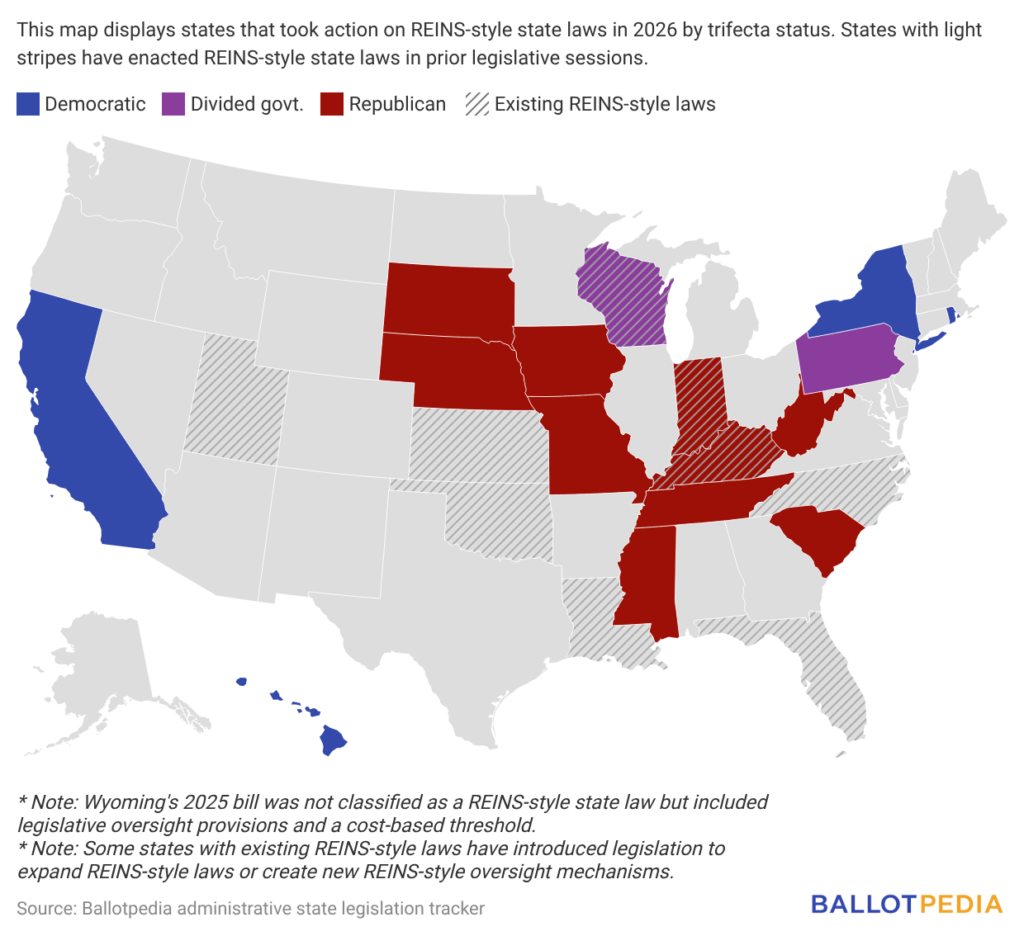
On March 12, South Dakota Governor Larry Rhoden (R) signed Senate Bill 133 into law. SB 133 is a REINS-style law, requiring legislative committee review and potential legislative approval for new executive agency rules expected to cost $3 million or more over a two-year period. South Dakota is the 10th state to enact a law that Ballotpedia classifies as REINS-style, and the first state to enact this type of law in 2026.
SB 133 requires that executive agencies submit prospective “major rules” — defined by the law as rules expected to cost local governments and “businesses, individuals, other nongovernmental entities” $3 million or more over a two-year period — to the legislature’s Interim Rules Review Committee (IRRC) for review. The IRRC may do one of three things after reviewing the prospective rule: 1) recommend changes to the rule that bring its cost below the “major rule” threshold, 2) find that existing statutory authority allows the rule to be promulgated, or 3) recommend a full vote of the legislature to enact or disapprove of the rule. The bill also limits judicial deference practices in cases involving prospective rules, requiring that courts adopt a de novo review standard (using their own interpretations rather than those of an agency) in cases when the “major rule” status of a prospective rule is in question.
SB 133 was introduced in the South Dakota Senate on January 26, and passed with amendments on February 24 by a vote of 33-0. The bill was passed by the South Dakota House of Representatives on March 3 by a vote of 66-1, with Rep. Mike Stevens (R) voting against the bill. South Dakota is a Republican trifecta state.
What is a REINS law?
The REINS Act is a proposed federal-level bill which would require Congressional approval of proposed executive agency rules that exceed an expected cost threshold of $100 million or more a year. While REINS has not been passed at the federal level, 10 states (including South Dakota) have enacted laws which Ballotpedia identifies as REINS-like.
Ballotpedia identifies a state bill as REINS-like if it identifies a cost threshold beyond which a bill is subject to legislative review (in the case of South Dakota’s SB 133, the “major rule” threshold of $3 million over two years), and if the bill requires legislative approval before the rule can go into effect. Ballotpedia does not identify other state laws which entail legislative involvement in agency rulemaking as REINS-like if they do not meet these two criteria. For example, West Virginia and Idaho laws which require legislative approval for all new agency rules are not considered REINS-like because they do not have a cost threshold.
What states have REINS laws?
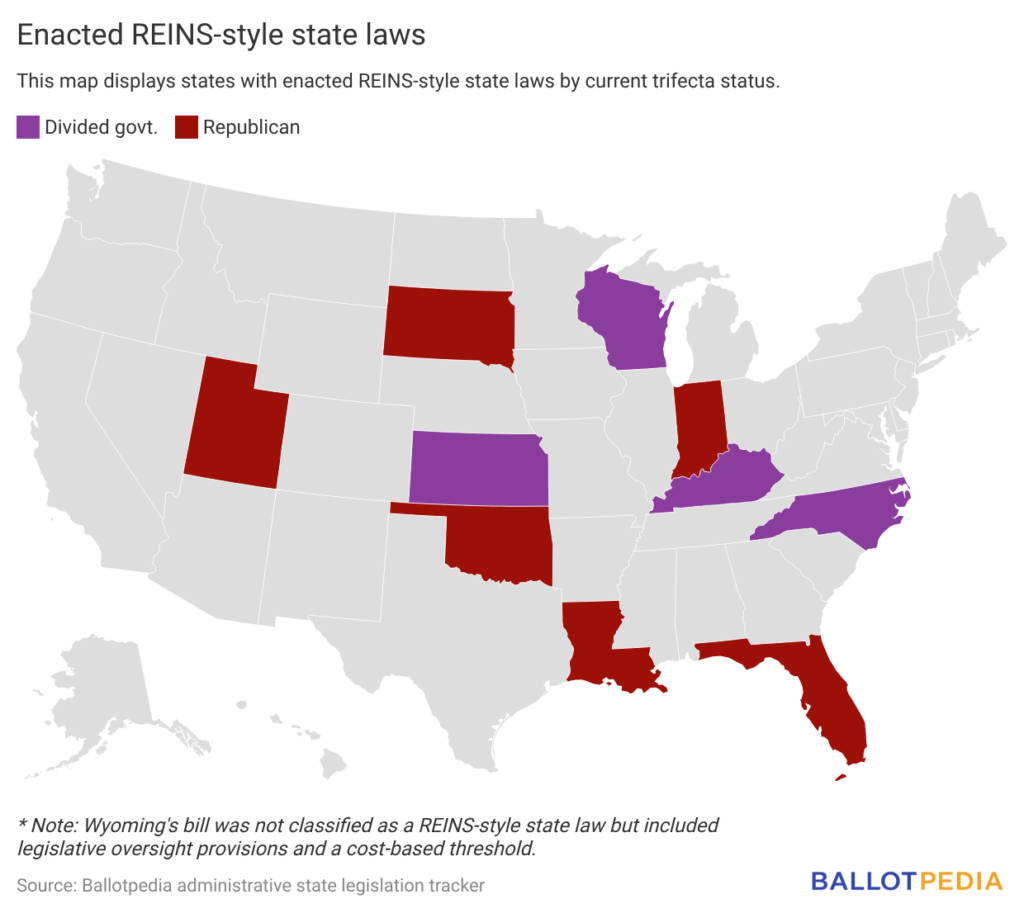
A total of 10 states — Florida, Wisconsin, Indiana, Kansas, Kentucky, Louisiana, Oklahoma, Utah, North Carolina, and South Dakota — have enacted REINS-like laws since 2010.
Half of these laws were passed in 2025, more than in every previous year put together. South Dakota is the first state to enact a REINS-like law in 2026. Indiana also enacted SB 4 in 2026, a law which amended its existing REINS law by reducing the cost threshold for legislative review of a rule from $1 million or more over a two-year period to $500,000 or more over a two-year period.
A total of 15 states (including South Dakota and Indiana) are considering or have considered a REINS-like bill in the 2026 legislative session. Besides South Dakota’s SB 133 and Indiana’s SB 4, two bills — in Missouri and South Carolina — have passed one chamber as of March 13.