


Welcome to the Monday, March 30, Brew.
By: Briana Ryan
Here’s what’s in store for you as you start your day:
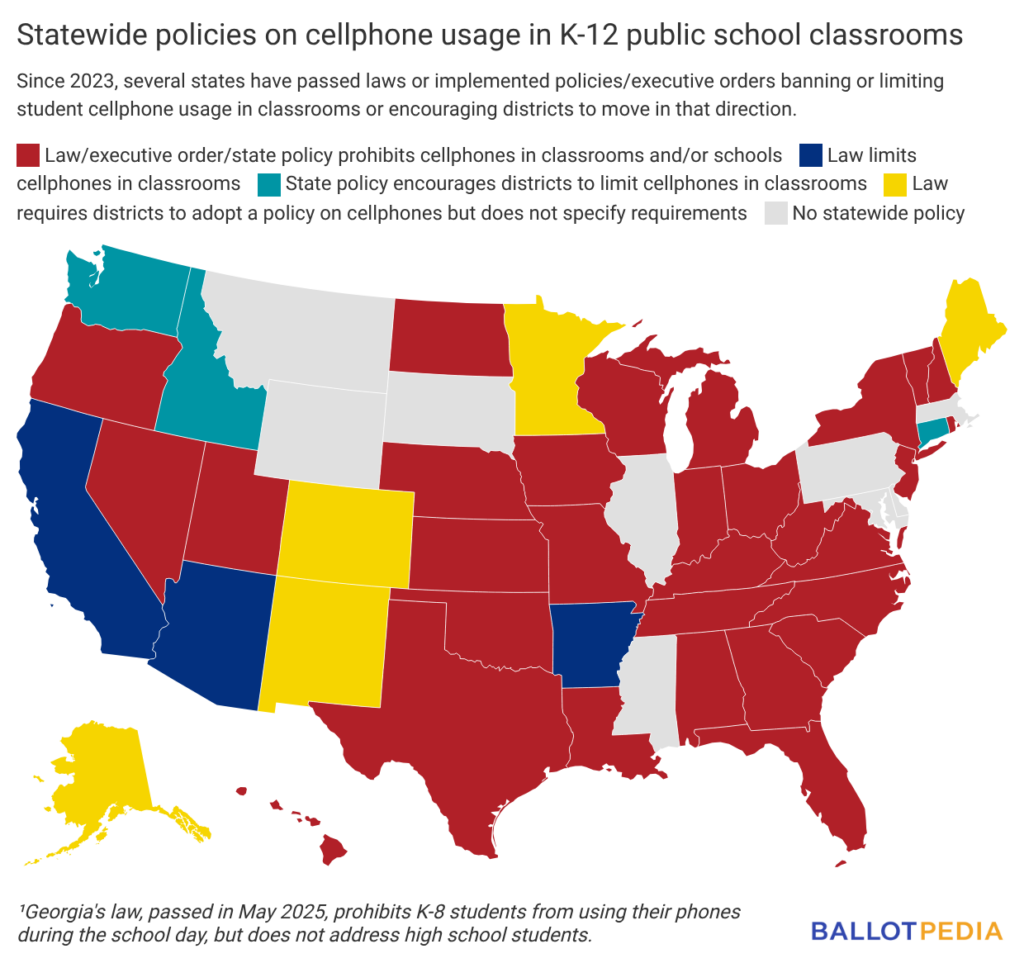
- Kansas becomes the 33rd state to enact a K-12 cellphone ban
- Where Wisconsin’s Supreme Court candidates stand on data centers, immigration, and Act 10
- A comprehensive look at 168 years of ballot measures in Minnesota
Kansas becomes the 33rd state to enact a K-12 cellphone ban
On March 20, Kansas Gov. Laura Kelly (D) signed a bill enacting a statewide ban on cellphones in K-12 schools.
The ban applies to all public and nonpublic accredited schools and prohibits the use of cellphones during the school day, commonly referred to as a bell-to-bell ban. School boards and governing authorities of accredited nonpublic schools must submit a certification to the Kansas Board of Education by Sept. 1 that they have adopted cellphone policies in accordance with the bill. In 2024, the Kansas Board of Education adopted a policy encouraging, but not requiring, school districts to adopt policies regulating cellphone use in the classroom.
Kansas is the 33rd state to enact a K-12 cellphone ban and the fifth to do so in 2026. On March 5, Indiana Gov. Mike Braun (R) signed SB 78, expanding the existing cellphone limit to a bell-to-bell cellphone ban. On Feb. 12, the Hawaii Board of Education adopted a statewide policy barring public school students in most grades from using their phones during the school day beginning in the 2026-27 school year. On Feb. 10, Michigan Gov. Gretchen Whitmer (D) signed a bill prohibiting public school students from using their cellphones in class beginning in the 2026-27 school year. New Jersey was the first state to enact a ban in 2026, when then-Gov. Phil Murphy (D) signed S3695 on Jan. 8.
Florida became the first state to pass a law regulating cellphones in schools when Gov. Ron DeSantis (R) signed HB 379 in 2023.
In total, 41 states have passed laws addressing cellphones in school. These bills generally require school boards to adopt cellphone policies that align with the legislation. In eight of those states, however, laws either encourage districts to limit student cellphone use or require them to adopt policies on technology in the classroom without specifying what form those policies should take.
The 33 states that limit student cellphone use either bar students from using their cellphones in class or during the entire school day. Like Kansas, most states give school boards leeway on how to enforce the bans or limits, though the Kansas bill specifies that phones must be stored away from a student's person.
Of these states with statewide cellphone policies, 18 had a Republican trifecta when the laws went into effect, while six had a Democratic trifecta. The remaining nine states had divided governments.
Other states' action on cellphone bans
The following states have taken recent action on bills to regulate cellphone use in schools:
- Illinois: On March 25, the Illinois House of Representatives' Education Policy Committee unanimously recommended the passage of SB2427. Illinois has a Democratic trifecta.
- Maryland: On March 23, the Maryland House of Delegates passed HB 0525 135-1. The Maryland Senate passed its companion bill, SB 0928, on March 20, 40-0. The bills advanced to the opposite chambers for consideration. Maryland has a Democratic trifecta.
- Georgia: On March 23, the Georgia General Assembly passed HB 1009 to regulate cellphone use in high schools. Georgia passed a law in 2025 limiting cellphone use in elementary and middle schools. Georgia has a Republican trifecta.
- South Dakota: On March 5, the South Dakota House of Representatives voted 28-39 against SB 198, after the South Dakota Senate voted 19-15 to pass it on Feb. 17. South Dakota has a Republican trifecta.
- New Mexico: SB 23 did not reach the floor of the New Mexico House of Representatives before the legislative session ended on Feb. 19. The New Mexico Senate passed it 32-6 on Feb. 15. New Mexico has a Democratic trifecta.
- Pennsylvania: On Feb. 3, the Pennsylvania Senate passed SB 1014 46-1. It advanced to the Pennsylvania House for consideration. Pennsylvania has a divided government.
Click here to read more about state policies on cellphone use in K-12 public schools.
Where Wisconsin’s Supreme Court candidates stand on data centers, immigration, and Act 10
Wisconsin's Supreme Court election is on April 7, and Wisconsin Court of Appeals judges Maria S. Lazar (District II) and Chris Taylor (District IV) are both running for a ten-year term. Incumbent Rebecca Bradley, a member of the Court's minority conservative bloc, is not running for re-election.
While the 2023 and 2025 elections broke records as the most expensive judicial races in U.S. history, this year's race has been quieter and cheaper. Ideological control isn't at stake, and the Court's liberal bloc is expected to have a majority until at least 2028. If Lazar wins, the Court would maintain its 4-3 liberal majority. If Taylor wins, the liberal majority would increase from 4-3 to 5-2.
Lazar describes herself as a constitutional conservative. She worked in the state attorney general's office as an assistant attorney general under J.B. Van Hollen (R). Taylor was a Democratic member of the Wisconsin Assembly from 2011 to 2020.
Today, we're taking a look at what Lazar and Taylor have said about some of the major issues that may come before the Court in the coming years. While these races are officially nonpartisan, candidates often take stances on specific issues and receive backing from the state's political parties.
Federal immigration enforcement
In interviews with PBS Wisconsin's Zac Schultz following the death of Alex Pretti in Minnesota, the candidates shared different opinions on the role the state's court system should play in cases involving federal immigration officials.
Lazar said, "It is a federal issue… You never want to see anyone injured or lose their life. That's a tragedy in all respects, in every case. But I think that cooler heads have to prevail. There is a right to First Amendment freedom of speech, but I also believe that this is an excellent example of why we need our courts, in this case it's probably federal courts, but why we need our courts to be fair, impartial and independent, to look at the facts, to make a reasoned, calm decision, and to do so fairly and justly."
Taylor said, "State courts absolutely could be involved, because criminal charges are brought in state courts typically. Nobody is above the law. The Constitution applies to everyone. And so, I think that we will see some involvement, or potentially see involvement, if there are criminal charges filed in the Minnesota state courts, and that could happen here in Wisconsin as well."
Act 10 and labor organizing
Another key issue that could come before the Court is Act 10, a 2011 law signed by former Gov. Scott Walker (R) that ended collective bargaining rights for most public employees.
During her time at the state attorney general's office, Lazar represented then-Secretary of State Douglas La Follette (D) in a case on whether Act 10 was properly enacted. In response to whether she would recuse herself in related cases, Lazar said, "If the matter came about as to whether or not Act 10 was a properly enacted law, I would have to recuse myself. If the issues come up as to whether or not Act 10, the merits of Act 10, whether it's constitutional, whether it applies to this group or that, there's no basis for me to recuse on any of those."
Taylor, who was elected to the state Assembly in 2011, also said she would not recuse herself: "I greatly value the ability of working people to earn a decent wage and to be able to support their families and live their dreams. I don't think that disqualifies me from hearing Act 10 if that gets to the state Supreme Court."
Data centers
As we've discussed in previous editions of the Daily Brew, voters in multiple jurisdictions, including Janesville and Port Washington, Wisconsin, will decide on local ballot measures related to data center development this year. The candidates addressed the issue in interviews with KBXT3.
Lazar said she doesn't have a judicial position or personal opinion on data centers, "I haven't seen anything move up the line, and I have no real position judicially speaking as to data centers."
Taylor also said that she can't take a position on policies that may come before her, but that she thinks "Wisconsinites want the centers to be accountable. They want them to pay their fair share of electricity uses. They want them not to use water resources."
Click here to see our full coverage of Wisconsin's Supreme Court election.
A comprehensive look at 168 years of ballot measures in Minnesota
Ballotpedia's Historical Ballot Measure Factbook will document nearly 200 years of direct democracy in the United States. This ongoing research effort will provide an unparalleled resource for researchers, reporters, and the public on how ballot measures have evolved, the issues they have covered, and their role in our civic life.
Today, let's look at historical ballot measures in Minnesota. Our comprehensive inventory spans from 1857 to 2025. During that time, Minnesota voters decided on 218 measures, approving 123 and defeating 95 — a 56% approval rate.
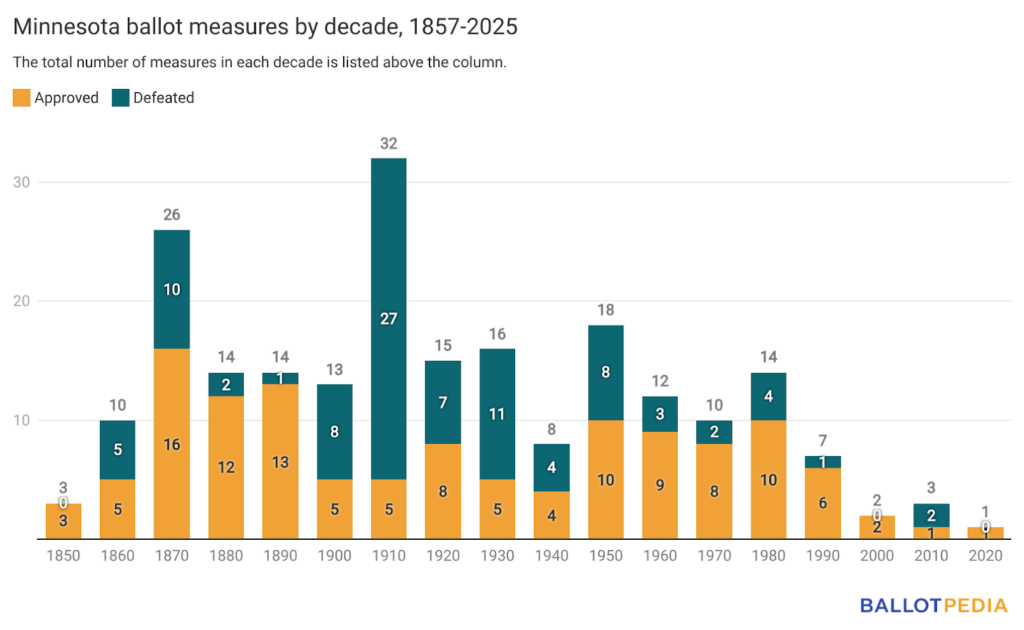
Minnesota has the 13th-highest approval rate of the 21 states for which we have completed Factbooks. Connecticut has the highest, at 91%, and South Dakota has the lowest, at 44%.
Minnesota ballot measures have addressed 88 unique topics. The most common topics are related to state legislative authority (20 measures), public education funding (18 measures), highways and bridges (18 measures), and property taxes (18 measures).
Here is a selection of notable ballot measures in Minnesota:
- Voters decided on two measures on creating a recall process for public officials. Voters defeated the first measure 76% to 24% in 1914. Voters approved the second measure 88% to 12% in 1996.
- In 1980, voters defeated a measure 58% to 42% that would have created a bipartisan commission with the authority to redraw legislative and congressional districts.
- In 1998, Minnesota became the second state to establish a constitutional right to hunt and fish via ballot measure. Voters approved it 77% to 23%.
- In 2012, voters defeated a measure 52% to 48% that would have defined marriage as between one man and one woman.
Click here to view our full Historical Ballot Measure Factbook for Minnesota.