


Florida, South Dakota, and Utah have joined nine other states in enacting laws requiring documentary proof of citizenship to register to vote.
On April 1, Florida Gov. Ron DeSantis (R) signed HB 991, which includes a proof of citizenship requirement that takes effect on January 1, 2027. On March 26, South Dakota Gov. Larry Rhoden (R) signed SB 175. The bill takes effect immediately, meaning the documentary proof of citizenship requirement will be in place for the state’s June 2 primary. On March 25, Utah Gov. Spencer Cox (R) signed HB 209, which takes effect on May 6, ahead of the state's June 23 primary.
The Florida law requires election officials to verify whether a prospective voter provided proof of citizenship when applying for a driver’s license or state ID card. If not, the person must provide proof of citizenship to be registered to vote. This also applies to individuals who are updating their registration with a change of name, address, or party affiliation. Six groups filed a federal lawsuit on April 1 seeking to block Florida’s law from being implemented.
The South Dakota and Utah laws allow voters who do not provide proof of citizenship to cast a ballot in federal elections only. To vote in state or local elections, however, voters must provide proof of citizenship. Documents establishing citizenship include a state driver’s license or ID card, a birth certificate, a naturalization certificate, or a passport. South Dakota and Utah do not require individuals who previously provided proof of citizenship to do so again when re-registering to vote, such as after an address change.
Individuals who are currently registered to vote in South Dakota do not have to provide proof of citizenship unless they have been removed from the voter rolls. South Dakota’s voter removal process begins when any voter “has failed to vote, has not updated the voter's registration information, and has not replied to a confirmation mailing at least once during the last preceding four consecutive years.”
The new Utah law does not require currently registered voters to provide proof of citizenship unless election officials notify them that their citizenship could not be established. The law requires election officials to complete a review by July 1, 2026, of registered voters using state and federal data to determine U.S. citizenship.
Federal law prohibits noncitizens from voting in any federal election, and no state constitutions explicitly allow noncitizens to vote in state or local elections. All 49 states with voter registration systems require voters to attest they are a U.S. citizen when registering to vote. The District of Columbia and municipalities in three states allow noncitizens to vote in local elections.
While the South Dakota and Utah laws only apply to state or local offices, prospective voters in all 50 states would be required to provide proof of citizenship in order to vote in federal races under legislation currently before the U.S. Senate.
The Republican-sponsored SAVE America Act says states could not accept voter registration applications for federal elections unless they include documentary proof of citizenship, such as a passport, military ID, or an enhanced REAL ID. Applicants could also present a different government-issued photo ID plus another document, such as a birth certificate or naturalization certificate.
The SAVE America Act would also require voters who register by mail to present their proof of citizenship in person to an election official before the election. In states that have same-day voter registration, voters could provide such proof at the polls on Election Day.
Individuals who have changed their name would need to provide proof of citizenship with their old name, as well as either "additional documentation as necessary to establish that the name on the documentation is a previous name of the applicant" or an affidavit attesting that the name on the documentation is their previous name.
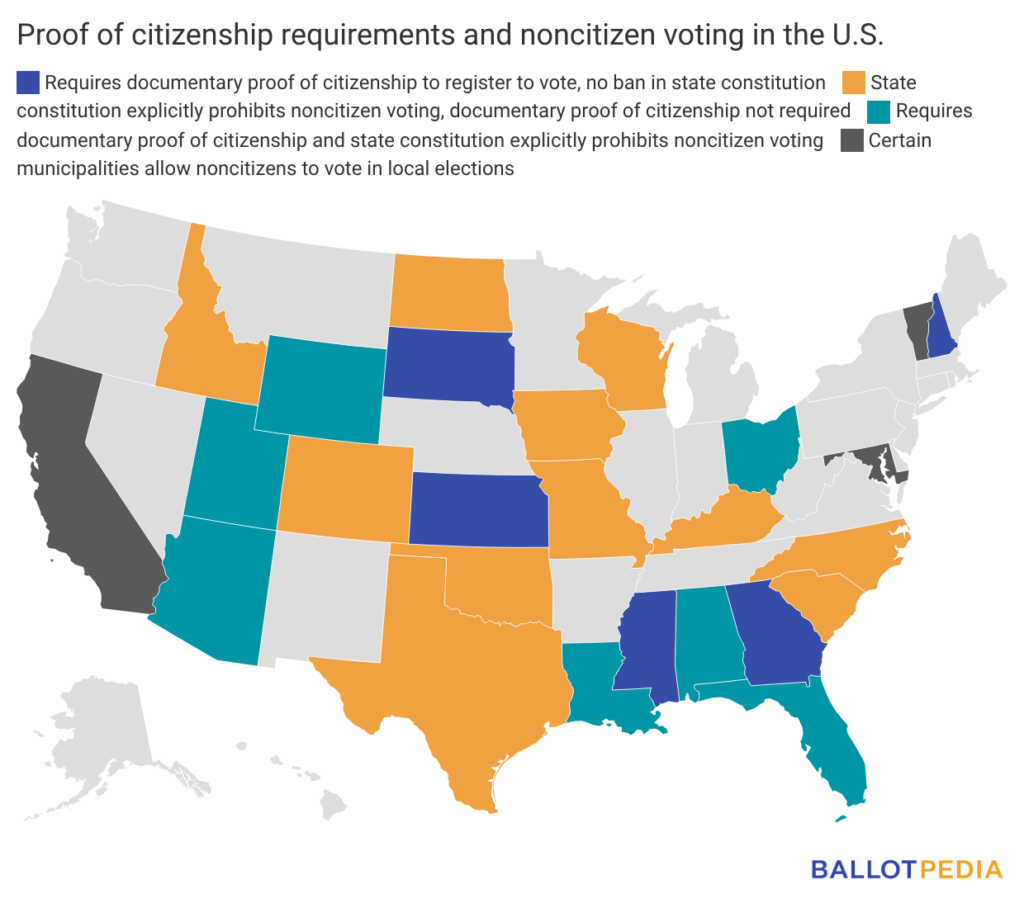
Florida, Utah, and South Dakota are the 10th, 11th, and 12th states to enact laws requiring proof of citizenship to register to vote in at least some cases, joining Alabama, Arizona, Georgia, Kansas, Louisiana, Mississippi, New Hampshire, Ohio, and Wyoming.
Alabama and Louisiana have not implemented their proof-of-citizenship laws. A U.S. District Court blocked Kansas' proof-of-citizenship law in 2018.
Ten of the 12 states with laws requiring proof of citizenship have Republican trifectas, while Arizona and Kansas have divided government. Of the states without documentary proof of citizenship laws, 16 have Democratic trifectas, 13 have Republican trifectas, and nine have divided government.
Legislators in 24 states have introduced 41 bills related to proof of citizenship for elections. On April 1, Gov. Tate Reeves (R) signed legislation in Mississippi requiring the state’s voter rolls to be checked against federal citizenship data, in addition to the state’s driver’s license database. An Iowa bill requiring proof of citizenship for registration has passed in one chamber.
Wyoming and Ohio enacted proof-of-citizenship laws in 2025. Two states, Louisiana and Oklahoma, enacted legislation related to proof of citizenship in 2024.
For more information on documentary proof of citizenship laws, click here.
Editor’s note: This article has been corrected to reflect that both Wyoming and Ohio enacted proof of citizenship legislation in 2025. An earlier version listed only Wyoming.