


On April 14, a U.S. district judge temporarily blocked the enforcement of a 2025 Indiana law that removed student IDs from the list of eligible voter identification.
The ruling from U.S. District Court Judge Richard Young allows student IDs to be used as voter identification in the state’s May 5 primary.
Governor Mike Braun (R) signed SB 10 into law last year. The legislation was passed along party lines in both the state House and state Senate.
On May 5, 2025, the groups Count US IN and Women4Change Indiana and an Indiana University student challenged the law in federal court, saying it would disenfranchise student voters and that it improperly targeted student IDs. The lawsuit sought both a temporary pause on enforcement of the ID ban and a more permanent ruling blocking the law.
“Legislators have attempted to justify the sudden change as a way to ensure that only U.S. citizens and Indiana residents can vote in Indiana elections,” the lawsuit said. “But there is no evidence that these are actual problems in Indiana, and even if they were, SB 10 does not require people to use IDs that prove citizenship or residency.”
Indiana Attorney General Todd Rokita's (R) office wrote in a legal filing supporting the law: "Public university students face similar travel times and distances to Indiana BMVs as all other voters, including voters in their same age bracket who attend private universities or do not attend university at all. ... And Plaintiffs do not allege that the cost of obtaining an ID is uniquely burdensome for students … Plaintiffs' arguments also ignore the numerous avenues open to voters to obtain an ID and vote with or without one."
In issuing the preliminary injunction, Young wrote that critics of the law were likely to prevail in their arguments that the policy violated the First and Fourteenth amendments to the U.S. Constitution.
"As discussed earlier, the law does not discriminate against students or young voters on its face," Young wrote. "But by eliminating student IDs as an acceptable form of identification, Defendants selectively excluded a form of identification that otherwise complies with the neutral criteria established by Indiana's voter ID law and that has been accepted as a form of voter identification for nearly two decades."
Rokita's office said that it planned to appeal the ruling.
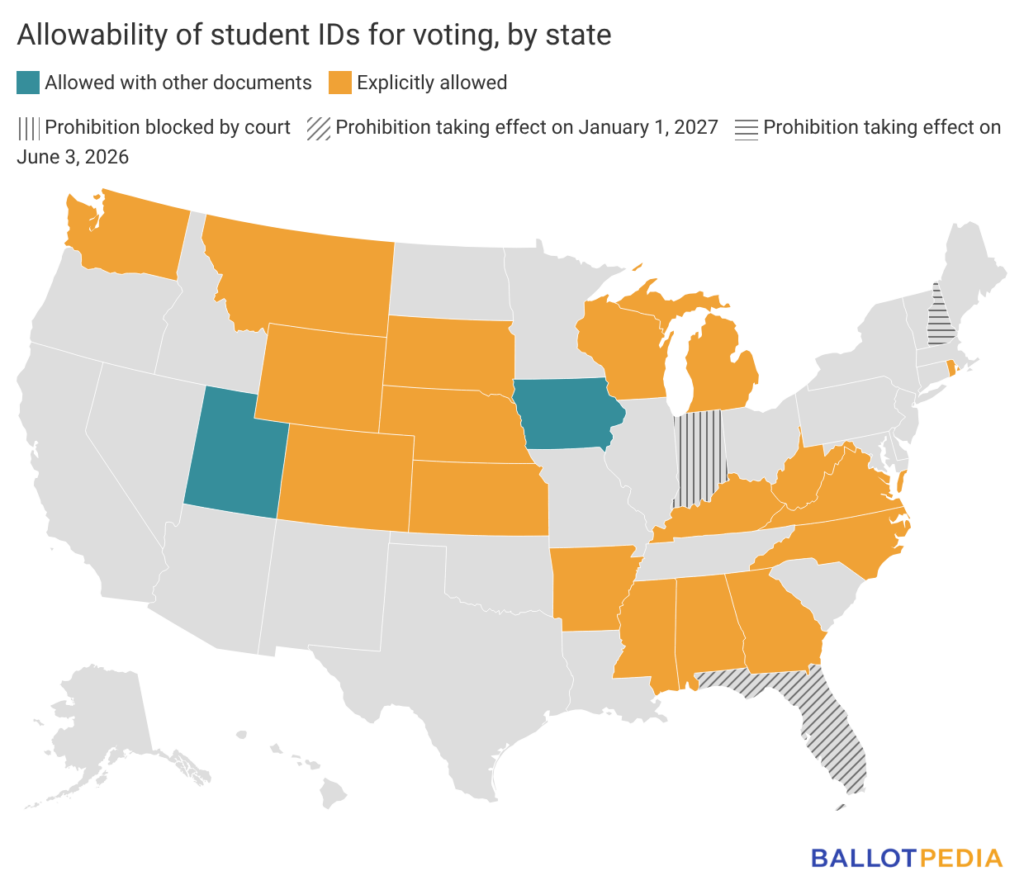
Eighteen states explicitly allow student IDs to be used for voting, while two states — Iowa and Utah — allow them to be used if presented with another form of identification. In states that do not explicitly allow student IDs to be used for voter identification, some student IDs may meet the state's voter identification criteria.
So far this year, two states — Florida and New Hampshire — have enacted legislation prohibiting the use of student IDs for voting. Florida Gov. Ron DeSantis (R) signed HB 991, which included the student ID provision, on April 1. The policy takes effect on Jan. 1, 2027.
New Hampshire Gov. Kelly Ayotte (R) signed HB 323 on April 3. The policy takes effect on June 2, meaning it will be in effect for the state’s Sept. 8 primary election.
Currently, 36 states require voters to present identification to vote at the polls on Election Day, though many states provide exceptions to these rules. Six of those states have Democratic trifectas, 23 states have Republican trifectas, and seven states have divided government.
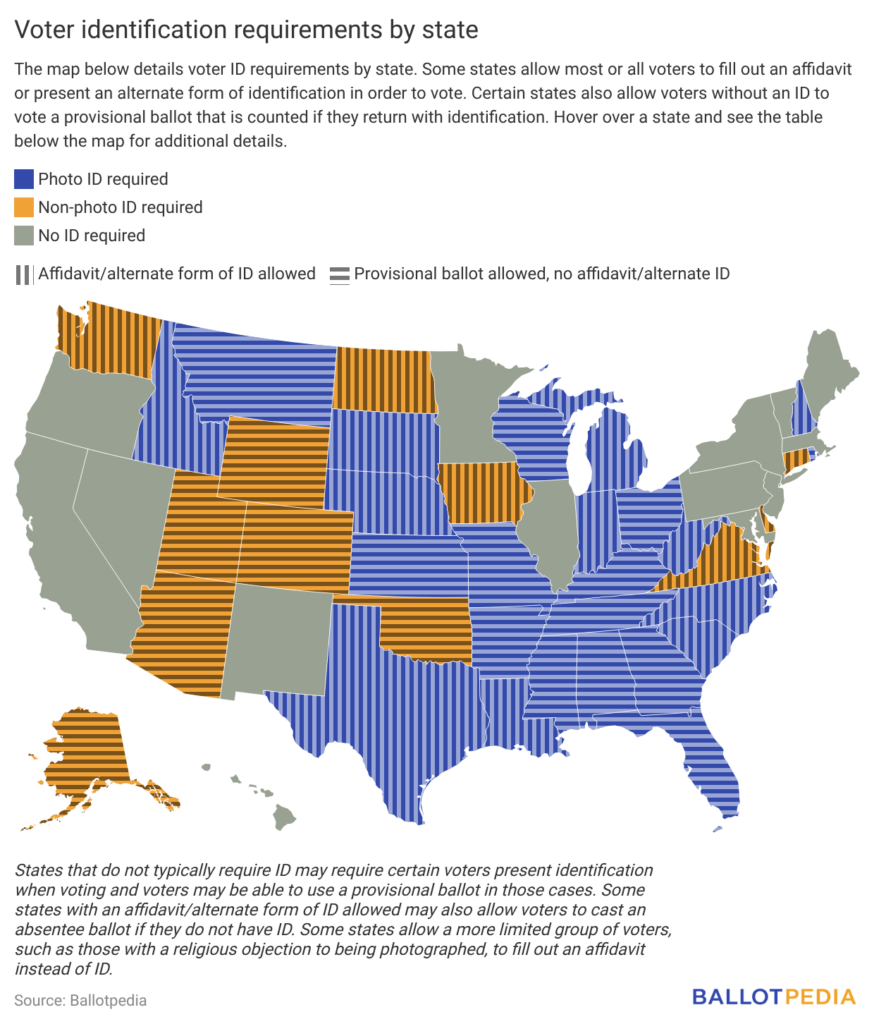
Of the states that require voter ID, 24 require ID that includes a photograph, with certain exceptions.
The remaining 14 states do not generally require voters to present identification to vote at the polls on Election Day, aside from what is required in federal law. Of the states without voter ID laws, 10 states have Democratic trifectas, and four have divided government.
Read more about the Indiana lawsuit here.