


Virginia voters will decide on a constitutional amendment in a special election on April 21 to determine if the state will use the general assembly’s newly drawn congressional maps for the 2026 elections.
The constitutional amendment would allow the Virginia General Assembly to conduct congressional redistricting between January 1, 2025, and October 31, 2030, if another state first participates in congressional redistricting.
Because Texas, California, and other states enacted new district maps in 2025, the amendment would allow the General Assembly to conduct congressional redistricting before the next scheduled redistricting process, planned for 2031.
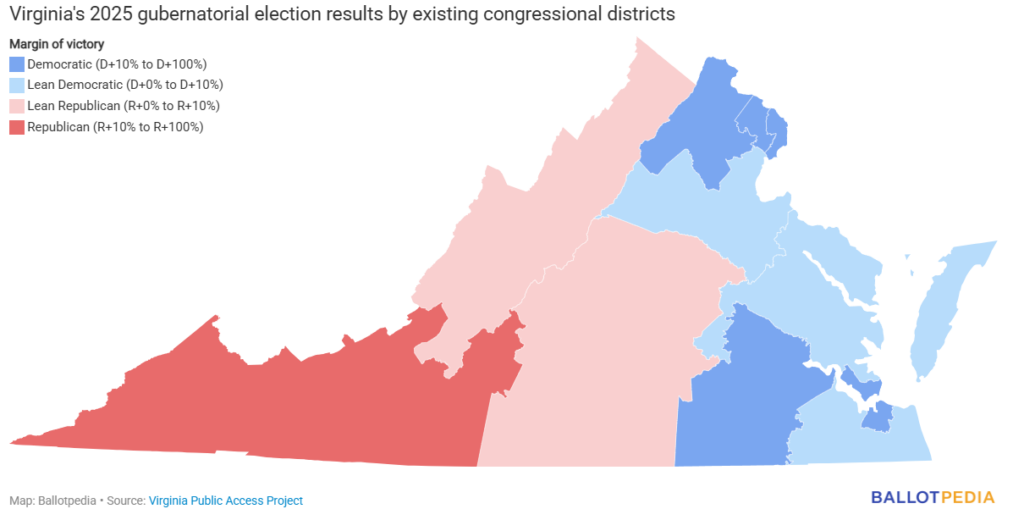
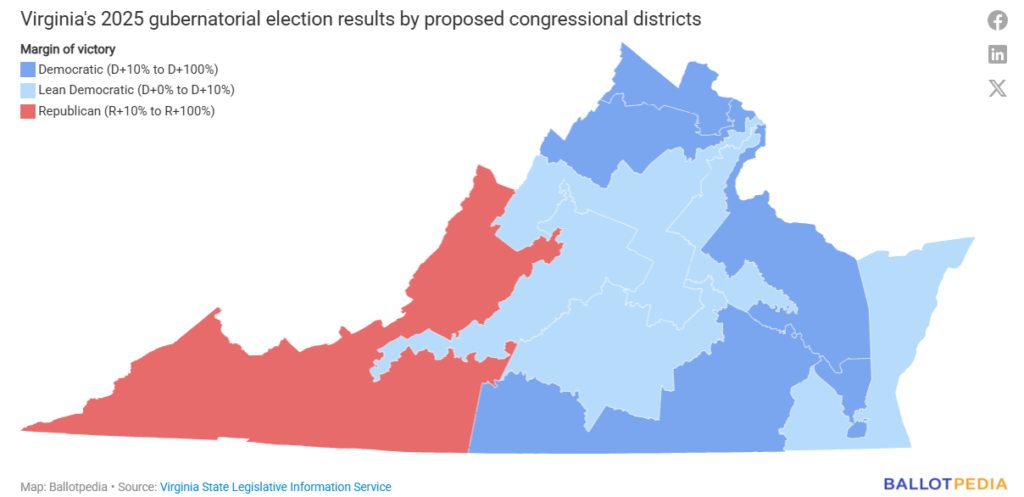
The state legislature approved House Bill 29, which contains new congressional districts and would take effect if the amendment is approved. The map would be used for U.S. House elections in 2026, 2028, and 2030. As of 2026, the partisan split of Virginia delegates in the U.S. House is 6-5. If election results align with the 2025 gubernatorial election, the map could produce a 10–1 split, with Democrats potentially gaining four U.S. House seats. Click here to see how the proposed maps would change each of Virginia’s 11 congressional districts.
Supporters of the amendment
Former President Barack Obama (D) endorsed the measure and appeared in video advertisements supporting the constitutional amendment. “Over the past year, several Republican-controlled states have taken the unprecedented step of redrawing their congressional maps in the middle of the decade,” he said. “In April, Virginians can respond by making sure your voting power is not diminished by what Republicans are doing in other states. This amendment gives you the power to level the playing field in the midterms this fall.”
Both Virginia U.S. senators have endorsed the measure. House Minority Leader Hakeem Jeffries (D-NY) and all six Democratic members of the U.S. House from Virginia endorsed the measure. Virginia Gov. Abigail Spanberger (D) has endorsed the measure, as well as the Democratic Party of Virginia, the Virginia NAACP, and the Human Rights Campaign.
Opponents of the amendment
U.S. Speaker of the House Mike Johnson (R-LA) spoke to voters at a rally in opposition to the measure, “You have the power to protect fair maps in Virginia and to protect, truly, the entire House Republican majority in the Congress,” he said. “That’s in your hands right now.”
U.S. Rep. Rob Wittman (R-1) also publicly opposed the measure. In his reasoning for why, he stated, “You cannot condemn gerrymandering nationally and celebrate it locally. The answer to partisan map manipulation in another state is not to import it here. In 2020, 65% of Virginia voters decided to take map drawing out of the hands of politicians to prevent partisan gerrymandering. This is exactly why. Virginia is a competitive state.”
Wittman is joined by the other four Republican members of the U.S. House from Virginia in opposing the measure. The Republican Party of Virginia and the Forward Party both oppose the constitutional amendment. Organizations that oppose the amendment include Conservatives for America, The Family Foundation of Virginia, and the National Shooting Sports Foundation.
Campaign finance
As of the April 15 state campaign finance filing deadline, campaigns supporting and opposing the measure have received a combined $89 million in contributions from donors.
Campaigns to support the measure have outearned those that oppose the measure. Campaigns to support the measure have received more than $66 million in contributions, while campaigns to oppose the measure have received more than $22 million.
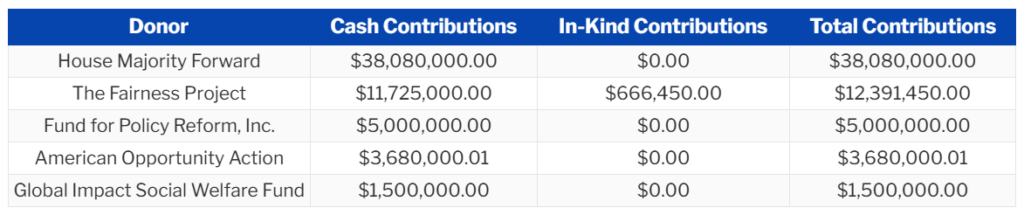
Virginians for Fair Elections, the National Democratic Redistricting Committee - VA, and Commonwealth Voters for Fairness registered to financially support the measure. Virginians for Fair Elections reported the greatest amount of contributions: they reported $64 million in cash and $1.75 million in in-kind donations.
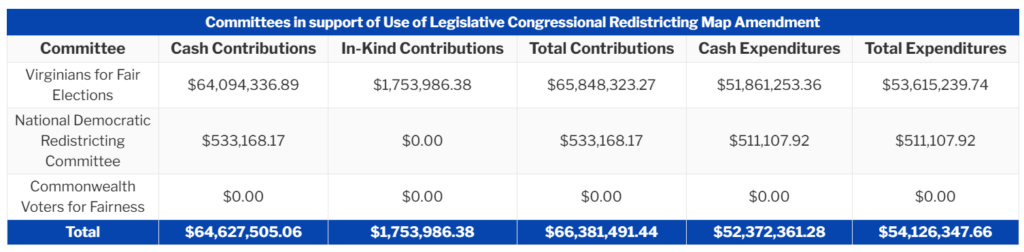
The single greatest contributor to the support campaign came from House Majority Forward, a nonprofit organization that aims to promote “economic growth and opportunity, social justice, environmental stewardship, and democracy.” The organization has donated $38 million in cash contributions to the Virginians for Fair Elections committee, more than the combined reported total of contributions to all opposition committees.
Below are the top donors who contributed to the support committees:
Virginians for Fair Maps, Justice for Democracy, and No Gerrymandering Virginia registered to oppose the measure. Virginians for Fair Maps reported the greatest amount of contributions: just under $20 million in cash donations.
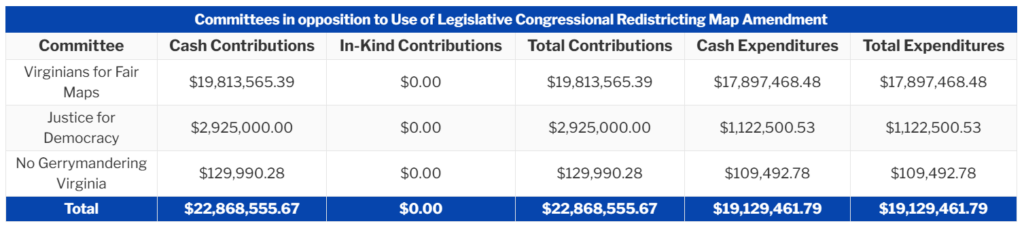
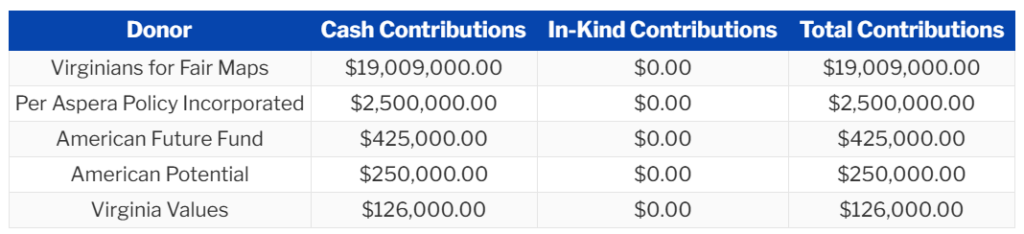
The single greatest contributor to the opposition campaign came from Virginians for Fair Maps, a 501(c)(4) nonprofit organization. The organization has donated $19 million in cash donations to oppose the constitutional amendment.
Below are the top donors who contributed to the opposition committees:
Polling
Of the five polls Ballotpedia has covered ahead of the special election, four found that a plurality or majority of respondents supported the constitutional amendment. One poll, conducted by Roanoke College in February, found that a majority of respondents said they would vote against it.
The most recent poll, conducted and published by State Navigate, surveyed likely voters and individuals who had already voted early. The poll found that 50% of respondents said they plan to vote or had already voted yes, 45% said they plan to vote or had already voted no, and 5% said they were undecided. The survey was conducted between April 10 and April 13, 2026.
Litigation
Even if voters approve the constitutional amendment, the Virginia Supreme Court could nullify the measure's outcome, leaving congressional districts unchanged. On October 28, 2025, a group of Republican state senators filed a complaint with the Virginia Circuit Court seeking to block the amendment from appearing on the statewide ballot. The complaint stated that the Speaker of the House lacked the authority to convene or expand the scope of the special legislative session in 2025 when the constitutional amendment was introduced.
After a series of lower-court rulings and appeals, the Virginia Supreme Court denied a motion to pause the administration of the referendum, stating that it could be placed on the ballot for the April 21 special election. They said that they would hear arguments concerning the validity of the amendment after the April 21 election. Final briefs in the case are due on April 23. Click here to read more about the ongoing litigation surrounding the amendment.
Redistricting by ballot measure in other states
Virginia is the second state to decide on a ballot measure that would implement a new congressional district map between 2024 and 2026. In 2025, California voters approved Proposition 50, which implemented a new map created by the state legislature. Under Proposition 50, five Republican-held congressional districts shifted to become more Democratic, based on presidential election results from 2024.
Additionally, two potential ballot measures in two states could implement new congressional district maps in 2026.
Voters may decide a veto referendum in Missouri which would repeal or uphold the new congressional district map created by the state legislature. Gov. Mike Kehoe (R) signed the new map into law on Sept. 28, 2025. As of 2026, the U.S. House delegation from Missouri has a 6-2 partisan split (Republican-Democrat). According to Inside Elections writer Nathaniel Rakich, the new map, “features seven districts with a Baseline of R+10 or redder and leaves just one seat that is D+10 or bluer."
Voters in Colorado may decide an initiated measure that would create a new congressional district map for the 2028 and 2030 elections. The measure would also move the state's congressional redistricting commission from the state constitution to state statute and reinstate the non-politician redistricting commission after the 2030 decennial census.
Additional reading: